Greek Period
Presented by Rustam
Greek Period 1200 B.C
Cosmic Views
• Thales
• Democritus
• Heraclitus
• Anaxagoras
• Pythagoras
• Empedocles
Sophistic Views
• Hippocrates
• Socrates
• Plato
• Aristotle
• Alexander the great
• Herodotus
Cosmic Views
Thales (640-546 B.C)
• First philosopher scientist
• Water is the basic reality of
Physical world
• Concept of sensory
threshold
Democritus ( 460-362 B.C)
• Universe is Atoms moving in
an order.
• Human is the part of
universe so human being is
also Bodily Atoms and Soul
Atoms.
Cosmic Views
Heraclitus (500 B.C)
• Said that fire is the basic
element of universe
changing every time
Empedocles ( 490-435 B.C)
• Said that universe is
composed of fire, water,
clay and air and these four
elements are also found in
human body
• He was famous for his
theory of perception
Anaxagoras (500-428 B.C)
• Said that cosmos can be
studied with the help of
figure and order.
• The moon has no light of its
own but it is reflected from
the sun.
Pythagoras (580-497 B.C)
• First who use the word “Philosophy”.
• Great Mathematician
• Invented numbers
• Made quantitative observation of the universe.
• Universe is composed of fire, water, clay and air
• He said that mind is the superior to body.
• Drew a sharp distinction between soul and body
• Body is corrupting process where soul was trapped
Sophistic Views
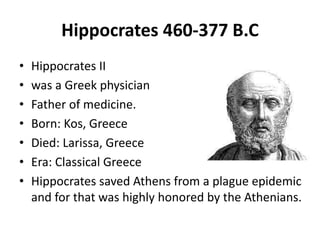
Hippocrates 460-377 B.C
• Hippocrates II
• was a Greek physician
• Father of medicine.
• Born: Kos, Greece
• Died: Larissa, Greece
• Era: Classical Greece
• Hippocrates saved Athens from a plague epidemic
and for that was highly honored by the Athenians.
Four types of Human Temporal
• Phlegmatic: Man become lazy and sluggish
due to excess of Phlegm
• Choleric: Man becomes enthusiastic and
aggressive due to the excess of yellow bile
• Sanguine: Man becomes very cheerful, fatty
and easygoing due to the excess of blood.
• Melancholic: Man becomes quiet, serious and
pessimistic due to the excess of black bile
Socrates 469-399 B.C
• Greek philosopher
• Find your self
• Founder of Western philosophy,
• Explore the questions of ethics
• Poisoning forced suicide by king
• Present Inductive Logic
• He didn’t wrote any book
• His student Plato arranged his ideas in Republic
Work for Psychology
• Use word “Psyche” mean Soul, mind or self
• Psyche is self consciousness attain by truth
• Soul and Body are two different things
• His tutorial method becomes base for Freud
Psychoanalysis and discovery of unconscious
• It also became the base for Roger’s Therapy
• It also became the base for Jung’s analytic
Psychology on 20 century
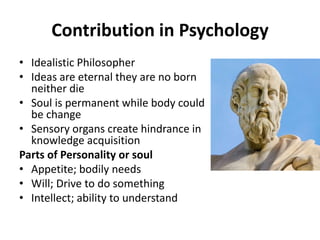
Plato 427-347 B.C
• Most important philosopher ever
• Founder of the Platonist school
of thought and the Academy,
• Influenced by Socrates,
Pythagoras, Heraclitus.
• Student of Socrates
• Father of idealism in philosophy
• Present Mind-Body Dualism
Contribution in Psychology
• Idealistic Philosopher
• Ideas are eternal they are no born
neither die
• Soul is permanent while body could
be change
• Sensory organs create hindrance in
knowledge acquisition
Parts of Personality or soul
• Appetite; bodily needs
• Will; Drive to do something
• Intellect; ability to understand
Aristotle 384-322 B.C
• A Greek philosopher
• Student of Plato,
• De Anima book
• Founder of the Lyceum
• Totally opposites with his teacher
• Teacher of Alexander the Great
• Rejected Dualism
• Soul is perfect unity
• Man is a social Animal
• Human is a biological being
• Mind is a function of body process and experiences
Contribution in Psychology
Types of soul
• Vegetable soul
Present in plants
• Animal soul
Present in animals
• Rational soul
Present in humans
Association reasons
• Similarity
Similar patterns of two things
• Contiguity
Two things happening close
• Contrast
Two events are totally
opposite
Thanks

Greek period

  • 1.
  • 2.
    Greek Period 1200B.C Cosmic Views • Thales • Democritus • Heraclitus • Anaxagoras • Pythagoras • Empedocles Sophistic Views • Hippocrates • Socrates • Plato • Aristotle • Alexander the great • Herodotus
  • 3.
    Cosmic Views Thales (640-546B.C) • First philosopher scientist • Water is the basic reality of Physical world • Concept of sensory threshold Democritus ( 460-362 B.C) • Universe is Atoms moving in an order. • Human is the part of universe so human being is also Bodily Atoms and Soul Atoms.
  • 4.
    Cosmic Views Heraclitus (500B.C) • Said that fire is the basic element of universe changing every time Empedocles ( 490-435 B.C) • Said that universe is composed of fire, water, clay and air and these four elements are also found in human body • He was famous for his theory of perception Anaxagoras (500-428 B.C) • Said that cosmos can be studied with the help of figure and order. • The moon has no light of its own but it is reflected from the sun.
  • 5.
    Pythagoras (580-497 B.C) •First who use the word “Philosophy”. • Great Mathematician • Invented numbers • Made quantitative observation of the universe. • Universe is composed of fire, water, clay and air • He said that mind is the superior to body. • Drew a sharp distinction between soul and body • Body is corrupting process where soul was trapped
  • 6.
  • 7.
    Hippocrates 460-377 B.C •Hippocrates II • was a Greek physician • Father of medicine. • Born: Kos, Greece • Died: Larissa, Greece • Era: Classical Greece • Hippocrates saved Athens from a plague epidemic and for that was highly honored by the Athenians.
  • 8.
    Four types ofHuman Temporal • Phlegmatic: Man become lazy and sluggish due to excess of Phlegm • Choleric: Man becomes enthusiastic and aggressive due to the excess of yellow bile • Sanguine: Man becomes very cheerful, fatty and easygoing due to the excess of blood. • Melancholic: Man becomes quiet, serious and pessimistic due to the excess of black bile
  • 9.
    Socrates 469-399 B.C •Greek philosopher • Find your self • Founder of Western philosophy, • Explore the questions of ethics • Poisoning forced suicide by king • Present Inductive Logic • He didn’t wrote any book • His student Plato arranged his ideas in Republic
  • 10.
    Work for Psychology •Use word “Psyche” mean Soul, mind or self • Psyche is self consciousness attain by truth • Soul and Body are two different things • His tutorial method becomes base for Freud Psychoanalysis and discovery of unconscious • It also became the base for Roger’s Therapy • It also became the base for Jung’s analytic Psychology on 20 century
  • 11.
    Plato 427-347 B.C •Most important philosopher ever • Founder of the Platonist school of thought and the Academy, • Influenced by Socrates, Pythagoras, Heraclitus. • Student of Socrates • Father of idealism in philosophy • Present Mind-Body Dualism
  • 12.
    Contribution in Psychology •Idealistic Philosopher • Ideas are eternal they are no born neither die • Soul is permanent while body could be change • Sensory organs create hindrance in knowledge acquisition Parts of Personality or soul • Appetite; bodily needs • Will; Drive to do something • Intellect; ability to understand
  • 13.
    Aristotle 384-322 B.C •A Greek philosopher • Student of Plato, • De Anima book • Founder of the Lyceum • Totally opposites with his teacher • Teacher of Alexander the Great • Rejected Dualism • Soul is perfect unity • Man is a social Animal • Human is a biological being • Mind is a function of body process and experiences
  • 14.
    Contribution in Psychology Typesof soul • Vegetable soul Present in plants • Animal soul Present in animals • Rational soul Present in humans Association reasons • Similarity Similar patterns of two things • Contiguity Two things happening close • Contrast Two events are totally opposite
  • 15.