Preview Starting Points Map: The Early Greeks Main Idea / Reading Focus Minoans and Mycenaeans Greek City-States Gods and Heroes Early Greece
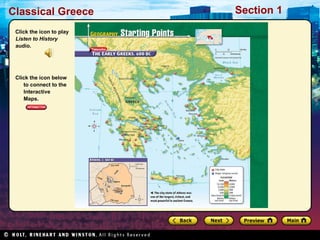
Click the icon to play  Listen to History  audio. Click the icon below to connect to the Interactive Maps.
Reading Focus What were Minoan and Mycenaean cultures like? What were the common characteristics of Greek city-states? What role did stories of gods and heroes play in Greek culture? Main Idea The earliest cultures in Greece, the Minoans and the Mycenaeans, were trading societies, but both disappeared and were replaced by Greek city-states. Early Greece
Many parts of early Greek history are still a mystery, but we do know that two distinct cultures developed in early Greece.  Minoans and Mycenaeans Minoan civilization developed as early as 3000 BC Lasted nearly 2,000 years Minoan ships sailed over Aegean Sea, possibly farther Colonies established on dozens of Aegean islands Ships filled with trade goods sailed back and forth between Crete and her colonies The Minoans of Crete Much of Minoan life revealed by excavations Solidly constructed buildings Private rooms Basic plumbing Brightly colored artwork Artwork shows life tied to sea, women as priests, dangerous games  Excavations at Knossos
Rapid Decline Minoan civilization fell apart rather suddenly, possibly from disaster. Large eruption of volcanic island near Crete may have affected worldwide weather patterns . Damage to Minoan ports, crops may have weakened society Minoans conquered by warlike Mycenaeans Speculation  Much history of Minoan civilization result of guesswork, speculation Historians cannot read Minoans’ writing, Linear A. Does not appear to be related to languages of mainland Greece Until writing deciphered, most knowledge will come from art, objects
The Mycenaean States Mycenaeans built small kingdoms, often fought with each other Name comes from fortress, Mycenae  Don't go to pun Minoan Influences Mycenaeans traded with Minoans, copied writing Became great traders Trade increased after they conquered Crete First Greeks   Mycenaeans considered first Greeks, spoke form of Greek language Earliest kingdoms owed much to Minoans Mycenaean Differences Society dominated by intense competition, frequent warfare, powerful kings Kings taxed trade, farming to build palaces, high walls Mycenaeans
Mycenaean Strength To show off strength, Mycenaeans built great monuments like Lion’s Gate Kings’ constant quest for power, glory inspired legends Most famous, story of Trojan War Downfall  War played part in end of Mycenaean civilization, as did drought, famine By end of 1100s BC, Mycenaean cities mostly in ruins; dark age followed Greek civilization almost disappeared Trojan War War supposedly involved early Greeks, led by Mycenae, who fought powerful city called Troy, in what is now Turkey War may not have happened, but ruins of city believed to be Troy found Mycenaean Strengths and Downfall
Compare and Contrast How were Minoan and Mycenaean cultures similar? How were they different? Answer(s):  similar—both were trading states; different—Mycenaean writing has been translated; Mycenaeans had frequent wars
A new type of society emerged in Greece in the 800s BC. The society was centered on the  polis , or city-state. Each polis developed independently, with its own form of government, laws and customs. Greek City-States Polis, center of daily life, culture Greeks fiercely loyal to their polis Did not think of selves as Greeks, but as residents of their particular city-state Life in the Polis Polis built around high area, called  acropolis Acropolis used as fortification Included temples, ceremonial spaces Agora , public marketplace, below Infrastructure  Shops, houses, temples near agora Gymnasium, athletes’ training grounds, public bath Sturdy wall for defense surrounded polis Other Attributes
Each major polis had a different political system that developed over time. Corinth, an oligarchy, ruled by a few individuals Athens, birthplace of democracy Sparta, one of mightiest city-states, but least typical Political Systems of Greek City-States
Beginnings  Sparta located on Peloponnesus, large peninsula of southern Greece First surrounded by smaller towns; over time Sparta seized control of towns After conquering town of Messenia, Spartans made Messenians into  helots War Spartan emphasis on war not due to fondness for fighting, but as way to keep order in society Helots outnumbered Spartans seven to one, kept in check by strong army Helots  Helots were state slaves given to Spartan citizens to work on farms so citizens did not have to perform manual labor. As result, Spartan citizens free to spend time training for war The Might of Sparta
Sparta was led by two kings who served as military commanders. Decision-making was largely left to an elected council of elders. To support their military lifestyle, the Spartans demanded strength and toughness. All babies were examined after birth and unhealthy children were left in the wild to die.  Militaristic State Boys taught physical, mental toughness by mothers until age 7 Entered combat school to toughen for hardships of being soldier At age 20 boys became  hoplites , foot soldiers; remained in army 10 years before becoming citizens Combat School Unusual among Greek city-states Women played important role Trained in gymnastics for physical fitness, to bear strong children Women had right to own property, unlike women in most of Greece Women in Society
Identify Cause and Effect Why did Sparta’s political system develop? Answer(s):  Because of Sparta's emphasis on war; it was led politically by two kings who served as military commanders.
Gods and Heroes Ancient Greeks believed in hundreds of gods, goddesses; each governed one aspect of nature, life Example: Apollo controlled movement of sun; sister Artemis did same for moon Greeks believed gods would protect them, city-states in exchange for proper rituals, sacrifices The Gods of Olympus Much of what is known about early Greece comes from studying Greeks’ legends, myths Myths, stories told to explain natural phenomena, events of distant past Greek myths explained where they came from, how they should live, cope with uncertain world Legends and Myths
12 gods, goddesses were particularly influential in Greek lives These 12 lived together on Mount Olympus, highest mountain in Greece Olympian gods thought to have great power, though not perfect Myths say gods flawed, often unpredictable—loved, hated, argued, made mistakes, got jealous, played tricks on each other Mount Olympus Almost all Greeks worshipped same gods Each polis claimed one god, goddess as special protector Example: Athens sacred to Athena Some locations considered sacred by all Greeks Worship Delphi sacred to all Greeks—priestesses of Apollo were thought to receive visions of future Olympia—every four years Greeks assembled there for Olympic Games; athletes competed against each other to honor gods Sacred Locations
Myths about Heroes Heroes killed monsters, made discoveries, founded cities, talked with gods on equal terms Examples inspired individuals, whole city-states, to achieve great things Hubris , great pride, brought many heroes to tragic ends Served as lessons not to overstretch abilities Lessons Greeks also told myths about heroes, used to teach Greeks where they came from, what kind of people they should be Some heroes, like Hercules, who had godlike strength, renowned through all Greece Others, like Theseus, who killed Minotaur of Crete, famous chiefly in home cities Hercules and Theseus
Describe What role did mythology play in Greek culture? Answer(s):  explained natural phenomena; taught Greeks where they came from and how to act

Minoans,+myceneans,+athens,+sparta,+gods,+

  • 1.
  • 2.
    Preview Starting PointsMap: The Early Greeks Main Idea / Reading Focus Minoans and Mycenaeans Greek City-States Gods and Heroes Early Greece
  • 3.
    Click the iconto play Listen to History audio. Click the icon below to connect to the Interactive Maps.
  • 4.
    Reading Focus Whatwere Minoan and Mycenaean cultures like? What were the common characteristics of Greek city-states? What role did stories of gods and heroes play in Greek culture? Main Idea The earliest cultures in Greece, the Minoans and the Mycenaeans, were trading societies, but both disappeared and were replaced by Greek city-states. Early Greece
  • 5.
    Many parts ofearly Greek history are still a mystery, but we do know that two distinct cultures developed in early Greece. Minoans and Mycenaeans Minoan civilization developed as early as 3000 BC Lasted nearly 2,000 years Minoan ships sailed over Aegean Sea, possibly farther Colonies established on dozens of Aegean islands Ships filled with trade goods sailed back and forth between Crete and her colonies The Minoans of Crete Much of Minoan life revealed by excavations Solidly constructed buildings Private rooms Basic plumbing Brightly colored artwork Artwork shows life tied to sea, women as priests, dangerous games Excavations at Knossos
  • 6.
    Rapid Decline Minoancivilization fell apart rather suddenly, possibly from disaster. Large eruption of volcanic island near Crete may have affected worldwide weather patterns . Damage to Minoan ports, crops may have weakened society Minoans conquered by warlike Mycenaeans Speculation Much history of Minoan civilization result of guesswork, speculation Historians cannot read Minoans’ writing, Linear A. Does not appear to be related to languages of mainland Greece Until writing deciphered, most knowledge will come from art, objects
  • 7.
    The Mycenaean StatesMycenaeans built small kingdoms, often fought with each other Name comes from fortress, Mycenae Don't go to pun Minoan Influences Mycenaeans traded with Minoans, copied writing Became great traders Trade increased after they conquered Crete First Greeks Mycenaeans considered first Greeks, spoke form of Greek language Earliest kingdoms owed much to Minoans Mycenaean Differences Society dominated by intense competition, frequent warfare, powerful kings Kings taxed trade, farming to build palaces, high walls Mycenaeans
  • 8.
    Mycenaean Strength Toshow off strength, Mycenaeans built great monuments like Lion’s Gate Kings’ constant quest for power, glory inspired legends Most famous, story of Trojan War Downfall War played part in end of Mycenaean civilization, as did drought, famine By end of 1100s BC, Mycenaean cities mostly in ruins; dark age followed Greek civilization almost disappeared Trojan War War supposedly involved early Greeks, led by Mycenae, who fought powerful city called Troy, in what is now Turkey War may not have happened, but ruins of city believed to be Troy found Mycenaean Strengths and Downfall
  • 9.
    Compare and ContrastHow were Minoan and Mycenaean cultures similar? How were they different? Answer(s): similar—both were trading states; different—Mycenaean writing has been translated; Mycenaeans had frequent wars
  • 10.
    A new typeof society emerged in Greece in the 800s BC. The society was centered on the polis , or city-state. Each polis developed independently, with its own form of government, laws and customs. Greek City-States Polis, center of daily life, culture Greeks fiercely loyal to their polis Did not think of selves as Greeks, but as residents of their particular city-state Life in the Polis Polis built around high area, called acropolis Acropolis used as fortification Included temples, ceremonial spaces Agora , public marketplace, below Infrastructure Shops, houses, temples near agora Gymnasium, athletes’ training grounds, public bath Sturdy wall for defense surrounded polis Other Attributes
  • 11.
    Each major polishad a different political system that developed over time. Corinth, an oligarchy, ruled by a few individuals Athens, birthplace of democracy Sparta, one of mightiest city-states, but least typical Political Systems of Greek City-States
  • 12.
    Beginnings Spartalocated on Peloponnesus, large peninsula of southern Greece First surrounded by smaller towns; over time Sparta seized control of towns After conquering town of Messenia, Spartans made Messenians into helots War Spartan emphasis on war not due to fondness for fighting, but as way to keep order in society Helots outnumbered Spartans seven to one, kept in check by strong army Helots Helots were state slaves given to Spartan citizens to work on farms so citizens did not have to perform manual labor. As result, Spartan citizens free to spend time training for war The Might of Sparta
  • 13.
    Sparta was ledby two kings who served as military commanders. Decision-making was largely left to an elected council of elders. To support their military lifestyle, the Spartans demanded strength and toughness. All babies were examined after birth and unhealthy children were left in the wild to die. Militaristic State Boys taught physical, mental toughness by mothers until age 7 Entered combat school to toughen for hardships of being soldier At age 20 boys became hoplites , foot soldiers; remained in army 10 years before becoming citizens Combat School Unusual among Greek city-states Women played important role Trained in gymnastics for physical fitness, to bear strong children Women had right to own property, unlike women in most of Greece Women in Society
  • 14.
    Identify Cause andEffect Why did Sparta’s political system develop? Answer(s): Because of Sparta's emphasis on war; it was led politically by two kings who served as military commanders.
  • 15.
    Gods and HeroesAncient Greeks believed in hundreds of gods, goddesses; each governed one aspect of nature, life Example: Apollo controlled movement of sun; sister Artemis did same for moon Greeks believed gods would protect them, city-states in exchange for proper rituals, sacrifices The Gods of Olympus Much of what is known about early Greece comes from studying Greeks’ legends, myths Myths, stories told to explain natural phenomena, events of distant past Greek myths explained where they came from, how they should live, cope with uncertain world Legends and Myths
  • 16.
    12 gods, goddesseswere particularly influential in Greek lives These 12 lived together on Mount Olympus, highest mountain in Greece Olympian gods thought to have great power, though not perfect Myths say gods flawed, often unpredictable—loved, hated, argued, made mistakes, got jealous, played tricks on each other Mount Olympus Almost all Greeks worshipped same gods Each polis claimed one god, goddess as special protector Example: Athens sacred to Athena Some locations considered sacred by all Greeks Worship Delphi sacred to all Greeks—priestesses of Apollo were thought to receive visions of future Olympia—every four years Greeks assembled there for Olympic Games; athletes competed against each other to honor gods Sacred Locations
  • 17.
    Myths about HeroesHeroes killed monsters, made discoveries, founded cities, talked with gods on equal terms Examples inspired individuals, whole city-states, to achieve great things Hubris , great pride, brought many heroes to tragic ends Served as lessons not to overstretch abilities Lessons Greeks also told myths about heroes, used to teach Greeks where they came from, what kind of people they should be Some heroes, like Hercules, who had godlike strength, renowned through all Greece Others, like Theseus, who killed Minotaur of Crete, famous chiefly in home cities Hercules and Theseus
  • 18.
    Describe What roledid mythology play in Greek culture? Answer(s): explained natural phenomena; taught Greeks where they came from and how to act