Review of Time Period
Absolute Monarchy
Divine Right
Parliamentary Monarchy
Art & Architecture
Church & State Relationship
Protestant Reformation
Scientific Revolution
Enlightenment
Another Absolutely
Divine Presentation for
AP World History
By Janet Pareja,
Signature School,
Evansville, IN
 Legitimization &
Competition:
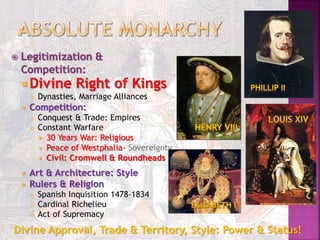
 Divine Right of Kings
 Dynasties, Marriage Alliances
 Competition:
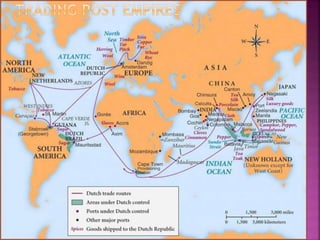
 Conquest & Trade: Empires
 Constant Warfare
 30 Years War: Religious
 Peace of Westphalia- Sovereignty
 Civil: Cromwell & Roundheads
 Art & Architecture: Style
 Rulers & Religion
 Spanish Inquisition 1478–1834
 Cardinal Richelieu
 Act of Supremacy
Divine Approval, Trade & Territory, Style: Power & Status!
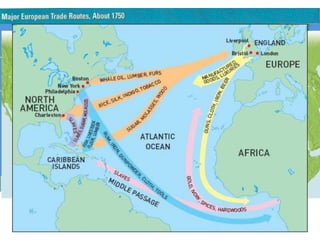
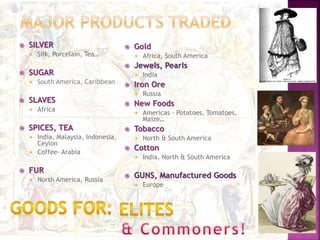
 SILVER
 Silk, Porcelain, Tea…
 SUGAR
 South America, Caribbean
 SLAVES
 Africa
 SPICES, TEA
 India, Malaysia, Indonesia,
Ceylon
 Coffee- Arabia
 FUR
 North America, Russia
 Gold
 Africa, South America
 Jewels, Pearls
 India
 Iron Ore
 Russia
 New Foods
 Americas – Potatoes, Tomatoes,
Maize…
 Tobacco
 North & South America
 Cotton
 India, North & South America
 GUNS, Manufactured Goods
 Europe
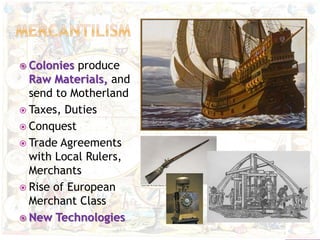
 Colonies produce
Raw Materials, and
send to Motherland
 Taxes, Duties
 Conquest
 Trade Agreements
with Local Rulers,
Merchants
 Rise of European
Merchant Class
 New Technologies
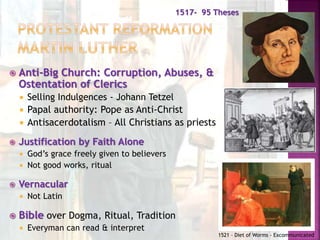
 Anti-Big Church: Corruption, Abuses, &
Ostentation of Clerics
 Selling Indulgences - Johann Tetzel
 Papal authority: Pope as Anti-Christ
 Antisacerdotalism – All Christians as priests
 Justification by Faith Alone
 God’s grace freely given to believers
 Not good works, ritual
 Vernacular
 Not Latin
 Bible over Dogma, Ritual, Tradition
 Everyman can read & interpret
1517- 95 Theses
1521 – Diet of Worms - Excommunicated
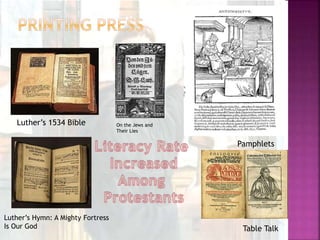
Luther’s 1534 Bible
Luther’s Hymn: A Mighty Fortress
Is Our God
On the Jews and
Their Lies
Table Talk
Pamphlets
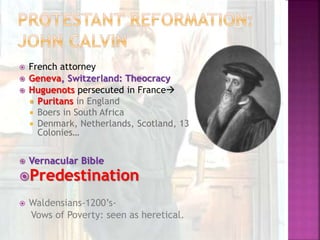
 French attorney
 Geneva, Switzerland: Theocracy
 Huguenots persecuted in France
 Puritans in England
 Boers in South Africa
 Denmark, Netherlands, Scotland, 13
Colonies…
 Vernacular Bible
Predestination
 Waldensians-1200’s-
Vows of Poverty: seen as heretical.
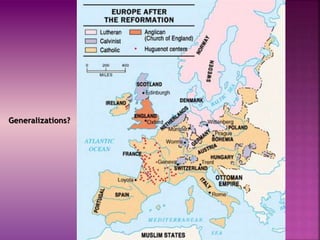
Generalizations?
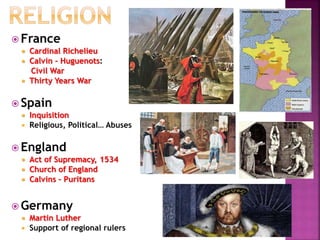
 France
 Cardinal Richelieu
 Calvin - Huguenots:
Civil War
 Thirty Years War
 Spain
 Inquisition
 Religious, Political… Abuses
 England
 Act of Supremacy, 1534
 Church of England
 Calvins – Puritans
 Germany
 Martin Luther
 Support of regional rulers
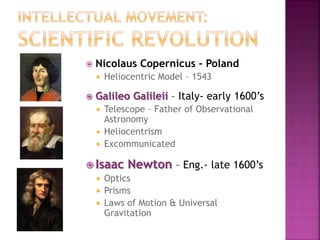
 Nicolaus Copernicus - Poland
 Heliocentric Model – 1543
 Galileo Galileii – Italy- early 1600’s
 Telescope – Father of Observational
Astronomy
 Heliocentrism
 Excommunicated
 Isaac Newton – Eng.- late 1600’s
 Optics
 Prisms
 Laws of Motion & Universal
Gravitation
 Robert Boyle – England-Late 1600’s
 Founder of Modern Chemistry
 Francis Bacon – England-Early 1600’s
 Father of the Scientific Method
 Empiricism: Inductive Method
 Rene Descartes – France- Early 1600’s
 Scientific Method, Math…
 William Harvey – England- Early 1600’s
 Circulation of Blood
Scientific discoveries overturned many traditional concepts and
introduced new perspectives on nature and man's place within it.
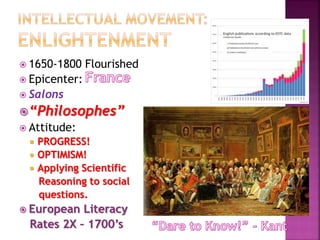
 1650-1800 Flourished
 Epicenter:
 Salons
“Philosophes”
 Attitude:
 PROGRESS!
 OPTIMISM!
 Applying Scientific
Reasoning to social
questions.
 European Literacy
Rates 2X – 1700’s
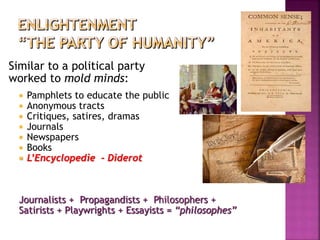
Similar to a political party
worked to mold minds:
 Pamphlets to educate the public
 Anonymous tracts
 Critiques, satires, dramas
 Journals
 Newspapers
 Books
 L’Encyclopedie - Diderot
Journalists + Propagandists + Philosophers +
Satirists + Playwrights + Essayists = “philosophes”
 Human Reason is more important than Authority.
 Knowledge comes from Experience and Experiment,
guided by Reason.
 Human mind is a Tabula Rasa (Locke): no one is
born with culture or education.
 Education (Emile), and Social Contract- Rousseau
 “Cogito ergo sum.” Descartes – Mind/Body Split
 Popularized scientific method & reason; against
authoritarianism of Church & Monarchy – Voltaire
 Separation of Powers – Montesquieu
 Natural Law & Consent of the Governed; Social
Contract (unquestioning obedience)– Thomas
Hobbes
 All Men created Equal, Consent of the Governed.
Right of Rebellion if Consent not given - Locke
 Deism
 Belief in God, but NOT in
authority of any organized
Religion
 Distrust of Hierarchies:
Church, Social, Political
 God as Clockmaker
 Creator ONLY
 Duty of Man to improve himself
= Progress!
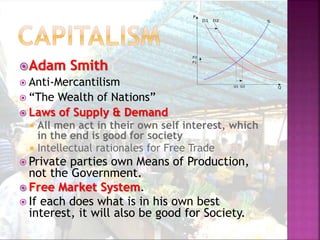
Adam Smith
 Anti-Mercantilism
 “The Wealth of Nations”
 Laws of Supply & Demand
 All men act in their own self interest, which
in the end is good for society
 Intellectual rationales for Free Trade
 Private parties own Means of Production,
not the Government.
 Free Market System.
 If each does what is in his own best
interest, it will also be good for Society.
1450 1750
 Charity =
Responsibility for
others
 Obedience
 Church interpreted
Gods word- Catholic
 Feudalism, Respect for
Authority
 Rural
 Agriculture or Artisans
 Illiterate
 Capitalism =
Responsibility for
oneself
 Education
 Individual interprets
Gods word for himself-
Protestant
 Commercial, Free
Market Economy
 Urban dwellers
 Merchants,
Businessmen
 Literate
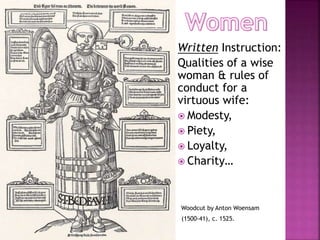
Written Instruction:
Qualities of a wise
woman & rules of
conduct for a
virtuous wife:
 Modesty,
 Piety,
 Loyalty,
 Charity…
Woodcut by Anton Woensam
(1500-41), c. 1525.
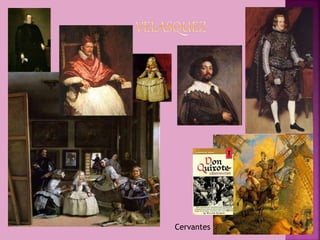
Cervantes
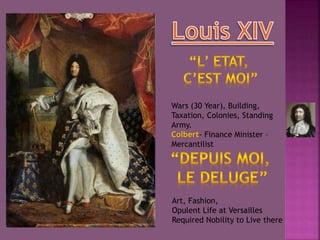
Wars (30 Year), Building,
Taxation, Colonies, Standing
Army.
Colbert- Finance Minister –
Mercantilist
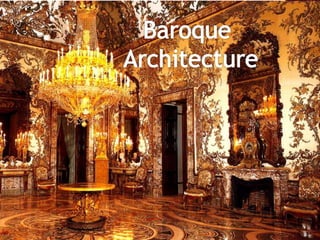
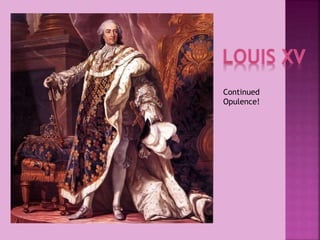
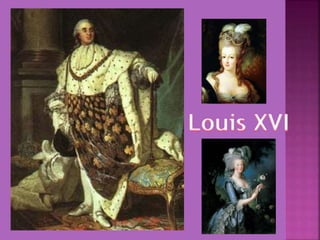
Art, Fashion,
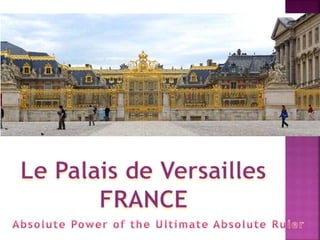
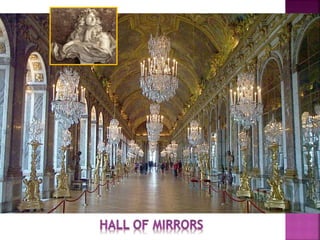
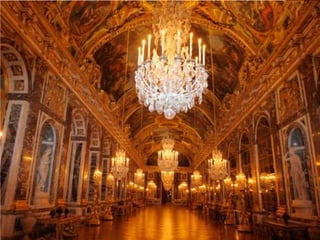
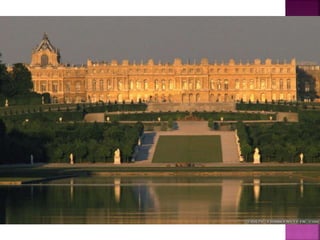
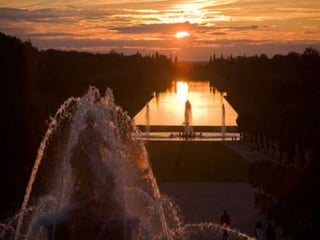
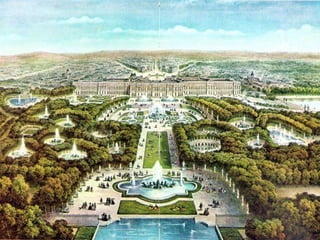
Opulent Life at Versailles
Required Nobility to Live there
Continued
Opulence!
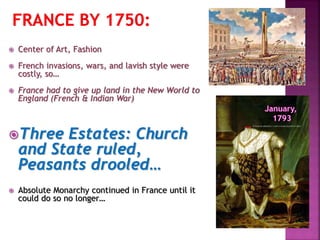
 Center of Art, Fashion
 French invasions, wars, and lavish style were
costly, so…
 France had to give up land in the New World to
England (French & Indian War)
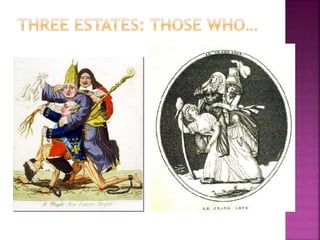
Three Estates: Church
and State ruled,
Peasants drooled…
 Absolute Monarchy continued in France until it
could do so no longer…
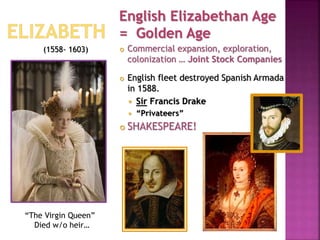
English Elizabethan Age
= Golden Age
 Commercial expansion, exploration,
colonization … Joint Stock Companies
 English fleet destroyed Spanish Armada
in 1588.
 Sir Francis Drake
 “Privateers”
 SHAKESPEARE!
(1558- 1603)
“The Virgin Queen”
Died w/o heir…
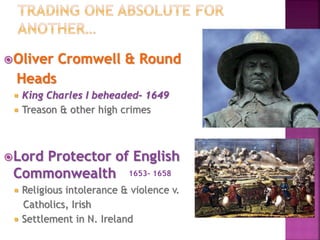
Oliver Cromwell & Round
Heads
 King Charles I beheaded- 1649
 Treason & other high crimes
Lord Protector of English
Commonwealth
 Religious intolerance & violence v.
Catholics, Irish
 Settlement in N. Ireland
1653- 1658
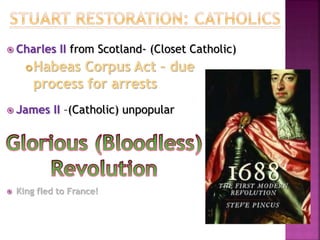
 Charles II from Scotland- (Closet Catholic)
Habeas Corpus Act – due
process for arrests
 James II –(Catholic) unpopular
 King fled to France!
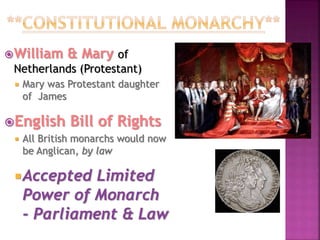
William & Mary of
Netherlands (Protestant)
 Mary was Protestant daughter
of James
English Bill of Rights
 All British monarchs would now
be Anglican, by law
Accepted Limited
Power of Monarch
- Parliament & Law
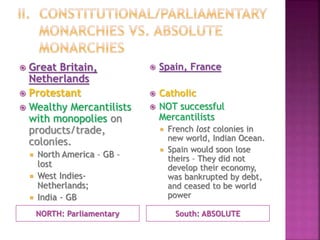
NORTH: Parliamentary South: ABSOLUTE
 Great Britain,
Netherlands
 Protestant
 Wealthy Mercantilists
with monopolies on
products/trade,
colonies.
 North America – GB –
lost
 West Indies-
Netherlands;
 India - GB
 Spain, France
 Catholic
 NOT successful
Mercantilists
 French lost colonies in
new world, Indian Ocean.
 Spain would soon lose
theirs – They did not
develop their economy,
was bankrupted by debt,
and ceased to be world
power
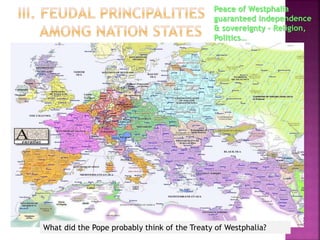
Peace of Westphalia
guaranteed independence
& sovereignty – Religion,
Politics…
What did the Pope probably think of the Treaty of Westphalia?
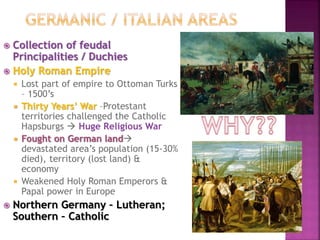
 Collection of feudal
Principalities / Duchies
 Holy Roman Empire
 Lost part of empire to Ottoman Turks
– 1500’s
 Thirty Years’ War –Protestant
territories challenged the Catholic
Hapsburgs  Huge Religious War
 Fought on German land
devastated area’s population (15-30%
died), territory (lost land) &
economy
 Weakened Holy Roman Emperors &
Papal power in Europe
 Northern Germany – Lutheran;
Southern – Catholic
 Maritime Technology
 China- Sternpost rudder, compass
 Arabs – Astrolabe, Lateen Sail, Maps & Charts
 Designed their own Galleons, Caravels.
 GUNS!!!
 PRINTING PRESS
 1500- Pocket watch - Germany
 Telescope, Microscope, other lenses…
 Laws of Nature - Circulation of the blood, Gravity, Heliocentrism...
 Greenwich Time, Latitude & Longitude perfected. Gregorian
Calendar.
 1700- Blast furnace to produce Iron; Seed drill
 1714- Fahrenheit invents mercury thermometer
 1721- Earliest smallpox vaccinations
 1733- Flying Shuttle Loom – John Kay, England.
 1740- Casting & galvanizing steel
 “New Empires”
 Gunpowder, Absolute Monarchs
 Islamic Empires, Russian, Chinese, Japanese…European
 Golden Age of Art, Architecture…
 Demographic Change
 Mass Migration, Great Dying, Columbian Exchange
 New Patterns of Commerce
 ATLANTIC WORLD! Columbian Exchange…
 European presence in Africa, Asia, Americas
 Joint Stock Companies, Rising Merchant Class
 Commercialism, Capitalism, Middle Class demands
 Cultural Insularity vs. Cultural Diffusion
 Spread of Christianity and support for individual sects
 Innovation: EUROPE!
 Technology- Yours, Mine, Ours
 Colonization & Mercantilism
 Scientific Revolution
 Protestant Reformation
 Enlightenment + Capitalist change in societies

Europe day

  • 1.
    Review of TimePeriod Absolute Monarchy Divine Right Parliamentary Monarchy Art & Architecture Church & State Relationship Protestant Reformation Scientific Revolution Enlightenment Another Absolutely Divine Presentation for AP World History By Janet Pareja, Signature School, Evansville, IN
  • 2.
     Legitimization & Competition: Divine Right of Kings  Dynasties, Marriage Alliances  Competition:  Conquest & Trade: Empires  Constant Warfare  30 Years War: Religious  Peace of Westphalia- Sovereignty  Civil: Cromwell & Roundheads  Art & Architecture: Style  Rulers & Religion  Spanish Inquisition 1478–1834  Cardinal Richelieu  Act of Supremacy Divine Approval, Trade & Territory, Style: Power & Status!
  • 5.
     SILVER  Silk,Porcelain, Tea…  SUGAR  South America, Caribbean  SLAVES  Africa  SPICES, TEA  India, Malaysia, Indonesia, Ceylon  Coffee- Arabia  FUR  North America, Russia  Gold  Africa, South America  Jewels, Pearls  India  Iron Ore  Russia  New Foods  Americas – Potatoes, Tomatoes, Maize…  Tobacco  North & South America  Cotton  India, North & South America  GUNS, Manufactured Goods  Europe
  • 6.
     Colonies produce RawMaterials, and send to Motherland  Taxes, Duties  Conquest  Trade Agreements with Local Rulers, Merchants  Rise of European Merchant Class  New Technologies
  • 7.
     Anti-Big Church:Corruption, Abuses, & Ostentation of Clerics  Selling Indulgences - Johann Tetzel  Papal authority: Pope as Anti-Christ  Antisacerdotalism – All Christians as priests  Justification by Faith Alone  God’s grace freely given to believers  Not good works, ritual  Vernacular  Not Latin  Bible over Dogma, Ritual, Tradition  Everyman can read & interpret 1517- 95 Theses 1521 – Diet of Worms - Excommunicated
  • 8.
    Luther’s 1534 Bible Luther’sHymn: A Mighty Fortress Is Our God On the Jews and Their Lies Table Talk Pamphlets
  • 9.
     French attorney Geneva, Switzerland: Theocracy  Huguenots persecuted in France  Puritans in England  Boers in South Africa  Denmark, Netherlands, Scotland, 13 Colonies…  Vernacular Bible Predestination  Waldensians-1200’s- Vows of Poverty: seen as heretical.
  • 10.
  • 11.
     France  CardinalRichelieu  Calvin - Huguenots: Civil War  Thirty Years War  Spain  Inquisition  Religious, Political… Abuses  England  Act of Supremacy, 1534  Church of England  Calvins – Puritans  Germany  Martin Luther  Support of regional rulers
  • 12.
     Nicolaus Copernicus- Poland  Heliocentric Model – 1543  Galileo Galileii – Italy- early 1600’s  Telescope – Father of Observational Astronomy  Heliocentrism  Excommunicated  Isaac Newton – Eng.- late 1600’s  Optics  Prisms  Laws of Motion & Universal Gravitation
  • 13.
     Robert Boyle– England-Late 1600’s  Founder of Modern Chemistry  Francis Bacon – England-Early 1600’s  Father of the Scientific Method  Empiricism: Inductive Method  Rene Descartes – France- Early 1600’s  Scientific Method, Math…  William Harvey – England- Early 1600’s  Circulation of Blood Scientific discoveries overturned many traditional concepts and introduced new perspectives on nature and man's place within it.
  • 14.
     1650-1800 Flourished Epicenter:  Salons “Philosophes”  Attitude:  PROGRESS!  OPTIMISM!  Applying Scientific Reasoning to social questions.  European Literacy Rates 2X – 1700’s
  • 15.
    Similar to apolitical party worked to mold minds:  Pamphlets to educate the public  Anonymous tracts  Critiques, satires, dramas  Journals  Newspapers  Books  L’Encyclopedie - Diderot Journalists + Propagandists + Philosophers + Satirists + Playwrights + Essayists = “philosophes”
  • 16.
     Human Reasonis more important than Authority.  Knowledge comes from Experience and Experiment, guided by Reason.  Human mind is a Tabula Rasa (Locke): no one is born with culture or education.  Education (Emile), and Social Contract- Rousseau  “Cogito ergo sum.” Descartes – Mind/Body Split  Popularized scientific method & reason; against authoritarianism of Church & Monarchy – Voltaire  Separation of Powers – Montesquieu  Natural Law & Consent of the Governed; Social Contract (unquestioning obedience)– Thomas Hobbes  All Men created Equal, Consent of the Governed. Right of Rebellion if Consent not given - Locke
  • 17.
     Deism  Beliefin God, but NOT in authority of any organized Religion  Distrust of Hierarchies: Church, Social, Political  God as Clockmaker  Creator ONLY  Duty of Man to improve himself = Progress!
  • 18.
    Adam Smith  Anti-Mercantilism “The Wealth of Nations”  Laws of Supply & Demand  All men act in their own self interest, which in the end is good for society  Intellectual rationales for Free Trade  Private parties own Means of Production, not the Government.  Free Market System.  If each does what is in his own best interest, it will also be good for Society.
  • 19.
    1450 1750  Charity= Responsibility for others  Obedience  Church interpreted Gods word- Catholic  Feudalism, Respect for Authority  Rural  Agriculture or Artisans  Illiterate  Capitalism = Responsibility for oneself  Education  Individual interprets Gods word for himself- Protestant  Commercial, Free Market Economy  Urban dwellers  Merchants, Businessmen  Literate
  • 20.
    Written Instruction: Qualities ofa wise woman & rules of conduct for a virtuous wife:  Modesty,  Piety,  Loyalty,  Charity… Woodcut by Anton Woensam (1500-41), c. 1525.
  • 22.
  • 35.
    Wars (30 Year),Building, Taxation, Colonies, Standing Army. Colbert- Finance Minister – Mercantilist Art, Fashion, Opulent Life at Versailles Required Nobility to Live there
  • 36.
  • 38.
     Center ofArt, Fashion  French invasions, wars, and lavish style were costly, so…  France had to give up land in the New World to England (French & Indian War) Three Estates: Church and State ruled, Peasants drooled…  Absolute Monarchy continued in France until it could do so no longer…
  • 39.
    English Elizabethan Age =Golden Age  Commercial expansion, exploration, colonization … Joint Stock Companies  English fleet destroyed Spanish Armada in 1588.  Sir Francis Drake  “Privateers”  SHAKESPEARE! (1558- 1603) “The Virgin Queen” Died w/o heir…
  • 40.
    Oliver Cromwell &Round Heads  King Charles I beheaded- 1649  Treason & other high crimes Lord Protector of English Commonwealth  Religious intolerance & violence v. Catholics, Irish  Settlement in N. Ireland 1653- 1658
  • 41.
     Charles IIfrom Scotland- (Closet Catholic) Habeas Corpus Act – due process for arrests  James II –(Catholic) unpopular  King fled to France!
  • 42.
    William & Maryof Netherlands (Protestant)  Mary was Protestant daughter of James English Bill of Rights  All British monarchs would now be Anglican, by law Accepted Limited Power of Monarch - Parliament & Law
  • 43.
    NORTH: Parliamentary South:ABSOLUTE  Great Britain, Netherlands  Protestant  Wealthy Mercantilists with monopolies on products/trade, colonies.  North America – GB – lost  West Indies- Netherlands;  India - GB  Spain, France  Catholic  NOT successful Mercantilists  French lost colonies in new world, Indian Ocean.  Spain would soon lose theirs – They did not develop their economy, was bankrupted by debt, and ceased to be world power
  • 44.
    Peace of Westphalia guaranteedindependence & sovereignty – Religion, Politics… What did the Pope probably think of the Treaty of Westphalia?
  • 45.
     Collection offeudal Principalities / Duchies  Holy Roman Empire  Lost part of empire to Ottoman Turks – 1500’s  Thirty Years’ War –Protestant territories challenged the Catholic Hapsburgs  Huge Religious War  Fought on German land devastated area’s population (15-30% died), territory (lost land) & economy  Weakened Holy Roman Emperors & Papal power in Europe  Northern Germany – Lutheran; Southern – Catholic
  • 46.
     Maritime Technology China- Sternpost rudder, compass  Arabs – Astrolabe, Lateen Sail, Maps & Charts  Designed their own Galleons, Caravels.  GUNS!!!  PRINTING PRESS  1500- Pocket watch - Germany  Telescope, Microscope, other lenses…  Laws of Nature - Circulation of the blood, Gravity, Heliocentrism...  Greenwich Time, Latitude & Longitude perfected. Gregorian Calendar.  1700- Blast furnace to produce Iron; Seed drill  1714- Fahrenheit invents mercury thermometer  1721- Earliest smallpox vaccinations  1733- Flying Shuttle Loom – John Kay, England.  1740- Casting & galvanizing steel
  • 47.
     “New Empires” Gunpowder, Absolute Monarchs  Islamic Empires, Russian, Chinese, Japanese…European  Golden Age of Art, Architecture…  Demographic Change  Mass Migration, Great Dying, Columbian Exchange  New Patterns of Commerce  ATLANTIC WORLD! Columbian Exchange…  European presence in Africa, Asia, Americas  Joint Stock Companies, Rising Merchant Class  Commercialism, Capitalism, Middle Class demands  Cultural Insularity vs. Cultural Diffusion  Spread of Christianity and support for individual sects  Innovation: EUROPE!  Technology- Yours, Mine, Ours  Colonization & Mercantilism  Scientific Revolution  Protestant Reformation  Enlightenment + Capitalist change in societies

Editor's Notes

  • #8 Bible, Hymns, Pamphlets, “Table Talks”
  • #10 Presbyterians, “Reformed”
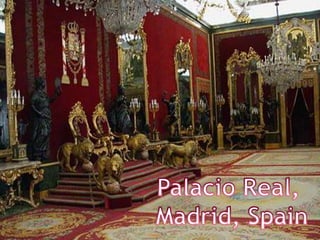
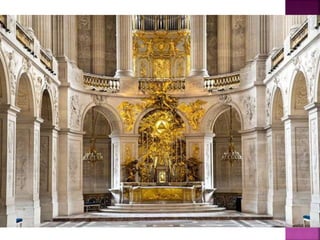
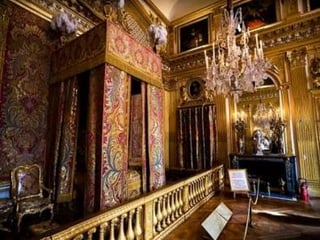
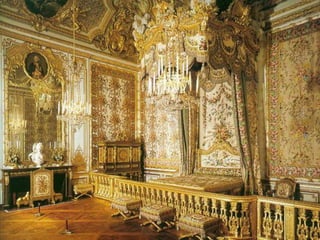
  • #35 Queen’s Bedroom
  • #40 Daughter of Henry VII; Sister of Mary who was married to Philip II
  • #41 After his death in 1658 he was buried in Westminster Abbey, but after the Royalists returned to power in 1660 they had his corpse dug up, hung in chains, and beheaded. Cromwell is one of the most controversial figures in the history of the British Isles, considered a regicidal dictator by historians such as David Hume as quoted by David Sharp,[4] but a hero of liberty by others such as Thomas Carlyle and Samuel Rawson Gardiner. In a 2002 BBC poll in Britain, Cromwell was selected as one of the ten greatest Britons of all time.[5] However, his measures against Catholics in Scotland and Ireland have been characterised by some as genocidal or near-genocidal,[6] and in Ireland his record is harshly criticised.[7] Wikipedia.
  • #42 Charles’ brother James. Mary was James’ daughter, married to William of Netherlands.
  • #44 WHY??? Maybe literacy and education rate, maybe rewards of entrepreneurial spirit… see video on Holland…
  • #45 Peace of Westphalia guaranteed independence and sovereignty.
  • #46 Good excuse for some princes to escape Papal /HRE control Corruption of church, power… people were sick of it and ready to change the whole social order. Middle class urban dwellers found religious legitimacy for their growing role in society, vis a vis their view of Catholicism related to rural and feudal world of aristocratic privelege.