Horse Evolution
Geology 331Geology 331
Paleontology
Horses
Equus caballus
Equus burchelli: the zebra
Horse-Zebra hybrid
Shows that genes are discrete and not blended by
genetic recombination.
The extinct quagga (1883), related to today's
1870
plains zebras.
“Family tree”
of the horsesof the horses
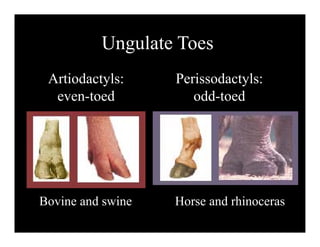
Ungulate ToesUngulate Toes
Artiodact ls: Perissodact ls:Artiodactyls:
even-toed
Perissodactyls:
odd-toed
Bovine and swine Horse and rhinocerasBovine and swine Horse and rhinoceras
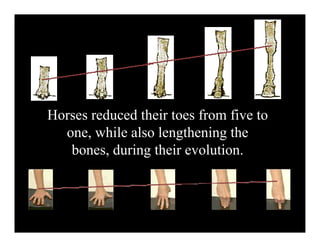
Horses reduced their toes from five to
one, while also lengthening the, g g
bones, during their evolution.
EquusMerychippusMiohippusHyracotherium
Hind feet left, front feet right.
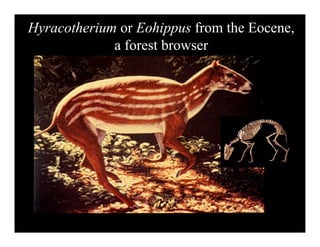
Hyracotherium or Eohippus from the Eocene,
a forest browsera forest browser
Orohippus from the late Eocene, also a forest browser
Miohippus from the Oligocene. Forests were
shrinking, grasslands were expanding.g, g p g
MerychippusMerychippus
from the
MioceneMiocene,
a plains
grazer
The modern horseThe modern horse
Equus from the
Pl i t dPleistocene and
Recent
Evolutionary trends in horses andEvolutionary trends in horses and
many other ungulates
• Reduction in toes
• Elongation of legs by standing on the toes
• Increased body size
• Elongation of the muzzle
• High crowned specialized teeth• High crowned, specialized teeth
Environmental Causes of
Evolutionary trends in horses and
many other ungulatesmany other ungulates
• Need for greater speed and body size to
escape predatorsescape predators.
• Cooling climate during the Cenozoic
replaced forests with grasslands Simplereplaced forests with grasslands. Simple
hooves and elongated legs are adaptive for
running in the open. Elongated muzzle tou g e ope . o g ed u e o
reach grass.
• Grasses are high in silica. High crownedg g
teeth are adaptive.

Horses