Graphics Kernel System (GKS)
• The Graphical Kernel System (GKS) was the first ISO
standard for computer graphics in low-level, established in
1977. GKS offers a group of drawing aspects for 2D vector
graphics appropriate for mapping and related duties.
• The calls are defined to be moveable across various
programming languages, graphics hardware, so that
applications noted to use GKS will be willingly portable to
different devices and platforms.
• The following documents are representing GKS standards:
• The language bindings are called in ISO 8651 standard.ANSI
X3.124 (1985) is part of ANSI standard.
• ISO/IEC 7942 noted in ISO standard, first part of 1985 and
two to four parts of 1997-99.
• ISO 8805 and ISO 8806.
•
Basic parts
• The GKS consists of three basic parts:
i) A casual exhibition of the substances of the standard which
contains such things as how text is placed, how polygonal zones are
to be filled, and so onward.
ii) An official of the descriptive material in (i), by way of conceptual
the ideas into separate functional explanations. These functional
descriptions have such data as descriptions of input and output
parameters, specific descriptions of the result of every function
should have references into the descriptive material in (i), and a
description of fault situation. The functional descriptions in this
division are language autonomous.
iii) Language bindings are an execution of the abstract functions
explained in (ii). in a explicit computer language such as C.
classes
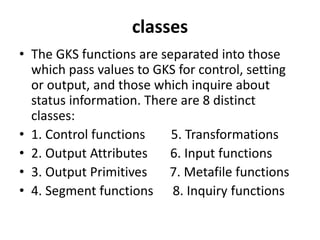
• The GKS functions are separated into those
which pass values to GKS for control, setting
or output, and those which inquire about
status information. There are 8 distinct
classes:
• 1. Control functions 5. Transformations
• 2. Output Attributes 6. Input functions
• 3. Output Primitives 7. Metafile functions
• 4. Segment functions 8. Inquiry functions
Graphics Kernel System (GKS).pptx

Graphics Kernel System (GKS).pptx

  • 1.
    Graphics Kernel System(GKS) • The Graphical Kernel System (GKS) was the first ISO standard for computer graphics in low-level, established in 1977. GKS offers a group of drawing aspects for 2D vector graphics appropriate for mapping and related duties. • The calls are defined to be moveable across various programming languages, graphics hardware, so that applications noted to use GKS will be willingly portable to different devices and platforms. • The following documents are representing GKS standards: • The language bindings are called in ISO 8651 standard.ANSI X3.124 (1985) is part of ANSI standard. • ISO/IEC 7942 noted in ISO standard, first part of 1985 and two to four parts of 1997-99. • ISO 8805 and ISO 8806. •
  • 2.
    Basic parts • TheGKS consists of three basic parts: i) A casual exhibition of the substances of the standard which contains such things as how text is placed, how polygonal zones are to be filled, and so onward. ii) An official of the descriptive material in (i), by way of conceptual the ideas into separate functional explanations. These functional descriptions have such data as descriptions of input and output parameters, specific descriptions of the result of every function should have references into the descriptive material in (i), and a description of fault situation. The functional descriptions in this division are language autonomous. iii) Language bindings are an execution of the abstract functions explained in (ii). in a explicit computer language such as C.
  • 4.
    classes • The GKSfunctions are separated into those which pass values to GKS for control, setting or output, and those which inquire about status information. There are 8 distinct classes: • 1. Control functions 5. Transformations • 2. Output Attributes 6. Input functions • 3. Output Primitives 7. Metafile functions • 4. Segment functions 8. Inquiry functions