ABRASIVE MACHINING PROCESSES
 Abrasive machining is
a machining process where
material is removed from a
workpiece using a multitude
of small abrasive particles.
Common examples include
grinding, honing, and
polishing. Abrasive
processes are usually
expensive, but capable of
tighter tolerances and better
surface finish than other
machining processes
 Abrasive machining processes can be divided into two
categories based on how the grains are applied to the
workpiece.
 In bonded abrasive processes, the particles are held
together within a matrix, and their combined shape
determines the geometry of the finished workpiece. For
example, in grinding the particles are bonded together
in a wheel. As the grinding wheel is fed into the part,
its shape is transferred onto the workpiece.
 In loose abrasive processes, there is no structure
connecting the grains. They may be applied without
lubrication as dry powder, or they may be mixed with a
lubricant to form a slurry. Since the grains can move
independently, they must be forced into the workpiece
with another object like a polishing cloth or a lapping
plate.
Manufacturing Technology
Grinding
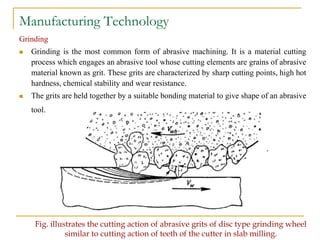
 Grinding is the most common form of abrasive machining. It is a material cutting
process which engages an abrasive tool whose cutting elements are grains of abrasive
material known as grit. These grits are characterized by sharp cutting points, high hot
hardness, chemical stability and wear resistance.
 The grits are held together by a suitable bonding material to give shape of an abrasive
tool.
Fig. illustrates the cutting action of abrasive grits of disc type grinding wheel
similar to cutting action of teeth of the cutter in slab milling.
Manufacturing Technology
Surface grinding
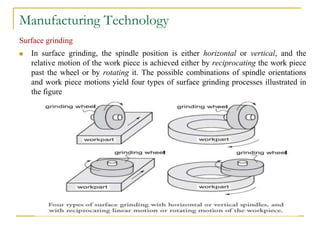
 In surface grinding, the spindle position is either horizontal or vertical, and the
relative motion of the work piece is achieved either by reciprocating the work piece
past the wheel or by rotating it. The possible combinations of spindle orientations
and work piece motions yield four types of surface grinding processes illustrated in
the figure
Manufacturing Technology
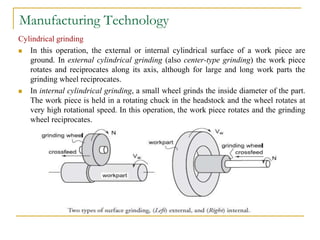
Cylindrical grinding
 In this operation, the external or internal cylindrical surface of a work piece are
ground. In external cylindrical grinding (also center-type grinding) the work piece
rotates and reciprocates along its axis, although for large and long work parts the
grinding wheel reciprocates.
 In internal cylindrical grinding, a small wheel grinds the inside diameter of the part.
The work piece is held in a rotating chuck in the headstock and the wheel rotates at
very high rotational speed. In this operation, the work piece rotates and the grinding
wheel reciprocates.
Manufacturing Technology
Center less grinding
 Center less grinding is a process for continuously grinding cylindrical
surfaces in which the work piece is supported not by centers or chucks but
by a rest blade. The work piece is ground between two wheels. The larger
grinding wheel does grinding, while the smaller regulating wheel, which is
tilted at an angle i, regulates the velocity Vf of the axial movement of the
work piece.
 Center less grinding can also be external or internal, traverse feed or plunge
grinding. The most common type of center less grinding is the external
traverse feed grinding.

Abrasive machining.ppt

  • 1.
    ABRASIVE MACHINING PROCESSES Abrasive machining is a machining process where material is removed from a workpiece using a multitude of small abrasive particles. Common examples include grinding, honing, and polishing. Abrasive processes are usually expensive, but capable of tighter tolerances and better surface finish than other machining processes  Abrasive machining processes can be divided into two categories based on how the grains are applied to the workpiece.  In bonded abrasive processes, the particles are held together within a matrix, and their combined shape determines the geometry of the finished workpiece. For example, in grinding the particles are bonded together in a wheel. As the grinding wheel is fed into the part, its shape is transferred onto the workpiece.  In loose abrasive processes, there is no structure connecting the grains. They may be applied without lubrication as dry powder, or they may be mixed with a lubricant to form a slurry. Since the grains can move independently, they must be forced into the workpiece with another object like a polishing cloth or a lapping plate.
  • 2.
    Manufacturing Technology Grinding  Grindingis the most common form of abrasive machining. It is a material cutting process which engages an abrasive tool whose cutting elements are grains of abrasive material known as grit. These grits are characterized by sharp cutting points, high hot hardness, chemical stability and wear resistance.  The grits are held together by a suitable bonding material to give shape of an abrasive tool. Fig. illustrates the cutting action of abrasive grits of disc type grinding wheel similar to cutting action of teeth of the cutter in slab milling.
  • 3.
    Manufacturing Technology Surface grinding In surface grinding, the spindle position is either horizontal or vertical, and the relative motion of the work piece is achieved either by reciprocating the work piece past the wheel or by rotating it. The possible combinations of spindle orientations and work piece motions yield four types of surface grinding processes illustrated in the figure
  • 4.
    Manufacturing Technology Cylindrical grinding In this operation, the external or internal cylindrical surface of a work piece are ground. In external cylindrical grinding (also center-type grinding) the work piece rotates and reciprocates along its axis, although for large and long work parts the grinding wheel reciprocates.  In internal cylindrical grinding, a small wheel grinds the inside diameter of the part. The work piece is held in a rotating chuck in the headstock and the wheel rotates at very high rotational speed. In this operation, the work piece rotates and the grinding wheel reciprocates.
  • 5.
    Manufacturing Technology Center lessgrinding  Center less grinding is a process for continuously grinding cylindrical surfaces in which the work piece is supported not by centers or chucks but by a rest blade. The work piece is ground between two wheels. The larger grinding wheel does grinding, while the smaller regulating wheel, which is tilted at an angle i, regulates the velocity Vf of the axial movement of the work piece.  Center less grinding can also be external or internal, traverse feed or plunge grinding. The most common type of center less grinding is the external traverse feed grinding.