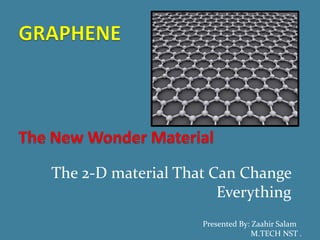
The 2-D material That Can Change
                       Everything
                    Presented By: Zaahir Salam
                                  M.TECH NST .
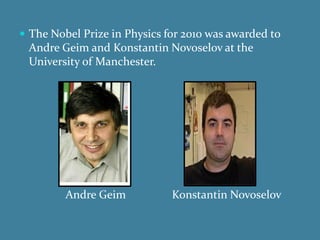
 The Nobel Prize in Physics for 2010 was awarded to
 Andre Geim and Konstantin Novoselov at the
 University of Manchester.


         Andre Geim           Konstantin Novoselov
INTRODUCTION
Graphene can be synthesized from Graphite to
 create the thinnest, strongest and most conductive
 material know today.


Graphite flakes are actually made of many layers
 of graphene stacked on top of each other with
 weak bonds holding them together.
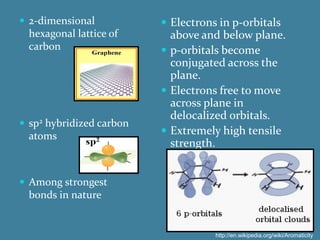
 2-dimensional            Electrons in p-orbitals
  hexagonal lattice of      above and below plane.
  carbon                   p-orbitals become
                            conjugated across the
                            plane.
                           Electrons free to move
                            across plane in
                            delocalized orbitals.
 sp2 hybridized carbon
  atoms                    Extremely high tensile
                            strength.


 Among strongest
  bonds in nature


                                     http://en.wikipedia.org/wiki/Aromaticity
Mother of all graphitic forms


0D buckyballs                 1D nanotubes                        3D graphite.
   A. K. Geim & K. S. Novoselov. The rise of graphene. Nature Materials Vol 6 183-191 (March 2007)
Graphene Visualized Under Various Available Microscopes


AFM Image               TEM Image                                       SEM Image


       A. K. Geim & K. S. Novoselov. The rise of graphene. Nature Materials Vol 6 183-191 (March 2007)
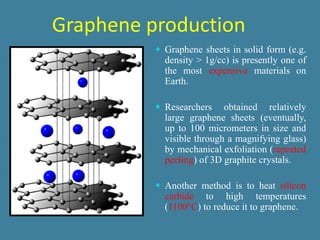
Graphene production
           Graphene sheets in solid form (e.g.
            density > 1g/cc) is presently one of
            the most expensive materials on
            Earth.

           Researchers    obtained relatively
            large graphene sheets (eventually,
            up to 100 micrometers in size and
            visible through a magnifying glass)
            by mechanical exfoliation (repeated
            peeling) of 3D graphite crystals.

           Another method is to heat silicon
            carbide to high temperatures
            (1100°C) to reduce it to graphene.
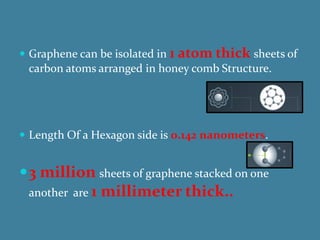
 Graphene can be isolated in 1 atom thick sheets of
 carbon atoms arranged in honey comb Structure.


 Length Of a Hexagon side is 0.142 nanometers.


 3 million sheets of graphene stacked on one
 another are 1   millimeter thick..
Graphene Unique properties
 STRENGTH:

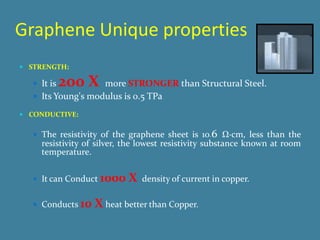
    It is   200 X  more STRONGER than Structural Steel.
    Its Young's modulus is 0.5 TPa

 CONDUCTIVE:


    The resistivity of the graphene sheet is 10−6 Ω·cm, less than the
     resistivity of silver, the lowest resistivity substance known at room
     temperature.


    It can Conduct   1000 X   density of current in copper.

    Conducts   10 X heat better than Copper.
 FLEXIBLE:
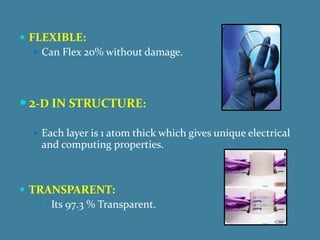
    Can Flex 20% without damage.


 2-D IN STRUCTURE:

   Each layer is 1 atom thick which gives unique electrical
    and computing properties.


 TRANSPARENT:
     Its 97.3 % Transparent.
Potential Applications:
 Graphene is being currently being tested by
 researchers and the following applications are
 considered:

 COMPUTING:
       Graphene may be able to replace semiconductor in
        computer chips and electronics.

       No need of cooling fans as it functions at room
        temperature.
   MIT has developed at 1000+ GHZ graphene
    microchip that is 300 times faster than
    commercially available chips today.

   This all could mean smaller and more
    powerful chips.


   CHALLENGE :

       The Graphene transistors cannot be switched
        on to off. This is a challenge researchers are
        currently taking ON.
Materials:
 Graphene  can be added in small
 amounts to metal and plastics to make
 stronger and lighter composite
 materials.

 Vehicles and airplanes could be lighter
 and stronger, increasing fuel efficiency
 and safety.

 By  seeding plastics with just 1%
 Graphene they can become conductive
 while remaining transparent.
Energy + Optics
 Graphene Could replace indium to
 make better solar cells which are
 flexible, cheaper and suited for mass
 production.

 Graphene   could make better
 touchscreens, LCD’s and LED’s.

 Graphene may revolutionize data
 transfer it can make smaller optical
 modulators that transfer data at
 speeds upto 10X faster than current
 technology.
References
 Graphene http://en.wikipedia.org/wiki/Grapheneaccessed

  on March, 29 2009
 Graphene Confirmed the World’s Stronged Known Material
  http://gizmodo.com/5026404/graphene-confirmed-as-the-
  worlds-strongest-known-material accessed on March, 29
  2009
 Nanotechnology Reserchers go Ballistic Over Graphene
  http://www.nanowerk.com/spotlight/spotid=2340.php accessed on
  March 29, 2009

 TR10: Graphene Transistors
  http://www.technologyreview.com/read_article.aspx?ch=specialse
  ctions&sc=emerging08&id=20242 accessed on March 29, 2009

 Graphene: Charged Up http://www.natureasia.com/asia-
  materials/highlight.php?id=77 accessed on March 29, 2009
THANK YOU

Graphene a wonder material

  • 1.
    The 2-D materialThat Can Change Everything Presented By: Zaahir Salam M.TECH NST .
  • 2.
     The NobelPrize in Physics for 2010 was awarded to Andre Geim and Konstantin Novoselov at the University of Manchester. Andre Geim Konstantin Novoselov
  • 3.
    INTRODUCTION Graphene can besynthesized from Graphite to create the thinnest, strongest and most conductive material know today. Graphite flakes are actually made of many layers of graphene stacked on top of each other with weak bonds holding them together.
  • 4.
     2-dimensional  Electrons in p-orbitals hexagonal lattice of above and below plane. carbon  p-orbitals become conjugated across the plane.  Electrons free to move across plane in delocalized orbitals.  sp2 hybridized carbon atoms  Extremely high tensile strength.  Among strongest bonds in nature http://en.wikipedia.org/wiki/Aromaticity
  • 5.
    Mother of allgraphitic forms 0D buckyballs 1D nanotubes 3D graphite. A. K. Geim & K. S. Novoselov. The rise of graphene. Nature Materials Vol 6 183-191 (March 2007)
  • 6.
    Graphene Visualized UnderVarious Available Microscopes AFM Image TEM Image SEM Image A. K. Geim & K. S. Novoselov. The rise of graphene. Nature Materials Vol 6 183-191 (March 2007)
  • 7.
    Graphene production  Graphene sheets in solid form (e.g. density > 1g/cc) is presently one of the most expensive materials on Earth.  Researchers obtained relatively large graphene sheets (eventually, up to 100 micrometers in size and visible through a magnifying glass) by mechanical exfoliation (repeated peeling) of 3D graphite crystals.  Another method is to heat silicon carbide to high temperatures (1100°C) to reduce it to graphene.
  • 8.
     Graphene canbe isolated in 1 atom thick sheets of carbon atoms arranged in honey comb Structure.  Length Of a Hexagon side is 0.142 nanometers.  3 million sheets of graphene stacked on one another are 1 millimeter thick..
  • 9.
    Graphene Unique properties STRENGTH:  It is 200 X more STRONGER than Structural Steel.  Its Young's modulus is 0.5 TPa  CONDUCTIVE:  The resistivity of the graphene sheet is 10−6 Ω·cm, less than the resistivity of silver, the lowest resistivity substance known at room temperature.  It can Conduct 1000 X density of current in copper.  Conducts 10 X heat better than Copper.
  • 10.
     FLEXIBLE:  Can Flex 20% without damage.  2-D IN STRUCTURE:  Each layer is 1 atom thick which gives unique electrical and computing properties.  TRANSPARENT:  Its 97.3 % Transparent.
  • 11.
    Potential Applications:  Grapheneis being currently being tested by researchers and the following applications are considered:  COMPUTING:  Graphene may be able to replace semiconductor in computer chips and electronics.  No need of cooling fans as it functions at room temperature.
  • 12.
    MIT has developed at 1000+ GHZ graphene microchip that is 300 times faster than commercially available chips today.  This all could mean smaller and more powerful chips.  CHALLENGE :  The Graphene transistors cannot be switched on to off. This is a challenge researchers are currently taking ON.
  • 13.
    Materials:  Graphene can be added in small amounts to metal and plastics to make stronger and lighter composite materials.  Vehicles and airplanes could be lighter and stronger, increasing fuel efficiency and safety.  By seeding plastics with just 1% Graphene they can become conductive while remaining transparent.
  • 14.
    Energy + Optics Graphene Could replace indium to make better solar cells which are flexible, cheaper and suited for mass production.  Graphene could make better touchscreens, LCD’s and LED’s.  Graphene may revolutionize data transfer it can make smaller optical modulators that transfer data at speeds upto 10X faster than current technology.
  • 15.
    References  Graphene http://en.wikipedia.org/wiki/Grapheneaccessed on March, 29 2009  Graphene Confirmed the World’s Stronged Known Material http://gizmodo.com/5026404/graphene-confirmed-as-the- worlds-strongest-known-material accessed on March, 29 2009  Nanotechnology Reserchers go Ballistic Over Graphene http://www.nanowerk.com/spotlight/spotid=2340.php accessed on March 29, 2009  TR10: Graphene Transistors http://www.technologyreview.com/read_article.aspx?ch=specialse ctions&sc=emerging08&id=20242 accessed on March 29, 2009  Graphene: Charged Up http://www.natureasia.com/asia- materials/highlight.php?id=77 accessed on March 29, 2009
  • 16.