We want to give you a stylish and logical presentation to
help you improve your knowledge about graphene.
What is
Graphene?
SEMINAR BY : Mr Rasoul Sadeghzadeh
Supervisor : Ms Dr Nikoonahad 1
CONTENTS
01 WHAT IS GRAPHENE?


02 PROPERTIES OF GRAPHENE


03 SOME PRODUCTION METHODS


04 APPLICATIONS


05 REFERENCES


2
WHAT IS GRAPHENE?


Graphene is a pure carbon-based
material. Graphene is a simple,
regular, hexagonal carbon structure
but very strong. In terms of
electricity, scientists divide carbon
into semiconductors
01
3
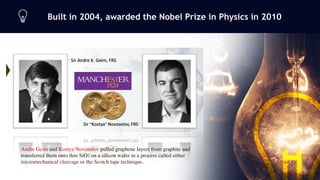
Built in 2004, awarded the Nobel Prize in Physics in 2010
Andre Geim and Kostya Novoselov pulled graphene layers from graphite and
transferred them onto thin SiO2 on a silicon wafer in a process called either
micromechanical cleavage or the Scotch tape technique.
4
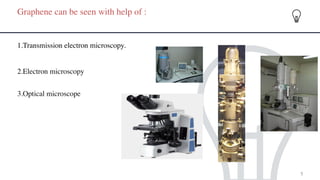
Graphene can be seen with help of :
1.Transmission electron microscopy
.

2.Electron microscop
y


3.Optical microscope
5
02. PROPERTIES OF GRAPHENE
STRUCTURAL
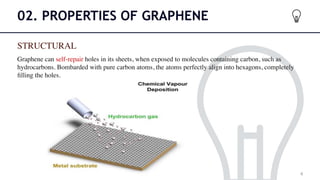
Graphene can self-repair holes in its sheets, when exposed to molecules containing carbon, such as
hydrocarbons. Bombarded with pure carbon atoms, the atoms perfectly align into hexagons, completely
fi
lling the holes.
6
CHEMICAL
• Graphene one atom thick are a hundred times more chemically reactive than thicker sheets.
(Stanford university)
• Graphene is chemically the most reactive form of carbon.
 

ELECTRONIC
• Intrinsic graphene is a semi-metal or zero-gap semiconductor.
 

ELECTRICAL
•Graphene has a remarkably high electron mobility at room temperature, with reported values in excess of
15000 cm2
·V−1
·s−1
•It conducts electricity as ef
fi
ciently as copper and outperforms all other materials as a conductor of heat
7
OPTICAL
 

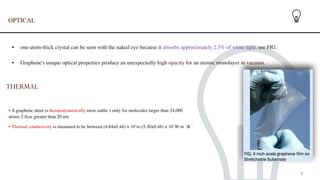
• one-atom-thick crystal can be seen with the naked eye because it absorbs approximately 2.3% of white light. see FIG.


• Graphene's unique optical properties produce an unexpectedly high opacity for an atomic monolayer in vacuum.
THERMAL


• A graphene sheet is thermodynamically most stable 1.only for molecules larger than 24,000
atoms 2.Size greater than 20 nm
• Thermal conductivity is measured to be between (4.84±0.44) × 103
to (5.30±0.48) × 103
W·m−1
·K−1
8
MECHANICAL
 

• The
fl
at graphene sheet is unstable with respect to scrolling i.e. bending into a cylindrical shape
• As of 2009, graphene appeared to be one of the strongest materials known with a breaking strength
over 100 times greater than a hypothetical steel
fi
lm of the same (thin) thickness, with a Young's
modulus (stiffness) of 1 TPa (150000000 psi).
• 1 square meter graphene hammock would support a 4 kg cat but would weigh only as much as one
of the cat's whiskers, at 0.77 mg (about 0.001% of the weight of 1 m2 of paper)
9
1.MECHANICAL EXFOLIATION


2. EPITAXY


3. REDUCTION OF GRAPHITE OXIDE


4. METAL CARBON MELT


5. SOLVENT EXFOLIATION


6. CARBON DIOXIDE REDUCTION


7. NANOTUBE SLICING


03 SOME PRODUCTION METHODS


How do they prepare?
Graphene can be easily
obtained by separating
graphite layers
10
04 APPLICATIONS


Improving the efficiency of solar cells
High charge batteries
Elastic screens (folding)
Utilizing the properties of hardness, strength and lightness in the aerospace
and automotive industries
Graphene is reported to have enhanced PCR by increasing the yield
of DNA product
Scientists are also trying to make graphene transistors and replace
them with silicon chips because of the very fast speed of electrons in
graphene.
11
05 REFERENCES
1. High Quality, Scalable Graphene Production Doug Speight, Ivan Vlassiouk


US Department of energy,


2. Graphene Technology: Roadmap to Applications


Andrea C. Ferrari


Department of Engineering, Cambridge University, Cambridge, UK


3. Environmental applications of graphene-based materials


Alina Catrinel Ion1, Ion Ion1, Florinela Sirbu2


1.Department of Analytical Chemistry and Environmental Engineering,


Faculty of Applied Chemistry and Materials Science, University Politehnica of Bucharest 2.Institute of Physical Chemistry “I. Gh. Murgulescu” of the Romanian
Academy


4.Adhesion mechanics of graphene membranes


J.S. Bunch n, M.L.Dunn


Department of Mechanical Engineering, University of Colorado,Boulder,CO80309USA


5. Graphene Membranes And Greenhouse Gas Pollution : An Interview With Professor Scott Bunch


Dr. Scott Bunch


UNIVERSITY OF COLORADO, Colorado,Boulder,CO80309USA


•
Large Arrays and Properties of 3-Terminal GrapheneNanoelectromechanical Switches .6
•
, Xinghui Liu ,Ji Won Suk , Narasimha G. Boddeti , Lauren Cantley , Luda Wang
•
, Jason M. Gray , Harris J. Hall ,Victor M. Bright , Charles T. Rogers , Martin L. Dunn
•
* Rodney S. Ruoff , and J. Scott Bunch


12
THANK YOU
13
rasoull2565@yahoo.com
@Rasoulsadeghzadeh

Graphene

  • 1.
    We want togive you a stylish and logical presentation to help you improve your knowledge about graphene. What is Graphene? SEMINAR BY : Mr Rasoul Sadeghzadeh Supervisor : Ms Dr Nikoonahad 1
  • 2.
    CONTENTS 01 WHAT ISGRAPHENE? 02 PROPERTIES OF GRAPHENE 03 SOME PRODUCTION METHODS 04 APPLICATIONS 05 REFERENCES 
 
 2
  • 3.
    WHAT IS GRAPHENE? Grapheneis a pure carbon-based material. Graphene is a simple, regular, hexagonal carbon structure but very strong. In terms of electricity, scientists divide carbon into semiconductors 01 3
  • 4.
    Built in 2004,awarded the Nobel Prize in Physics in 2010 Andre Geim and Kostya Novoselov pulled graphene layers from graphite and transferred them onto thin SiO2 on a silicon wafer in a process called either micromechanical cleavage or the Scotch tape technique. 4
  • 5.
    Graphene can beseen with help of : 1.Transmission electron microscopy . 2.Electron microscop y 
 3.Optical microscope 5
  • 6.
    02. PROPERTIES OFGRAPHENE STRUCTURAL Graphene can self-repair holes in its sheets, when exposed to molecules containing carbon, such as hydrocarbons. Bombarded with pure carbon atoms, the atoms perfectly align into hexagons, completely fi lling the holes. 6
  • 7.
    CHEMICAL • Graphene oneatom thick are a hundred times more chemically reactive than thicker sheets. (Stanford university) • Graphene is chemically the most reactive form of carbon. ELECTRONIC • Intrinsic graphene is a semi-metal or zero-gap semiconductor. ELECTRICAL •Graphene has a remarkably high electron mobility at room temperature, with reported values in excess of 15000 cm2 ·V−1 ·s−1 •It conducts electricity as ef fi ciently as copper and outperforms all other materials as a conductor of heat 7
  • 8.
    OPTICAL • one-atom-thickcrystal can be seen with the naked eye because it absorbs approximately 2.3% of white light. see FIG. 
 • Graphene's unique optical properties produce an unexpectedly high opacity for an atomic monolayer in vacuum. THERMAL 
 • A graphene sheet is thermodynamically most stable 1.only for molecules larger than 24,000 atoms 2.Size greater than 20 nm • Thermal conductivity is measured to be between (4.84±0.44) × 103 to (5.30±0.48) × 103 W·m−1 ·K−1 8
  • 9.
    MECHANICAL • The fl atgraphene sheet is unstable with respect to scrolling i.e. bending into a cylindrical shape • As of 2009, graphene appeared to be one of the strongest materials known with a breaking strength over 100 times greater than a hypothetical steel fi lm of the same (thin) thickness, with a Young's modulus (stiffness) of 1 TPa (150000000 psi). • 1 square meter graphene hammock would support a 4 kg cat but would weigh only as much as one of the cat's whiskers, at 0.77 mg (about 0.001% of the weight of 1 m2 of paper) 9
  • 10.
    1.MECHANICAL EXFOLIATION 2. EPITAXY 3.REDUCTION OF GRAPHITE OXIDE 4. METAL CARBON MELT 
 5. SOLVENT EXFOLIATION 
 6. CARBON DIOXIDE REDUCTION 7. NANOTUBE SLICING 03 SOME PRODUCTION METHODS How do they prepare? Graphene can be easily obtained by separating graphite layers 10
  • 11.
    04 APPLICATIONS Improving theefficiency of solar cells High charge batteries Elastic screens (folding) Utilizing the properties of hardness, strength and lightness in the aerospace and automotive industries Graphene is reported to have enhanced PCR by increasing the yield of DNA product Scientists are also trying to make graphene transistors and replace them with silicon chips because of the very fast speed of electrons in graphene. 11
  • 12.
    05 REFERENCES 1. HighQuality, Scalable Graphene Production Doug Speight, Ivan Vlassiouk US Department of energy, 2. Graphene Technology: Roadmap to Applications Andrea C. Ferrari 
 Department of Engineering, Cambridge University, Cambridge, UK 3. Environmental applications of graphene-based materials Alina Catrinel Ion1, Ion Ion1, Florinela Sirbu2 
 1.Department of Analytical Chemistry and Environmental Engineering, 
 Faculty of Applied Chemistry and Materials Science, University Politehnica of Bucharest 2.Institute of Physical Chemistry “I. Gh. Murgulescu” of the Romanian Academy 4.Adhesion mechanics of graphene membranes J.S. Bunch n, M.L.Dunn 
 Department of Mechanical Engineering, University of Colorado,Boulder,CO80309USA 5. Graphene Membranes And Greenhouse Gas Pollution : An Interview With Professor Scott Bunch Dr. Scott Bunch 
 UNIVERSITY OF COLORADO, Colorado,Boulder,CO80309USA • Large Arrays and Properties of 3-Terminal GrapheneNanoelectromechanical Switches .6 • , Xinghui Liu ,Ji Won Suk , Narasimha G. Boddeti , Lauren Cantley , Luda Wang • , Jason M. Gray , Harris J. Hall ,Victor M. Bright , Charles T. Rogers , Martin L. Dunn • * Rodney S. Ruoff , and J. Scott Bunch 12
  • 13.