GRAPHENE AND ITS FUTURE
APPLICATIONS
Presented By:
Contents:
• What is Graphene?
• Graphite Discovery.
• Properties.
• Applications.
• Future Scope.
• Conclusion.
NanoSmiths
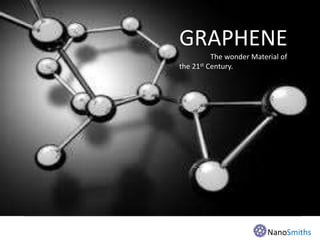
GRAPHENE
The wonder Material of
the 21st Century.
NanoSmiths
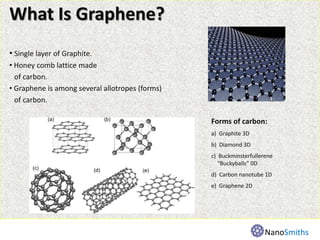
What Is Graphene?
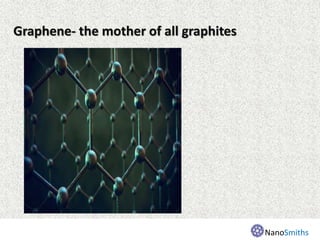
• Single layer of Graphite.
• Honey comb lattice made
of carbon.
• Graphene is among several allotropes (forms)
of carbon.
Forms of carbon:
a) Graphite 3D
b) Diamond 3D
c) Buckminsterfullerene
“Buckyballs” 0D
d) Carbon nanotube 1D
e) Graphene 2D
NanoSmiths
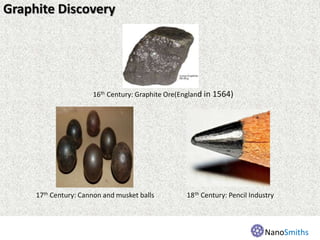
Graphite Discovery
16th Century: Graphite Ore(England in 1564)
17th Century: Cannon and musket balls 18th Century: Pencil Industry
NanoSmiths
Graphene- the mother of all graphites
NanoSmiths
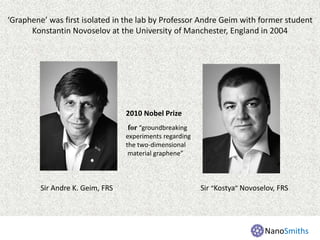
‘Graphene’ was first isolated in the lab by Professor Andre Geim with former student
Konstantin Novoselov at the University of Manchester, England in 2004
Sir Andre K. Geim, FRS Sir “Kostya” Novoselov, FRS
2010 Nobel Prize
for “groundbreaking
experiments regarding
the two-dimensional
material graphene”
NanoSmiths
NanoSmiths
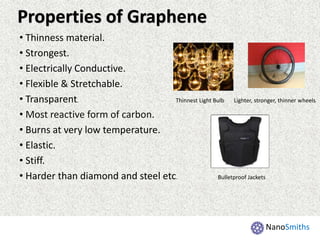
Properties of Graphene
• Thinness material.
• Strongest.
• Electrically Conductive.
• Flexible & Stretchable.
• Transparent. Thinnest Light Bulb Lighter, stronger, thinner wheels
• Most reactive form of carbon.
• Burns at very low temperature.
• Elastic.
• Stiff.
• Harder than diamond and steel etc. Bulletproof Jackets
NanoSmiths
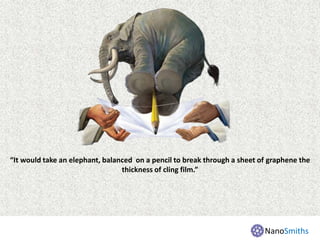
“It would take an elephant, balanced on a pencil to break through a sheet of graphene the
thickness of cling film.”
NanoSmiths
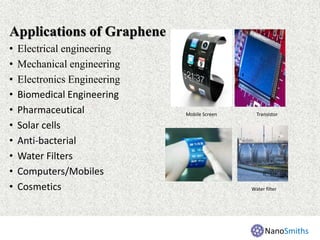
Applications of Graphene
• Electrical engineering
• Mechanical engineering
• Electronics Engineering
• Biomedical Engineering
• Pharmaceutical
• Solar cells
• Anti-bacterial
• Water Filters
• Computers/Mobiles
• Cosmetics
Transistor
Water filter
Mobile Screen
NanoSmiths
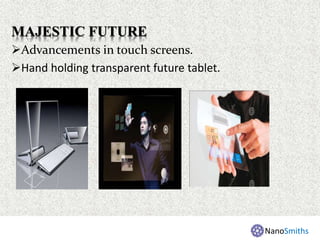
MAJESTIC FUTURE
Advancements in touch screens.
Hand holding transparent future tablet.
NanoSmiths
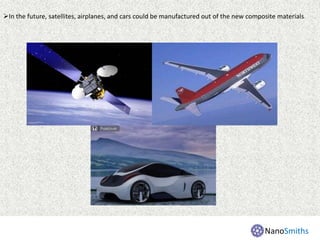
In the future, satellites, airplanes, and cars could be manufactured out of the new composite materials.
NanoSmiths
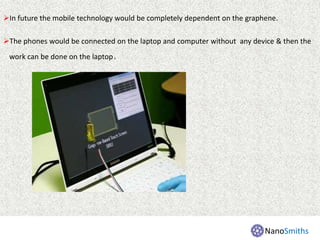
In future the mobile technology would be completely dependent on the graphene.
The phones would be connected on the laptop and computer without any device & then the
work can be done on the laptop.
NanoSmiths
Conclusion:
• Graphene is single layer of carbon atoms.
• Discovered in 2004
• Exceptional mechanical and electrical properties.
• Strongest known material among all materials.
• Graphene has applications in every sphere of life like
touch screens, solar cells, water filters etc.
NanoSmiths
THANK YOU
NanoSmiths

nanotechnology1

  • 1.
    GRAPHENE AND ITSFUTURE APPLICATIONS Presented By:
  • 2.
    Contents: • What isGraphene? • Graphite Discovery. • Properties. • Applications. • Future Scope. • Conclusion. NanoSmiths
  • 3.
    GRAPHENE The wonder Materialof the 21st Century. NanoSmiths
  • 4.
    What Is Graphene? •Single layer of Graphite. • Honey comb lattice made of carbon. • Graphene is among several allotropes (forms) of carbon. Forms of carbon: a) Graphite 3D b) Diamond 3D c) Buckminsterfullerene “Buckyballs” 0D d) Carbon nanotube 1D e) Graphene 2D NanoSmiths
  • 5.
    Graphite Discovery 16th Century:Graphite Ore(England in 1564) 17th Century: Cannon and musket balls 18th Century: Pencil Industry NanoSmiths
  • 6.
    Graphene- the motherof all graphites NanoSmiths
  • 7.
    ‘Graphene’ was firstisolated in the lab by Professor Andre Geim with former student Konstantin Novoselov at the University of Manchester, England in 2004 Sir Andre K. Geim, FRS Sir “Kostya” Novoselov, FRS 2010 Nobel Prize for “groundbreaking experiments regarding the two-dimensional material graphene” NanoSmiths
  • 8.
  • 9.
    Properties of Graphene •Thinness material. • Strongest. • Electrically Conductive. • Flexible & Stretchable. • Transparent. Thinnest Light Bulb Lighter, stronger, thinner wheels • Most reactive form of carbon. • Burns at very low temperature. • Elastic. • Stiff. • Harder than diamond and steel etc. Bulletproof Jackets NanoSmiths
  • 10.
    “It would takean elephant, balanced on a pencil to break through a sheet of graphene the thickness of cling film.” NanoSmiths
  • 11.
    Applications of Graphene •Electrical engineering • Mechanical engineering • Electronics Engineering • Biomedical Engineering • Pharmaceutical • Solar cells • Anti-bacterial • Water Filters • Computers/Mobiles • Cosmetics Transistor Water filter Mobile Screen NanoSmiths
  • 12.
    MAJESTIC FUTURE Advancements intouch screens. Hand holding transparent future tablet. NanoSmiths
  • 13.
    In the future,satellites, airplanes, and cars could be manufactured out of the new composite materials. NanoSmiths
  • 14.
    In future themobile technology would be completely dependent on the graphene. The phones would be connected on the laptop and computer without any device & then the work can be done on the laptop. NanoSmiths
  • 15.
    Conclusion: • Graphene issingle layer of carbon atoms. • Discovered in 2004 • Exceptional mechanical and electrical properties. • Strongest known material among all materials. • Graphene has applications in every sphere of life like touch screens, solar cells, water filters etc. NanoSmiths
  • 16.

Editor's Notes