Mobile phones using Graphene

       Presented by Nehal
Contents
•   Introduction to Graphene
•   History
•   Graphene as a material
•   Difference between Graphene and Silicon
•   Properties of Graphene
•   Technology using Graphene
•   Mobile phones and Graphene
•   Advantages
•   Disadvantages
Introduction
   What is graphene?
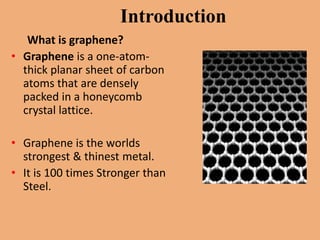
• Graphene is a one-atom-
  thick planar sheet of carbon
  atoms that are densely
  packed in a honeycomb
  crystal lattice.

• Graphene is the worlds
  strongest & thinest metal.
• It is 100 times Stronger than
  Steel.
What is graphene?
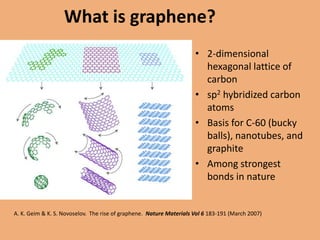
                                                                     • 2-dimensional
                                                                       hexagonal lattice of
                                                                       carbon
                                                                     • sp2 hybridized carbon
                                                                       atoms
                                                                     • Basis for C-60 (bucky
                                                                       balls), nanotubes, and
                                                                       graphite
                                                                     • Among strongest
                                                                       bonds in nature


A. K. Geim & K. S. Novoselov. The rise of graphene. Nature Materials Vol 6 183-191 (March 2007)
History
• The Nobel Prize in Physics for 2010 was awarded to Andre
Geim and Konstantin Novoselov "for groundbreaking
experiments regarding the two-dimensional material graphene".

• Carbon-the basis of all known life on the earth-has surprised
the scientific community once again with its exotic properties.

•Researchers have found that a form of carbon called graphene
makes experiments possible that give new twist to electronics
field.

•This devices are predicted to be substantially faster, thinner &
more efficient than current silicon based devices.
History
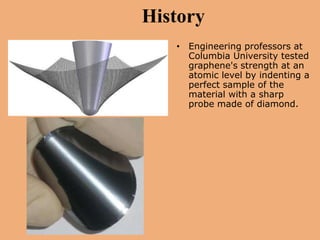
   • Engineering professors at
     Columbia University tested
     graphene's strength at an
     atomic level by indenting a
     perfect sample of the
     material with a sharp
     probe made of diamond.
Graphene as a material

   Basic structure
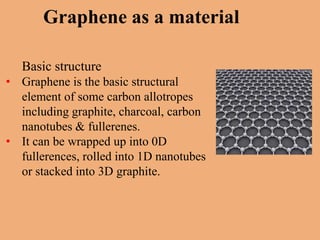
• Graphene is the basic structural
  element of some carbon allotropes
  including graphite, charcoal, carbon
  nanotubes & fullerenes.
• It can be wrapped up into 0D
  fullerences, rolled into 1D nanotubes
  or stacked into 3D graphite.
Graphene as a material
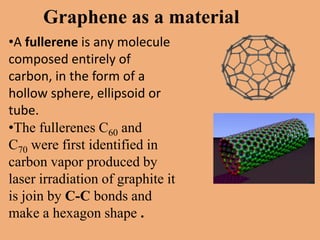
•A fullerene is any molecule
composed entirely of
carbon, in the form of a
hollow sphere, ellipsoid or
tube.
•The fullerenes C60 and
C70 were first identified in
carbon vapor produced by
laser irradiation of graphite it
is join by C-C bonds and
make a hexagon shape .
Graphene as a material

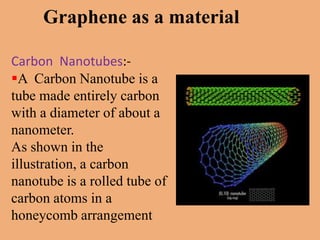
Carbon Nanotubes:-
A Carbon Nanotube is a
tube made entirely carbon
with a diameter of about a
nanometer.
As shown in the
illustration, a carbon
nanotube is a rolled tube of
carbon atoms in a
honeycomb arrangement
Graphene as a material


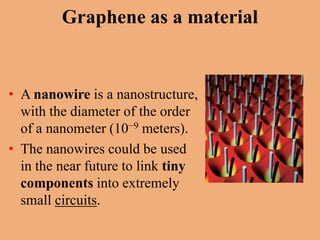
• A nanowire is a nanostructure,
  with the diameter of the order
  of a nanometer (10−9 meters).
• The nanowires could be used
  in the near future to link tiny
  components into extremely
  small circuits.
Graphene as a material
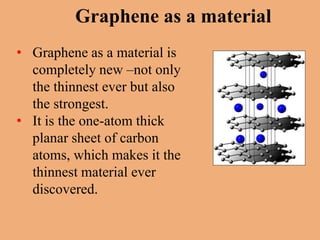
• Graphene as a material is
  completely new –not only
  the thinnest ever but also
  the strongest.
• It is the one-atom thick
  planar sheet of carbon
  atoms, which makes it the
  thinnest material ever
  discovered.
Graphene as a material

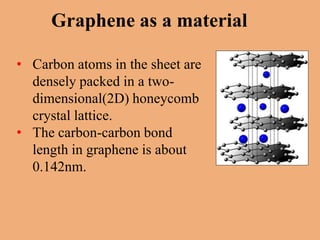
• Carbon atoms in the sheet are
  densely packed in a two-
  dimensional(2D) honeycomb
  crystal lattice.
• The carbon-carbon bond
  length in graphene is about
  0.142nm.
Graphene as a material


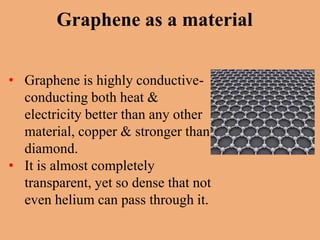
• Graphene is highly conductive-
  conducting both heat &
  electricity better than any other
  material, copper & stronger than
  diamond.
• It is almost completely
  transparent, yet so dense that not
  even helium can pass through it.
Properties of Graphene
   Resistivity
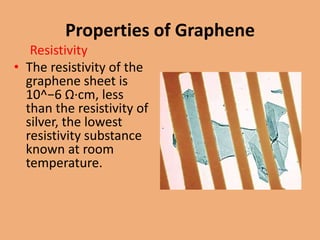
• The resistivity of the
  graphene sheet is
  10^−6 Ω·cm, less
  than the resistivity of
  silver, the lowest
  resistivity substance
  known at room
  temperature.
Properties of Graphene
   More Properties
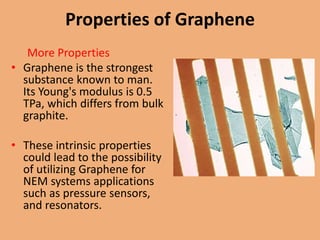
• Graphene is the strongest
  substance known to man.
  Its Young's modulus is 0.5
  TPa, which differs from bulk
  graphite.

• These intrinsic properties
  could lead to the possibility
  of utilizing Graphene for
  NEM systems applications
  such as pressure sensors,
  and resonators.
Graphene and its Applications

Applications:
• Membranes with controlled permeability

• Supercapacitors for energy applications.

• Graphene electronics could be useful for
  communications and imaging technologies
  that require ultrafast transistors.
Mobile Phones Using Graphene

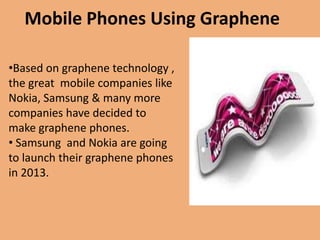
•Based on graphene technology ,
the great mobile companies like
Nokia, Samsung & many more
companies have decided to
make graphene phones.
• Samsung and Nokia are going
to launch their graphene phones
in 2013.
Mobile Phones Using Graphene
   Samsung’s invention
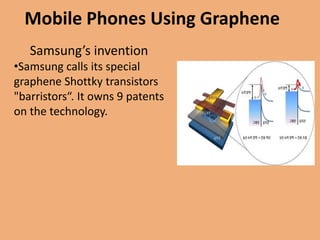
•Samsung calls its special
graphene Shottky transistors
"barristors“. It owns 9 patents
on the technology.
Mobile Phones Using Graphene

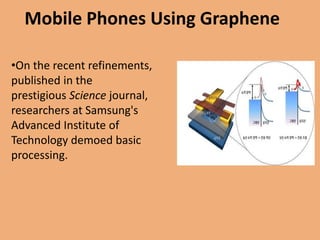
•On the recent refinements,
published in the
prestigious Science journal,
researchers at Samsung's
Advanced Institute of
Technology demoed basic
processing.
Mobile Phones Using Graphene

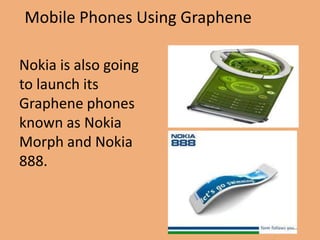
Nokia is also going
to launch its
Graphene phones
known as Nokia
Morph and Nokia
888.
Nokia Morph
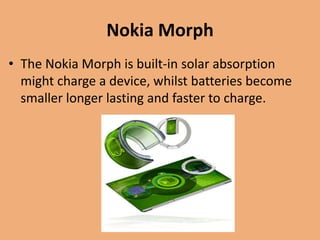
• The Nokia Morph is built-in solar absorption
  might charge a device, whilst batteries become
  smaller longer lasting and faster to charge.
Nokia Morph
 Its integrated sensors
  might allow us to learn
  more about the
  environment around
  us, empowering us to
  make better choices in
  life.
What kind of materials does it have?
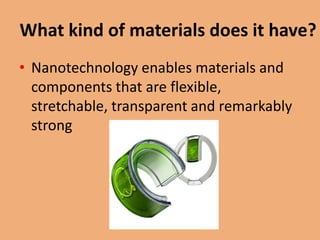
• Nanotechnology enables materials and
  components that are flexible,
  stretchable, transparent and remarkably
  strong
Mobile Phones Using Graphene

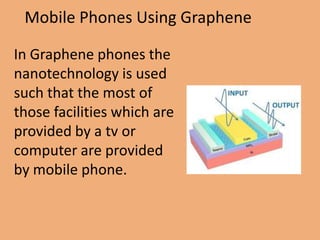
In Graphene phones the
nanotechnology is used
such that the most of
those facilities which are
provided by a tv or
computer are provided
by mobile phone.
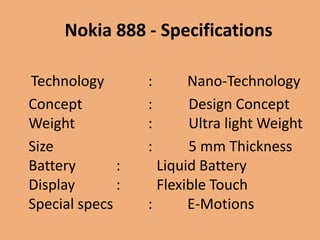
Nokia 888 - Specifications

Technology        :      Nano-Technology
Concept           :      Design Concept
Weight            :      Ultra light Weight
Size              :      5 mm Thickness
Battery       :     Liquid Battery
Display       :     Flexible Touch
Special specs     :      E-Motions
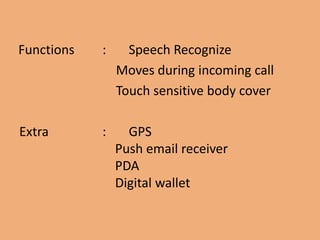
Functions   :     Speech Recognize
                Moves during incoming call
                Touch sensitive body cover

Extra       :     GPS
                Push email receiver
                PDA
                Digital wallet
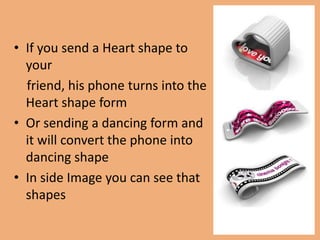
• If you send a Heart shape to
  your
  friend, his phone turns into the
  Heart shape form
• Or sending a dancing form and
  it will convert the phone into
  dancing shape
• In side Image you can see that
  shapes
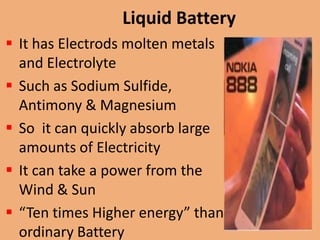
Liquid Battery
 It has Electrods molten metals
  and Electrolyte
 Such as Sodium Sulfide,
  Antimony & Magnesium
 So it can quickly absorb large
  amounts of Electricity
 It can take a power from the
  Wind & Sun
 “Ten times Higher energy” than
  ordinary Battery
Advantages Of Graphene Technology
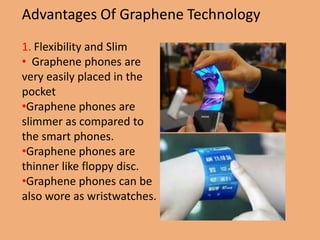
1. Flexibility and Slim
• Graphene phones are
very easily placed in the
pocket
•Graphene phones are
slimmer as compared to
the smart phones.
•Graphene phones are
thinner like floppy disc.
•Graphene phones can be
also wore as wristwatches.
Advantages Of Graphene Technology
     Toughness
•Graphene phones as cannot be broken
down as it is a metal.
•Both the graphene (carbon) and the
silicon flex with the battery’s charge
cycles, but don’t break.
•Thus the graphene phones are
charged quickly and can remain charge
for a longer time
Advantages

-Large memory capacity
-Ultra-low power consumption
-Compatible with state-of-the-art
technology
-Strong immunity to short channel
effects
Advantages
Graphene transistors are more
better than the Carbon Nanotubes
as they have no drawbacks like
Carbon nanotubes and hence are
used in making transistors & logic
gates .
Disadvantages
1.Fear of losing phone when kept at
  outdoors.
• It can be easily carried out by factors such
  as wind, water etc if carelessly kept
  outdoors.
Disadvantages

2. The Memory Card cannot be inserted.
3. Although graphene can be switched
   between different electrical conductivity
   states, the on/off ratio, isn't very high
   resulting in loss of energy .
Disadvantages

4. No facility for Headset.
5. No facility for Data Cable.
6. No facility for bluetooth.
7. Danger from the radiation
Future

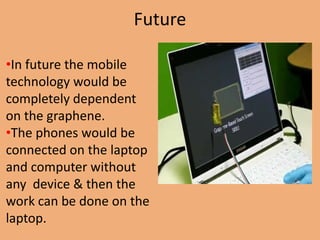
•In future the mobile
technology would be
completely dependent
on the graphene.
•The phones would be
connected on the laptop
and computer without
any device & then the
work can be done on the
laptop.
Mobile phones using graphene

Mobile phones using graphene

  • 1.
    Mobile phones usingGraphene Presented by Nehal
  • 2.
    Contents • Introduction to Graphene • History • Graphene as a material • Difference between Graphene and Silicon • Properties of Graphene • Technology using Graphene • Mobile phones and Graphene • Advantages • Disadvantages
  • 3.
    Introduction What is graphene? • Graphene is a one-atom- thick planar sheet of carbon atoms that are densely packed in a honeycomb crystal lattice. • Graphene is the worlds strongest & thinest metal. • It is 100 times Stronger than Steel.
  • 4.
    What is graphene? • 2-dimensional hexagonal lattice of carbon • sp2 hybridized carbon atoms • Basis for C-60 (bucky balls), nanotubes, and graphite • Among strongest bonds in nature A. K. Geim & K. S. Novoselov. The rise of graphene. Nature Materials Vol 6 183-191 (March 2007)
  • 5.
    History • The NobelPrize in Physics for 2010 was awarded to Andre Geim and Konstantin Novoselov "for groundbreaking experiments regarding the two-dimensional material graphene". • Carbon-the basis of all known life on the earth-has surprised the scientific community once again with its exotic properties. •Researchers have found that a form of carbon called graphene makes experiments possible that give new twist to electronics field. •This devices are predicted to be substantially faster, thinner & more efficient than current silicon based devices.
  • 6.
    History • Engineering professors at Columbia University tested graphene's strength at an atomic level by indenting a perfect sample of the material with a sharp probe made of diamond.
  • 7.
    Graphene as amaterial Basic structure • Graphene is the basic structural element of some carbon allotropes including graphite, charcoal, carbon nanotubes & fullerenes. • It can be wrapped up into 0D fullerences, rolled into 1D nanotubes or stacked into 3D graphite.
  • 8.
    Graphene as amaterial •A fullerene is any molecule composed entirely of carbon, in the form of a hollow sphere, ellipsoid or tube. •The fullerenes C60 and C70 were first identified in carbon vapor produced by laser irradiation of graphite it is join by C-C bonds and make a hexagon shape .
  • 9.
    Graphene as amaterial Carbon Nanotubes:- A Carbon Nanotube is a tube made entirely carbon with a diameter of about a nanometer. As shown in the illustration, a carbon nanotube is a rolled tube of carbon atoms in a honeycomb arrangement
  • 10.
    Graphene as amaterial • A nanowire is a nanostructure, with the diameter of the order of a nanometer (10−9 meters). • The nanowires could be used in the near future to link tiny components into extremely small circuits.
  • 11.
    Graphene as amaterial • Graphene as a material is completely new –not only the thinnest ever but also the strongest. • It is the one-atom thick planar sheet of carbon atoms, which makes it the thinnest material ever discovered.
  • 12.
    Graphene as amaterial • Carbon atoms in the sheet are densely packed in a two- dimensional(2D) honeycomb crystal lattice. • The carbon-carbon bond length in graphene is about 0.142nm.
  • 13.
    Graphene as amaterial • Graphene is highly conductive- conducting both heat & electricity better than any other material, copper & stronger than diamond. • It is almost completely transparent, yet so dense that not even helium can pass through it.
  • 14.
    Properties of Graphene Resistivity • The resistivity of the graphene sheet is 10^−6 Ω·cm, less than the resistivity of silver, the lowest resistivity substance known at room temperature.
  • 15.
    Properties of Graphene More Properties • Graphene is the strongest substance known to man. Its Young's modulus is 0.5 TPa, which differs from bulk graphite. • These intrinsic properties could lead to the possibility of utilizing Graphene for NEM systems applications such as pressure sensors, and resonators.
  • 16.
    Graphene and itsApplications Applications: • Membranes with controlled permeability • Supercapacitors for energy applications. • Graphene electronics could be useful for communications and imaging technologies that require ultrafast transistors.
  • 17.
    Mobile Phones UsingGraphene •Based on graphene technology , the great mobile companies like Nokia, Samsung & many more companies have decided to make graphene phones. • Samsung and Nokia are going to launch their graphene phones in 2013.
  • 18.
    Mobile Phones UsingGraphene Samsung’s invention •Samsung calls its special graphene Shottky transistors "barristors“. It owns 9 patents on the technology.
  • 19.
    Mobile Phones UsingGraphene •On the recent refinements, published in the prestigious Science journal, researchers at Samsung's Advanced Institute of Technology demoed basic processing.
  • 20.
    Mobile Phones UsingGraphene Nokia is also going to launch its Graphene phones known as Nokia Morph and Nokia 888.
  • 21.
    Nokia Morph • TheNokia Morph is built-in solar absorption might charge a device, whilst batteries become smaller longer lasting and faster to charge.
  • 22.
    Nokia Morph  Itsintegrated sensors might allow us to learn more about the environment around us, empowering us to make better choices in life.
  • 23.
    What kind ofmaterials does it have? • Nanotechnology enables materials and components that are flexible, stretchable, transparent and remarkably strong
  • 24.
    Mobile Phones UsingGraphene In Graphene phones the nanotechnology is used such that the most of those facilities which are provided by a tv or computer are provided by mobile phone.
  • 25.
    Nokia 888 -Specifications Technology : Nano-Technology Concept : Design Concept Weight : Ultra light Weight Size : 5 mm Thickness Battery : Liquid Battery Display : Flexible Touch Special specs : E-Motions
  • 26.
    Functions : Speech Recognize Moves during incoming call Touch sensitive body cover Extra : GPS Push email receiver PDA Digital wallet
  • 27.
    • If yousend a Heart shape to your friend, his phone turns into the Heart shape form • Or sending a dancing form and it will convert the phone into dancing shape • In side Image you can see that shapes
  • 28.
    Liquid Battery  Ithas Electrods molten metals and Electrolyte  Such as Sodium Sulfide, Antimony & Magnesium  So it can quickly absorb large amounts of Electricity  It can take a power from the Wind & Sun  “Ten times Higher energy” than ordinary Battery
  • 29.
    Advantages Of GrapheneTechnology 1. Flexibility and Slim • Graphene phones are very easily placed in the pocket •Graphene phones are slimmer as compared to the smart phones. •Graphene phones are thinner like floppy disc. •Graphene phones can be also wore as wristwatches.

  • 30.
    Advantages Of GrapheneTechnology Toughness •Graphene phones as cannot be broken down as it is a metal. •Both the graphene (carbon) and the silicon flex with the battery’s charge cycles, but don’t break. •Thus the graphene phones are charged quickly and can remain charge for a longer time
  • 31.
    Advantages -Large memory capacity -Ultra-lowpower consumption -Compatible with state-of-the-art technology -Strong immunity to short channel effects
  • 32.
    Advantages Graphene transistors aremore better than the Carbon Nanotubes as they have no drawbacks like Carbon nanotubes and hence are used in making transistors & logic gates .
  • 33.
    Disadvantages 1.Fear of losingphone when kept at outdoors. • It can be easily carried out by factors such as wind, water etc if carelessly kept outdoors.
  • 34.
    Disadvantages 2. The MemoryCard cannot be inserted. 3. Although graphene can be switched between different electrical conductivity states, the on/off ratio, isn't very high resulting in loss of energy .
  • 35.
    Disadvantages 4. No facilityfor Headset. 5. No facility for Data Cable. 6. No facility for bluetooth. 7. Danger from the radiation
  • 36.
    Future •In future themobile technology would be completely dependent on the graphene. •The phones would be connected on the laptop and computer without any device & then the work can be done on the laptop.