Granulation is the process in which
primary powder particles adhere to
form larger, multiparticle entities
called granules.
Size range between 0.2 and 4.0 mm.
Used as intermediate product in the
production of tablet and capsules
(size range between 0.2 and 0.5
mm).
3
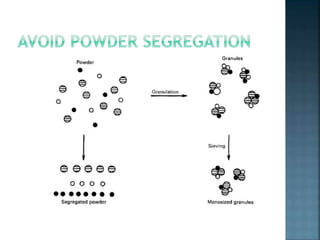
To avoid powder segregation.
To enhance the flow of powder.
To produce uniform mixtures.
To produce dust free formulations.
To eliminate poor content uniformity.
To improve compaction characteristics of
mix.
4
 DRYGRANULATION
WET GRANULATION
6
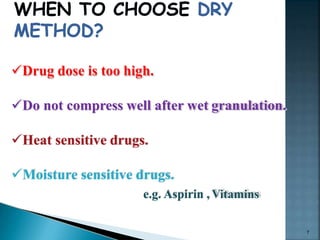
Drug dose is too high.
Do not compress well after wet granulation.
Heat sensitive drugs.
Moisture sensitive drugs.
e.g. Aspirin , Vitamins
7
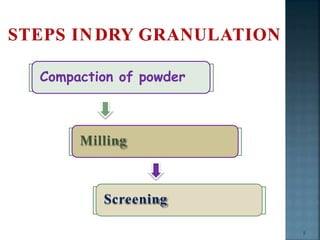
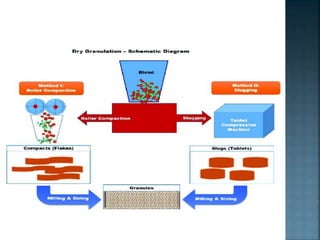
Compaction of powder
Milling
Screening
8
Contd…
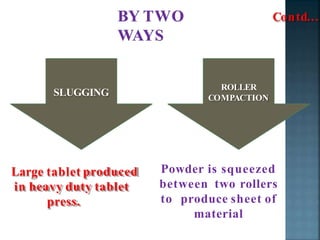
SLUGGING
ROLLER
COMPACTION
Large tablet produced
in heavy duty tablet
press.
Powder is squeezed
between two rollers
to produce sheet of
material
Contd…
wet granulation
In this, powdered medicament
and other excipients are
moistened with granulating
agent.
1
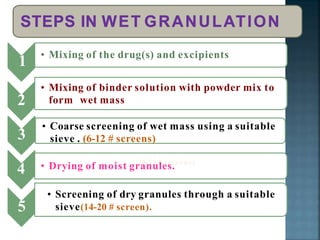
• Mixing of the drug(s) and excipients
2
• Mixing of binder solution with powder mix to
form wet mass
3
• Coarse screening of wet mass using a suitable
sieve . (6-12 # screens)
(6-12 # screens)
4 • Drying of moist granules.
5
• Screening of dry granules through a suitable
sieve(14-20 # screen).
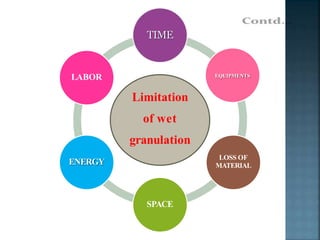
Limitation
of wet
granulation
EQUIPMENTS
LOSS OF
MATERIAL
SPACE
ENERGY
LABOR
To form granules, bonds must be formed between powder particles
so that they adhere and these bonds must be sufficiently strong to
prevent breakdown of the granule to powder in subsequent handling
operations.
There are FIVE primary bonding mechanisms between
particles are-
1. Adhesion and cohesion forces in the immobile liquid films
between individual primary powder particles.
2. Interfacial forces in mobile liquid filmswithin the
granules
3. The formation of solid bridges after solvent evaporation
4. Attractive forces between solid particles
5. Mechanical interlocking
Mechanism Forces Additional
information
Immobile liquid films Adhesional and
cohesional forces
Between primary
particles
Mobile liquid films Interfacial forces,
capillary pressure
Strong bonds,
prerequisite for solid
bridges
Solid bridges Hardening of
binders,
partial melting or
recrystallisation of
materials
Main mechanism in wet
granulation
Attractive forces Van der Waals forces,
electrostatic forces
Does not necessarily
need
any liquid
Mechanical
interlocking
Often fibrous or flat
particles
 Presence of liquid in a powder form a very
thin, immobile layer  decrease in
interparticulate distance  increase in
contact area between the particles.
 Increase bond strength between the particles
 liquid is added to the powder mix and will be
distributed as films around and between the
particles.
 There are three states of water distribution
between particles, which are
1. Pendular state
2. Capillary state
3. Funicular state
Mechanism….
Agglomeration, granulation and pelletizing processes involve the wetting and
mechanical handling of particulates. An open and porous agglomerate
structure changes to a more closed and grain- like granule structure as the
degree of wetting and mixing is increased. Particulates engineering involves
the control of moisture and energy input to achieve a desired change in
structural and other properties.
Pendular funicular capillary droplet
By improving:
free floability
ease of handling visual
appearance ease of
compaction
 These can be formed by:
1. Partial melting
2. Hardening binders
3. crystallization of dissolved substances.
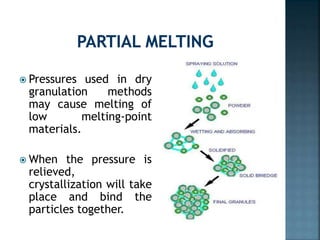
 Pressures used in dry
granulation methods
may cause melting of
low melting-point
materials.
 When the pressure is
relieved,
crystallization will take
place and bind the
particles together.
 In wet granulations when a binder or
adhesive is added in the granulating solvent.
 The adhesive will harden or crystallize on
drying to form solid bridges to bind the
particles.
 Adhesives such as polyvinylpyrrolidone, the
cellulose derivatives (such as CMC) and
pregelatinized starch function in this way.
 The granulating liquid, during wet granulation
may partially dissolve one of the powdered
ingredients.
 When the granules are dried, crystallization of
this material will take place and the dissolved
substance then acts as a hardening binder.
 E.G. incorporation of lactose
 The size of the crystals produced in the bridge
will be influenced by the rate of drying of the
granules:
 The slower the drying time, the larger the
particle size.
• In the absence of binding agents bonds are formed by
– Electrostatic forces
– Vander wall forces
• Electrostatic forces may be important in causing powder
cohesion and the initial formation of agglomerates, e.g. during
mixing.
• Van der Waals forces, are about four orders of magnitude
greater than electrostatic forces and contribute significantly to
the strength of granules produced by dry granulation.
• Good adhesion occurs only when
– an adhesive penetrates into the pores, holes and crevices
and other irregularities of the adhered surface of a
substrate,
– and locks mechanically to the substrate.
– Or hooking and twisting of the packed material.
 The proposed granulation mechanism can be
divided into three stages.
1. Nucleation
2. Transition
3. Ball growth
Granulation starts with particle-particle
contact and adhesion occur due to liquid
bridges
 Nuclei can grow in two possible ways: either single
particles can be added to the nuclei by pendular
bridges, or two or more nuclei may combine.
 The combined nuclei will be reshaped by the
agitation.
 This stage is characterized by the presence of a
large number of small granules with a fairly wide
size distribution.
 This distribution is suitable end-point for granules
used in capsule and tablet manufacture, as
relatively small granules will produce a uniform
tablet.
 Larger granules may give rise to problems in small-
diameter dies and leads to uneven fill.
 Further granule growth produces large,
spherical granules.
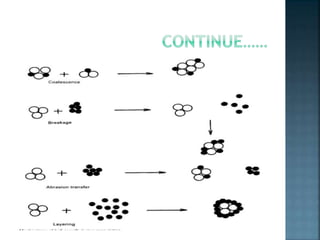
 The four possible mechanisms of ball growth
are:
1. Coalescence
2. Breakage
3. Abrasion transfer
4. Layering
 Coalescence: Two or more granules join to
form a larger granule.
 Breakage: Granules break into fragments
which adhere to other granules, forming a
layer of material over the surviving granule.
 Abrasion transfer: Agitation of the granule
bed leads to the attrition of material from
granules. This abraded material adheres to
other granules, increasing their size.
 Layering: When a second batch of powder
mix is added to a bed of granules the powder
will adhere to the granules, forming a layer
over the surface and increasing the granule
size.
 This mechanism is only relevant to the
production of layered granules.
Granulation
Granulation
Granulation

Granulation

  • 2.
    Granulation is theprocess in which primary powder particles adhere to form larger, multiparticle entities called granules. Size range between 0.2 and 4.0 mm. Used as intermediate product in the production of tablet and capsules (size range between 0.2 and 0.5 mm).
  • 3.
  • 4.
    To avoid powdersegregation. To enhance the flow of powder. To produce uniform mixtures. To produce dust free formulations. To eliminate poor content uniformity. To improve compaction characteristics of mix. 4
  • 6.
  • 7.
    Drug dose istoo high. Do not compress well after wet granulation. Heat sensitive drugs. Moisture sensitive drugs. e.g. Aspirin , Vitamins 7
  • 8.
  • 9.
  • 10.
    SLUGGING ROLLER COMPACTION Large tablet produced inheavy duty tablet press. Powder is squeezed between two rollers to produce sheet of material Contd…
  • 13.
    wet granulation In this,powdered medicament and other excipients are moistened with granulating agent.
  • 14.
    1 • Mixing ofthe drug(s) and excipients 2 • Mixing of binder solution with powder mix to form wet mass 3 • Coarse screening of wet mass using a suitable sieve . (6-12 # screens) (6-12 # screens) 4 • Drying of moist granules. 5 • Screening of dry granules through a suitable sieve(14-20 # screen).
  • 15.
  • 17.
    To form granules,bonds must be formed between powder particles so that they adhere and these bonds must be sufficiently strong to prevent breakdown of the granule to powder in subsequent handling operations. There are FIVE primary bonding mechanisms between particles are- 1. Adhesion and cohesion forces in the immobile liquid films between individual primary powder particles. 2. Interfacial forces in mobile liquid filmswithin the granules 3. The formation of solid bridges after solvent evaporation 4. Attractive forces between solid particles 5. Mechanical interlocking
  • 18.
    Mechanism Forces Additional information Immobileliquid films Adhesional and cohesional forces Between primary particles Mobile liquid films Interfacial forces, capillary pressure Strong bonds, prerequisite for solid bridges Solid bridges Hardening of binders, partial melting or recrystallisation of materials Main mechanism in wet granulation Attractive forces Van der Waals forces, electrostatic forces Does not necessarily need any liquid Mechanical interlocking Often fibrous or flat particles
  • 19.
     Presence ofliquid in a powder form a very thin, immobile layer  decrease in interparticulate distance  increase in contact area between the particles.  Increase bond strength between the particles
  • 20.
     liquid isadded to the powder mix and will be distributed as films around and between the particles.  There are three states of water distribution between particles, which are 1. Pendular state 2. Capillary state 3. Funicular state
  • 21.
    Mechanism…. Agglomeration, granulation andpelletizing processes involve the wetting and mechanical handling of particulates. An open and porous agglomerate structure changes to a more closed and grain- like granule structure as the degree of wetting and mixing is increased. Particulates engineering involves the control of moisture and energy input to achieve a desired change in structural and other properties. Pendular funicular capillary droplet By improving: free floability ease of handling visual appearance ease of compaction
  • 22.
     These canbe formed by: 1. Partial melting 2. Hardening binders 3. crystallization of dissolved substances.
  • 23.
     Pressures usedin dry granulation methods may cause melting of low melting-point materials.  When the pressure is relieved, crystallization will take place and bind the particles together.
  • 24.
     In wetgranulations when a binder or adhesive is added in the granulating solvent.  The adhesive will harden or crystallize on drying to form solid bridges to bind the particles.  Adhesives such as polyvinylpyrrolidone, the cellulose derivatives (such as CMC) and pregelatinized starch function in this way.
  • 25.
     The granulatingliquid, during wet granulation may partially dissolve one of the powdered ingredients.  When the granules are dried, crystallization of this material will take place and the dissolved substance then acts as a hardening binder.  E.G. incorporation of lactose  The size of the crystals produced in the bridge will be influenced by the rate of drying of the granules:  The slower the drying time, the larger the particle size.
  • 26.
    • In theabsence of binding agents bonds are formed by – Electrostatic forces – Vander wall forces • Electrostatic forces may be important in causing powder cohesion and the initial formation of agglomerates, e.g. during mixing. • Van der Waals forces, are about four orders of magnitude greater than electrostatic forces and contribute significantly to the strength of granules produced by dry granulation.
  • 27.
    • Good adhesionoccurs only when – an adhesive penetrates into the pores, holes and crevices and other irregularities of the adhered surface of a substrate, – and locks mechanically to the substrate. – Or hooking and twisting of the packed material.
  • 28.
     The proposedgranulation mechanism can be divided into three stages. 1. Nucleation 2. Transition 3. Ball growth
  • 29.
    Granulation starts withparticle-particle contact and adhesion occur due to liquid bridges
  • 30.
     Nuclei cangrow in two possible ways: either single particles can be added to the nuclei by pendular bridges, or two or more nuclei may combine.  The combined nuclei will be reshaped by the agitation.  This stage is characterized by the presence of a large number of small granules with a fairly wide size distribution.  This distribution is suitable end-point for granules used in capsule and tablet manufacture, as relatively small granules will produce a uniform tablet.  Larger granules may give rise to problems in small- diameter dies and leads to uneven fill.
  • 31.
     Further granulegrowth produces large, spherical granules.  The four possible mechanisms of ball growth are: 1. Coalescence 2. Breakage 3. Abrasion transfer 4. Layering
  • 32.
     Coalescence: Twoor more granules join to form a larger granule.  Breakage: Granules break into fragments which adhere to other granules, forming a layer of material over the surviving granule.  Abrasion transfer: Agitation of the granule bed leads to the attrition of material from granules. This abraded material adheres to other granules, increasing their size.
  • 33.
     Layering: Whena second batch of powder mix is added to a bed of granules the powder will adhere to the granules, forming a layer over the surface and increasing the granule size.  This mechanism is only relevant to the production of layered granules.