EXPANSION STRATEGIES
Presenters:-
Nandini Bardawaj
Ravneet Kaur
Rishab Singhal
Satyajeet Patle
Vinayak Chopra
Flow of Presentation
 Need For Expansion
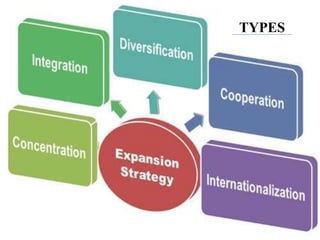
 Types of expansion strategies
What is Expansion Strategies ??
 The growth strategy is called terms as Expansion Strategy
 The Expansion Strategy is adopted by an organization when it
attempts to achieve a high growth as compared to its past
achievements
 When a firm aims to grow considerably by broadening the scope of
one of its business operations
TYPES
CONCENTRATION
 Moving resources to more developing product lines in one
industry
 The concentration expansion is the first level form of expansion
Grand strategy that involves the investment of resources in the
product line, catering to the needs of the identified market
 Due to the familiarity with the industry the firm likes to invest in
the known businesses rather than a new one. The firms prefer
expansion through concentration because they are required to do
things what they are already doing.
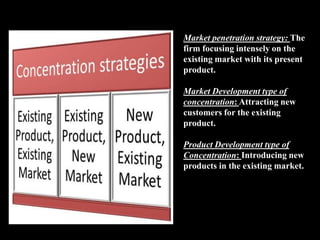
Market penetration strategy: The
firm focusing intensely on the
existing market with its present
product.
Market Development type of
concentration: Attracting new
customers for the existing
product.
Product Development type of
Concentration: Introducing new
products in the existing market.
DIVERSIFICATION
The Expansion through Diversification is followed when an organization
aims at changing the business definition, i.e. either developing a new
product or expanding into a new market, either individually or jointly. A
firm adopts the expansion through diversification strategy, to prepare itself
to overcome the economic downturns.
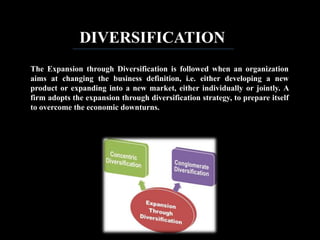
Concentric Diversification: When an organization acquires or develops a new
product or service that are closely related to the organization’s existing range
of products and services is called as a concentric diversification. For example,
the shoe manufacturing company may acquire the leather manufacturing
company with a view to entering into the new consumer markets and
escalate sales.
Conglomerate Diversification: When an organization expands itself into
different areas, whether related or unrelated to its core business is called as a
conglomerate diversification. Simply, conglomerate diversification is when the
firm acquires or develops the product and services that may or may not be
related to the existing range of product and services.
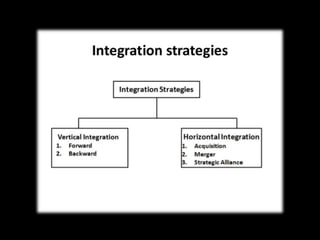
INTEGRATION
 This strategy is adopted when the company attempts to widen
the scope of its business definition in such a manner that its
result in serving the same set of customers
 The alternative technology of the business undergoes a change
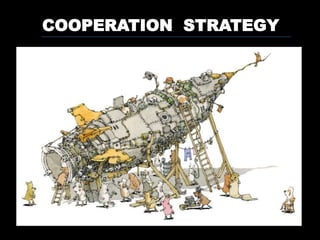
COOPERATION STRATEGY
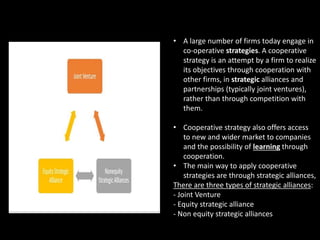
• A large number of firms today engage in
co-operative strategies. A cooperative
strategy is an attempt by a firm to realize
its objectives through cooperation with
other firms, in strategic alliances and
partnerships (typically joint ventures),
rather than through competition with
them.
• Cooperative strategy also offers access
to new and wider market to companies
and the possibility of learning through
cooperation.
• The main way to apply cooperative
strategies are through strategic alliances,
There are three types of strategic alliances:
- Joint Venture
- Equity strategic alliance
- Non equity strategic alliances
JOINT VENTURE :
• A Joint Venture is a shared equity firm wherein the
participant commit the same quantity of resources,
this means that this legally independent new
company share resources, capabilities and risks to
achieve a competitive advantage.
• An example of a Joint Venture is the case of
Facebook and Skype in 2011 that sign a Strategic
Alliance that gave Facebook economic benefits and
let Microsoft to open its market and move forward
the social network market.
EQUITY JOINT VENTURE
Non equity strategic alliance
• Non equity Strategic Alliance refers to a type of cooperation
wherein two or more companies establish a contractual relation
which specifies that each company will share their resources and
knowledge to achieve competitive advantage
• In this case cooperation is not totally equal because each
company will share only the resources that are convenient and
this could cause that a company lose more than the others
Retrenchment
Strategy:
A strategy used by corporations to reduce
the diversity or the overall size of the
operations of the company.
This strategy is often used in order to cut
expenses with the goal of becoming a more
financial stable business.
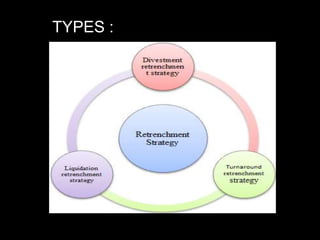
TYPES :
TURNAROUND:
Turnaround strategy means backing out,
withdrawing or retreating from a decision
wrongly taken earlier in order to reverse
the process of decline.
There are certain conditions or indicators
which point out that a turnaround is
needed if the organization has to survive.
These danger signs are as follows:
a) Persistent negative cash flow
b) Continuous losses
c) Declining market share
d) Uncompetitive products or services
e) Mismanagement
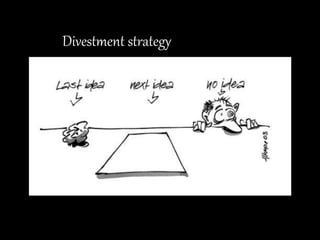
Divestment strategy
Divestment strategy involves the sale or liquidation of a portion of
business, or a major division.
Divestment is usually a restructuring plan and is adopted when a turnaround has
been attempted but has proved to be unsuccessful or it was ignored.
A divestment strategy may be adopted due to the following reasons:
a) A business cannot be integrated within the company.
b) Persistent negative cash flows from a particular business create financial
problems for the whole company.
c) Firm is unable to face competition
d) Technological up gradation is required if the business is to survive which
company cannot afford.
e) A better alternative may be available for investment
Liquidation Strategy :
Liquidation strategy means closing down the entire firm and selling
its assets. It is considered the most extreme and the last resort
because it leads to serious consequences such as loss of employment
for employees, termination of opportunities where a firm could
pursue any future activities, and the stigma of failure.
Generally it is seen that small-scale units, proprietorship firms, and
partnership, liquidate frequently but companies rarely liquidate. The
company management, government, banks and financial institutions,
trade unions, suppliers and creditors, and other agencies do not
generally prefer liquidation.
INTERNATIONATIONALIZATION:
Expansion through internationalization is the strategy followed by an organization
when it aims to expand beyond the national market. Typically, international business
strategy refers to the plans and actions of private companies rather than governments; as
such, the goal is increased profit.
It is the process of increasing involvement of enterprises in international markets,
although there is no agreed definition of internationalization.
There are several internationalization theories which try to explain why there are
international activities.
a) INTERNATIONAL STRATEGY: refers to plans that guide commercial
transactions taking place between entities in different countries. Wherein, local
market its trends and expectations are not being considered.
b) MULTIDOMESTIC STRATEGY: It is a strategy by which companies try to
achieve maximum local responsiveness by customizing both their product offering
and marketing strategy to match different national conditions.
c) GLOBAL STRATEGY: Global business strategy is employed by companies who
may sell in foreign markets, but their primary focus is on their home market. These
companies may include international strategies in their business model to increase
sales, but they know that their main target consumer is local. Also, their strategy
structure is that of low cost structured.
d) TRANSNATIONAL STRATEGY: A transnational strategy combines global reach,
coordination of operations and leveraging unique advantages of local markets to
drive sales, market share and profit growth. The foundation of a transnational
strategy is a global vision, but with customized implementations for local markets
and regions.
Which one do you think is easier to opt for?

Expansion strartegies

  • 1.
    EXPANSION STRATEGIES Presenters:- Nandini Bardawaj RavneetKaur Rishab Singhal Satyajeet Patle Vinayak Chopra
  • 2.
    Flow of Presentation Need For Expansion  Types of expansion strategies
  • 3.
    What is ExpansionStrategies ??  The growth strategy is called terms as Expansion Strategy  The Expansion Strategy is adopted by an organization when it attempts to achieve a high growth as compared to its past achievements  When a firm aims to grow considerably by broadening the scope of one of its business operations
  • 4.
  • 5.
    CONCENTRATION  Moving resourcesto more developing product lines in one industry  The concentration expansion is the first level form of expansion Grand strategy that involves the investment of resources in the product line, catering to the needs of the identified market  Due to the familiarity with the industry the firm likes to invest in the known businesses rather than a new one. The firms prefer expansion through concentration because they are required to do things what they are already doing.
  • 6.
    Market penetration strategy:The firm focusing intensely on the existing market with its present product. Market Development type of concentration: Attracting new customers for the existing product. Product Development type of Concentration: Introducing new products in the existing market.
  • 7.
    DIVERSIFICATION The Expansion throughDiversification is followed when an organization aims at changing the business definition, i.e. either developing a new product or expanding into a new market, either individually or jointly. A firm adopts the expansion through diversification strategy, to prepare itself to overcome the economic downturns.
  • 8.
    Concentric Diversification: Whenan organization acquires or develops a new product or service that are closely related to the organization’s existing range of products and services is called as a concentric diversification. For example, the shoe manufacturing company may acquire the leather manufacturing company with a view to entering into the new consumer markets and escalate sales. Conglomerate Diversification: When an organization expands itself into different areas, whether related or unrelated to its core business is called as a conglomerate diversification. Simply, conglomerate diversification is when the firm acquires or develops the product and services that may or may not be related to the existing range of product and services.
  • 9.
    INTEGRATION  This strategyis adopted when the company attempts to widen the scope of its business definition in such a manner that its result in serving the same set of customers  The alternative technology of the business undergoes a change
  • 11.
  • 12.
    • A largenumber of firms today engage in co-operative strategies. A cooperative strategy is an attempt by a firm to realize its objectives through cooperation with other firms, in strategic alliances and partnerships (typically joint ventures), rather than through competition with them. • Cooperative strategy also offers access to new and wider market to companies and the possibility of learning through cooperation. • The main way to apply cooperative strategies are through strategic alliances, There are three types of strategic alliances: - Joint Venture - Equity strategic alliance - Non equity strategic alliances
  • 13.
    JOINT VENTURE : •A Joint Venture is a shared equity firm wherein the participant commit the same quantity of resources, this means that this legally independent new company share resources, capabilities and risks to achieve a competitive advantage. • An example of a Joint Venture is the case of Facebook and Skype in 2011 that sign a Strategic Alliance that gave Facebook economic benefits and let Microsoft to open its market and move forward the social network market.
  • 14.
  • 15.
    Non equity strategicalliance • Non equity Strategic Alliance refers to a type of cooperation wherein two or more companies establish a contractual relation which specifies that each company will share their resources and knowledge to achieve competitive advantage • In this case cooperation is not totally equal because each company will share only the resources that are convenient and this could cause that a company lose more than the others
  • 16.
    Retrenchment Strategy: A strategy usedby corporations to reduce the diversity or the overall size of the operations of the company. This strategy is often used in order to cut expenses with the goal of becoming a more financial stable business.
  • 17.
  • 18.
    TURNAROUND: Turnaround strategy meansbacking out, withdrawing or retreating from a decision wrongly taken earlier in order to reverse the process of decline. There are certain conditions or indicators which point out that a turnaround is needed if the organization has to survive.
  • 19.
    These danger signsare as follows: a) Persistent negative cash flow b) Continuous losses c) Declining market share d) Uncompetitive products or services e) Mismanagement
  • 20.
  • 21.
    Divestment strategy involvesthe sale or liquidation of a portion of business, or a major division. Divestment is usually a restructuring plan and is adopted when a turnaround has been attempted but has proved to be unsuccessful or it was ignored. A divestment strategy may be adopted due to the following reasons: a) A business cannot be integrated within the company. b) Persistent negative cash flows from a particular business create financial problems for the whole company. c) Firm is unable to face competition d) Technological up gradation is required if the business is to survive which company cannot afford. e) A better alternative may be available for investment
  • 22.
  • 23.
    Liquidation Strategy : Liquidationstrategy means closing down the entire firm and selling its assets. It is considered the most extreme and the last resort because it leads to serious consequences such as loss of employment for employees, termination of opportunities where a firm could pursue any future activities, and the stigma of failure. Generally it is seen that small-scale units, proprietorship firms, and partnership, liquidate frequently but companies rarely liquidate. The company management, government, banks and financial institutions, trade unions, suppliers and creditors, and other agencies do not generally prefer liquidation.
  • 24.
    INTERNATIONATIONALIZATION: Expansion through internationalizationis the strategy followed by an organization when it aims to expand beyond the national market. Typically, international business strategy refers to the plans and actions of private companies rather than governments; as such, the goal is increased profit. It is the process of increasing involvement of enterprises in international markets, although there is no agreed definition of internationalization.
  • 25.
    There are severalinternationalization theories which try to explain why there are international activities. a) INTERNATIONAL STRATEGY: refers to plans that guide commercial transactions taking place between entities in different countries. Wherein, local market its trends and expectations are not being considered. b) MULTIDOMESTIC STRATEGY: It is a strategy by which companies try to achieve maximum local responsiveness by customizing both their product offering and marketing strategy to match different national conditions. c) GLOBAL STRATEGY: Global business strategy is employed by companies who may sell in foreign markets, but their primary focus is on their home market. These companies may include international strategies in their business model to increase sales, but they know that their main target consumer is local. Also, their strategy structure is that of low cost structured. d) TRANSNATIONAL STRATEGY: A transnational strategy combines global reach, coordination of operations and leveraging unique advantages of local markets to drive sales, market share and profit growth. The foundation of a transnational strategy is a global vision, but with customized implementations for local markets and regions.
  • 26.
    Which one doyou think is easier to opt for?