GRAMMER BOOK 
Agustin Mongold
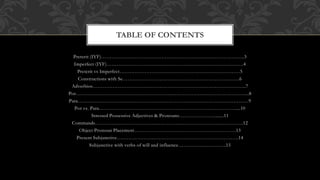
TABLE OF CONTENTS 
Preterit (IYF)…………………………………………………………………………..3 
Imperfect (IYF)……………………………………………………………………….4 
Preterit vs Imperfect………………………………………………………………5 
Constructions with Se…………………………………………………………….6 
Adverbios………………………………………………………………………………..7 
Por…………………………………………………………………………………………..8 
Para…………………………………………………………………………………………9 
Por vs. Para……………………………………………………………………….....10 
Stressed Possessive Adjectives & Pronouns…………………........11 
Commands……………………………………………………………………………..12 
Object Pronoun Placement…………………………………………………….13 
Present Subjunctive……………………………………………………………….14 
Subjunctive with verbs of will and influence………………………..15
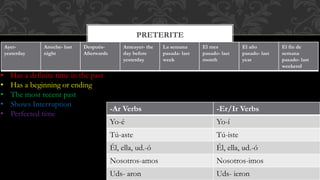
PRETERITE 
-Ar Verbs -Er/Ir Verbs 
Yo-é Yo-í 
Tú-aste Tú-iste 
Él, ella, ud.-ó Él, ella, ud.-ó 
Nosotros-amos Nosotros-imos 
Uds- aron Uds- ieron 
Ayer-yesterday 
Anoche- last 
night 
Después- 
Afterwards 
Anteayer- the 
day before 
yesterday 
La semana 
pasada- last 
week 
El mes 
pasado- last 
month 
El año 
pasado- last 
year 
El fin de 
semana 
pasado- last 
weekend 
• Has a definite time in the past 
• Has a beginning or ending 
• The most recent past 
• Shows Interruption 
• Perfected time
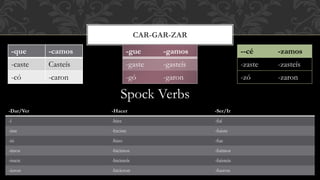
-que -camos 
-caste Casteís 
-có -caron 
CAR-GAR-ZAR 
--cé -zamos 
-zaste -zasteís 
-zó -zaron 
-gue -gamos 
-gaste -gasteís 
-gó -garon 
Spock Verbs 
-Dar/Ver -Hacer -Ser/Ir 
-í -hice -fuí 
-iste -hiciste -fuiste 
-ió -hizo -fue 
-imos -hicimos -fuimos 
-isteis -hicisteís -fuisteis 
-ieron -hicieron -fueron
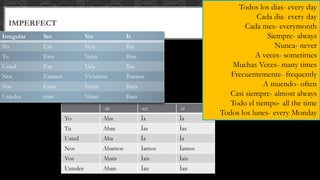
IMPERFECT 
-ar -er -ir 
Yo Aba Ía Ía 
Tu Abas Ías Ías 
Usted Aba Ía Ía 
Nos Abamos Íamos Íamos 
Vos Abais Íais Íais 
Ustedes Aban Ían Ían 
Todos los dias- every day 
Cada dia- every day 
Cada mes- everymonth 
Siempre- always 
Nunca- never 
A veces- sometimes 
Muchas Veces- many times 
Frecuentemente- frequently 
A muendo- often 
Casi siempre- almost always 
Todo el tiempo- all the time 
Todos los lunes- every Monday 
Irregular Ser Ver Ir 
Yo Era Veía Iba 
Tu Eras Veías Ibas 
Usted Era Veía Iba 
Nos Éramos Vivíamos Íbamos 
Vos Erais Veíais Ibais 
Ustedes eran Veían Iban
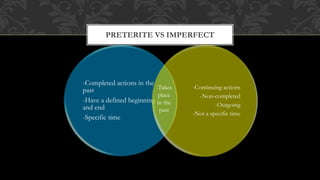
PRETERITE VS IMPERFECT 
-Completed actions in the 
past 
-Have a defined beginning 
and end 
-Specific time 
-Continuing actions 
-Non-completed 
-Outgoing 
-Not a specific time 
-Takes 
place 
in the 
past
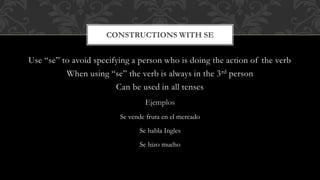
CONSTRUCTIONS WITH SE 
Use “se” to avoid specifying a person who is doing the action of the verb 
When using “se” the verb is always in the 3rd person 
Can be used in all tenses 
Ejemplos 
Se vende fruta en el mercado 
Se habla Ingles 
Se hizo mucho
ADVERBIOS 
Add –mente (in most cases) to the feminine singular form of an adjective 
This ending corresponds to –ly in English
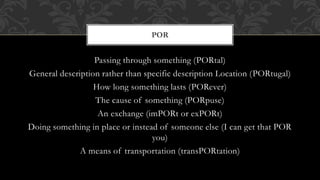
POR 
Passing through something (PORtal) 
General description rather than specific description Location (PORtugal) 
How long something lasts (PORever) 
The cause of something (PORpuse) 
An exchange (imPORt or exPORt) 
Doing something in place or instead of someone else (I can get that POR 
you) 
A means of transportation (transPORtation)
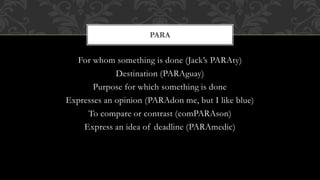
PARA 
For whom something is done (Jack’s PARAty) 
Destination (PARAguay) 
Purpose for which something is done 
Expresses an opinion (PARAdon me, but I like blue) 
To compare or contrast (comPARAson) 
Express an idea of deadline (PARAmedic)
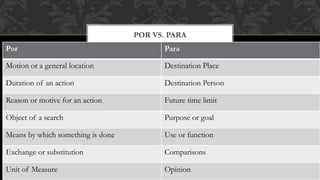
POR VS. PARA 
Por Para 
Motion or a general location Destination Place 
Duration of an action Destination Person 
Reason or motive for an action Future time limit 
Object of a search Purpose or goal 
Means by which something is done Use or function 
Exchange or substitution Comparisons 
Unit of Measure Opinion
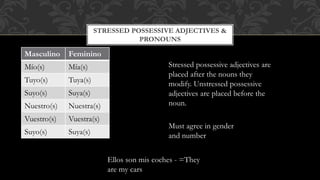
STRESSED POSSESSIVE ADJECTIVES & 
PRONOUNS 
Masculino Feminino 
Mío(s) Mía(s) 
Tuyo(s) Tuya(s) 
Suyo(s) Suya(s) 
Nuestro(s) Nuestra(s) 
Vuestro(s) Vuestra(s) 
Suyo(s) Suya(s) 
Stressed possessive adjectives are 
placed after the nouns they 
modify. Unstressed possessive 
adjectives are placed before the 
noun. 
Must agree in gender 
and number 
Ellos son mis coches - =They 
are my cars
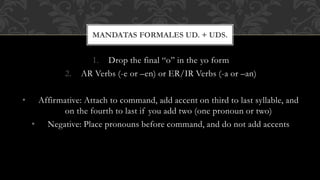
MANDATAS FORMALES UD. + UDS. 
1. Drop the final “o” in the yo form 
2. AR Verbs (-e or –en) or ER/IR Verbs (-a or –an) 
• Affirmative: Attach to command, add accent on third to last syllable, and 
on the fourth to last if you add two (one pronoun or two) 
• Negative: Place pronouns before command, and do not add accents
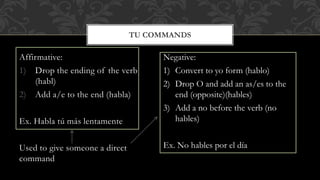
Affirmative: 
1) Drop the ending of the verb 
(habl) 
2) Add a/e to the end (habla) 
Ex. Habla tú más lentamente 
Used to give someone a direct 
command 
TU COMMANDS 
Negative: 
1) Convert to yo form (hablo) 
2) Drop O and add an as/es to the 
end (opposite)(hables) 
3) Add a no before the verb (no 
hables) 
Ex. No hables por el día
For Affirmative: 
NOSOTROS COMMANDS 
1) Convert verb to nosotros form (hablamos) 
2) Drop the s at the end, and add the needed pronouns (hablamonos) 
For Negative: 
1) Convert to nosotros (hablamos) 
2) Add a no then pronoun(s) before the verb (No nos hablamos)
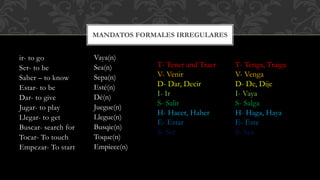
ir- to go 
Ser- to be 
Saber – to know 
Estar- to be 
Dar- to give 
Jugar- to play 
Llegar- to get 
Buscar- search for 
Tocar- To touch 
Empezar- To start 
MANDATOS FORMALES IRREGULARES 
Vaya(n) 
Sea(n) 
Sepa(n) 
Esté(n) 
Dé(n) 
Juegue(n) 
Llegue(n) 
Busqie(n) 
Toque(n) 
Empiece(n) 
T- Tener and Traer 
V- Venir 
D- Dar, Decir 
I- Ir 
S- Salir 
H- Hacer, Haber 
E- Estar 
S- Ser 
T- Tenga, Traiga 
V- Venga 
D- De, Dije 
I- Vaya 
S- Salga 
H- Haga, Haya 
E- Este 
S- Sea
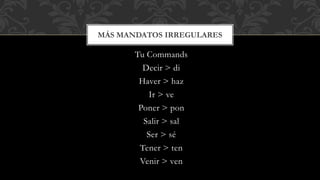
MÁS MANDATOS IRREGULARES 
Tu Commands 
Decir > di 
Haver > haz 
Ir > ve 
Poner > pon 
Salir > sal 
Ser > sé 
Tener > ten 
Venir > ven
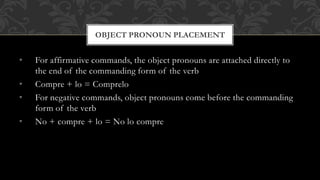
OBJECT PRONOUN PLACEMENT 
• For affirmative commands, the object pronouns are attached directly to 
the end of the commanding form of the verb 
• Compre + lo = Comprelo 
• For negative commands, object pronouns come before the commanding 
form of the verb 
• No + compre + lo = No lo compre
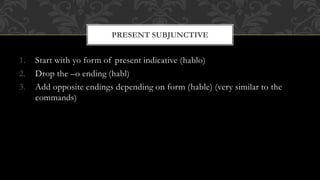
1. Start with yo form of present indicative (hablo) 
2. Drop the –o ending (habl) 
3. Add opposite endings depending on form (hable) (very similar to the 
commands) 
PRESENT SUBJUNCTIVE
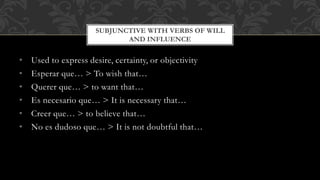
SUBJUNCTIVE WITH VERBS OF WILL 
AND INFLUENCE 
• Used to express desire, certainty, or objectivity 
• Esperar que… > To wish that… 
• Querer que… > to want that… 
• Es necesario que… > It is necessary that… 
• Creer que… > to believe that… 
• No es dudoso que… > It is not doubtful that…

Grammer book

  • 1.
  • 2.
    TABLE OF CONTENTS Preterit (IYF)…………………………………………………………………………..3 Imperfect (IYF)……………………………………………………………………….4 Preterit vs Imperfect………………………………………………………………5 Constructions with Se…………………………………………………………….6 Adverbios………………………………………………………………………………..7 Por…………………………………………………………………………………………..8 Para…………………………………………………………………………………………9 Por vs. Para……………………………………………………………………….....10 Stressed Possessive Adjectives & Pronouns…………………........11 Commands……………………………………………………………………………..12 Object Pronoun Placement…………………………………………………….13 Present Subjunctive……………………………………………………………….14 Subjunctive with verbs of will and influence………………………..15
  • 3.
    PRETERITE -Ar Verbs-Er/Ir Verbs Yo-é Yo-í Tú-aste Tú-iste Él, ella, ud.-ó Él, ella, ud.-ó Nosotros-amos Nosotros-imos Uds- aron Uds- ieron Ayer-yesterday Anoche- last night Después- Afterwards Anteayer- the day before yesterday La semana pasada- last week El mes pasado- last month El año pasado- last year El fin de semana pasado- last weekend • Has a definite time in the past • Has a beginning or ending • The most recent past • Shows Interruption • Perfected time
  • 4.
    -que -camos -casteCasteís -có -caron CAR-GAR-ZAR --cé -zamos -zaste -zasteís -zó -zaron -gue -gamos -gaste -gasteís -gó -garon Spock Verbs -Dar/Ver -Hacer -Ser/Ir -í -hice -fuí -iste -hiciste -fuiste -ió -hizo -fue -imos -hicimos -fuimos -isteis -hicisteís -fuisteis -ieron -hicieron -fueron
  • 5.
    IMPERFECT -ar -er-ir Yo Aba Ía Ía Tu Abas Ías Ías Usted Aba Ía Ía Nos Abamos Íamos Íamos Vos Abais Íais Íais Ustedes Aban Ían Ían Todos los dias- every day Cada dia- every day Cada mes- everymonth Siempre- always Nunca- never A veces- sometimes Muchas Veces- many times Frecuentemente- frequently A muendo- often Casi siempre- almost always Todo el tiempo- all the time Todos los lunes- every Monday Irregular Ser Ver Ir Yo Era Veía Iba Tu Eras Veías Ibas Usted Era Veía Iba Nos Éramos Vivíamos Íbamos Vos Erais Veíais Ibais Ustedes eran Veían Iban
  • 6.
    PRETERITE VS IMPERFECT -Completed actions in the past -Have a defined beginning and end -Specific time -Continuing actions -Non-completed -Outgoing -Not a specific time -Takes place in the past
  • 7.
    CONSTRUCTIONS WITH SE Use “se” to avoid specifying a person who is doing the action of the verb When using “se” the verb is always in the 3rd person Can be used in all tenses Ejemplos Se vende fruta en el mercado Se habla Ingles Se hizo mucho
  • 8.
    ADVERBIOS Add –mente(in most cases) to the feminine singular form of an adjective This ending corresponds to –ly in English
  • 9.
    POR Passing throughsomething (PORtal) General description rather than specific description Location (PORtugal) How long something lasts (PORever) The cause of something (PORpuse) An exchange (imPORt or exPORt) Doing something in place or instead of someone else (I can get that POR you) A means of transportation (transPORtation)
  • 10.
    PARA For whomsomething is done (Jack’s PARAty) Destination (PARAguay) Purpose for which something is done Expresses an opinion (PARAdon me, but I like blue) To compare or contrast (comPARAson) Express an idea of deadline (PARAmedic)
  • 11.
    POR VS. PARA Por Para Motion or a general location Destination Place Duration of an action Destination Person Reason or motive for an action Future time limit Object of a search Purpose or goal Means by which something is done Use or function Exchange or substitution Comparisons Unit of Measure Opinion
  • 12.
    STRESSED POSSESSIVE ADJECTIVES& PRONOUNS Masculino Feminino Mío(s) Mía(s) Tuyo(s) Tuya(s) Suyo(s) Suya(s) Nuestro(s) Nuestra(s) Vuestro(s) Vuestra(s) Suyo(s) Suya(s) Stressed possessive adjectives are placed after the nouns they modify. Unstressed possessive adjectives are placed before the noun. Must agree in gender and number Ellos son mis coches - =They are my cars
  • 13.
    MANDATAS FORMALES UD.+ UDS. 1. Drop the final “o” in the yo form 2. AR Verbs (-e or –en) or ER/IR Verbs (-a or –an) • Affirmative: Attach to command, add accent on third to last syllable, and on the fourth to last if you add two (one pronoun or two) • Negative: Place pronouns before command, and do not add accents
  • 14.
    Affirmative: 1) Dropthe ending of the verb (habl) 2) Add a/e to the end (habla) Ex. Habla tú más lentamente Used to give someone a direct command TU COMMANDS Negative: 1) Convert to yo form (hablo) 2) Drop O and add an as/es to the end (opposite)(hables) 3) Add a no before the verb (no hables) Ex. No hables por el día
  • 15.
    For Affirmative: NOSOTROSCOMMANDS 1) Convert verb to nosotros form (hablamos) 2) Drop the s at the end, and add the needed pronouns (hablamonos) For Negative: 1) Convert to nosotros (hablamos) 2) Add a no then pronoun(s) before the verb (No nos hablamos)
  • 16.
    ir- to go Ser- to be Saber – to know Estar- to be Dar- to give Jugar- to play Llegar- to get Buscar- search for Tocar- To touch Empezar- To start MANDATOS FORMALES IRREGULARES Vaya(n) Sea(n) Sepa(n) Esté(n) Dé(n) Juegue(n) Llegue(n) Busqie(n) Toque(n) Empiece(n) T- Tener and Traer V- Venir D- Dar, Decir I- Ir S- Salir H- Hacer, Haber E- Estar S- Ser T- Tenga, Traiga V- Venga D- De, Dije I- Vaya S- Salga H- Haga, Haya E- Este S- Sea
  • 17.
    MÁS MANDATOS IRREGULARES Tu Commands Decir > di Haver > haz Ir > ve Poner > pon Salir > sal Ser > sé Tener > ten Venir > ven
  • 18.
    OBJECT PRONOUN PLACEMENT • For affirmative commands, the object pronouns are attached directly to the end of the commanding form of the verb • Compre + lo = Comprelo • For negative commands, object pronouns come before the commanding form of the verb • No + compre + lo = No lo compre
  • 19.
    1. Start withyo form of present indicative (hablo) 2. Drop the –o ending (habl) 3. Add opposite endings depending on form (hable) (very similar to the commands) PRESENT SUBJUNCTIVE
  • 20.
    SUBJUNCTIVE WITH VERBSOF WILL AND INFLUENCE • Used to express desire, certainty, or objectivity • Esperar que… > To wish that… • Querer que… > to want that… • Es necesario que… > It is necessary that… • Creer que… > to believe that… • No es dudoso que… > It is not doubtful that…