IN THE NAME OF GOD
Grammer :
Exclamations
and
Interjection
I’m very Sorry .
I couldn’t share on the sentences sound and translate each sentences for you.
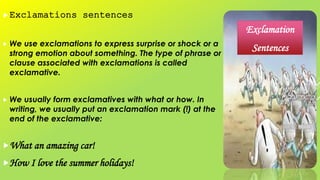
Exclamations sentences
 We use exclamations to express surprise or shock or a
strong emotion about something. The type of phrase or
clause associated with exclamations is called
exclamative.
 We usually form exclamatives with what or how. In
writing, we usually put an exclamation mark (!) at the
end of the exclamative:
What an amazing car!
How I love the summer holidays!
Exclamation
Sentences
EXCLAMATIONS WITH HOW
Form: How + adjective/adverb + subject + verb +
 How cold it is! (NOT How it is cold!)
 How beautifully she sings!
 The structure How + subject + verb is also possible+!
How you have grown!
Exdamation
structure
Form: what a/an (+ adjective) + singular countable noun+
 What a lovely song! (NOT What lovely song!)
 What a surprise! (NOT What surprise!)
We use what + adjective before an uncountable or plural
noun+!
 What lovely flowers! (NOT What a lovely flowers!)
 What fools! (NOT What a fools!)
 What beautiful weather! (NOT What a beautiful weather!)
Exclamations with what
What + object + subject + verb+!
 What a beautiful smile you have!
 (NOT What a beautiful smile have you!)
Different structures are possible.
Form: so + adjective+! You are so sweet!
Form: such a/an (+ adjective) + singular countable noun+!
He is such a nice boy!
Exclamations with so and such
Form: such (+ adjective) + uncountable/plural noun+!
They are such kind people! They talk such rubbish!
What …!
+ noun phrase + verb + tag
What a beautiful
day!
What a beautiful day it
is!
What a beautiful day
it is, isn’t it!
What bad luck!
What bad luck they
had!
What bad luck they
had, didn’t they!
We can use what + noun phrase ((+ verb) (+ tag)):
How …!
How sweet ! How lovely! How amazing!
We can use How + adjective/adverb + subject + verb + ! :
How interesting it was to hear her story!
How wonderful it is to see you!
How beautifully she sang! Everyone was delighted.
We often use how followed by an adjective only:
In informal styles, we can also use :
How + adjective + verb + subject. This is particularly common in American English:
How clever am I!
How crazy is that!
Here are some short expressions we use to express surprise
Wow! No way!
Gosh! That’s amazing!
Exclamatives with interrogative form
We sometimes make an exclamation using interrogative
(question) word order:
Have I got news for you! Peter and Michaela are getting
divorced! (or, less strong: I’ve got news for you!)
Did I do something stupid last night!
Interjections (ouch, hooray)
Interjections are more common in speaking than in writing:
Ouch, it stings. (expresses pain)
You’re going to the Maldives.
That’s a long way, wow. (expresses surprise and wonder)
Hooray, here comes the bus at last! (expresses delight)
Ugh, sorry, I can’t eat tomatoes. (expresses disgust)
We use interjections to express emotions such as pleasure, surprise, shock
and disgust. Most interjections are just sounds, rather than actual words, and
come at the beginning or at the end of what we say.
Important : Interjection isn’t equal with Exclamation
See also:
Research resources:
Cambridge Online Dictionary &…
Researchist:Amirhoseyn Dastjerdi
His teacher’s Name: Mr. Rouhani

Exclamation sentences &Interjection

  • 1.
    IN THE NAMEOF GOD Grammer : Exclamations and Interjection I’m very Sorry . I couldn’t share on the sentences sound and translate each sentences for you.
  • 2.
    Exclamations sentences  Weuse exclamations to express surprise or shock or a strong emotion about something. The type of phrase or clause associated with exclamations is called exclamative.  We usually form exclamatives with what or how. In writing, we usually put an exclamation mark (!) at the end of the exclamative: What an amazing car! How I love the summer holidays! Exclamation Sentences
  • 3.
    EXCLAMATIONS WITH HOW Form:How + adjective/adverb + subject + verb +  How cold it is! (NOT How it is cold!)  How beautifully she sings!  The structure How + subject + verb is also possible+! How you have grown! Exdamation structure
  • 4.
    Form: what a/an(+ adjective) + singular countable noun+  What a lovely song! (NOT What lovely song!)  What a surprise! (NOT What surprise!) We use what + adjective before an uncountable or plural noun+!  What lovely flowers! (NOT What a lovely flowers!)  What fools! (NOT What a fools!)  What beautiful weather! (NOT What a beautiful weather!) Exclamations with what
  • 5.
    What + object+ subject + verb+!  What a beautiful smile you have!  (NOT What a beautiful smile have you!) Different structures are possible. Form: so + adjective+! You are so sweet! Form: such a/an (+ adjective) + singular countable noun+! He is such a nice boy! Exclamations with so and such Form: such (+ adjective) + uncountable/plural noun+! They are such kind people! They talk such rubbish!
  • 6.
    What …! + nounphrase + verb + tag What a beautiful day! What a beautiful day it is! What a beautiful day it is, isn’t it! What bad luck! What bad luck they had! What bad luck they had, didn’t they! We can use what + noun phrase ((+ verb) (+ tag)):
  • 7.
    How …! How sweet! How lovely! How amazing! We can use How + adjective/adverb + subject + verb + ! : How interesting it was to hear her story! How wonderful it is to see you! How beautifully she sang! Everyone was delighted. We often use how followed by an adjective only: In informal styles, we can also use : How + adjective + verb + subject. This is particularly common in American English: How clever am I! How crazy is that!
  • 8.
    Here are someshort expressions we use to express surprise Wow! No way! Gosh! That’s amazing! Exclamatives with interrogative form We sometimes make an exclamation using interrogative (question) word order: Have I got news for you! Peter and Michaela are getting divorced! (or, less strong: I’ve got news for you!) Did I do something stupid last night!
  • 9.
    Interjections (ouch, hooray) Interjectionsare more common in speaking than in writing: Ouch, it stings. (expresses pain) You’re going to the Maldives. That’s a long way, wow. (expresses surprise and wonder) Hooray, here comes the bus at last! (expresses delight) Ugh, sorry, I can’t eat tomatoes. (expresses disgust) We use interjections to express emotions such as pleasure, surprise, shock and disgust. Most interjections are just sounds, rather than actual words, and come at the beginning or at the end of what we say. Important : Interjection isn’t equal with Exclamation
  • 10.
    See also: Research resources: CambridgeOnline Dictionary &… Researchist:Amirhoseyn Dastjerdi His teacher’s Name: Mr. Rouhani