Grammar Unit 4
HD. 4.1 t/m 4.7
4.1 Present Simple:
     bevestigende zinnen
Vorm:
– Hele werkwoord
– Hele werkwoord + (e)s bij he/she/it


Wanneer gebruik je het? Signaalwoorden
– Altijd                      Always, every …
– Nooit                       Never
– Regelmatig                  Usually
I always go to school at 9 o’clock (go)
He always goes to school at 9 o‘clock (go)

 Let op bij he/she/it soms -es:
  – Go  goes
  – Do  does
  – Miss  misses
4.2 Present Simple: vragen en
        ontkenningen
 Vraagzinnen:
  – do / does + hele werkwoord

           Does he go to school every day?
       Do you know what it feels like to be hurt?

 Ontkennende zinnen:
 – Don’t / doesn’t + hele werkwoord

          He doesn’t go to school every day.
              We don’t like to eat early.
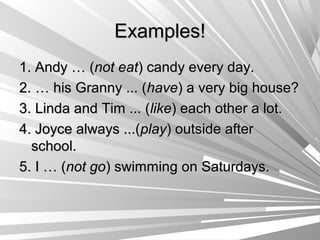
Examples!
1. Andy … (not eat) candy every day.
2. … his Granny ... (have) a very big house?
3. Linda and Tim ... (like) each other a lot.
4. Joyce always ...(play) outside after
  school.
5. I … (not go) swimming on Saturdays.
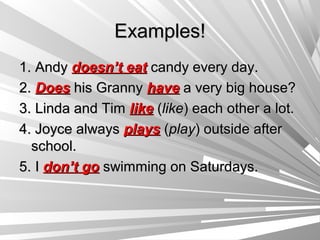
Examples!
1. Andy doesn’t eat candy every day.
2. Does his Granny have a very big house?
3. Linda and Tim like (like) each other a lot.
4. Joyce always plays (play) outside after
  school.
5. I don’t go swimming on Saturdays.
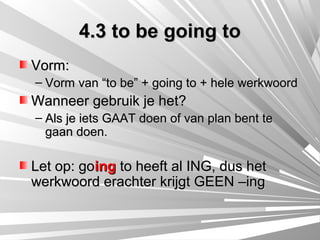
4.3 to be going to
Vorm:
– Vorm van “to be” + going to + hele werkwoord
Wanneer gebruik je het?
– Als je iets GAAT doen of van plan bent te
  gaan doen.

Let op: going to heeft al ING, dus het
werkwoord erachter krijgt GEEN –ing
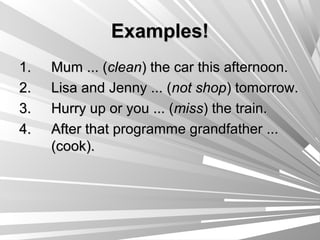
Examples!
1.   Mum ... (clean) the car this afternoon.
2.   Lisa and Jenny ... (not shop) tomorrow.
3.   Hurry up or you ... (miss) the train.
4.   After that programme grandfather ...
     (cook).
Examples!
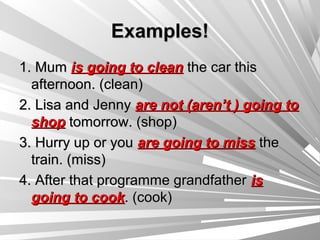
1. Mum is going to clean the car this
  afternoon. (clean)
2. Lisa and Jenny are not (aren’t ) going to
  shop tomorrow. (shop)
3. Hurry up or you are going to miss the
  train. (miss)
4. After that programme grandfather is
  going to cook. (cook)
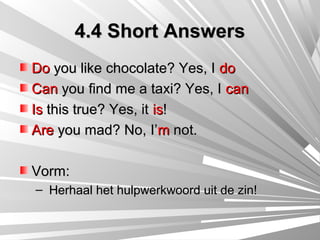
4.4 Short Answers
Do you like chocolate? Yes, I do
Can you find me a taxi? Yes, I can
Is this true? Yes, it is!
Are you mad? No, I’m not.

Vorm:
– Herhaal het hulpwerkwoord uit de zin!
Examples!
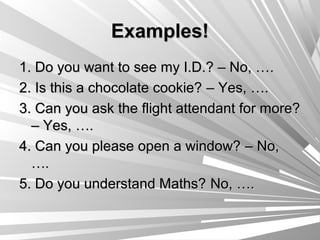
1. Do you want to see my I.D.? – No, … .
2. Is this a chocolate cookie? – Yes, ….
3. Can you ask the flight attendant for more?
  – Yes, ….
4. Can you please open a window? – No,
  ….
5. Do you understand Maths? No, ….
Examples!
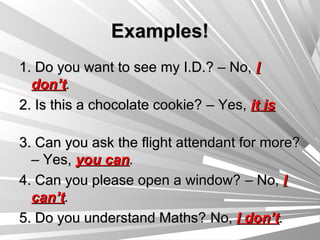
1. Do you want to see my I.D.? – No, I
  don’t.
2. Is this a chocolate cookie? – Yes, it is

3. Can you ask the flight attendant for more?
  – Yes, you can.
4. Can you please open a window? – No, I
  can’t.
5. Do you understand Maths? No, I don’t.
4.5 Wel doen! / Niet doen!
  Niet doen!
Ontkenning maken we met don’t / doesn’t
Don’t worry!
Don’t fall asleep!

  Wel doen!
Gebruik het werkwoord ‘gewoon’
Sleep tight!
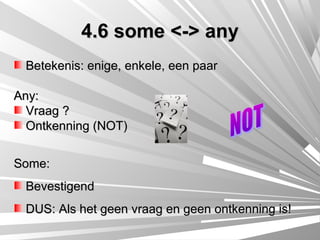
4.6 some <-> any
 Betekenis: enige, enkele, een paar

Any:
  Vraag ?
  Ontkenning (NOT)


Some:
 Bevestigend
 DUS: Als het geen vraag en geen ontkenning is!
Don’t forget:

Bij vragen en ontkennie (ontkenning),
    gebruik je geen some, maar any.
Examples!
1. I haven’t got … paper
2. There aren’t … apples in the kitchen.
3. There is … milk left in the fridge.
4. Have you got … vegetables or should I
   go get groceries?
4. I’ve got … good ideas for the band.
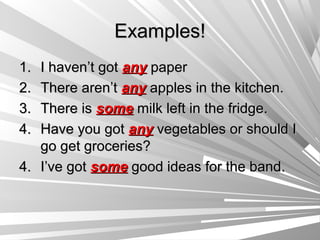
Examples!
1. I haven’t got any paper
2. There aren’t any apples in the kitchen.
3. There is some milk left in the fridge.
4. Have you got any vegetables or should I
   go get groceries?
4. I’ve got some good ideas for the band.
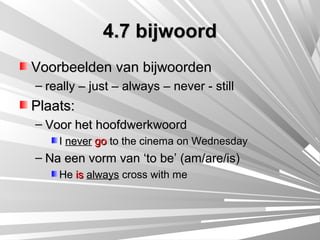
4.7 bijwoord
Voorbeelden van bijwoorden
– really – just – always – never - still
Plaats:
– Voor het hoofdwerkwoord
    I never go to the cinema on Wednesday
– Na een vorm van ‘to be’ (am/are/is)
    He is always cross with me
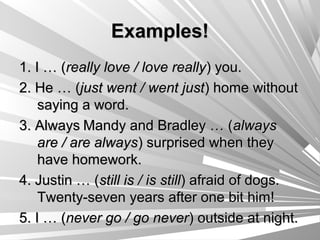
Examples!
1. I … (really love / love really) you.
2. He … (just went / went just) home without
    saying a word.
3. Always Mandy and Bradley … (always
    are / are always) surprised when they
    have homework.
4. Justin … (still is / is still) afraid of dogs.
    Twenty-seven years after one bit him!
5. I … (never go / go never) outside at night.
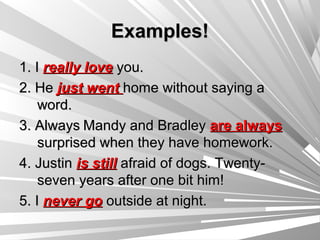
Examples!
1. I really love you.
2. He just went home without saying a
    word.
3. Always Mandy and Bradley are always
    surprised when they have homework.
4. Justin is still afraid of dogs. Twenty-
    seven years after one bit him!
5. I never go outside at night.
Grammatica unit 4 klas 1

Grammatica unit 4 klas 1

  • 1.
    Grammar Unit 4 HD.4.1 t/m 4.7
  • 2.
    4.1 Present Simple: bevestigende zinnen Vorm: – Hele werkwoord – Hele werkwoord + (e)s bij he/she/it Wanneer gebruik je het? Signaalwoorden – Altijd Always, every … – Nooit Never – Regelmatig Usually
  • 3.
    I always goto school at 9 o’clock (go) He always goes to school at 9 o‘clock (go) Let op bij he/she/it soms -es: – Go  goes – Do  does – Miss  misses
  • 4.
    4.2 Present Simple:vragen en ontkenningen Vraagzinnen: – do / does + hele werkwoord Does he go to school every day? Do you know what it feels like to be hurt? Ontkennende zinnen: – Don’t / doesn’t + hele werkwoord He doesn’t go to school every day. We don’t like to eat early.
  • 5.
    Examples! 1. Andy …(not eat) candy every day. 2. … his Granny ... (have) a very big house? 3. Linda and Tim ... (like) each other a lot. 4. Joyce always ...(play) outside after school. 5. I … (not go) swimming on Saturdays.
  • 6.
    Examples! 1. Andy doesn’teat candy every day. 2. Does his Granny have a very big house? 3. Linda and Tim like (like) each other a lot. 4. Joyce always plays (play) outside after school. 5. I don’t go swimming on Saturdays.
  • 7.
    4.3 to begoing to Vorm: – Vorm van “to be” + going to + hele werkwoord Wanneer gebruik je het? – Als je iets GAAT doen of van plan bent te gaan doen. Let op: going to heeft al ING, dus het werkwoord erachter krijgt GEEN –ing
  • 8.
    Examples! 1. Mum ... (clean) the car this afternoon. 2. Lisa and Jenny ... (not shop) tomorrow. 3. Hurry up or you ... (miss) the train. 4. After that programme grandfather ... (cook).
  • 9.
    Examples! 1. Mum isgoing to clean the car this afternoon. (clean) 2. Lisa and Jenny are not (aren’t ) going to shop tomorrow. (shop) 3. Hurry up or you are going to miss the train. (miss) 4. After that programme grandfather is going to cook. (cook)
  • 10.
    4.4 Short Answers Doyou like chocolate? Yes, I do Can you find me a taxi? Yes, I can Is this true? Yes, it is! Are you mad? No, I’m not. Vorm: – Herhaal het hulpwerkwoord uit de zin!
  • 11.
    Examples! 1. Do youwant to see my I.D.? – No, … . 2. Is this a chocolate cookie? – Yes, …. 3. Can you ask the flight attendant for more? – Yes, …. 4. Can you please open a window? – No, …. 5. Do you understand Maths? No, ….
  • 12.
    Examples! 1. Do youwant to see my I.D.? – No, I don’t. 2. Is this a chocolate cookie? – Yes, it is 3. Can you ask the flight attendant for more? – Yes, you can. 4. Can you please open a window? – No, I can’t. 5. Do you understand Maths? No, I don’t.
  • 13.
    4.5 Wel doen!/ Niet doen! Niet doen! Ontkenning maken we met don’t / doesn’t Don’t worry! Don’t fall asleep! Wel doen! Gebruik het werkwoord ‘gewoon’ Sleep tight!
  • 14.
    4.6 some <->any Betekenis: enige, enkele, een paar Any: Vraag ? Ontkenning (NOT) Some: Bevestigend DUS: Als het geen vraag en geen ontkenning is!
  • 15.
    Don’t forget: Bij vragenen ontkennie (ontkenning), gebruik je geen some, maar any.
  • 16.
    Examples! 1. I haven’tgot … paper 2. There aren’t … apples in the kitchen. 3. There is … milk left in the fridge. 4. Have you got … vegetables or should I go get groceries? 4. I’ve got … good ideas for the band.
  • 17.
    Examples! 1. I haven’tgot any paper 2. There aren’t any apples in the kitchen. 3. There is some milk left in the fridge. 4. Have you got any vegetables or should I go get groceries? 4. I’ve got some good ideas for the band.
  • 18.
    4.7 bijwoord Voorbeelden vanbijwoorden – really – just – always – never - still Plaats: – Voor het hoofdwerkwoord I never go to the cinema on Wednesday – Na een vorm van ‘to be’ (am/are/is) He is always cross with me
  • 19.
    Examples! 1. I …(really love / love really) you. 2. He … (just went / went just) home without saying a word. 3. Always Mandy and Bradley … (always are / are always) surprised when they have homework. 4. Justin … (still is / is still) afraid of dogs. Twenty-seven years after one bit him! 5. I … (never go / go never) outside at night.
  • 20.
    Examples! 1. I reallylove you. 2. He just went home without saying a word. 3. Always Mandy and Bradley are always surprised when they have homework. 4. Justin is still afraid of dogs. Twenty- seven years after one bit him! 5. I never go outside at night.