HD 3.1 t/m 3.7
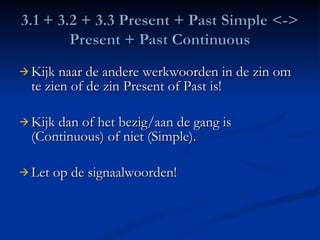
Kijk naar de andere werkwoorden in de zin om te zien of de zin Present of Past is! Kijk dan of het bezig/aan de gang is (Continuous) of niet (Simple). Let op de signaalwoorden!
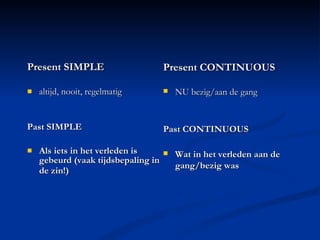
Present SIMPLE altijd, nooit, regelmatig Past SIMPLE Als iets in het verleden is gebeurd (vaak tijdsbepaling in de zin!)   Present CONTINUOUS NU bezig/aan de gang Past CONTINUOUS Wat in het verleden aan de gang/bezig was
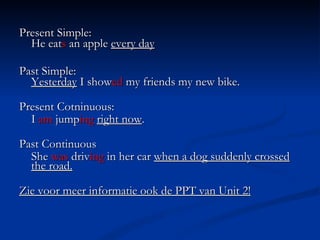
Present Simple:  He eat s  an apple  every day Past Simple:  Yesterday  I show ed  my friends my new bike. Present Cotninuous: I  am  jump ing   right now . Past Continuous She  was  driv ing  in her car  when a dog suddenly crossed the road. Zie voor meer informatie ook de PPT van Unit 2!
1.  Sandy … (read) two books every month. 2.  I … (check) to see if I’ve got enough money in my pocket to buy that CD. 3.  I … (hear) Mary talk about Namil yesterday.  4.  Mum phoned me when I … (shop) with some friends.  5.  He never … (forget) his money when he goes to the supermarket.
1.  Sandy  reads  two books every month. 2.  I  am checking  to see if I’ve got enough money in my pocket to buy that CD. 3.  I  heard  Mary talk about Namil yesterday.  4.  Mum phoned me when I  was shopping  with some friends.  5.  He never  forgets  his money when he goes to the supermarket.
Vorm “ To be” going to + hele werkwoord Wanneer gebruik je het?  Om aan te geven dat je iets vast van plan bent en/of wat zeker gebeuren zal.  Om aan te geven dat je iets van plan was en/of wat zeker gebeuren zou. I  am going to eat  my dinner after the TV show.  I  was going to tell  my father about my bad marks, but didn’t have the courage (=moed).
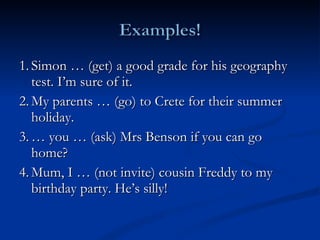
1. Simon … (get) a good grade for his geography test. I’m sure of it. 2. My parents … (go) to Crete for their summer holiday.  3. … you … (ask) Mrs Benson if you can go home?  4. Mum, I … (not invite) cousin Freddy to my birthday party. He’s silly!
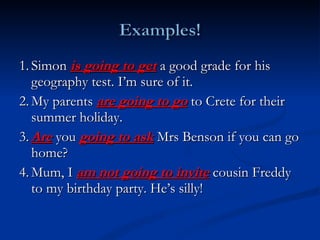
1. Simon  is going to get  a good grade for his geography test. I’m sure of it. 2. My parents  are going to go  to Crete for their summer holiday.  3. Are  you  going to ask  Mrs Benson if you can go home?  4. Mum, I  am not going to invite  cousin Freddy to my birthday party. He’s silly!
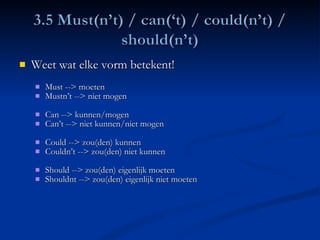
Weet wat elke vorm betekent!  Must --> moeten Mustn’t --> niet mogen Can --> kunnen/mogen  Can’t --> niet kunnen/niet mogen Could --> zou(den) kunnen Couldn’t --> zou(den) niet kunnen Should --> zou(den) eigenlijk moeten Shouldnt --> zou(den) eigenlijk niet moeten
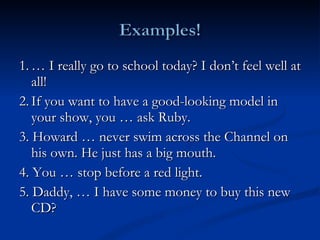
1. … I really go to school today? I don’t feel well at all! 2. If you want to have a good-looking model in your show, you … ask Ruby. 3. Howard … never swim across the Channel on his own. He just has a big mouth. 4. You … stop before a red light. 5. Daddy, … I have some money to buy this new CD?
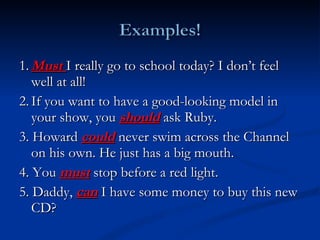
1. Must  I really go to school today? I don’t feel well at all! 2. If you want to have a good-looking model in your show, you  should  ask Ruby. 3. Howard  could  never swim across the Channel on his own. He just has a big mouth. 4. You  must  stop before a red light. 5. Daddy,  can  I have some money to buy this new CD?
Many Kisses, much love Much money, many pennies
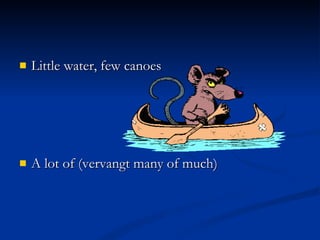
Little water, few canoes A lot of (vervangt many of much)
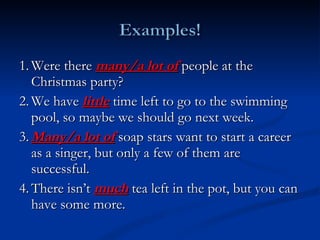
1. Were there  many/a lot of   people at the Christmas party? 2. We have  little  time left to go to the swimming pool, so maybe we should go next week. 3. Many/a lot of  soap stars want to start a career as a singer, but only a few of them are successful. 4. There isn’t  much  tea left in the pot, but you can have some more.
Vorm: Eindigt op -ly Wanneer gebruik je het? Om aan te geven HOE iets gebeurt Plaats Vóór het woord waar het iets van zegt I know  nearly  everything of Indian clothes.  Vóór het hoofdwerkwoord I  don’t   really   believe  you! Na een vorm van TO BE John  was   secretly  in love.
Uitzonderingen (eindigen niet op –ly):  Always, still, never, often, well
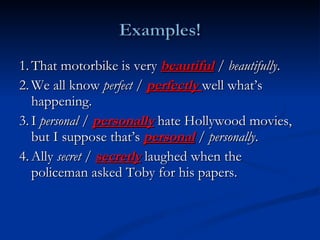
1. That motorbike is very  beautiful  / beautifully . 2. We all know  perfect /  perfectly  well what’s happening. 3. I  personal /  personally  hate Hollywood movies, but I suppose that’s  personal  / personally . 4. Ally  secret /  secretly  laughed when the policeman asked Toby for his papers.
Vergeet ook vooral niet de onregelmatige werkwoorden van hoofdstuk 3 te leren!!

Grammatica unit 3 klas 2

  • 1.
  • 2.
    Kijk naar deandere werkwoorden in de zin om te zien of de zin Present of Past is! Kijk dan of het bezig/aan de gang is (Continuous) of niet (Simple). Let op de signaalwoorden!
  • 3.
    Present SIMPLE altijd,nooit, regelmatig Past SIMPLE Als iets in het verleden is gebeurd (vaak tijdsbepaling in de zin!) Present CONTINUOUS NU bezig/aan de gang Past CONTINUOUS Wat in het verleden aan de gang/bezig was
  • 4.
    Present Simple: He eat s an apple every day Past Simple: Yesterday I show ed my friends my new bike. Present Cotninuous: I am jump ing right now . Past Continuous She was driv ing in her car when a dog suddenly crossed the road. Zie voor meer informatie ook de PPT van Unit 2!
  • 5.
    1. Sandy… (read) two books every month. 2. I … (check) to see if I’ve got enough money in my pocket to buy that CD. 3. I … (hear) Mary talk about Namil yesterday. 4. Mum phoned me when I … (shop) with some friends. 5. He never … (forget) his money when he goes to the supermarket.
  • 6.
    1. Sandy reads two books every month. 2. I am checking to see if I’ve got enough money in my pocket to buy that CD. 3. I heard Mary talk about Namil yesterday. 4. Mum phoned me when I was shopping with some friends. 5. He never forgets his money when he goes to the supermarket.
  • 7.
    Vorm “ Tobe” going to + hele werkwoord Wanneer gebruik je het? Om aan te geven dat je iets vast van plan bent en/of wat zeker gebeuren zal. Om aan te geven dat je iets van plan was en/of wat zeker gebeuren zou. I am going to eat my dinner after the TV show. I was going to tell my father about my bad marks, but didn’t have the courage (=moed).
  • 8.
    1. Simon …(get) a good grade for his geography test. I’m sure of it. 2. My parents … (go) to Crete for their summer holiday. 3. … you … (ask) Mrs Benson if you can go home? 4. Mum, I … (not invite) cousin Freddy to my birthday party. He’s silly!
  • 9.
    1. Simon is going to get a good grade for his geography test. I’m sure of it. 2. My parents are going to go to Crete for their summer holiday. 3. Are you going to ask Mrs Benson if you can go home? 4. Mum, I am not going to invite cousin Freddy to my birthday party. He’s silly!
  • 10.
    Weet wat elkevorm betekent! Must --> moeten Mustn’t --> niet mogen Can --> kunnen/mogen Can’t --> niet kunnen/niet mogen Could --> zou(den) kunnen Couldn’t --> zou(den) niet kunnen Should --> zou(den) eigenlijk moeten Shouldnt --> zou(den) eigenlijk niet moeten
  • 11.
    1. … Ireally go to school today? I don’t feel well at all! 2. If you want to have a good-looking model in your show, you … ask Ruby. 3. Howard … never swim across the Channel on his own. He just has a big mouth. 4. You … stop before a red light. 5. Daddy, … I have some money to buy this new CD?
  • 12.
    1. Must I really go to school today? I don’t feel well at all! 2. If you want to have a good-looking model in your show, you should ask Ruby. 3. Howard could never swim across the Channel on his own. He just has a big mouth. 4. You must stop before a red light. 5. Daddy, can I have some money to buy this new CD?
  • 13.
    Many Kisses, muchlove Much money, many pennies
  • 14.
    Little water, fewcanoes A lot of (vervangt many of much)
  • 15.
    1. Were there many/a lot of people at the Christmas party? 2. We have little time left to go to the swimming pool, so maybe we should go next week. 3. Many/a lot of soap stars want to start a career as a singer, but only a few of them are successful. 4. There isn’t much tea left in the pot, but you can have some more.
  • 16.
    Vorm: Eindigt op-ly Wanneer gebruik je het? Om aan te geven HOE iets gebeurt Plaats Vóór het woord waar het iets van zegt I know nearly everything of Indian clothes. Vóór het hoofdwerkwoord I don’t really believe you! Na een vorm van TO BE John was secretly in love.
  • 17.
    Uitzonderingen (eindigen nietop –ly): Always, still, never, often, well
  • 18.
    1. That motorbikeis very beautiful / beautifully . 2. We all know perfect / perfectly well what’s happening. 3. I personal / personally hate Hollywood movies, but I suppose that’s personal / personally . 4. Ally secret / secretly laughed when the policeman asked Toby for his papers.
  • 19.
    Vergeet ook vooralniet de onregelmatige werkwoorden van hoofdstuk 3 te leren!!