Unit 13 to 16
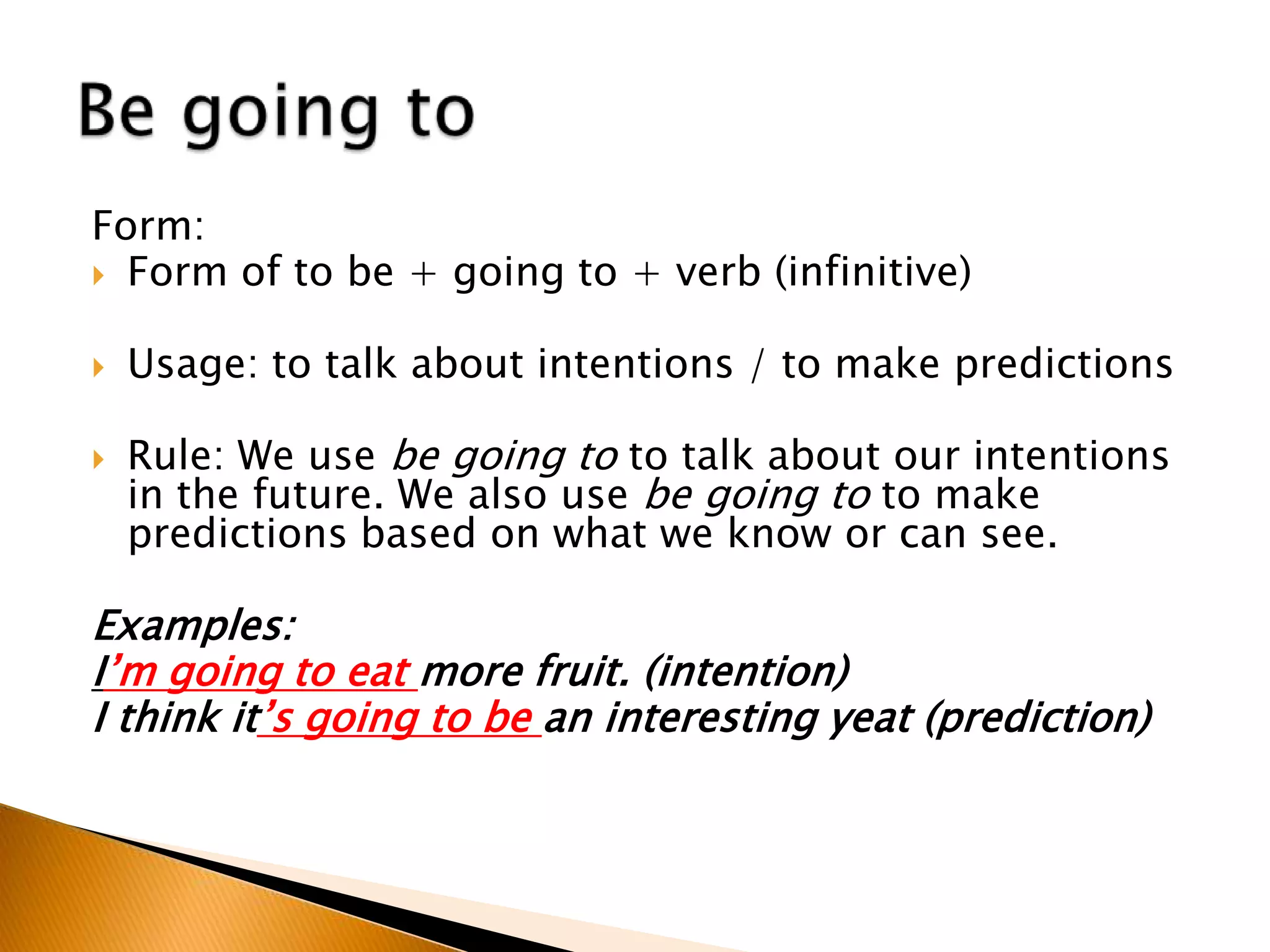
Form:
 Form of to be + going to + verb (infinitive)
 Usage: to talk about intentions / to make predictions
 Rule: We use be going to to talk about our intentions
in the future. We also use be going to to make
predictions based on what we know or can see.
Examples:
I’m going to eat more fruit. (intention)
I think it’s going to be an interesting yeat (prediction)
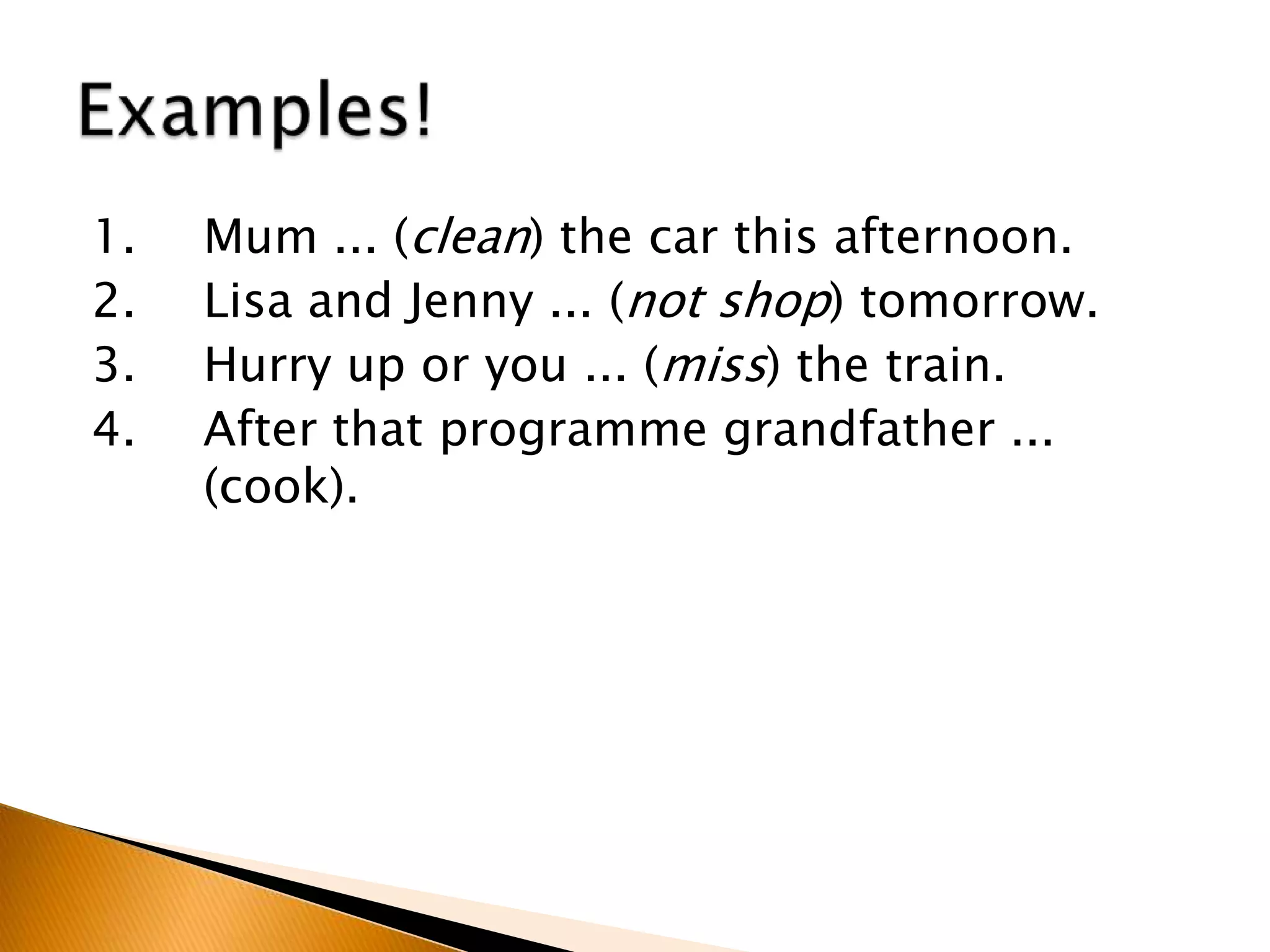
1. Mum ... (clean) the car this afternoon.
2. Lisa and Jenny ... (not shop) tomorrow.
3. Hurry up or you ... (miss) the train.
4. After that programme grandfather ...
(cook).
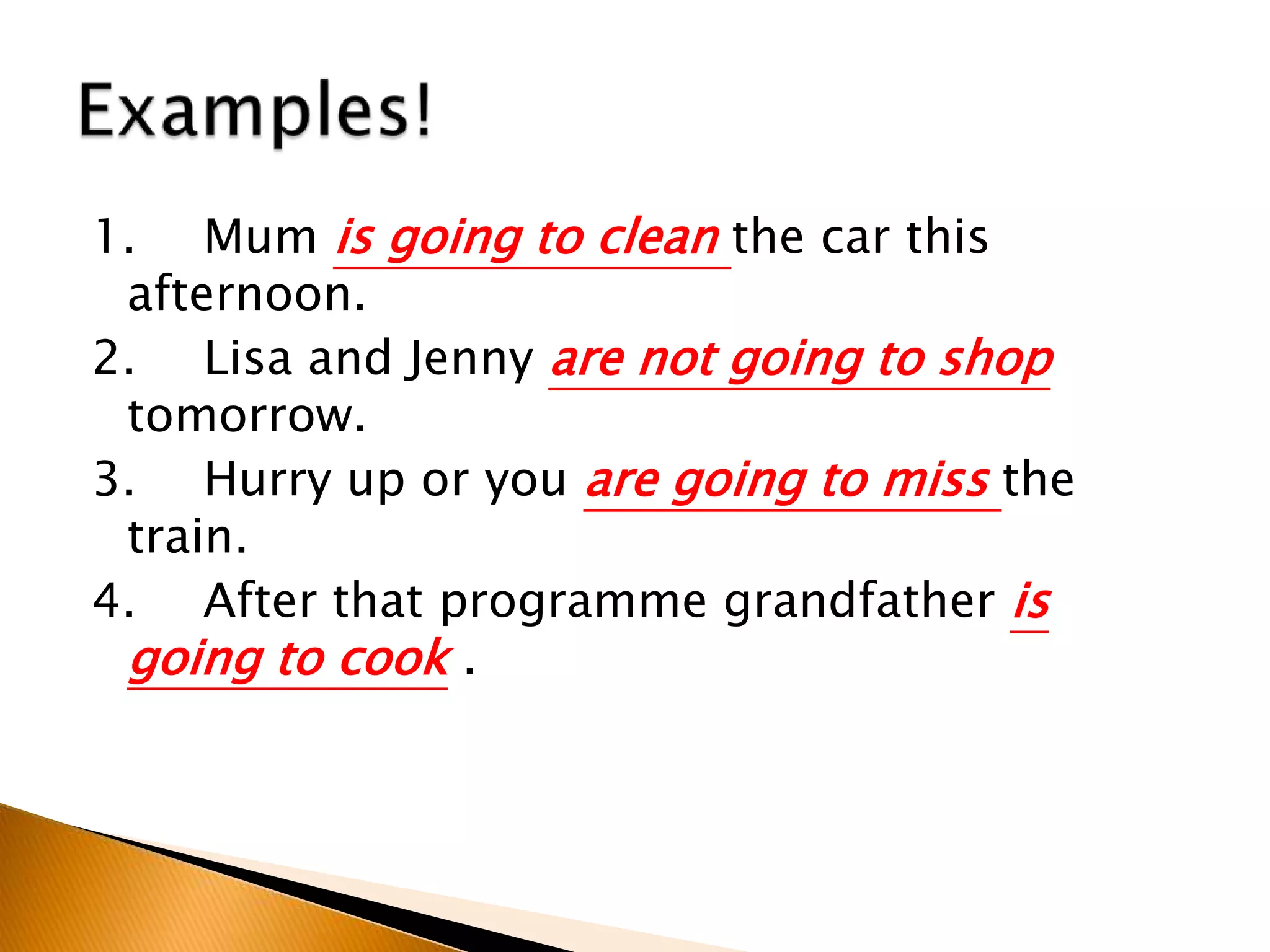
1. Mum is going to clean the car this
afternoon.
2. Lisa and Jenny are not going to shop
tomorrow.
3. Hurry up or you are going to miss the
train.
4. After that programme grandfather is
going to cook .
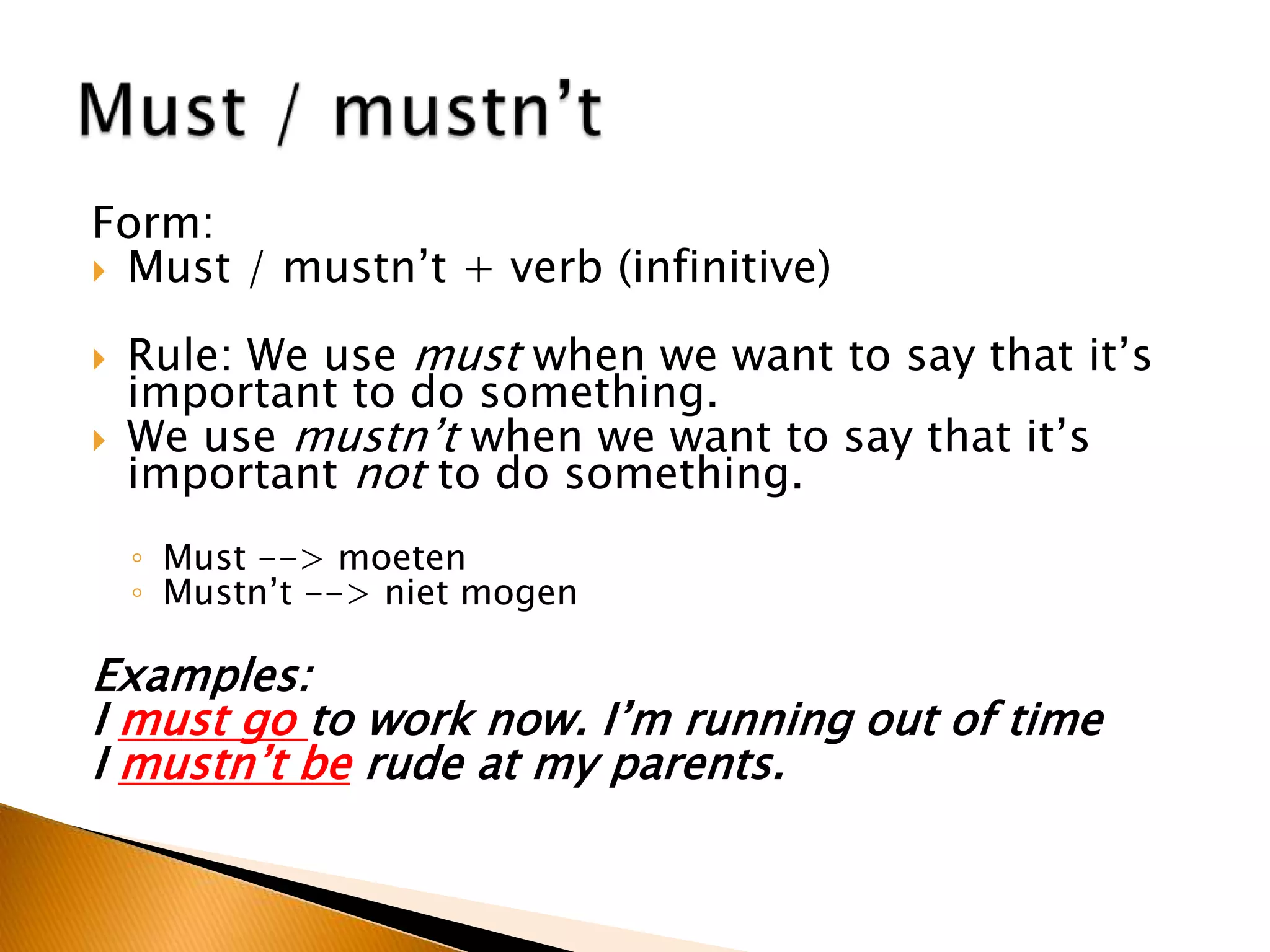
Form:
 Must / mustn’t + verb (infinitive)
 Rule: We use must when we want to say that it’s
important to do something.
 We use mustn’t when we want to say that it’s
important not to do something.
◦ Must --> moeten
◦ Mustn’t --> niet mogen
Examples:
I must go to work now. I’m running out of time
I mustn’t be rude at my parents.
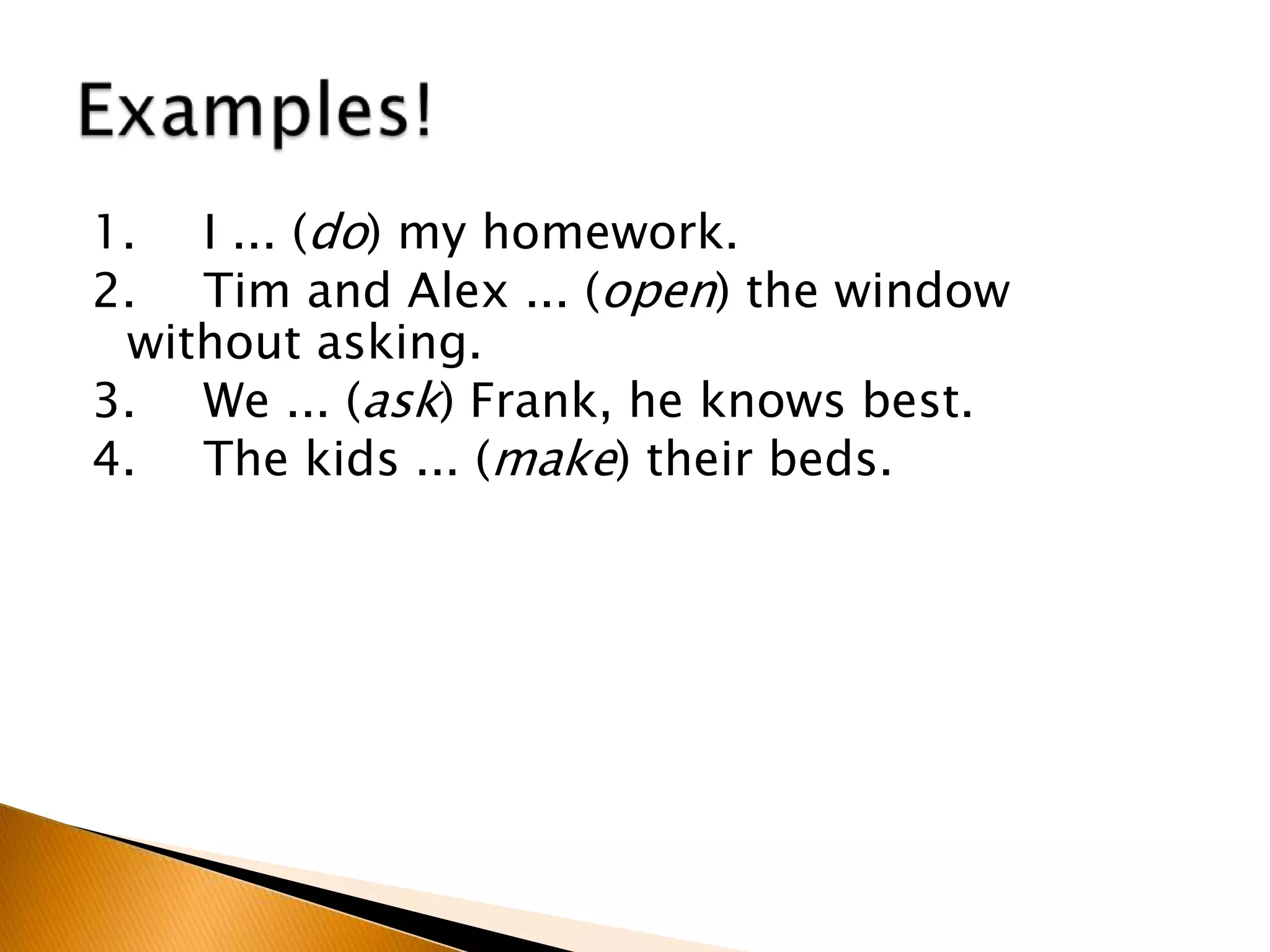
1. I ... (do) my homework.
2. Tim and Alex ... (open) the window
without asking.
3. We ... (ask) Frank, he knows best.
4. The kids ... (make) their beds.
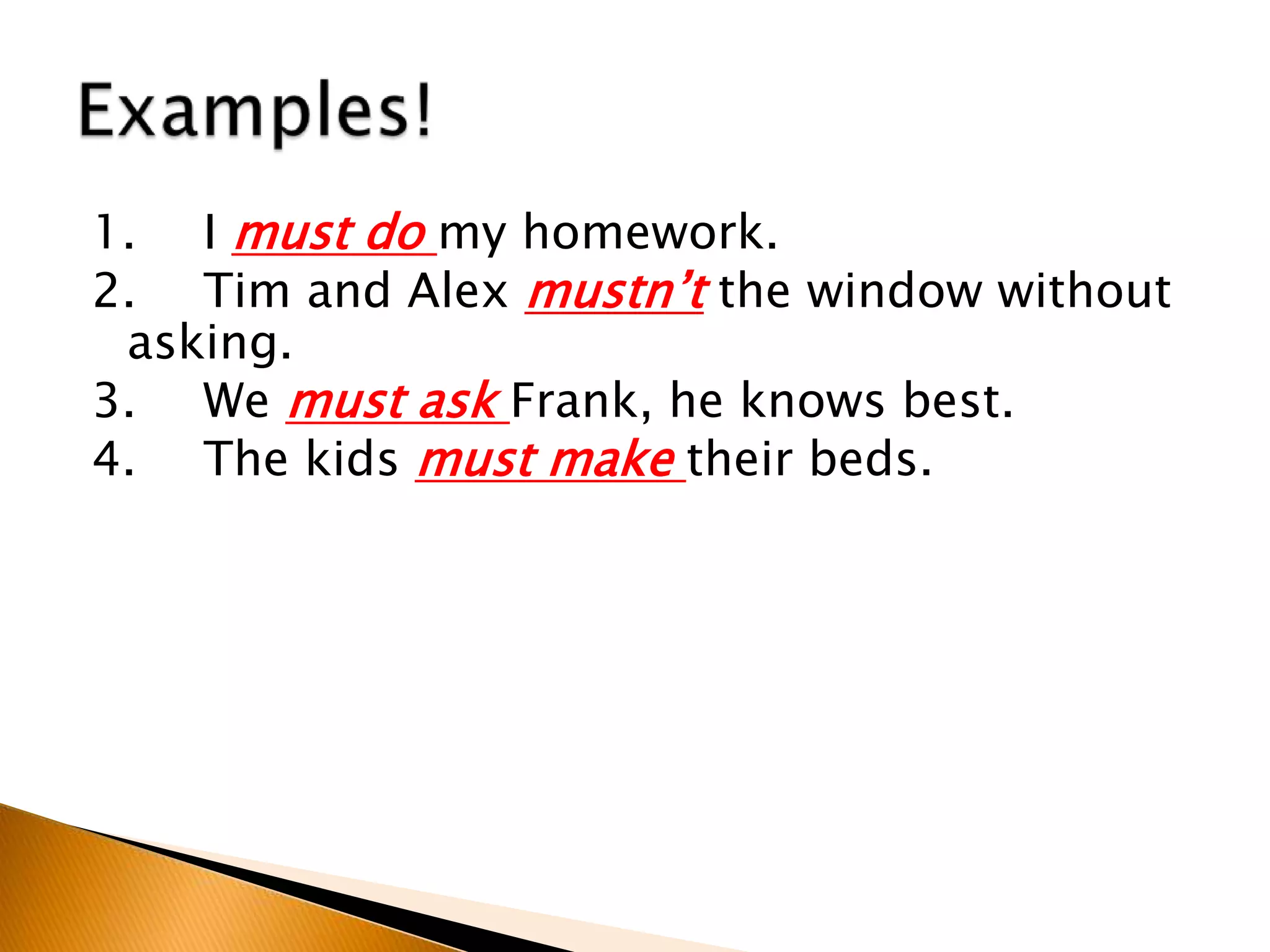
1. I must do my homework.
2. Tim and Alex mustn’t the window without
asking.
3. We must ask Frank, he knows best.
4. The kids must make their beds.
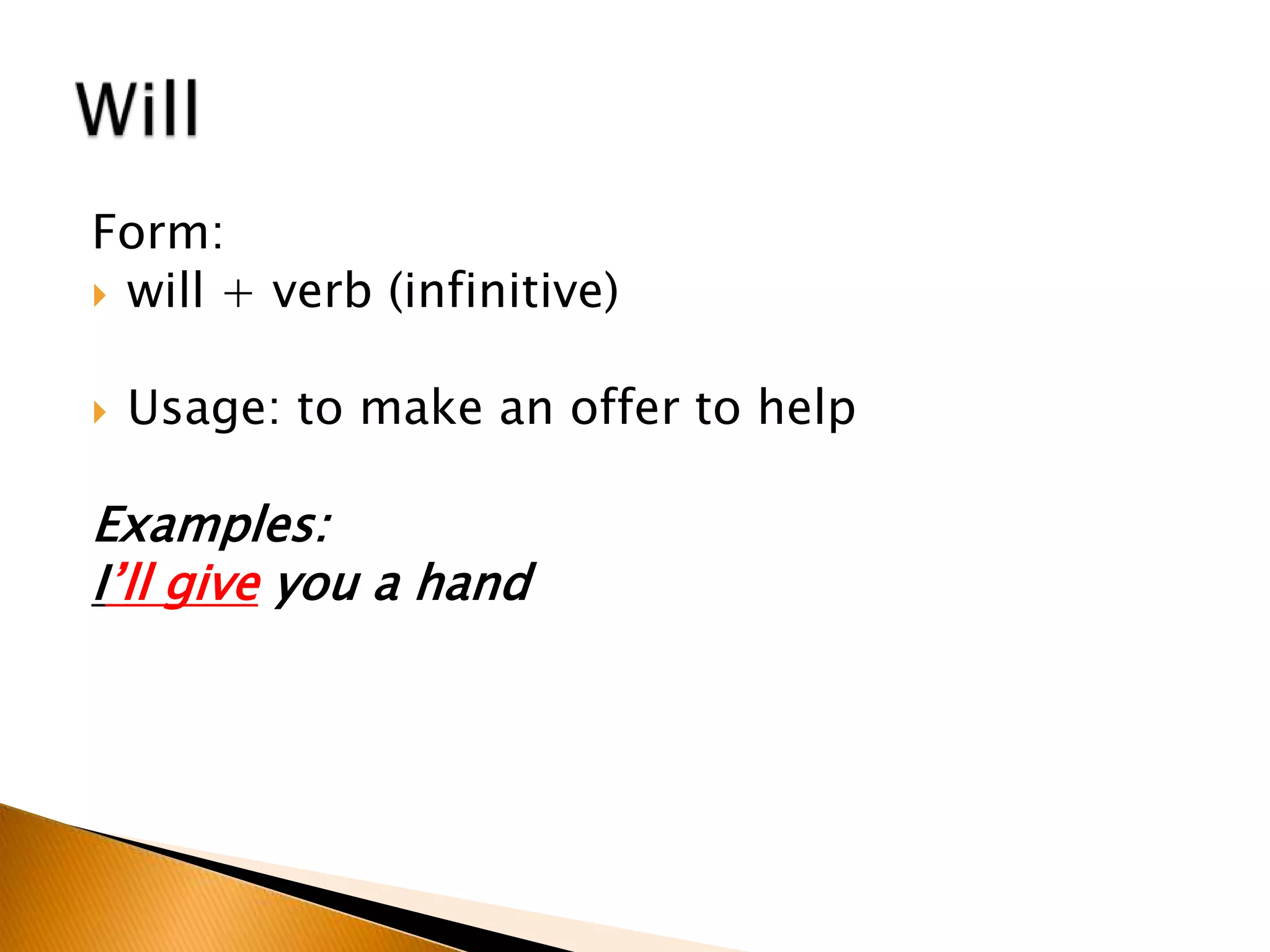
Form:
 will + verb (infinitive)
 Usage: to make an offer to help
Examples:
I’ll give you a hand
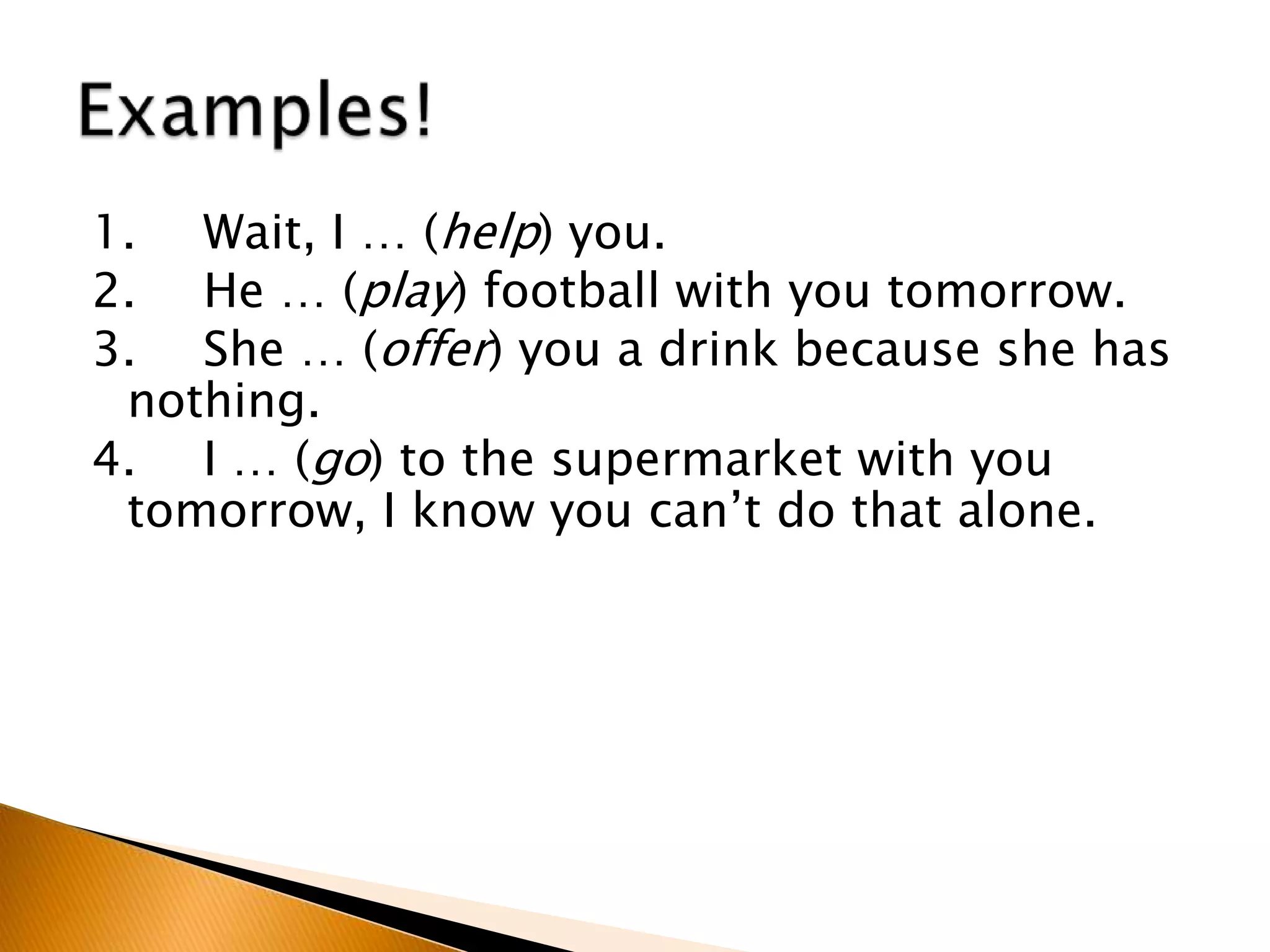
1. Wait, I … (help) you.
2. He … (play) football with you tomorrow.
3. She … (offer) you a drink because she has
nothing.
4. I … (go) to the supermarket with you
tomorrow, I know you can’t do that alone.
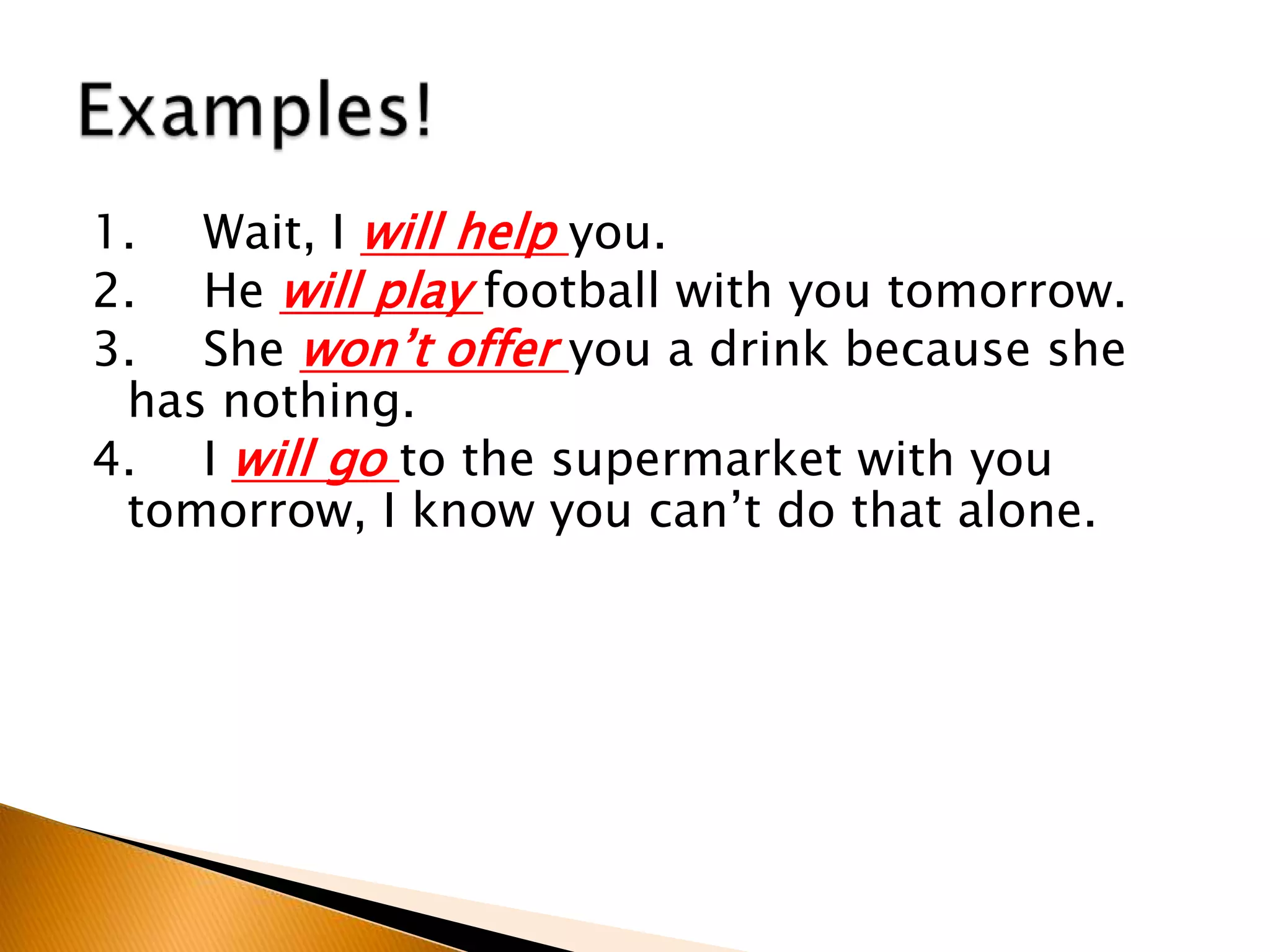
1. Wait, I will help you.
2. He will play football with you tomorrow.
3. She won’t offer you a drink because she
has nothing.
4. I will go to the supermarket with you
tomorrow, I know you can’t do that alone.
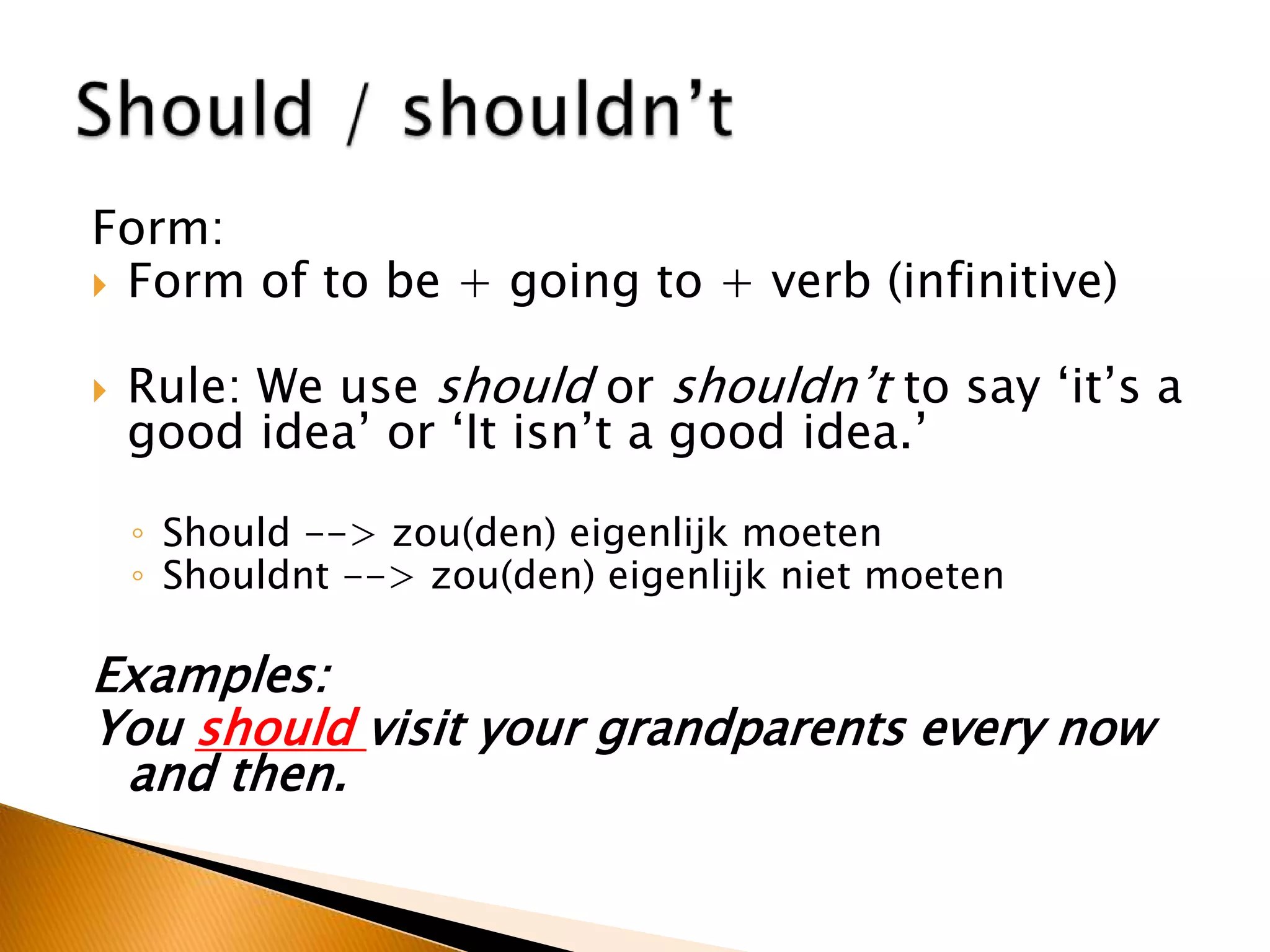
Form:
 Form of to be + going to + verb (infinitive)
 Rule: We use should or shouldn’t to say ‘it’s a
good idea’ or ‘It isn’t a good idea.’
◦ Should --> zou(den) eigenlijk moeten
◦ Shouldnt --> zou(den) eigenlijk niet moeten
Examples:
You should visit your grandparents every now
and then.
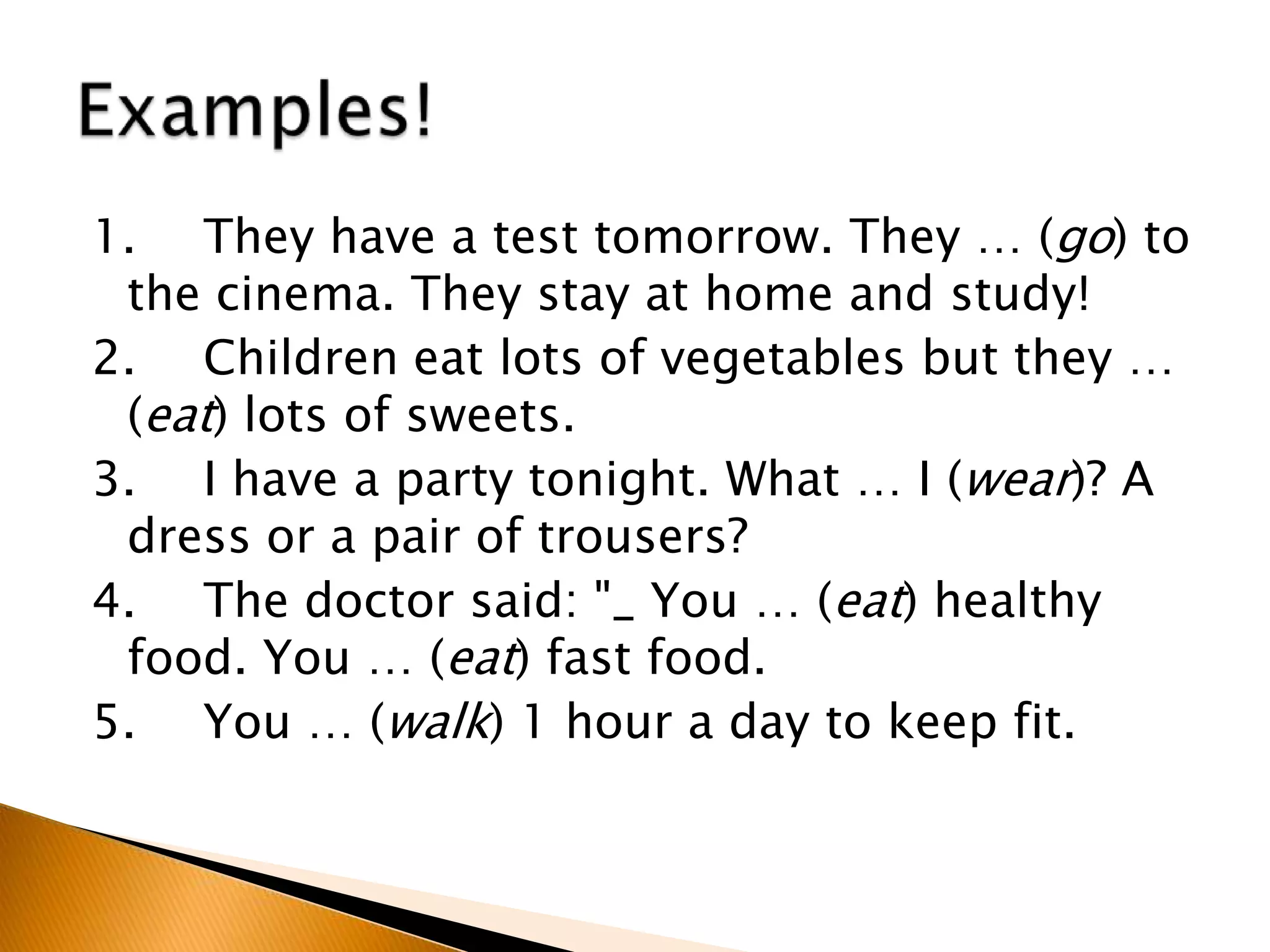
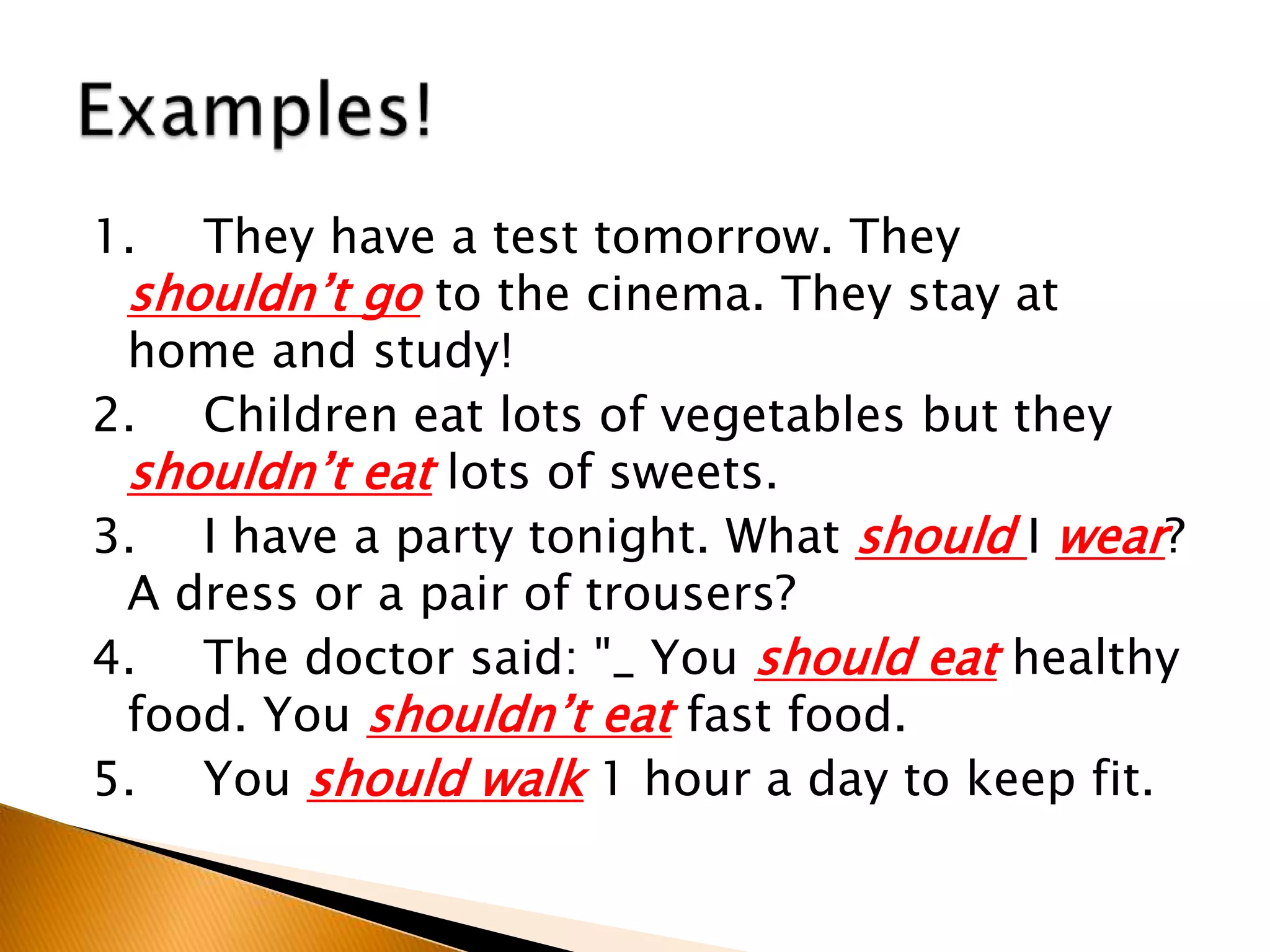
1. They have a test tomorrow. They … (go) to
the cinema. They stay at home and study!
2. Children eat lots of vegetables but they …
(eat) lots of sweets.
3. I have a party tonight. What … I (wear)? A
dress or a pair of trousers?
4. The doctor said: "_ You … (eat) healthy
food. You … (eat) fast food.
5. You … (walk) 1 hour a day to keep fit.
1. They have a test tomorrow. They
shouldn’t go to the cinema. They stay at
home and study!
2. Children eat lots of vegetables but they
shouldn’t eat lots of sweets.
3. I have a party tonight. What should I wear?
A dress or a pair of trousers?
4. The doctor said: "_ You should eat healthy
food. You shouldn’t eat fast food.
5. You should walk 1 hour a day to keep fit.
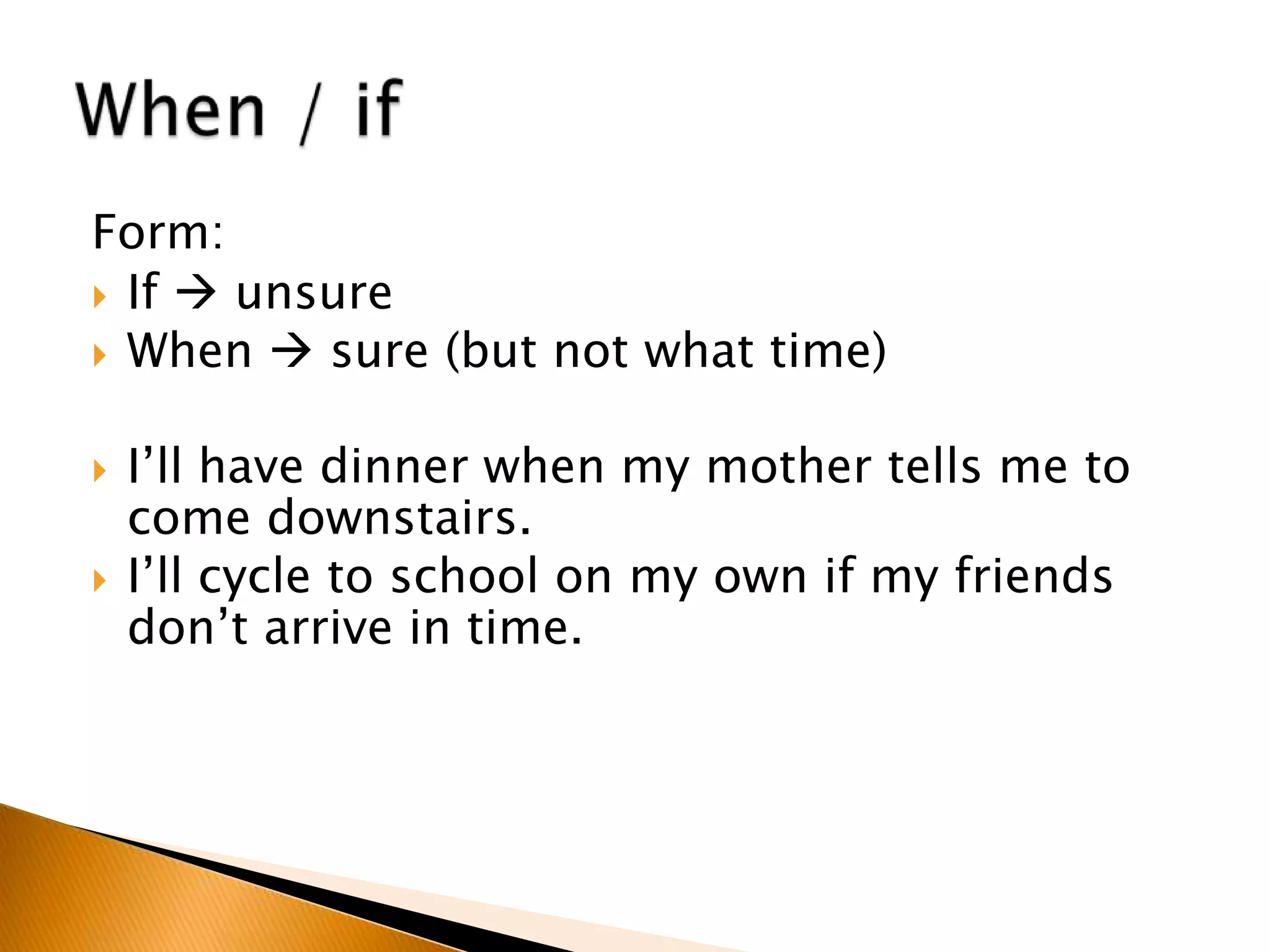
Form:
 If  unsure
 When  sure (but not what time)
 I’ll have dinner when my mother tells me to
come downstairs.
 I’ll cycle to school on my own if my friends
don’t arrive in time.
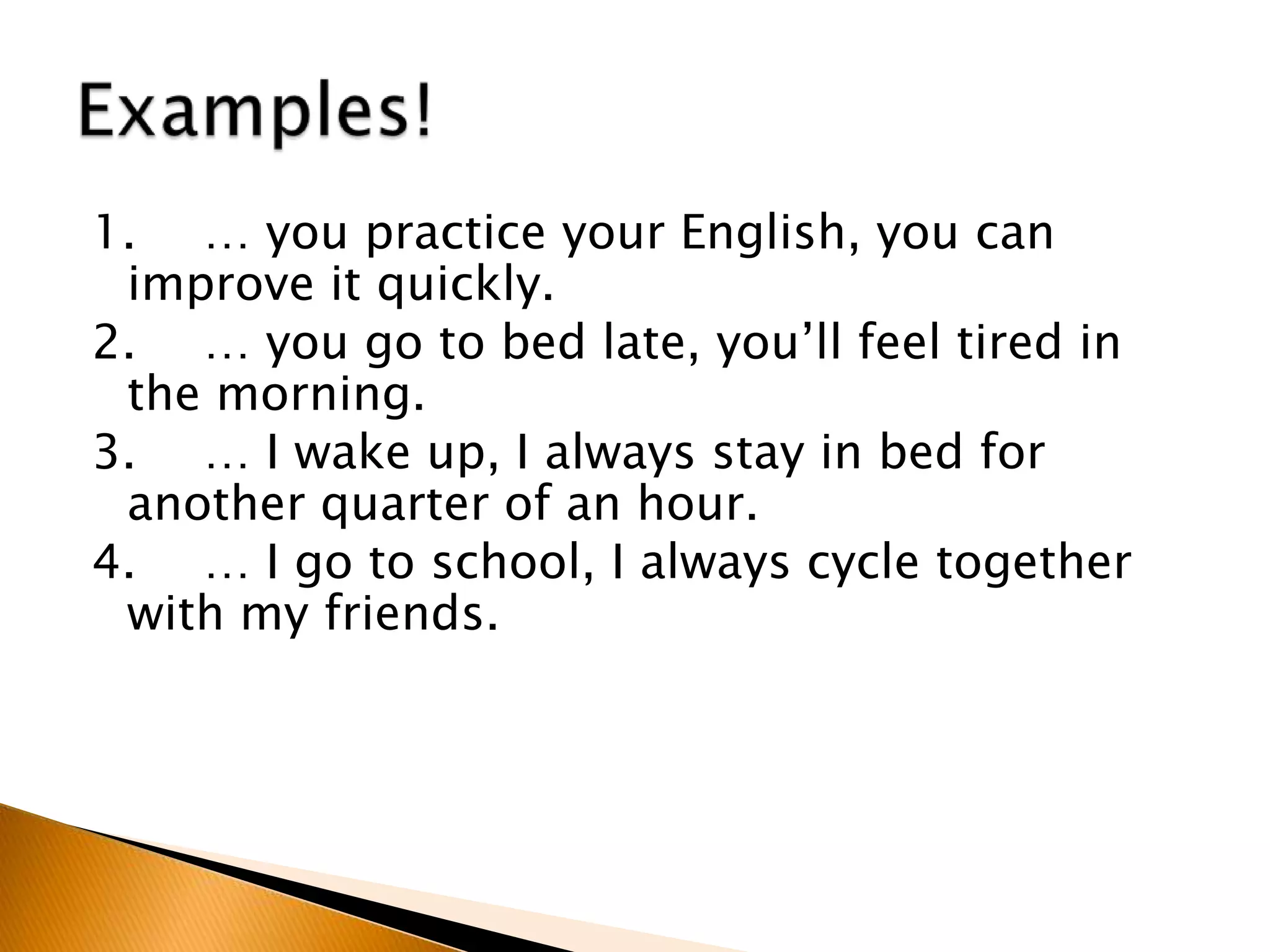
1. … you practice your English, you can
improve it quickly.
2. … you go to bed late, you’ll feel tired in
the morning.
3. … I wake up, I always stay in bed for
another quarter of an hour.
4. … I go to school, I always cycle together
with my friends.
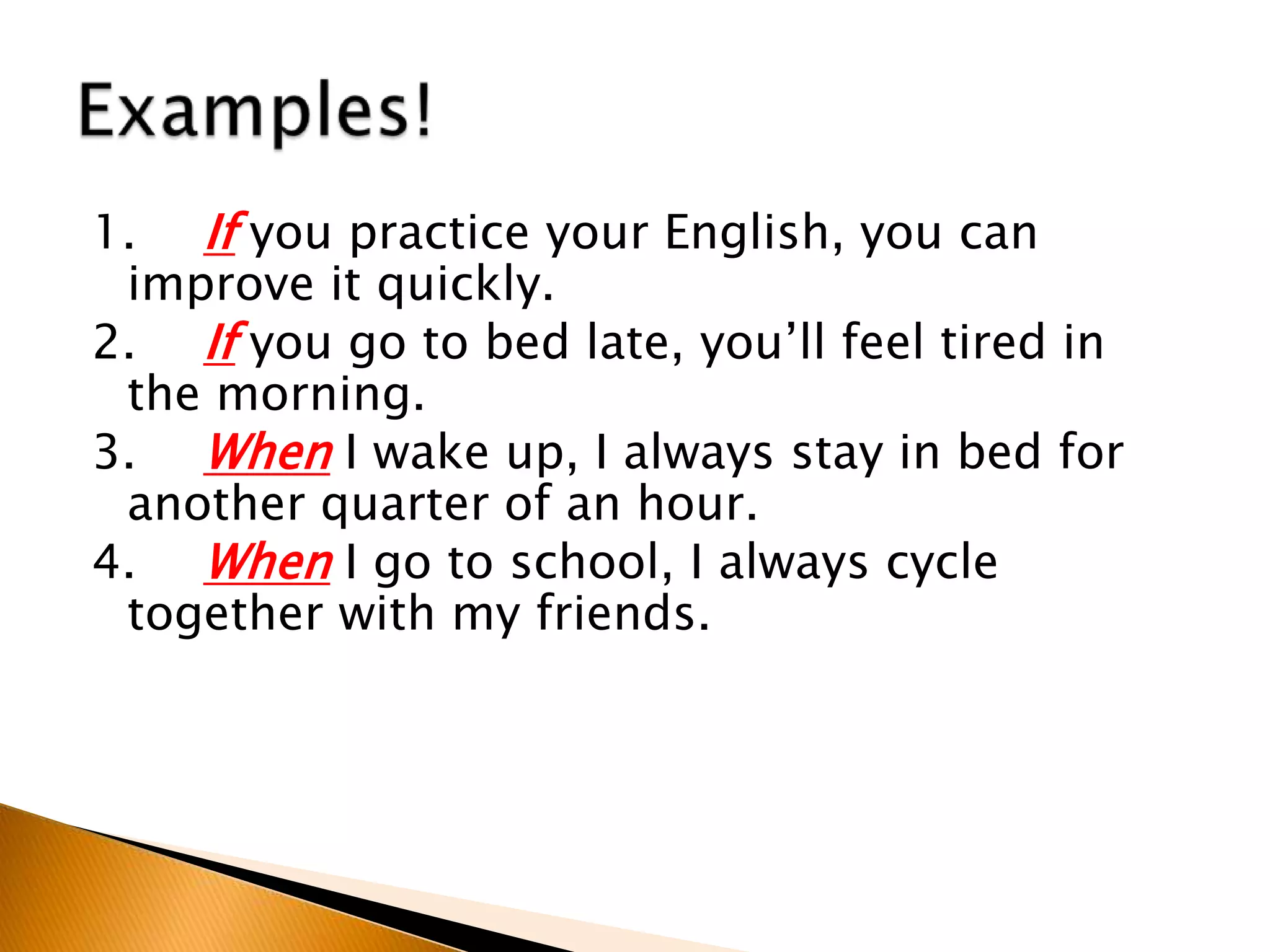
1. If you practice your English, you can
improve it quickly.
2. If you go to bed late, you’ll feel tired in
the morning.
3. When I wake up, I always stay in bed for
another quarter of an hour.
4. When I go to school, I always cycle
together with my friends.
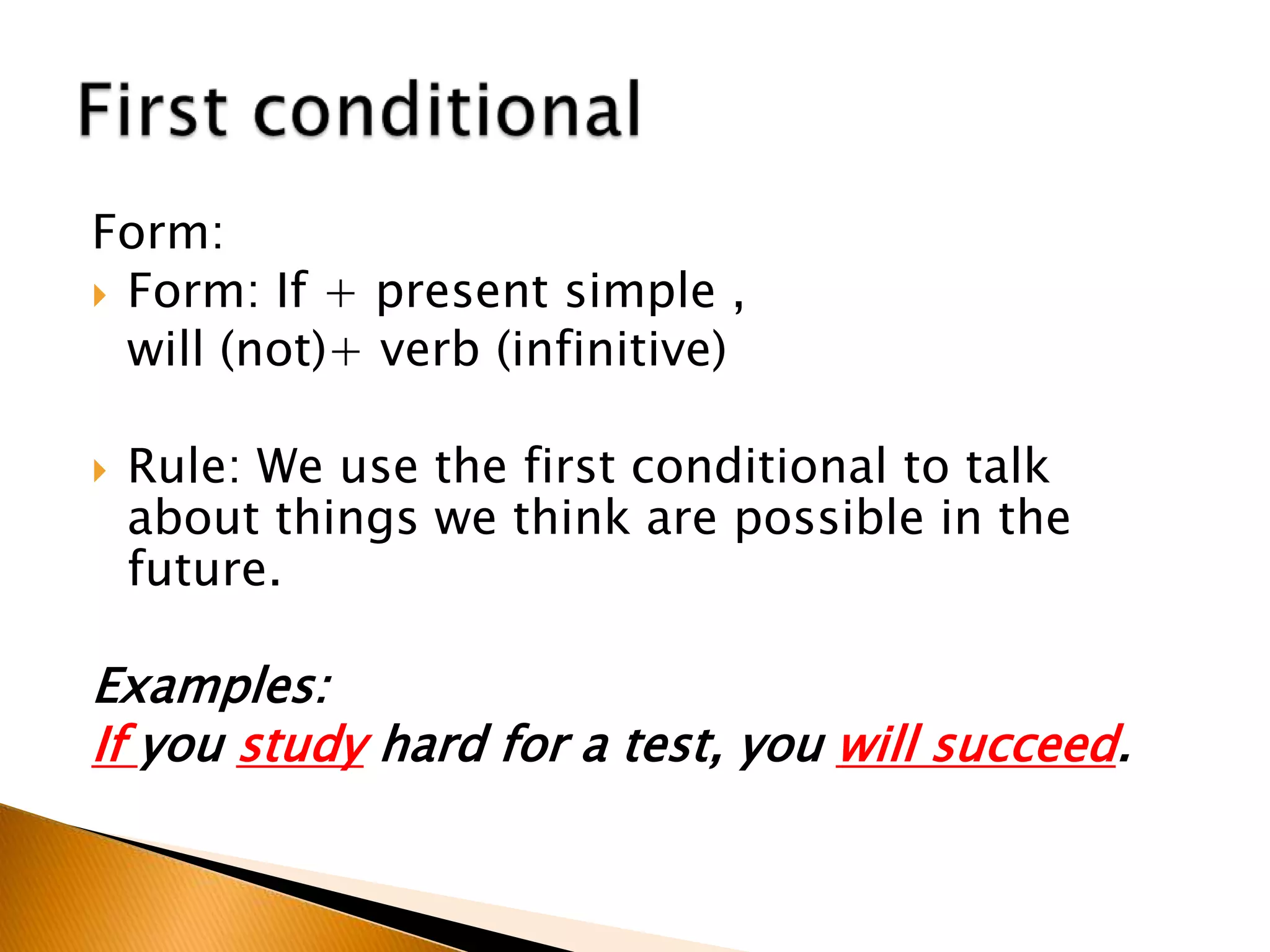
Form:
 Form: If + present simple ,
will (not)+ verb (infinitive)
 Rule: We use the first conditional to talk
about things we think are possible in the
future.
Examples:
If you study hard for a test, you will succeed.
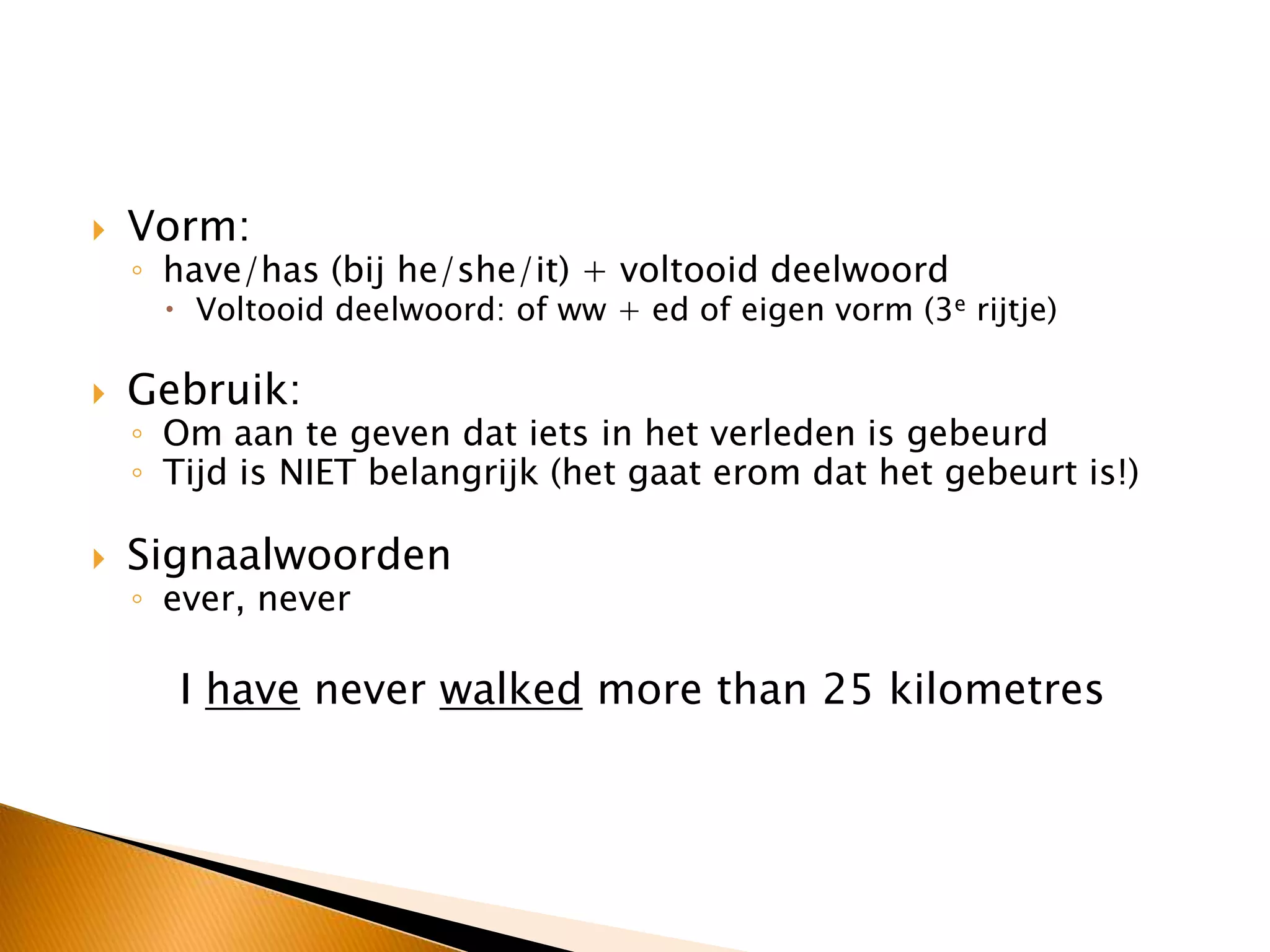
 Vorm:
◦ have/has (bij he/she/it) + voltooid deelwoord
 Voltooid deelwoord: of ww + ed of eigen vorm (3e rijtje)
 Gebruik:
◦ Om aan te geven dat iets in het verleden is gebeurd
◦ Tijd is NIET belangrijk (het gaat erom dat het gebeurt is!)
 Signaalwoorden
◦ ever, never
I have never walked more than 25 kilometres
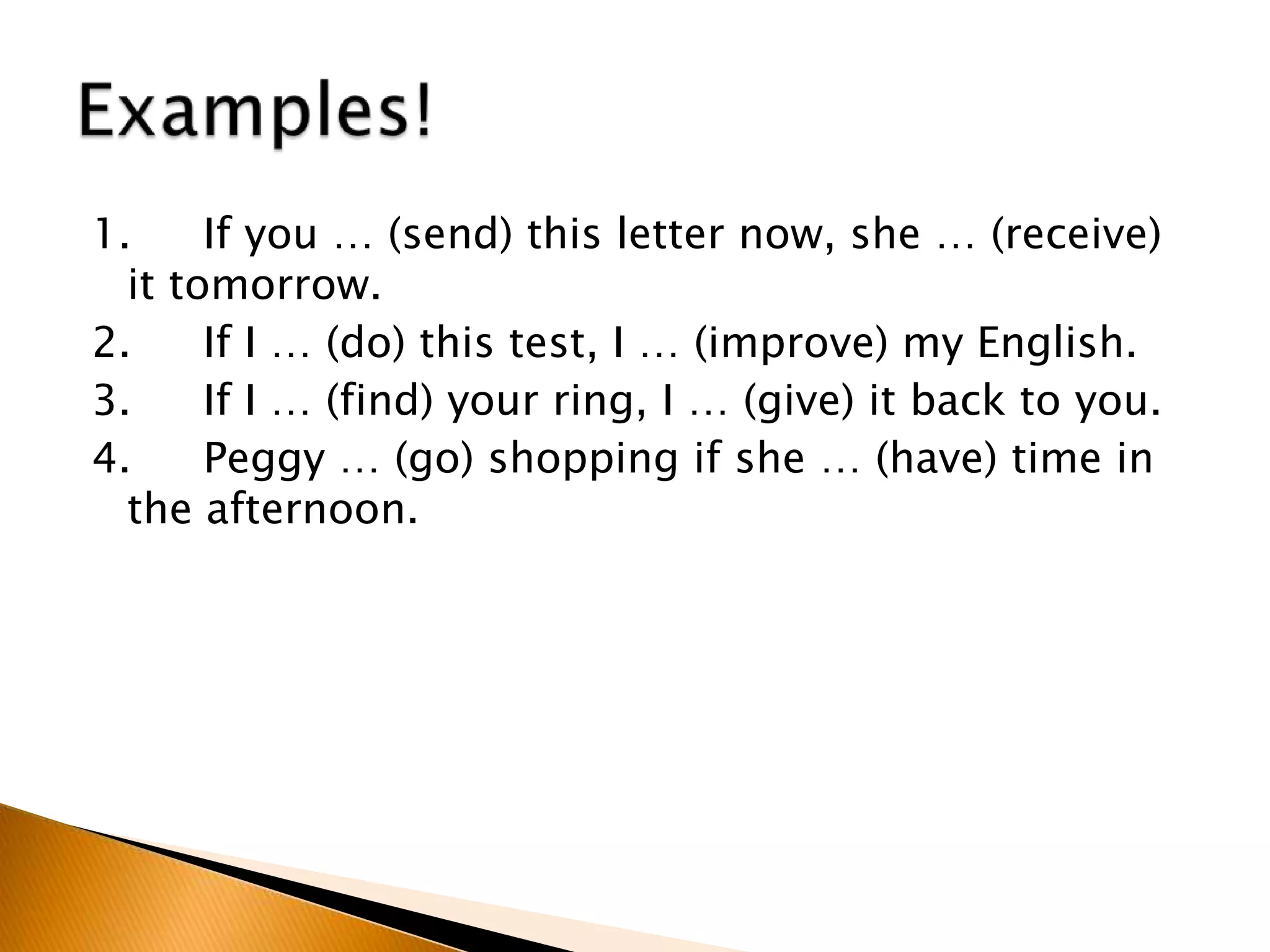
1. If you … (send) this letter now, she … (receive)
it tomorrow.
2. If I … (do) this test, I … (improve) my English.
3. If I … (find) your ring, I … (give) it back to you.
4. Peggy … (go) shopping if she … (have) time in
the afternoon.
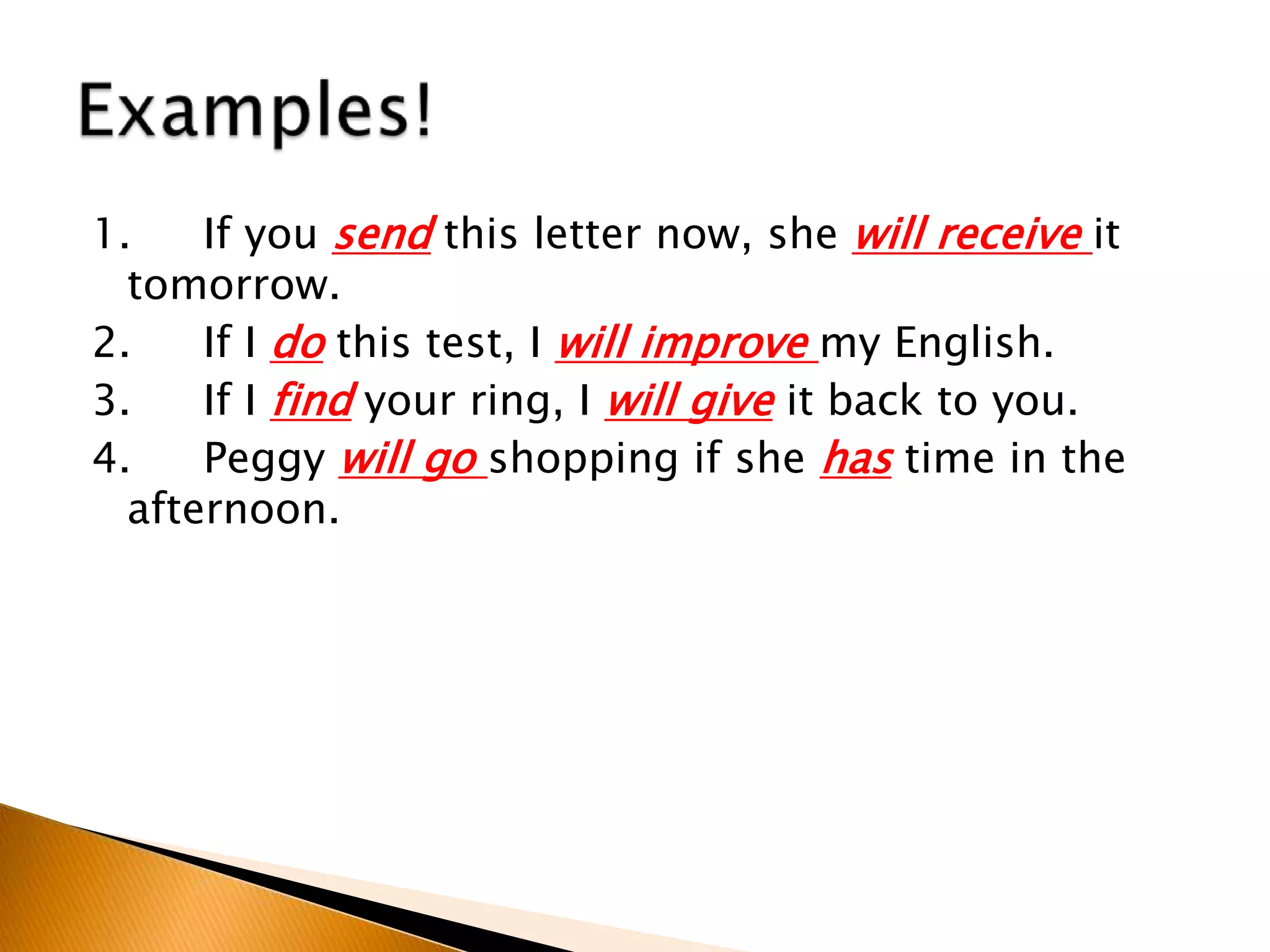
1. If you send this letter now, she will receive it
tomorrow.
2. If I do this test, I will improve my English.
3. If I find your ring, I will give it back to you.
4. Peggy will go shopping if she has time in the
afternoon.
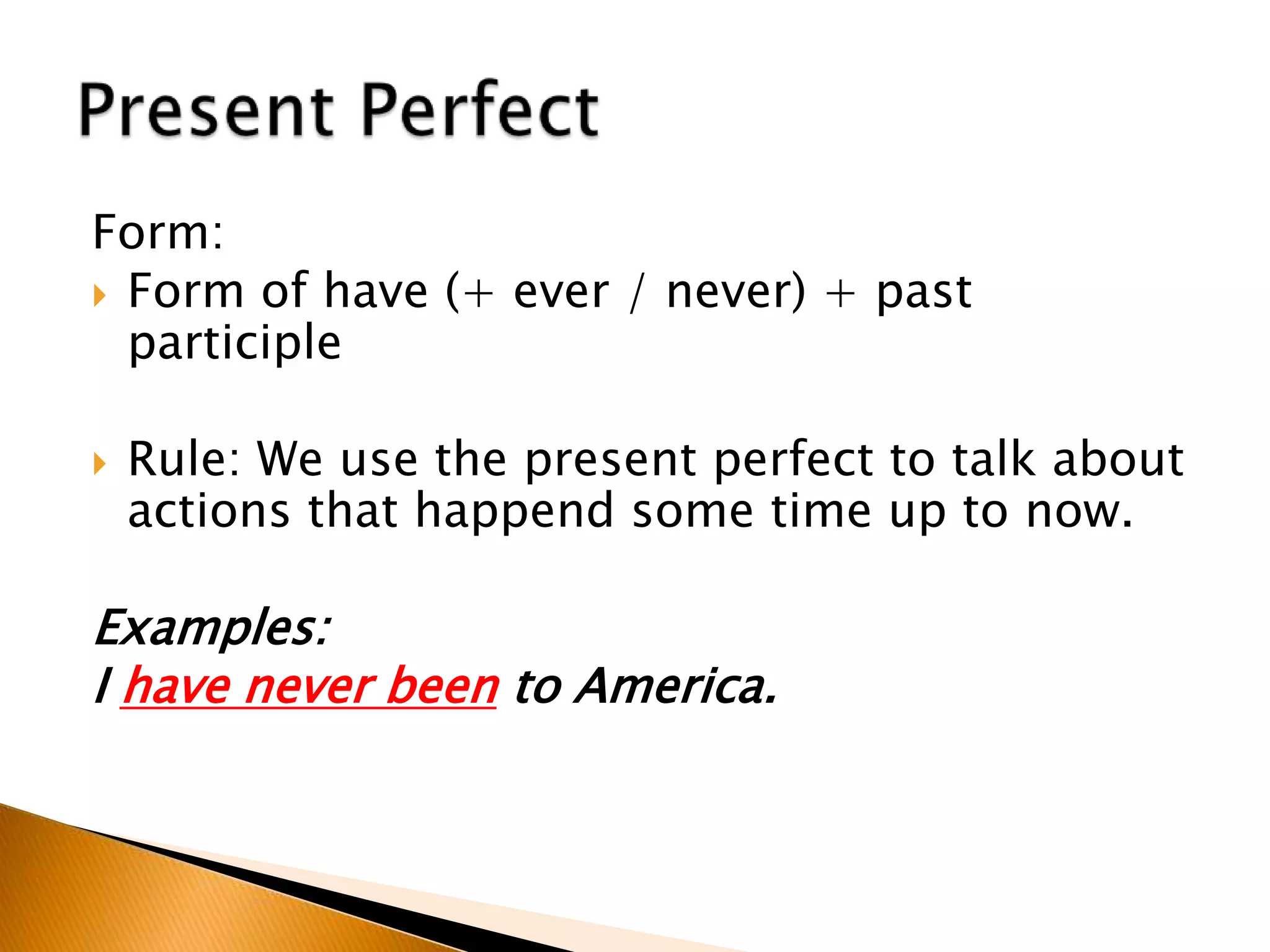
Form:
 Form of have (+ ever / never) + past
participle
 Rule: We use the present perfect to talk about
actions that happend some time up to now.
Examples:
I have never been to America.
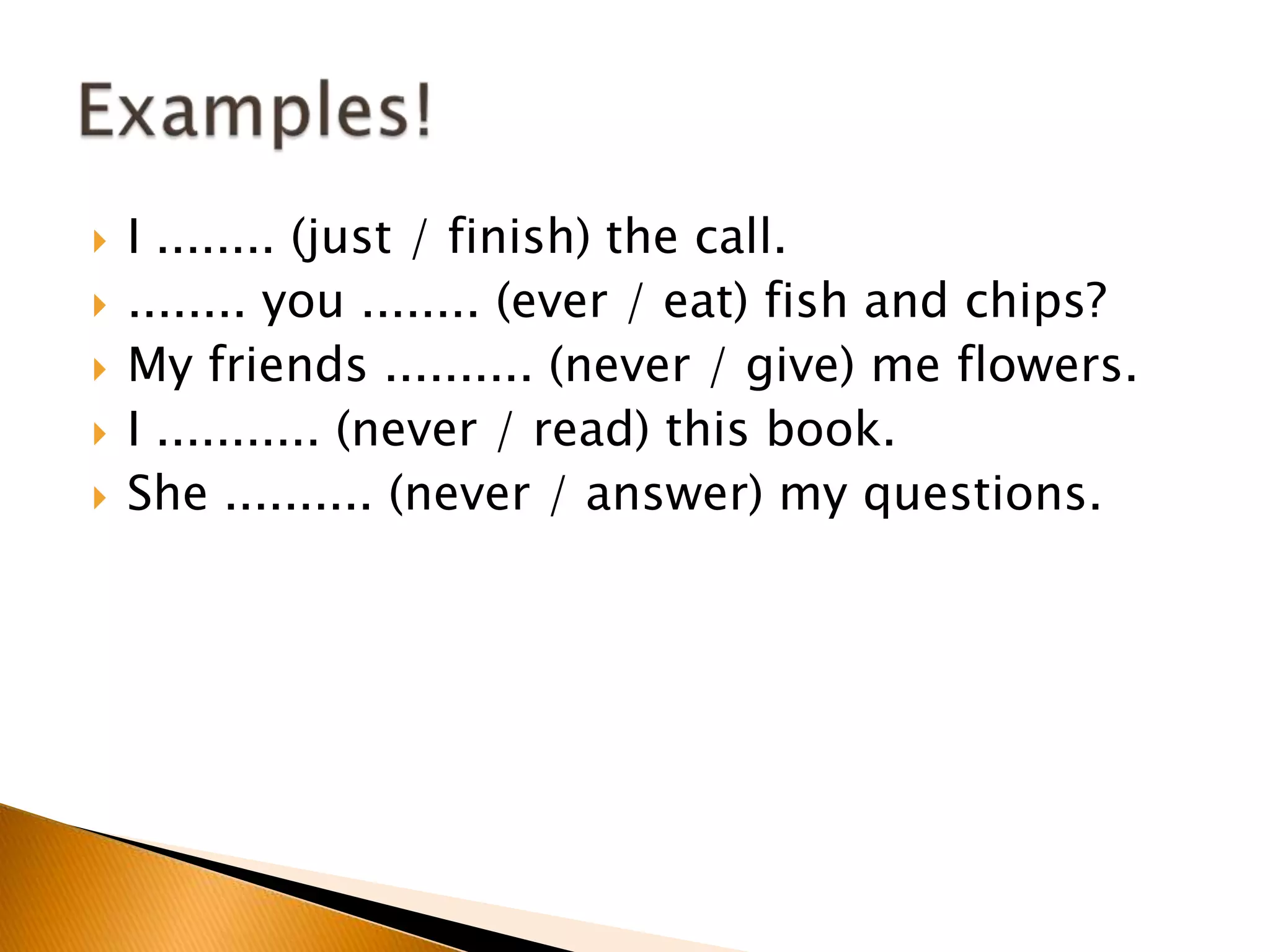
 I ........ (just / finish) the call.
 ........ you ........ (ever / eat) fish and chips?
 My friends .......... (never / give) me flowers.
 I ........... (never / read) this book.
 She .......... (never / answer) my questions.
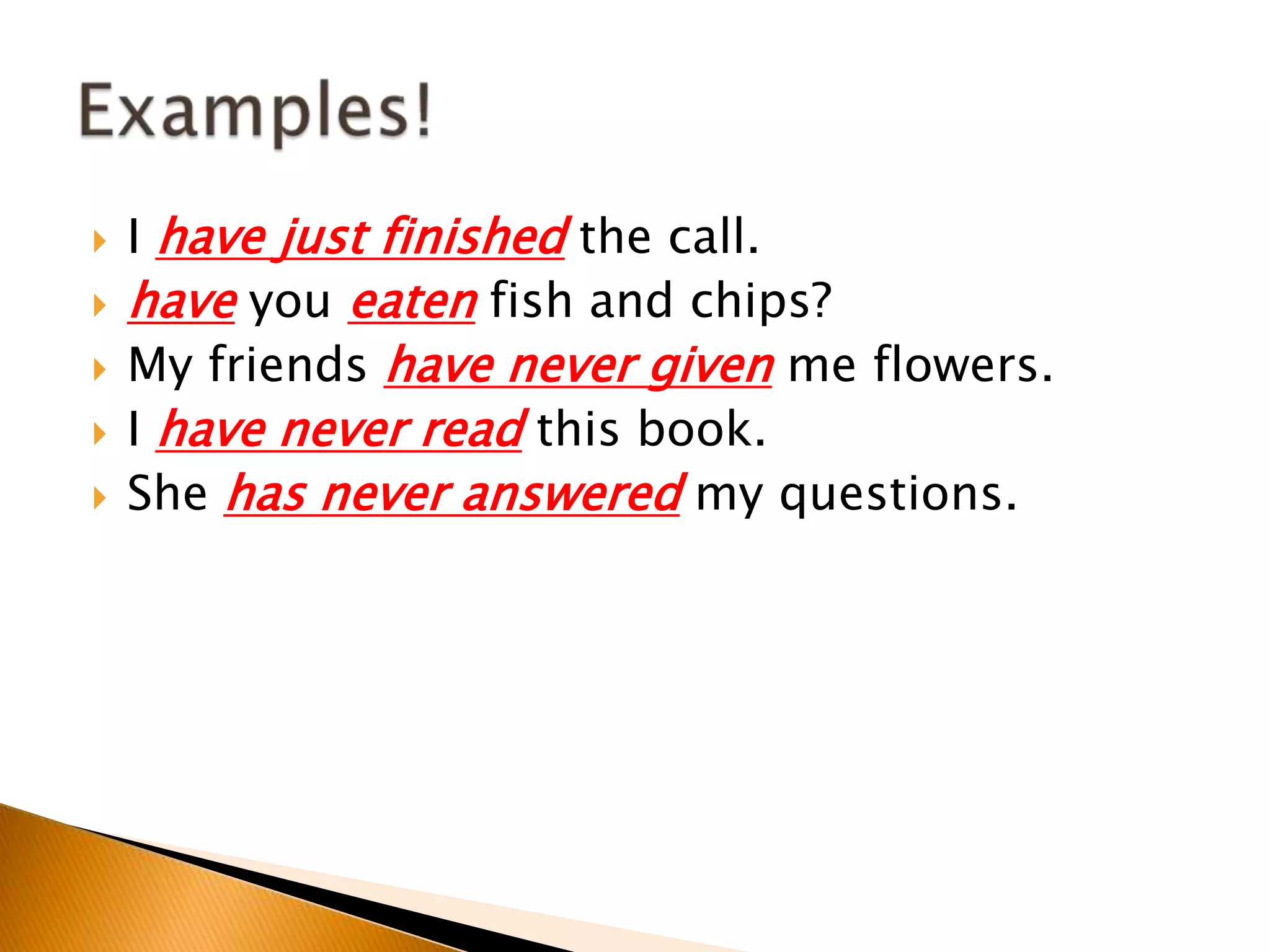
 I have just finished the call.
 have you eaten fish and chips?
 My friends have never given me flowers.
 I have never read this book.
 She has never answered my questions.

Cambridge grammar module 4 (unit 13,14,15,16)

  • 1.
  • 2.
    Form:  Form ofto be + going to + verb (infinitive)  Usage: to talk about intentions / to make predictions  Rule: We use be going to to talk about our intentions in the future. We also use be going to to make predictions based on what we know or can see. Examples: I’m going to eat more fruit. (intention) I think it’s going to be an interesting yeat (prediction)
  • 3.
    1. Mum ...(clean) the car this afternoon. 2. Lisa and Jenny ... (not shop) tomorrow. 3. Hurry up or you ... (miss) the train. 4. After that programme grandfather ... (cook).
  • 4.
    1. Mum isgoing to clean the car this afternoon. 2. Lisa and Jenny are not going to shop tomorrow. 3. Hurry up or you are going to miss the train. 4. After that programme grandfather is going to cook .
  • 5.
    Form:  Must /mustn’t + verb (infinitive)  Rule: We use must when we want to say that it’s important to do something.  We use mustn’t when we want to say that it’s important not to do something. ◦ Must --> moeten ◦ Mustn’t --> niet mogen Examples: I must go to work now. I’m running out of time I mustn’t be rude at my parents.
  • 6.
    1. I ...(do) my homework. 2. Tim and Alex ... (open) the window without asking. 3. We ... (ask) Frank, he knows best. 4. The kids ... (make) their beds.
  • 7.
    1. I mustdo my homework. 2. Tim and Alex mustn’t the window without asking. 3. We must ask Frank, he knows best. 4. The kids must make their beds.
  • 8.
    Form:  will +verb (infinitive)  Usage: to make an offer to help Examples: I’ll give you a hand
  • 9.
    1. Wait, I… (help) you. 2. He … (play) football with you tomorrow. 3. She … (offer) you a drink because she has nothing. 4. I … (go) to the supermarket with you tomorrow, I know you can’t do that alone.
  • 10.
    1. Wait, Iwill help you. 2. He will play football with you tomorrow. 3. She won’t offer you a drink because she has nothing. 4. I will go to the supermarket with you tomorrow, I know you can’t do that alone.
  • 11.
    Form:  Form ofto be + going to + verb (infinitive)  Rule: We use should or shouldn’t to say ‘it’s a good idea’ or ‘It isn’t a good idea.’ ◦ Should --> zou(den) eigenlijk moeten ◦ Shouldnt --> zou(den) eigenlijk niet moeten Examples: You should visit your grandparents every now and then.
  • 12.
    1. They havea test tomorrow. They … (go) to the cinema. They stay at home and study! 2. Children eat lots of vegetables but they … (eat) lots of sweets. 3. I have a party tonight. What … I (wear)? A dress or a pair of trousers? 4. The doctor said: "_ You … (eat) healthy food. You … (eat) fast food. 5. You … (walk) 1 hour a day to keep fit.
  • 13.
    1. They havea test tomorrow. They shouldn’t go to the cinema. They stay at home and study! 2. Children eat lots of vegetables but they shouldn’t eat lots of sweets. 3. I have a party tonight. What should I wear? A dress or a pair of trousers? 4. The doctor said: "_ You should eat healthy food. You shouldn’t eat fast food. 5. You should walk 1 hour a day to keep fit.
  • 14.
    Form:  If unsure  When  sure (but not what time)  I’ll have dinner when my mother tells me to come downstairs.  I’ll cycle to school on my own if my friends don’t arrive in time.
  • 15.
    1. … youpractice your English, you can improve it quickly. 2. … you go to bed late, you’ll feel tired in the morning. 3. … I wake up, I always stay in bed for another quarter of an hour. 4. … I go to school, I always cycle together with my friends.
  • 16.
    1. If youpractice your English, you can improve it quickly. 2. If you go to bed late, you’ll feel tired in the morning. 3. When I wake up, I always stay in bed for another quarter of an hour. 4. When I go to school, I always cycle together with my friends.
  • 17.
    Form:  Form: If+ present simple , will (not)+ verb (infinitive)  Rule: We use the first conditional to talk about things we think are possible in the future. Examples: If you study hard for a test, you will succeed.
  • 18.
     Vorm: ◦ have/has(bij he/she/it) + voltooid deelwoord  Voltooid deelwoord: of ww + ed of eigen vorm (3e rijtje)  Gebruik: ◦ Om aan te geven dat iets in het verleden is gebeurd ◦ Tijd is NIET belangrijk (het gaat erom dat het gebeurt is!)  Signaalwoorden ◦ ever, never I have never walked more than 25 kilometres
  • 19.
    1. If you… (send) this letter now, she … (receive) it tomorrow. 2. If I … (do) this test, I … (improve) my English. 3. If I … (find) your ring, I … (give) it back to you. 4. Peggy … (go) shopping if she … (have) time in the afternoon.
  • 20.
    1. If yousend this letter now, she will receive it tomorrow. 2. If I do this test, I will improve my English. 3. If I find your ring, I will give it back to you. 4. Peggy will go shopping if she has time in the afternoon.
  • 21.
    Form:  Form ofhave (+ ever / never) + past participle  Rule: We use the present perfect to talk about actions that happend some time up to now. Examples: I have never been to America.
  • 22.
     I ........(just / finish) the call.  ........ you ........ (ever / eat) fish and chips?  My friends .......... (never / give) me flowers.  I ........... (never / read) this book.  She .......... (never / answer) my questions.
  • 23.
     I havejust finished the call.  have you eaten fish and chips?  My friends have never given me flowers.  I have never read this book.  She has never answered my questions.