Grammar Unit 1 HD 1.1 t/m 1.9
1.1 Present Simple <--> Present Continuous Present Simple Vorm: hele werkwoord. SHIT-rule: + s Gebruik: feit, gewoonte Signaalwoorden: always, usually, often, never, every day/week etc.  He eats an apple every day Present Continuous Vorm: ‘to be’ + hele werkwoord + ING Gebruik: nu aan de gang, nu bezig Signaalwoorden: at the moment, (right) now, currently He is eating an apple right now
Examples 1. My dad usually ...  (play)  tennis, but at the moment he ...  (do)  a hang-gliding course in Bristol. 2. My little brother always ...  (have to)  go to bed at seven, but right now it's eight o' clock and he ...  (still play)  outside! 3. Where's Linda? - Over there, she ...  (buy)  some souvenirs. 4. My sister always ...  (think)  there are more important things than homework. Right now, for example, she ...  (chat)  with her best friend. 5. Joseph, what ... you ...  (watch) ? - Can't you see? This is  The Weakest Link . I always ...  (watch)  this programme on Wednesdays. 6. I usually ...  (stay)  in England during the summer holidays, but at the moment I ...  (plan)  a trip to America for a change.
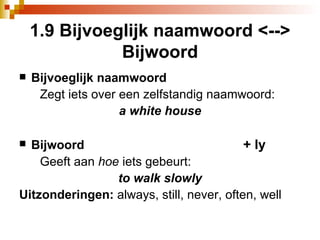
1.9 Bijvoeglijk naamwoord <--> Bijwoord Bijvoeglijk naamwoord Zegt iets over een zelfstandig naamwoord:  a white house Bijwoord + ly Geeft aan  hoe  iets gebeurt:  to walk slowly Uitzonderingen:  always, still, never, often, well
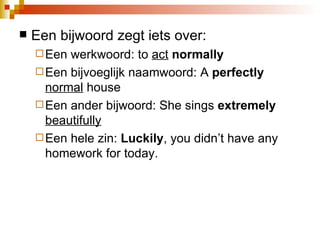
Een bijwoord zegt iets over:  Een werkwoord: to  act   normal ly Een bijvoeglijk naamwoord: A  perfect ly   normal  house Een ander bijwoord: She sings  extreme ly   beautifully   Een hele zin:  Lucki ly , you didn’t have any homework for today.
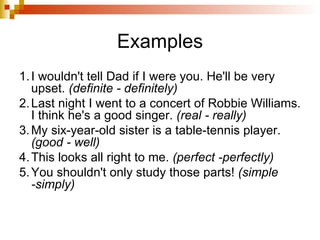
Examples 1. I wouldn't tell Dad if I were you. He'll be very upset.  (definite - definitely) 2. Last night I went to a concert of Robbie Williams. I think he's a good singer.  (real - really) 3. My six-year-old sister is a table-tennis player.  (good - well) 4. This looks all right to me.  (perfect -perfectly) 5. You shouldn't only study those parts!  (simple -simply)
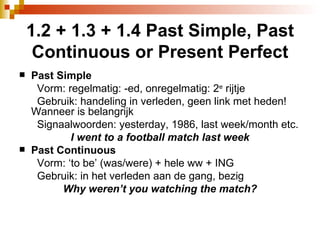
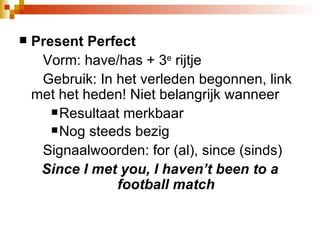
1.2 + 1.3 + 1.4 Past Simple, Past Continuous or Present Perfect Past Simple Vorm: regelmatig: -ed, onregelmatig: 2 e  rijtje  Gebruik: handeling in verleden, geen link met heden!  Wanneer is belangrijk Signaalwoorden: yesterday, 1986, last week/month etc.  I went to a football match last week Past Continuous Vorm: ‘to be’ (was/were) + hele ww + ING Gebruik: in het verleden aan de gang, bezig Why weren’t you watching the match?
Present Perfect Vorm: have/has + 3 e  rijtje  Gebruik: In het verleden begonnen, link met het heden! Niet belangrijk wanneer Resultaat merkbaar Nog steeds bezig Signaalwoorden: for (al), since (sinds)  Since I met you, I haven’t been to a football match
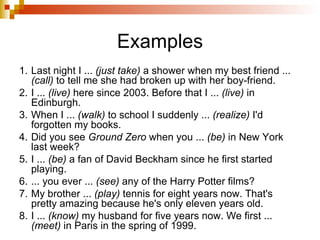
Examples 1. Last night I ...  (just take)  a shower when my best friend ...  (call)  to tell me she had broken up with her boy-friend. 2. I ...  (live)  here since 2003. Before that I ...  (live)  in Edinburgh. 3. When I ...  (walk)  to school I suddenly ...  (realize)  I'd forgotten my books. 4. Did you see  Ground Zero  when you ...  (be)  in New York last week? 5. I ...  (be)  a fan of David Beckham since he first started playing. 6. ... you ever ...  (see)  any of the Harry Potter films? 7. My brother ...  (play)  tennis for eight years now. That's pretty amazing because he's only eleven years old. 8. I ...  (know)  my husband for five years now. We first ...  (meet)  in Paris in the spring of 1999.
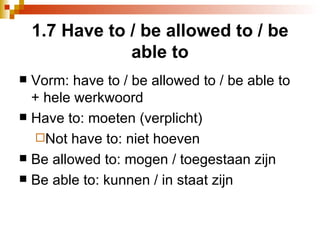
1.7 Have to / be allowed to / be able to Vorm: have to / be allowed to / be able to + hele werkwoord Have to: moeten (verplicht) Not have to: niet hoeven Be allowed to: mogen / toegestaan zijn Be able to: kunnen / in staat zijn
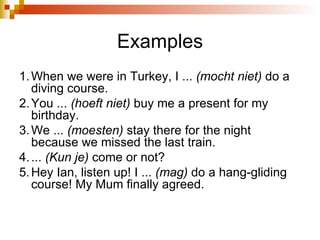
Examples 1. When we were in Turkey, I ...  (mocht niet)  do a diving course. 2. You ...  (hoeft niet)  buy me a present for my birthday. 3. We ...  (moesten)  stay there for the night because we missed the last train. 4. ...  (Kun je)  come or not? 5. Hey Ian, listen up! I ...  (mag)  do a hang-gliding course! My Mum finally agreed.
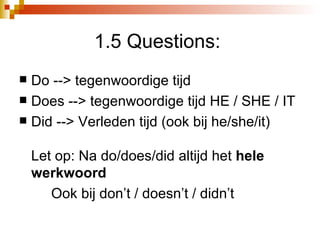
1.5 Questions:  Do --> tegenwoordige tijd  Does --> tegenwoordige tijd HE / SHE / IT Did --> Verleden tijd (ook bij he/she/it) Let op: Na do/does/did altijd het  hele werkwoord Ook bij don’t / doesn’t / didn’t
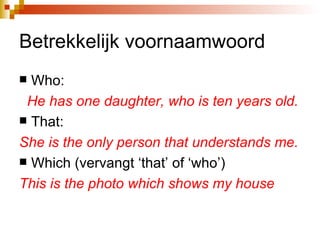
Betrekkelijk voornaamwoord Who: He has one daughter, who is ten years old.   That: She is the only person that understands me. Which (vervangt ‘that’ of ‘who’) This is the photo which shows my house

Grammatica unit 1 klas3

  • 1.
    Grammar Unit 1HD 1.1 t/m 1.9
  • 2.
    1.1 Present Simple<--> Present Continuous Present Simple Vorm: hele werkwoord. SHIT-rule: + s Gebruik: feit, gewoonte Signaalwoorden: always, usually, often, never, every day/week etc. He eats an apple every day Present Continuous Vorm: ‘to be’ + hele werkwoord + ING Gebruik: nu aan de gang, nu bezig Signaalwoorden: at the moment, (right) now, currently He is eating an apple right now
  • 3.
    Examples 1. Mydad usually ... (play) tennis, but at the moment he ... (do) a hang-gliding course in Bristol. 2. My little brother always ... (have to) go to bed at seven, but right now it's eight o' clock and he ... (still play) outside! 3. Where's Linda? - Over there, she ... (buy) some souvenirs. 4. My sister always ... (think) there are more important things than homework. Right now, for example, she ... (chat) with her best friend. 5. Joseph, what ... you ... (watch) ? - Can't you see? This is The Weakest Link . I always ... (watch) this programme on Wednesdays. 6. I usually ... (stay) in England during the summer holidays, but at the moment I ... (plan) a trip to America for a change.
  • 4.
    1.9 Bijvoeglijk naamwoord<--> Bijwoord Bijvoeglijk naamwoord Zegt iets over een zelfstandig naamwoord: a white house Bijwoord + ly Geeft aan hoe iets gebeurt: to walk slowly Uitzonderingen: always, still, never, often, well
  • 5.
    Een bijwoord zegtiets over: Een werkwoord: to act normal ly Een bijvoeglijk naamwoord: A perfect ly normal house Een ander bijwoord: She sings extreme ly beautifully Een hele zin: Lucki ly , you didn’t have any homework for today.
  • 6.
    Examples 1. Iwouldn't tell Dad if I were you. He'll be very upset. (definite - definitely) 2. Last night I went to a concert of Robbie Williams. I think he's a good singer. (real - really) 3. My six-year-old sister is a table-tennis player. (good - well) 4. This looks all right to me. (perfect -perfectly) 5. You shouldn't only study those parts! (simple -simply)
  • 7.
    1.2 + 1.3+ 1.4 Past Simple, Past Continuous or Present Perfect Past Simple Vorm: regelmatig: -ed, onregelmatig: 2 e rijtje Gebruik: handeling in verleden, geen link met heden! Wanneer is belangrijk Signaalwoorden: yesterday, 1986, last week/month etc. I went to a football match last week Past Continuous Vorm: ‘to be’ (was/were) + hele ww + ING Gebruik: in het verleden aan de gang, bezig Why weren’t you watching the match?
  • 8.
    Present Perfect Vorm:have/has + 3 e rijtje Gebruik: In het verleden begonnen, link met het heden! Niet belangrijk wanneer Resultaat merkbaar Nog steeds bezig Signaalwoorden: for (al), since (sinds) Since I met you, I haven’t been to a football match
  • 9.
    Examples 1. Lastnight I ... (just take) a shower when my best friend ... (call) to tell me she had broken up with her boy-friend. 2. I ... (live) here since 2003. Before that I ... (live) in Edinburgh. 3. When I ... (walk) to school I suddenly ... (realize) I'd forgotten my books. 4. Did you see Ground Zero when you ... (be) in New York last week? 5. I ... (be) a fan of David Beckham since he first started playing. 6. ... you ever ... (see) any of the Harry Potter films? 7. My brother ... (play) tennis for eight years now. That's pretty amazing because he's only eleven years old. 8. I ... (know) my husband for five years now. We first ... (meet) in Paris in the spring of 1999.
  • 10.
    1.7 Have to/ be allowed to / be able to Vorm: have to / be allowed to / be able to + hele werkwoord Have to: moeten (verplicht) Not have to: niet hoeven Be allowed to: mogen / toegestaan zijn Be able to: kunnen / in staat zijn
  • 11.
    Examples 1. Whenwe were in Turkey, I ... (mocht niet) do a diving course. 2. You ... (hoeft niet) buy me a present for my birthday. 3. We ... (moesten) stay there for the night because we missed the last train. 4. ... (Kun je) come or not? 5. Hey Ian, listen up! I ... (mag) do a hang-gliding course! My Mum finally agreed.
  • 12.
    1.5 Questions: Do --> tegenwoordige tijd Does --> tegenwoordige tijd HE / SHE / IT Did --> Verleden tijd (ook bij he/she/it) Let op: Na do/does/did altijd het hele werkwoord Ook bij don’t / doesn’t / didn’t
  • 13.
    Betrekkelijk voornaamwoord Who:He has one daughter, who is ten years old. That: She is the only person that understands me. Which (vervangt ‘that’ of ‘who’) This is the photo which shows my house