adverb  +  adjective noun  +  noun
adverbs can  indicate  strength
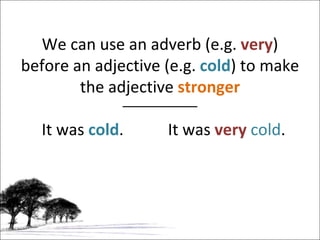
We can use an adverb (e.g.  very ) before an adjective (e.g.  cold ) to make the adjective  stronger
We can use an adverb (e.g.  very ) before an adjective (e.g.  cold ) to make the adjective  stronger It was  cold .
We can use an adverb (e.g.  very ) before an adjective (e.g.  cold ) to make the adjective  stronger It was  cold . It was  very   cold .
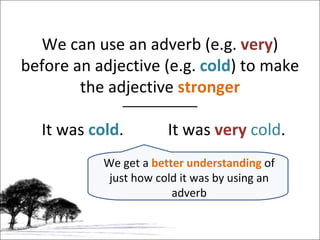
We can use an adverb (e.g.  very ) before an adjective (e.g.  cold ) to make the adjective  stronger It was  cold . It was  very   cold . We get a  better understanding  of just how cold it was by using an adverb
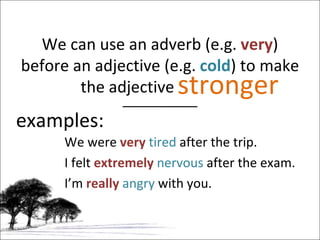
We can use an adverb (e.g.  very ) before an adjective (e.g.  cold ) to make the adjective  stronger stronger We were  very  tired  after the trip. I felt  extremely  nervous  after the exam. I’m  really  angry  with you. examples:
adverbs can  show  weakness
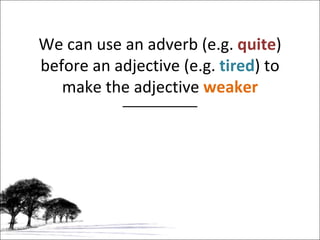
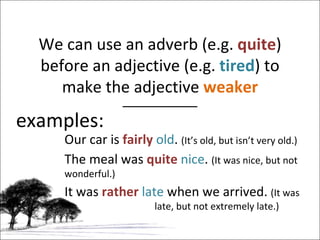
We can use an adverb (e.g.  quite ) before an adjective (e.g.  tired ) to make the adjective  weaker
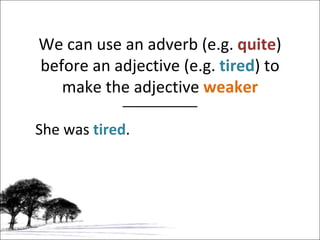
We can use an adverb (e.g.  quite ) before an adjective (e.g.  tired ) to make the adjective  weaker She was  tired .
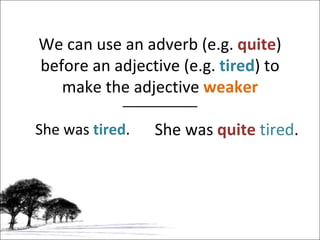
We can use an adverb (e.g.  quite ) before an adjective (e.g.  tired ) to make the adjective  weaker She was  tired . She was  quite   tired .
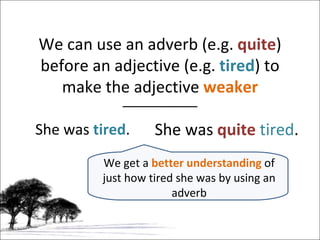
We can use an adverb (e.g.  quite ) before an adjective (e.g.  tired ) to make the adjective  weaker She was  tired . She was  quite   tired . We get a  better understanding  of just how tired she was by using an adverb
We can use an adverb (e.g.  quite ) before an adjective (e.g.  tired ) to make the adjective  weaker Our car is  fairly  old .  (It’s old, but isn’t very old.) The meal was  quite  nice .  (It was nice, but not wonderful.) It was  rather  late  when we arrived.  (It was  late, but not extremely late.) examples:
multiple adjectives  may be used
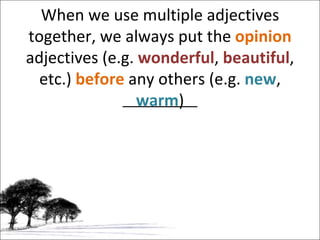
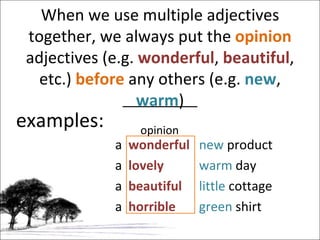
When we use multiple adjectives together, we always put the  opinion  adjectives (e.g.  wonderful ,  beautiful , etc.)  before  any others (e.g.  new ,  warm )
When we use multiple adjectives together, we always put the  opinion  adjectives (e.g.  wonderful ,  beautiful , etc.)  before  any others (e.g.  new ,  warm ) examples: a  wonderful   new  product a  lovely   warm  day a  beautiful   little  cottage a  horrible   green  shirt opinion
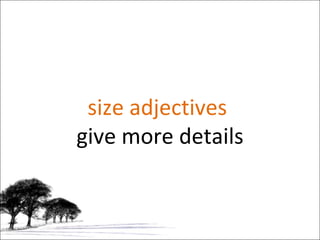
size adjectives  give more details
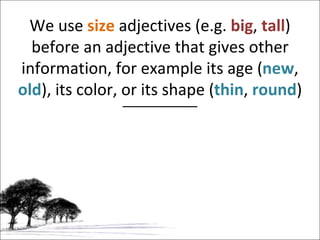
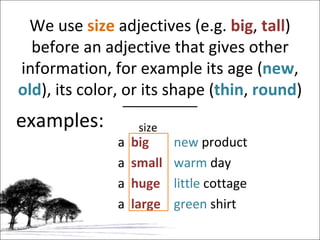
We use  size   adjectives (e.g.  big ,  tall ) before an adjective that gives other information, for example its age ( new ,  old ), its color, or its shape ( thin ,   round )
examples: We use  size  adjectives (e.g.  big ,  tall ) before an adjective that gives other information, for example its age ( new ,  old ), its color, or its shape ( thin ,   round ) a  big new  product a  small warm  day a  huge little  cottage a  large green  shirt size
finally
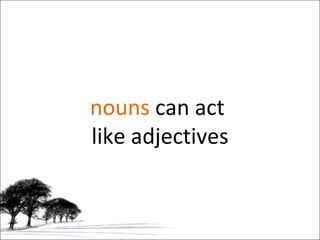
nouns  can act  like adjectives
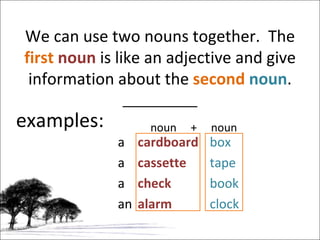
We can use two nouns together.  The  first   noun  is like an adjective and give information about the  second  noun .
examples: We can use two nouns together.  The  first   noun  is like an adjective and give information about the  second  noun . a  cardboard box a  cassette tape a  check book an  alarm clock noun  +  noun
works cited Coe, Norman, Mark Harrison, and Ken Paterson .  Oxford Practice Grammar Basic with Answers . Oxford, England: Oxford  University Press, 2006.

Grammar - Adverb + Adjective; Noun + Noun

  • 1.
    adverb + adjective noun + noun
  • 2.
    adverbs can indicate strength
  • 3.
    We can usean adverb (e.g. very ) before an adjective (e.g. cold ) to make the adjective stronger
  • 4.
    We can usean adverb (e.g. very ) before an adjective (e.g. cold ) to make the adjective stronger It was cold .
  • 5.
    We can usean adverb (e.g. very ) before an adjective (e.g. cold ) to make the adjective stronger It was cold . It was very cold .
  • 6.
    We can usean adverb (e.g. very ) before an adjective (e.g. cold ) to make the adjective stronger It was cold . It was very cold . We get a better understanding of just how cold it was by using an adverb
  • 7.
    We can usean adverb (e.g. very ) before an adjective (e.g. cold ) to make the adjective stronger stronger We were very tired after the trip. I felt extremely nervous after the exam. I’m really angry with you. examples:
  • 8.
    adverbs can show weakness
  • 9.
    We can usean adverb (e.g. quite ) before an adjective (e.g. tired ) to make the adjective weaker
  • 10.
    We can usean adverb (e.g. quite ) before an adjective (e.g. tired ) to make the adjective weaker She was tired .
  • 11.
    We can usean adverb (e.g. quite ) before an adjective (e.g. tired ) to make the adjective weaker She was tired . She was quite tired .
  • 12.
    We can usean adverb (e.g. quite ) before an adjective (e.g. tired ) to make the adjective weaker She was tired . She was quite tired . We get a better understanding of just how tired she was by using an adverb
  • 13.
    We can usean adverb (e.g. quite ) before an adjective (e.g. tired ) to make the adjective weaker Our car is fairly old . (It’s old, but isn’t very old.) The meal was quite nice . (It was nice, but not wonderful.) It was rather late when we arrived. (It was late, but not extremely late.) examples:
  • 14.
  • 15.
    When we usemultiple adjectives together, we always put the opinion adjectives (e.g. wonderful , beautiful , etc.) before any others (e.g. new , warm )
  • 16.
    When we usemultiple adjectives together, we always put the opinion adjectives (e.g. wonderful , beautiful , etc.) before any others (e.g. new , warm ) examples: a wonderful new product a lovely warm day a beautiful little cottage a horrible green shirt opinion
  • 17.
    size adjectives give more details
  • 18.
    We use size adjectives (e.g. big , tall ) before an adjective that gives other information, for example its age ( new , old ), its color, or its shape ( thin , round )
  • 19.
    examples: We use size adjectives (e.g. big , tall ) before an adjective that gives other information, for example its age ( new , old ), its color, or its shape ( thin , round ) a big new product a small warm day a huge little cottage a large green shirt size
  • 20.
  • 21.
    nouns canact like adjectives
  • 22.
    We can usetwo nouns together. The first noun is like an adjective and give information about the second noun .
  • 23.
    examples: We canuse two nouns together. The first noun is like an adjective and give information about the second noun . a cardboard box a cassette tape a check book an alarm clock noun + noun
  • 24.
    works cited Coe,Norman, Mark Harrison, and Ken Paterson . Oxford Practice Grammar Basic with Answers . Oxford, England: Oxford University Press, 2006.