15/12/151
The present simple
 Affirmative
 Negative
?? Interrogative
 Spelling
 Exercises
15/12/152
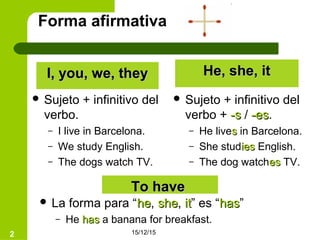
Forma afirmativa
I, you, we, theyI, you, we, they He, she, itHe, she, it
 Sujeto + infinitivo del
verbo.
– I live in Barcelona.
– We study English.
– The dogs watch TV.
 Sujeto + infinitivo del
verbo + -s-s / -es-es.
– He livess in Barcelona.
– She studiesies English.
– The dog watcheses TV.
To haveTo have
 La forma para “hehe, sheshe, itit” es “hashas”
– He hashas a banana for breakfast.
15/12/153
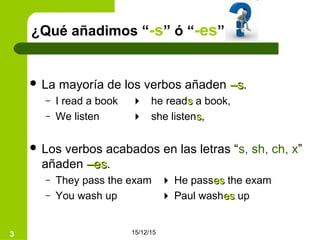
¿Qué añadimos “-s” ó “-es”
 La mayoría de los verbos añaden –s–s.
– I read a book  he readss a book,
– We listen  she listenss,
 Los verbos acabados en las letras “s, sh, ch, x”
añaden –es–es.
– They pass the exam  He passeses the exam
– You wash up  Paul washeses up
15/12/154
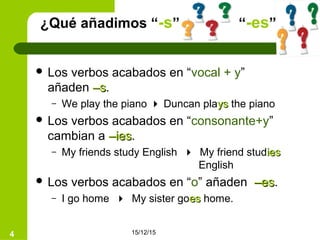
¿Qué añadimos “-s” “-es”?
 Los verbos acabados en “vocal + y”
añaden –s–s.
– We play the piano  Duncan playsys the piano
 Los verbos acabados en “consonante+y”
cambian a –ies–ies.
– My friends study English  My friend studiesies
English
 Los verbos acabados en “o” añaden –es–es.
– I go home  My sister goeses home.
How do you pronounce “–s” ?
15/12/155
15/12/156
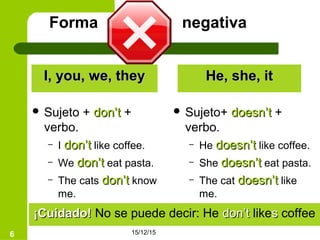
Forma negativa
I, you, we, theyI, you, we, they He, she, itHe, she, it
 Sujeto + don’tdon’t +
verbo.
– I don’tdon’t like coffee.
– We don’tdon’t eat pasta.
– The cats don’tdon’t know
me.
 Sujeto+ doesn’tdoesn’t +
verbo.
– He doesn’tdoesn’t like coffee.
– She doesn’tdoesn’t eat pasta.
– The cat doesn’tdoesn’t like
me.
¡Cuidado!¡Cuidado! No se puede decir: He don’tdon’t likess coffee
15/12/157
Look at the table and and write sentences:
Ann plays tennis but she doesn’t play cardsAnn plays tennis but she doesn’t play cards
Tennis Chess Cards Cooks Piano
Anne  XX XX  XX
Pete XX   XX 
Joe XX XX   XX
Sarah   XX  XX
You
15/12/158
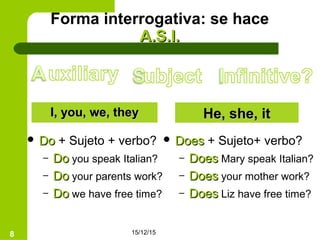
Forma interrogativa: se hace
A.S.I.A.S.I.
I, you, we, theyI, you, we, they He, she, itHe, she, it
 DoDo + Sujeto + verbo?
– DoDo you speak Italian?
– DoDo your parents work?
– DoDo we have free time?
 DoesDoes + Sujeto+ verbo?
– DoesDoes Mary speak Italian?
– DoesDoes your mother work?
– DoesDoes Liz have free time?
15/12/159
 They live in a flat.  Do they live in a flat?
¡¡CuidadoCuidado!! No se puede decir: DoDo Mary speakss Italian?
?? Interrogative Affirmative
 He works in a bank.  Does he work in a
bank?
15/12/1510
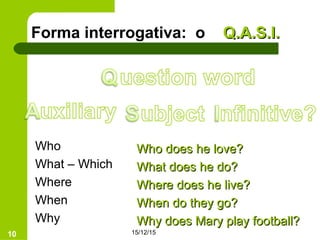
Forma interrogativa: o Q.A.S.I.Q.A.S.I.
Who
What – Which
Where
When
Why
Who does he love?Who does he love?
What does he do?What does he do?
Where does he live?Where does he live?
When do they go?When do they go?
Why does Mary play football?Why does Mary play football?
15/12/15 Yolanda Cabezas
11
Respuestas cortas
 Si la respuesta corta es afirmativa:
– Yes, + pronombre + do / does.
 Do you like English?  Yes, I do.
 Does Janice live here?  Yes, she does.
 Si la respuesta corta es negativa:
– No, + pronombre + don’t / doesn’t.
 Do you speak Chinese?  No, I don’t.
 Does Sarah work?  No, she doesn’t.
¡¡CuidadoCuidado!! Si la respuesta es negativa, siempre hay que
contraer auxiliar y negación: don’t / doesn’t.
15/12/15 Yolanda Cabezas
12
¡¡¡¡¡¡ CUIDADOCUIDADO !!!!!!
 Cuando tenemos que hacer una negación o
una pregunta con el verbo “to do”, aparecerá
dos veces, la primera como auxiliar y la
segunda como verbo con significado:
 Affirmative Sam does his homework.
 Negative Sam doesn’t do his homework.
?? Interrogative Does Sam do his homework?
15/12/1513
¿Cuándo lo usamos?
 Para expresar cosas que son verdaderas en
general:
– The Earth goes round the sun.
– The Sun rises on the east.
 Cosas que ocurren con cierta frecuencia o
habitualmente:
– Tim works in the morning.
 Se suele usar con adverbios de frecuencia:
always, usually, sometimes, never.
15/12/1514
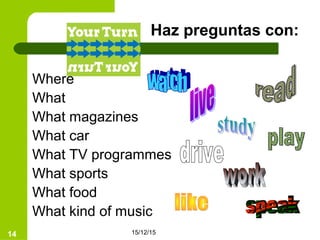
Haz preguntas con:
Where
What
What magazines
What car
What TV programmes
What sports
What food
What kind of music
15/12/1515
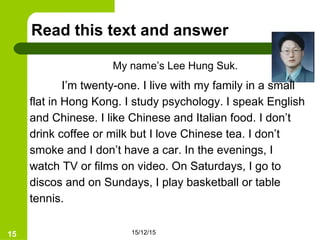
Read this text and answer
I’m twenty-one. I live with my family in a small
flat in Hong Kong. I study psychology. I speak English
and Chinese. I like Chinese and Italian food. I don’t
drink coffee or milk but I love Chinese tea. I don’t
smoke and I don’t have a car. In the evenings, I
watch TV or films on video. On Saturdays, I go to
discos and on Sundays, I play basketball or table
tennis.
My name’s Lee Hung Suk.
15/12/1516
Completa las preguntas y
respuestas
1. Does Lee live in a flat? Yes, he does.
2. _____ he work? No, he _____. He studies
psychology.
3. _____ he speak Chinese? Yes, _____ .
4. _____ he drink milk? _____ , he _____ . He
_____ tea.
5. _____ a car? _____ , he _____ .
6. _____ study on Saturdays? No, _____ . He
_____ discos.
15/12/1517
Completa las preguntas y
respuestas
1. Does Lee live in a flat? Yes, he does.
2. Does he work? No, he doesn’t. He studies
psychology.
3. Does he speak Chinese? Yes, does .
4. Does he drink milk? No , he doesn’t. He
drinks tea.
5. Does he have a car? No , he doesn’t.
6. Does he study on Saturdays? No, doesn’t.
He goes to discos.
15/12/1518
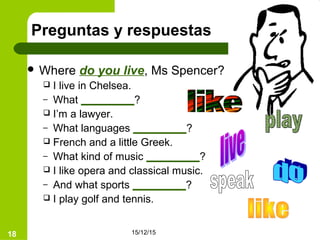
Preguntas y respuestas
 Where do you live, Ms Spencer?
 I live in Chelsea.
– What _________?
 I’m a lawyer.
– What languages _________?
 French and a little Greek.
– What kind of music _________?
 I like opera and classical music.
– And what sports _________?
 I play golf and tennis.
15/12/1519
Preguntas y respuestas
 Where do you live, Ms Spencer?
 I live in Chelsea.
 What do you do?
 I’m a lawyer.
 What languages do you speak?
 French and a little Greek.
 What kind of music do you like?
 I like opera and classical music.
 And what sports do you play?
 I play golf and tennis.
15/12/1520
The Hat
Bernardo ______ (live) in Rome. He ______ (like)
hats. One day he ______ (be) at a street market near
the Colosseum. Suddenly, he ______ (stop).
“I like that hat!” he ______ (say).
Bernardo ______ (buy) the hat.
“I can put it in a bag for you” the woman ______
(say).
“No, it ______ (be) OK,” Bernardo ______ (say). I can
wear it. Put my old hat in the bag, please.
15/12/1521
Bernardo ______ (arrive ) home.
“Hello, Natalie,” he ______ (tell) his wife. “______
(you like) my new hat?”
Natalie ______ (look) at him. She ______ (think),
“No!” But she ______ (say), “Why ______ (you want)
another hat, Bernardo? You ______ ( have) 20!”.
“I ______ ( like) hats,” Bernardo ______ (say). “And I
like this hat.”
15/12/1522
The Hat
Bernardo liveslives in Rome. He likeslikes (like) hats. One day
he isis (be) at a street market near the Colosseum.
Suddenly, he stopsstops (stop).
“I like that hat!” he sayssays (say).
Bernardo buysbuys (buy) the hat.
“I can put it in a bag for you” the woman sayssays (say).
“No, it isis (be) OK,” Bernardo sayssays (say). I can wear it.
Put my old hat in the bag, please.
15/12/1523
Bernardo arrivesarrives (arrive ) home.
“Hello, Natalie,” he tellstells (tell) his wife. “Do you likeDo you like
(you like) my new hat?”
Natalie lookslooks (look) at him. She thinksthinks (think), “No!”
But she sayssays (say), “Why do you wantdo you want (you want)
another hat, Bernardo? You havehave ( have) 20!”.
“I likelike ( like) hats,” Bernardo sayssays (say). “And I like
this hat.”

Present simple

  • 1.
    15/12/151 The present simple Affirmative  Negative ?? Interrogative  Spelling  Exercises
  • 2.
    15/12/152 Forma afirmativa I, you,we, theyI, you, we, they He, she, itHe, she, it  Sujeto + infinitivo del verbo. – I live in Barcelona. – We study English. – The dogs watch TV.  Sujeto + infinitivo del verbo + -s-s / -es-es. – He livess in Barcelona. – She studiesies English. – The dog watcheses TV. To haveTo have  La forma para “hehe, sheshe, itit” es “hashas” – He hashas a banana for breakfast.
  • 3.
    15/12/153 ¿Qué añadimos “-s”ó “-es”  La mayoría de los verbos añaden –s–s. – I read a book  he readss a book, – We listen  she listenss,  Los verbos acabados en las letras “s, sh, ch, x” añaden –es–es. – They pass the exam  He passeses the exam – You wash up  Paul washeses up
  • 4.
    15/12/154 ¿Qué añadimos “-s”“-es”?  Los verbos acabados en “vocal + y” añaden –s–s. – We play the piano  Duncan playsys the piano  Los verbos acabados en “consonante+y” cambian a –ies–ies. – My friends study English  My friend studiesies English  Los verbos acabados en “o” añaden –es–es. – I go home  My sister goeses home.
  • 5.
    How do youpronounce “–s” ? 15/12/155
  • 6.
    15/12/156 Forma negativa I, you,we, theyI, you, we, they He, she, itHe, she, it  Sujeto + don’tdon’t + verbo. – I don’tdon’t like coffee. – We don’tdon’t eat pasta. – The cats don’tdon’t know me.  Sujeto+ doesn’tdoesn’t + verbo. – He doesn’tdoesn’t like coffee. – She doesn’tdoesn’t eat pasta. – The cat doesn’tdoesn’t like me. ¡Cuidado!¡Cuidado! No se puede decir: He don’tdon’t likess coffee
  • 7.
    15/12/157 Look at thetable and and write sentences: Ann plays tennis but she doesn’t play cardsAnn plays tennis but she doesn’t play cards Tennis Chess Cards Cooks Piano Anne  XX XX  XX Pete XX   XX  Joe XX XX   XX Sarah   XX  XX You
  • 8.
    15/12/158 Forma interrogativa: sehace A.S.I.A.S.I. I, you, we, theyI, you, we, they He, she, itHe, she, it  DoDo + Sujeto + verbo? – DoDo you speak Italian? – DoDo your parents work? – DoDo we have free time?  DoesDoes + Sujeto+ verbo? – DoesDoes Mary speak Italian? – DoesDoes your mother work? – DoesDoes Liz have free time?
  • 9.
    15/12/159  They livein a flat.  Do they live in a flat? ¡¡CuidadoCuidado!! No se puede decir: DoDo Mary speakss Italian? ?? Interrogative Affirmative  He works in a bank.  Does he work in a bank?
  • 10.
    15/12/1510 Forma interrogativa: oQ.A.S.I.Q.A.S.I. Who What – Which Where When Why Who does he love?Who does he love? What does he do?What does he do? Where does he live?Where does he live? When do they go?When do they go? Why does Mary play football?Why does Mary play football?
  • 11.
    15/12/15 Yolanda Cabezas 11 Respuestascortas  Si la respuesta corta es afirmativa: – Yes, + pronombre + do / does.  Do you like English?  Yes, I do.  Does Janice live here?  Yes, she does.  Si la respuesta corta es negativa: – No, + pronombre + don’t / doesn’t.  Do you speak Chinese?  No, I don’t.  Does Sarah work?  No, she doesn’t. ¡¡CuidadoCuidado!! Si la respuesta es negativa, siempre hay que contraer auxiliar y negación: don’t / doesn’t.
  • 12.
    15/12/15 Yolanda Cabezas 12 ¡¡¡¡¡¡CUIDADOCUIDADO !!!!!!  Cuando tenemos que hacer una negación o una pregunta con el verbo “to do”, aparecerá dos veces, la primera como auxiliar y la segunda como verbo con significado:  Affirmative Sam does his homework.  Negative Sam doesn’t do his homework. ?? Interrogative Does Sam do his homework?
  • 13.
    15/12/1513 ¿Cuándo lo usamos? Para expresar cosas que son verdaderas en general: – The Earth goes round the sun. – The Sun rises on the east.  Cosas que ocurren con cierta frecuencia o habitualmente: – Tim works in the morning.  Se suele usar con adverbios de frecuencia: always, usually, sometimes, never.
  • 14.
    15/12/1514 Haz preguntas con: Where What Whatmagazines What car What TV programmes What sports What food What kind of music
  • 15.
    15/12/1515 Read this textand answer I’m twenty-one. I live with my family in a small flat in Hong Kong. I study psychology. I speak English and Chinese. I like Chinese and Italian food. I don’t drink coffee or milk but I love Chinese tea. I don’t smoke and I don’t have a car. In the evenings, I watch TV or films on video. On Saturdays, I go to discos and on Sundays, I play basketball or table tennis. My name’s Lee Hung Suk.
  • 16.
    15/12/1516 Completa las preguntasy respuestas 1. Does Lee live in a flat? Yes, he does. 2. _____ he work? No, he _____. He studies psychology. 3. _____ he speak Chinese? Yes, _____ . 4. _____ he drink milk? _____ , he _____ . He _____ tea. 5. _____ a car? _____ , he _____ . 6. _____ study on Saturdays? No, _____ . He _____ discos.
  • 17.
    15/12/1517 Completa las preguntasy respuestas 1. Does Lee live in a flat? Yes, he does. 2. Does he work? No, he doesn’t. He studies psychology. 3. Does he speak Chinese? Yes, does . 4. Does he drink milk? No , he doesn’t. He drinks tea. 5. Does he have a car? No , he doesn’t. 6. Does he study on Saturdays? No, doesn’t. He goes to discos.
  • 18.
    15/12/1518 Preguntas y respuestas Where do you live, Ms Spencer?  I live in Chelsea. – What _________?  I’m a lawyer. – What languages _________?  French and a little Greek. – What kind of music _________?  I like opera and classical music. – And what sports _________?  I play golf and tennis.
  • 19.
    15/12/1519 Preguntas y respuestas Where do you live, Ms Spencer?  I live in Chelsea.  What do you do?  I’m a lawyer.  What languages do you speak?  French and a little Greek.  What kind of music do you like?  I like opera and classical music.  And what sports do you play?  I play golf and tennis.
  • 20.
    15/12/1520 The Hat Bernardo ______(live) in Rome. He ______ (like) hats. One day he ______ (be) at a street market near the Colosseum. Suddenly, he ______ (stop). “I like that hat!” he ______ (say). Bernardo ______ (buy) the hat. “I can put it in a bag for you” the woman ______ (say). “No, it ______ (be) OK,” Bernardo ______ (say). I can wear it. Put my old hat in the bag, please.
  • 21.
    15/12/1521 Bernardo ______ (arrive) home. “Hello, Natalie,” he ______ (tell) his wife. “______ (you like) my new hat?” Natalie ______ (look) at him. She ______ (think), “No!” But she ______ (say), “Why ______ (you want) another hat, Bernardo? You ______ ( have) 20!”. “I ______ ( like) hats,” Bernardo ______ (say). “And I like this hat.”
  • 22.
    15/12/1522 The Hat Bernardo liveslivesin Rome. He likeslikes (like) hats. One day he isis (be) at a street market near the Colosseum. Suddenly, he stopsstops (stop). “I like that hat!” he sayssays (say). Bernardo buysbuys (buy) the hat. “I can put it in a bag for you” the woman sayssays (say). “No, it isis (be) OK,” Bernardo sayssays (say). I can wear it. Put my old hat in the bag, please.
  • 23.
    15/12/1523 Bernardo arrivesarrives (arrive) home. “Hello, Natalie,” he tellstells (tell) his wife. “Do you likeDo you like (you like) my new hat?” Natalie lookslooks (look) at him. She thinksthinks (think), “No!” But she sayssays (say), “Why do you wantdo you want (you want) another hat, Bernardo? You havehave ( have) 20!”. “I likelike ( like) hats,” Bernardo sayssays (say). “And I like this hat.”