Chapter 4
  Going out

   Grammar
Stepping Stones 2 kgt
Past continuous

• Gebruik je om te zeggen dat iets in het verleden aan de
  gang was.
• Bestaat uit was of were gevolgd door werkwoord + ing:

Jane was working in the garden yesterday afternoon.
Last night we were talking to the headmaster.
It was snowing all afternoon.

Let op: was gebruik je bij I, he, she, it
        were gebruik je bij you, we they
• De past continuous komt vaak voor samen met de past
  simple en het woord when. In de zin staat dan iets wat
  onverwachts gebeurde, (past simple) terwijl het andere al
  een tijdje aan de gang was (past continuous).

He was having dinner when we knocked on the door.
Kathy was skating when she saw him.
They were kissing when I came in.

Let op: de past simple komt in het zinsdeel dat met when
  begint!
Denk eraan dat je de onregelmatige ww kent! (tweede rijtje)
Now show what you know!
(maak zinnen met de past continuous én de past simple)

1. I (to type) when my computer (to crash).
I was typing when my computer crashed.

2.   Bess (to sleep) when the accident (to happen).
3.   They (to eat) when the mail (to come).
4.   Nick (to watch) a movie when I (to call).
5.   We (to fly) when we (to see) the volcano.
6.   You (to wait) when the shop (to open).
7.   I (to read) when Joe (to go) out.
8.   Bo (to brush) her hair when the brush (to break).
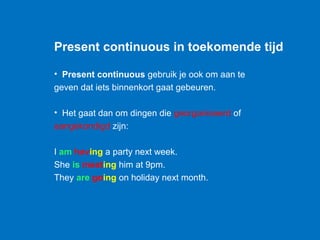
Present continuous in toekomende tijd

• Present continuous gebruik je ook om aan te
geven dat iets binnenkort gaat gebeuren.

• Het gaat dan om dingen die georganiseerd of
aangekondigd zijn:

I am having a party next week.
She is meeting him at 9pm.
They are going on holiday next month.
Now show what you know!
(maak zinnen met de present continuous)

1.   The train                  in half an hour. (to arrive)
2.   They                       a party in September. (to give)
3.   We                         the event next week. (to organise)
4.   Tomorrow I                            my penpal. (to meet)
5.   Sue                        a trip this summer. (to plan)
6.   This Easter, Fred                     a dance. (to have)
7.   Susan                      the shop on Thursday. (to close)
8.   Tonight, we                           a movie. (to see)
Can, may en could

Can, may en could zijn hulpwerkwoorden die je kunt
gebruiken om toestemming te vragen. Maak zinnen met: can /
may / could en het hele werkwoord zonder to.

• Can en may gebruik je voor het vragen van toestemming:

Can/may I leave the classroom, please?
Can/may Janet go to the cinema?

• Could gebruik je als je beleefd (=polite) wilt zijn:

Could you tell me where the post office is?
Could I have a cup of tea please?
In een antwoord op zo’n vraag gebruik je NOOIT could.

Dus:
Yes, you can/may
She can/may go to the cinema.
You can’t/may not leave now.
No, you can’t/may not
Now show what you know!
(maak zinnen met can(‘t) – may (not)– could)


1.           I go to Tim’s party?
2.           I have the menu please?
3.           you tell me your name please?
4. No, Marie            have another glass of milk.
5.           we go with them to the theatre?
6.           you tell me where I can find a shoe store?
7. No, Becca           sleep over tonight.
8.           you help me with this please?
Now show what you know!
(maak zinnen met can(‘t) – may (not)– could)


1.           I go to Tim’s party?
2.           I have the menu please?
3.           you tell me your name please?
4. No, Marie            have another glass of milk.
5.           we go with them to the theatre?
6.           you tell me where I can find a shoe store?
7. No, Becca           sleep over tonight.
8.           you help me with this please?

2kgt chapter 4 grammar

  • 1.
    Chapter 4 Going out Grammar Stepping Stones 2 kgt
  • 2.
    Past continuous • Gebruikje om te zeggen dat iets in het verleden aan de gang was. • Bestaat uit was of were gevolgd door werkwoord + ing: Jane was working in the garden yesterday afternoon. Last night we were talking to the headmaster. It was snowing all afternoon. Let op: was gebruik je bij I, he, she, it were gebruik je bij you, we they
  • 3.
    • De pastcontinuous komt vaak voor samen met de past simple en het woord when. In de zin staat dan iets wat onverwachts gebeurde, (past simple) terwijl het andere al een tijdje aan de gang was (past continuous). He was having dinner when we knocked on the door. Kathy was skating when she saw him. They were kissing when I came in. Let op: de past simple komt in het zinsdeel dat met when begint! Denk eraan dat je de onregelmatige ww kent! (tweede rijtje)
  • 4.
    Now show whatyou know! (maak zinnen met de past continuous én de past simple) 1. I (to type) when my computer (to crash). I was typing when my computer crashed. 2. Bess (to sleep) when the accident (to happen). 3. They (to eat) when the mail (to come). 4. Nick (to watch) a movie when I (to call). 5. We (to fly) when we (to see) the volcano. 6. You (to wait) when the shop (to open). 7. I (to read) when Joe (to go) out. 8. Bo (to brush) her hair when the brush (to break).
  • 5.
    Present continuous intoekomende tijd • Present continuous gebruik je ook om aan te geven dat iets binnenkort gaat gebeuren. • Het gaat dan om dingen die georganiseerd of aangekondigd zijn: I am having a party next week. She is meeting him at 9pm. They are going on holiday next month.
  • 6.
    Now show whatyou know! (maak zinnen met de present continuous) 1. The train in half an hour. (to arrive) 2. They a party in September. (to give) 3. We the event next week. (to organise) 4. Tomorrow I my penpal. (to meet) 5. Sue a trip this summer. (to plan) 6. This Easter, Fred a dance. (to have) 7. Susan the shop on Thursday. (to close) 8. Tonight, we a movie. (to see)
  • 7.
    Can, may encould Can, may en could zijn hulpwerkwoorden die je kunt gebruiken om toestemming te vragen. Maak zinnen met: can / may / could en het hele werkwoord zonder to. • Can en may gebruik je voor het vragen van toestemming: Can/may I leave the classroom, please? Can/may Janet go to the cinema? • Could gebruik je als je beleefd (=polite) wilt zijn: Could you tell me where the post office is? Could I have a cup of tea please?
  • 8.
    In een antwoordop zo’n vraag gebruik je NOOIT could. Dus: Yes, you can/may She can/may go to the cinema. You can’t/may not leave now. No, you can’t/may not
  • 9.
    Now show whatyou know! (maak zinnen met can(‘t) – may (not)– could) 1. I go to Tim’s party? 2. I have the menu please? 3. you tell me your name please? 4. No, Marie have another glass of milk. 5. we go with them to the theatre? 6. you tell me where I can find a shoe store? 7. No, Becca sleep over tonight. 8. you help me with this please?
  • 10.
    Now show whatyou know! (maak zinnen met can(‘t) – may (not)– could) 1. I go to Tim’s party? 2. I have the menu please? 3. you tell me your name please? 4. No, Marie have another glass of milk. 5. we go with them to the theatre? 6. you tell me where I can find a shoe store? 7. No, Becca sleep over tonight. 8. you help me with this please?