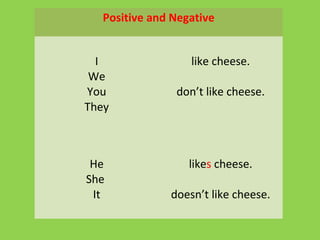
Positive and Negative
I
We
You
They
like cheese.
don’t like cheese.
He
She
It
likes cheese.
doesn’t like cheese.
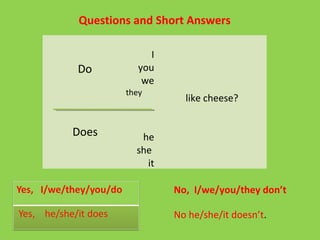
Questions and Short Answers
I
you
we
they
he
she
it
like cheese?
No, I/we/you/they don’t
No he/she/it doesn’t.
Do
Does
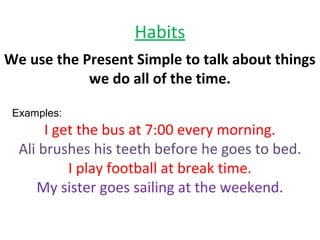
Habits
We use the Present Simple to talk about things
we do all of the time.
Examples:
I get the bus at 7:00 every morning.
Ali brushes his teeth before he goes to bed.
I play football at break time.
My sister goes sailing at the weekend.
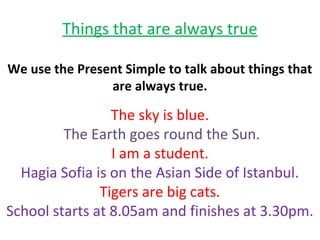
Things that are always true
We use the Present Simple to talk about things that
are always true.
The sky is blue.
The Earth goes round the Sun.
I am a student.
Hagia Sofia is on the Asian Side of Istanbul.
Tigers are big cats.
School starts at 8.05am and finishes at 3.30pm.
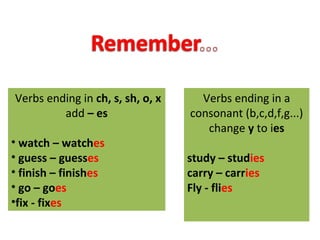
Verbs ending in ch, s, sh, o, x
add – es
• watch – watches
• guess – guesses
• finish – finishes
• go – goes
•fix - fixes
Verbs ending in a
consonant (b,c,d,f,g...)
change y to ies
study – studies
carry – carries
Fly - flies
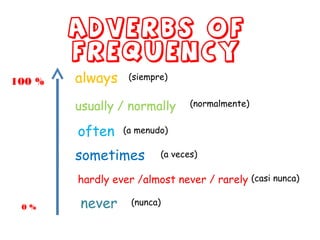
Adverbs of
frequency
100 %
0 %
always
usually / normally
often
sometimes
hardly ever /almost never / rarely
never
(siempre)
(normalmente)
(a menudo)
(a veces)
(casi nunca)
(nunca)
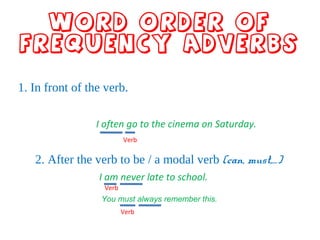
Word order of
frequency adverbs
1. In front of the verb.
I often go to the cinema on Saturday.
Verb
2. After the verb to be / a modal verb (can, must,…)
I am never late to school.
Verb
You must always remember this.
Verb
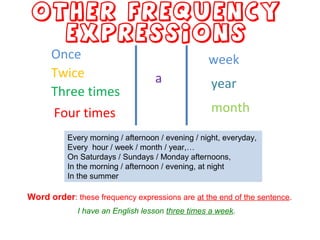
Other frequency
expressions
Once
Twice
Three times
Four times
a
week
year
month
Every morning / afternoon / evening / night, everyday,
Every hour / week / month / year,…
On Saturdays / Sundays / Monday afternoons,
In the morning / afternoon / evening, at night
In the summer
Word order: these frequency expressions are at the end of the sentence.
I have an English lesson three times a week.
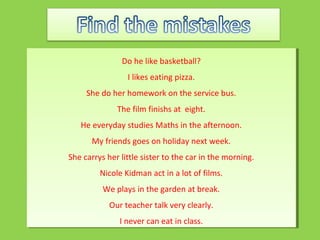
Do he like basketball?
I likes eating pizza.
She do her homework on the service bus.
The film finishs at eight.
He everyday studies Maths in the afternoon.
My friends goes on holiday next week.
She carrys her little sister to the car in the morning.
Nicole Kidman act in a lot of films.
We plays in the garden at break.
Our teacher talk very clearly.
I never can eat in class.
Do he like basketball?
I likes eating pizza.
She do her homework on the service bus.
The film finishs at eight.
He everyday studies Maths in the afternoon.
My friends goes on holiday next week.
She carrys her little sister to the car in the morning.
Nicole Kidman act in a lot of films.
We plays in the garden at break.
Our teacher talk very clearly.
I never can eat in class.

Present Simple

  • 2.
    Positive and Negative I We You They likecheese. don’t like cheese. He She It likes cheese. doesn’t like cheese.
  • 3.
    Questions and ShortAnswers I you we they he she it like cheese? No, I/we/you/they don’t No he/she/it doesn’t. Do Does
  • 5.
    Habits We use thePresent Simple to talk about things we do all of the time. Examples: I get the bus at 7:00 every morning. Ali brushes his teeth before he goes to bed. I play football at break time. My sister goes sailing at the weekend.
  • 6.
    Things that arealways true We use the Present Simple to talk about things that are always true. The sky is blue. The Earth goes round the Sun. I am a student. Hagia Sofia is on the Asian Side of Istanbul. Tigers are big cats. School starts at 8.05am and finishes at 3.30pm.
  • 7.
    Verbs ending inch, s, sh, o, x add – es • watch – watches • guess – guesses • finish – finishes • go – goes •fix - fixes Verbs ending in a consonant (b,c,d,f,g...) change y to ies study – studies carry – carries Fly - flies
  • 9.
    Adverbs of frequency 100 % 0% always usually / normally often sometimes hardly ever /almost never / rarely never (siempre) (normalmente) (a menudo) (a veces) (casi nunca) (nunca)
  • 10.
    Word order of frequencyadverbs 1. In front of the verb. I often go to the cinema on Saturday. Verb 2. After the verb to be / a modal verb (can, must,…) I am never late to school. Verb You must always remember this. Verb
  • 11.
    Other frequency expressions Once Twice Three times Fourtimes a week year month Every morning / afternoon / evening / night, everyday, Every hour / week / month / year,… On Saturdays / Sundays / Monday afternoons, In the morning / afternoon / evening, at night In the summer Word order: these frequency expressions are at the end of the sentence. I have an English lesson three times a week.
  • 12.
    Do he likebasketball? I likes eating pizza. She do her homework on the service bus. The film finishs at eight. He everyday studies Maths in the afternoon. My friends goes on holiday next week. She carrys her little sister to the car in the morning. Nicole Kidman act in a lot of films. We plays in the garden at break. Our teacher talk very clearly. I never can eat in class. Do he like basketball? I likes eating pizza. She do her homework on the service bus. The film finishs at eight. He everyday studies Maths in the afternoon. My friends goes on holiday next week. She carrys her little sister to the car in the morning. Nicole Kidman act in a lot of films. We plays in the garden at break. Our teacher talk very clearly. I never can eat in class.