A simple guide to
Punctuations Part Two
(Semicolon and Dashes)
Prepared by Ronuel L del Rosario
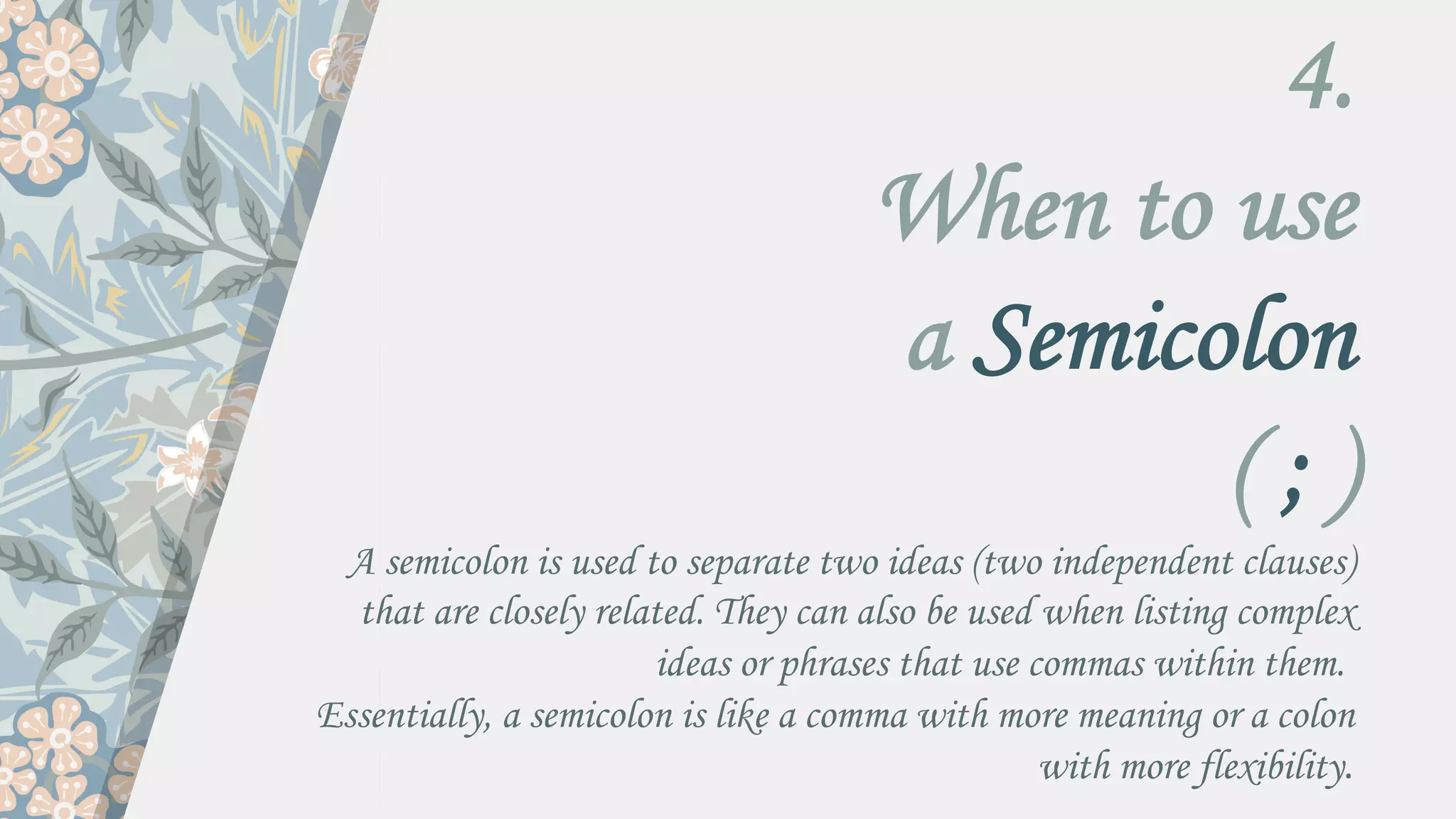
4.
When to use
a Semicolon
( ; )
A semicolon is used to separate two ideas (two independent clauses)
that are closely related. They can also be used when listing complex
ideas or phrases that use commas within them.
Essentially, a semicolon is like a comma with more meaning or a colon
with more flexibility.
To join two or more ideas (parts)
in a sentence when their ideas
are given equal position or rank
The universe has always called
to human beings; there could be no
more final frontier than space
When to use
a Semicolon ( ; )
To join two independent clauses
connected by conjunctive adverbs
or transitional phrases
Sam thought David was
inviting him to the picnic to enjoy a
nice day out; as it turned out,
David was planning a surprise
birthday party.
When to use
a Semicolon ( ; )
To present items in a list or series
if there are commas within the
items, or if the items are relatively
long and complex
Our family members came all the
way from Denver, Colorado;
Rochester, Minnesota; and even
Paris, France.
When to use
a Semicolon ( ; )
When to use a Semicolon
To connect independent clauses joined by a
coordinating conjunction (if the clauses are already
punctuated with commas) or if they are lengthy.
My main research objective is to isolate the cause of
the disease, as well as to contribute to the existing
literature; for this will bring an end to starvation
across the continent, create new study designs related
to epidemiology, and change the very paradigm of my
research field.
Using a Semicolon ( ; ) instead
of a Comma ( , )
Incorrect: The specimens were treated properly,
however, they were not stored properly.
Correct: The specimens were treated properly; however,
they were not stored properly.
*The conjunctive adverb “however” shows a connection between the
two independent clauses; do not use a comma to connect two
independent clauses without a coordinating conjunction (and, but,
or, nor, etc.).
Using a Semicolon ( ; ) instead
of a Comma ( , )
Incorrect: The sun is wonderful: it produces light, which plants
need to survive, it gives us warmth, which is useful for most life, and
it makes a sad day happier, which is obviously a positive trait!
Correct: The sun is wonderful: it produces light, which plants need
to survive; it gives us warmth, which is useful for most life; and it
makes a sad day happier, which is obviously a positive trait!
(Using only commas, it is unclear what items are being
listed exactly. Semicolons help divide listed items that each
contain commas.)
5.
When to use
a Dashes:
the Hyphen ( - )
The hyphen is the shortest of the three marks, used
most commonly to combine words and to separate
numbers that are not inclusive.
well-being, self-esteem, forty-six, 0905-678-8888
5.
When to use Dashes:
the Hyphen ( - )
The hyphen is the shortest of the three marks,
used most commonly to combine words
and to separate numbers that are not inclusive.
well-being, self-esteem, forty-six, 0905-678-8888
When to use Dashes:
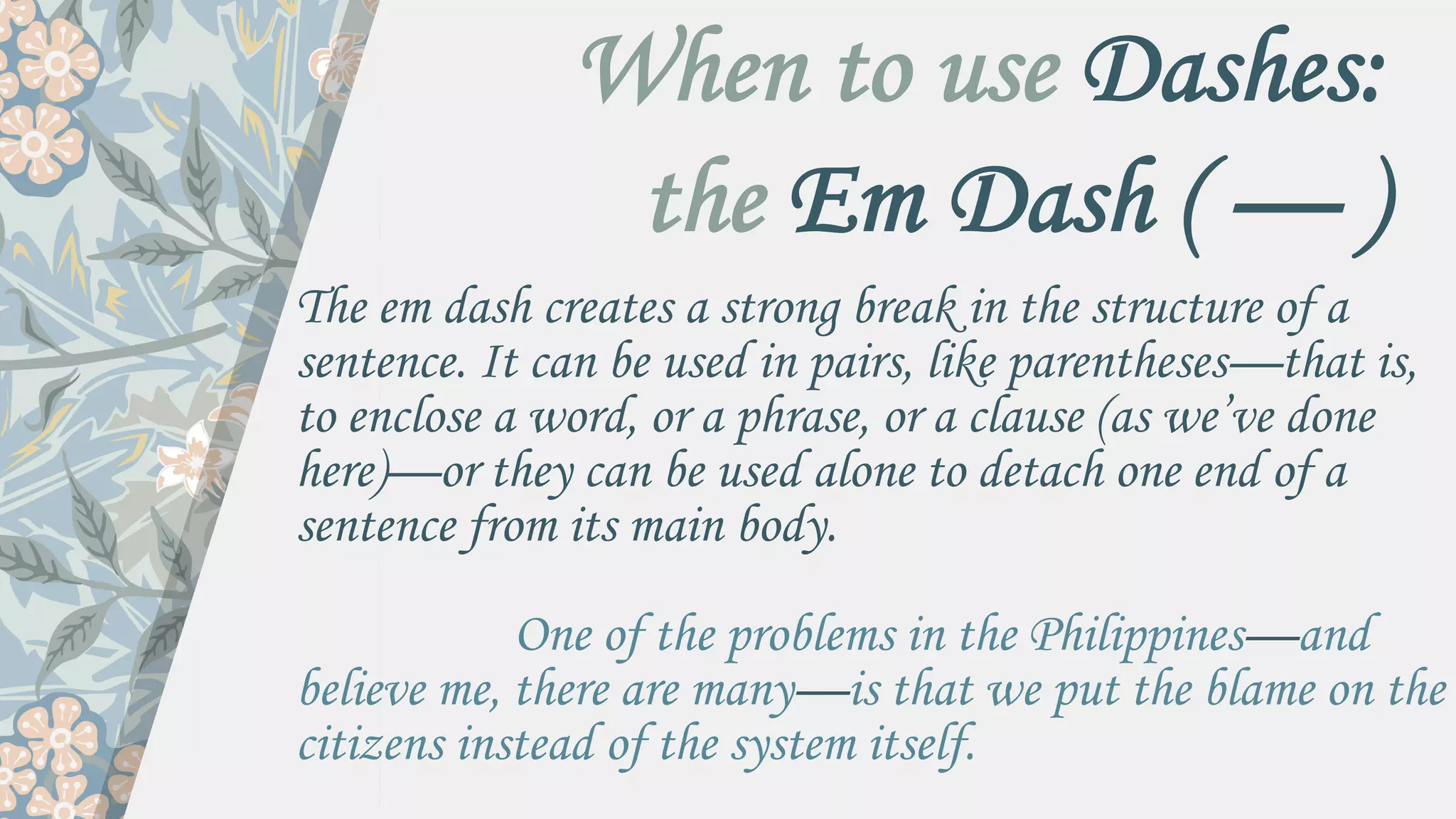
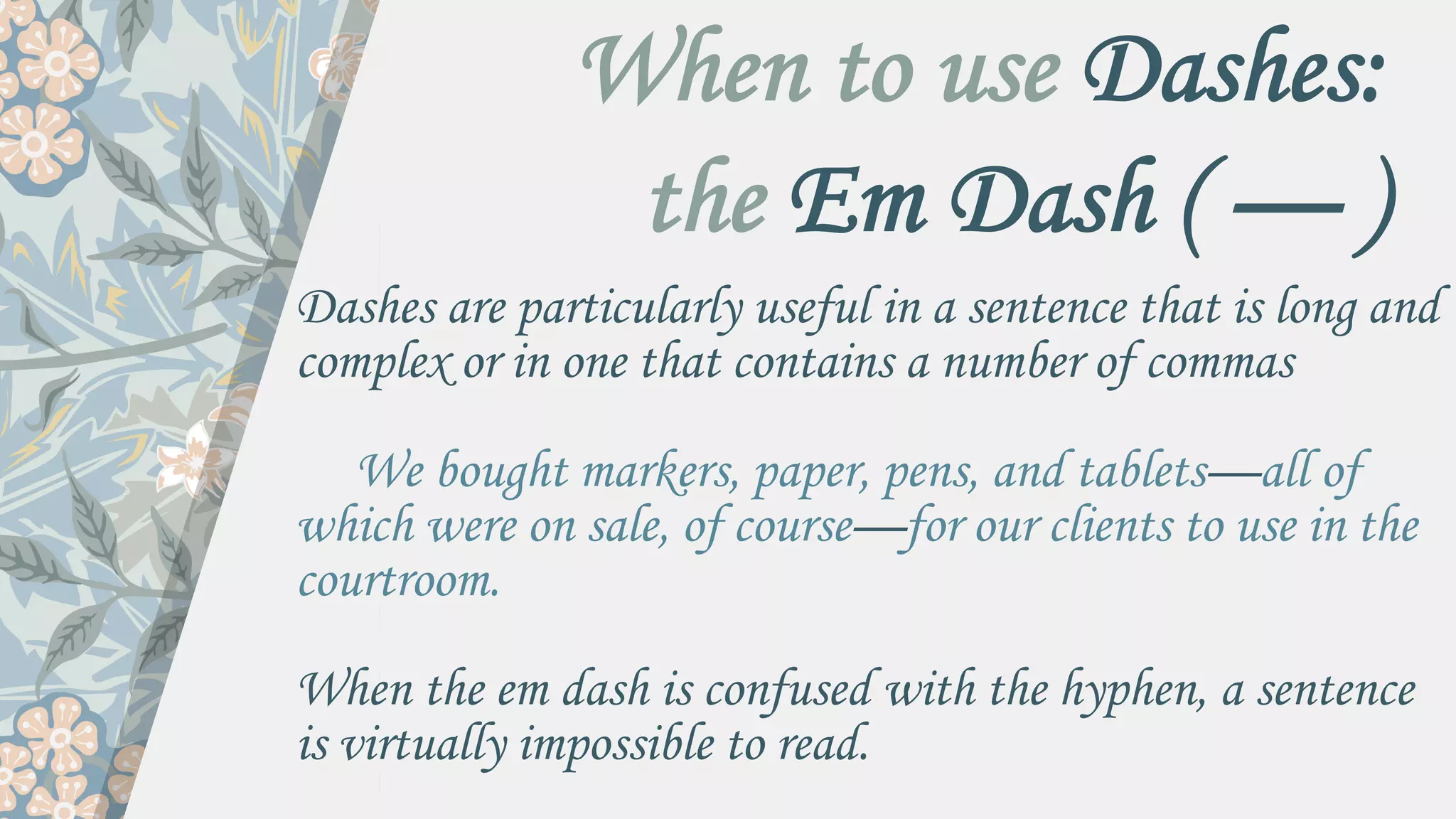
the Em Dash ( — )
The em dash creates a strong break in the structure of a
sentence. It can be used in pairs, like parentheses—that is,
to enclose a word, or a phrase, or a clause (as we’ve done
here)—or they can be used alone to detach one end of a
sentence from its main body.
One of the problems in the Philippines—and
believe me, there are many—is that we put the blame on the
citizens instead of the system itself.
When to use Dashes:
the Em Dash ( — )
Dashes are particularly useful in a sentence that is long and
complex or in one that contains a number of commas
We bought markers, paper, pens, and tablets—all of
which were on sale, of course—for our clients to use in the
courtroom.
When the em dash is confused with the hyphen, a sentence
is virtually impossible to read.
When to use Dashes:
the En Dash ( – )
The en dash is slightly longer than the hyphen but not as
long as the em dash.
The en dash means, quite simply, “through.” We use it most
commonly to indicate inclusive dates and numbers:
July 9–August 17; pp. 37–59.
Em Dashes, Parentheses,
or Commas?
* Reserve em dashes for places
where the comma simply doesn’t
provide a strong enough break.
* If commas work, use them instead.
* Parentheses tend to downplay an
idea; they suggest that the information
is not necessary.
*Em dashes draw attention to the
information they enclose or set apart.
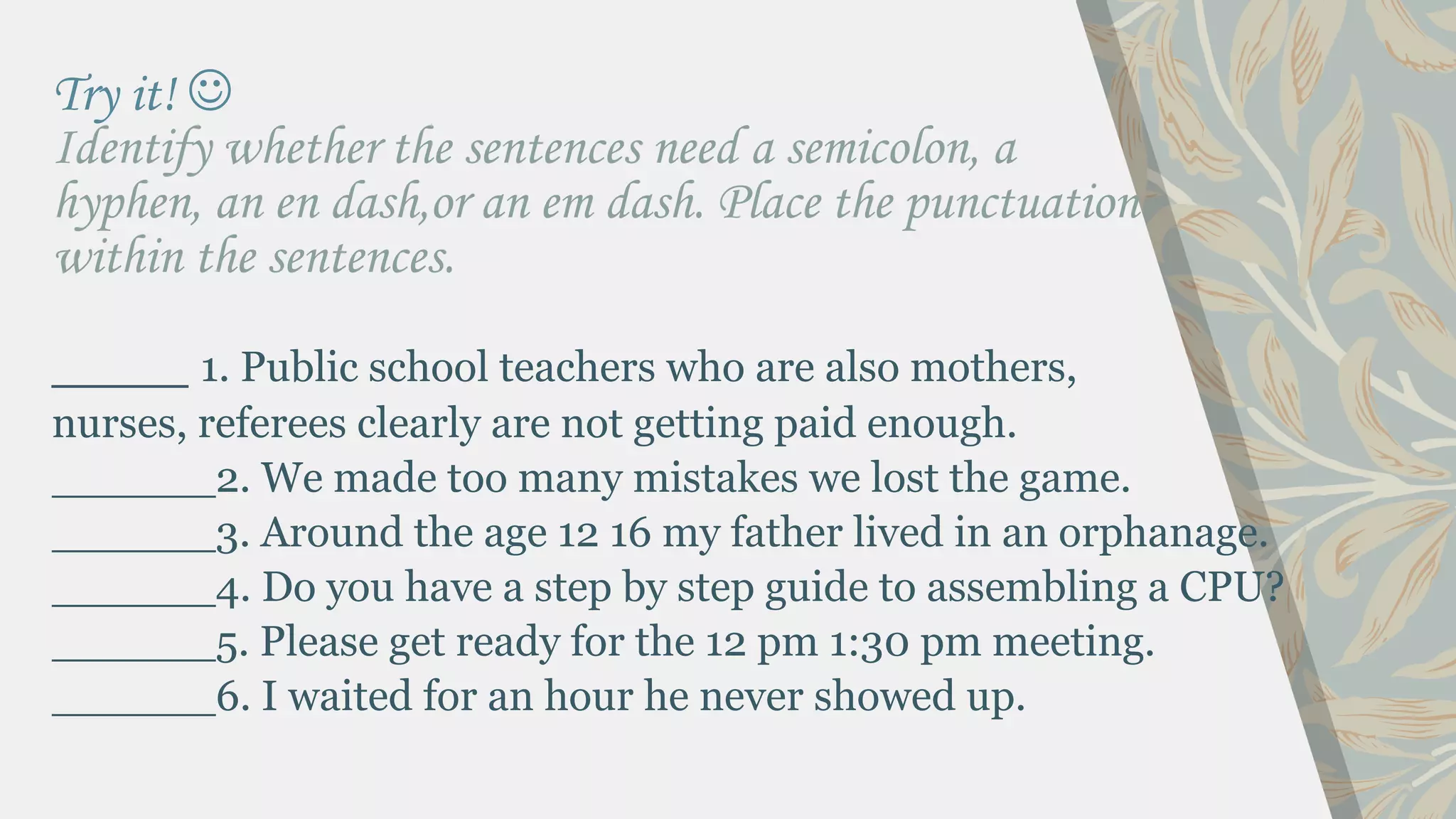
Try it! J
Identify whether the sentences need a semicolon, a
hyphen, an en dash,or an em dash. Place the punctuation
within the sentences.
_____ 1. Public school teachers who are also mothers,
nurses, referees clearly are not getting paid enough.
______2. We made too many mistakes we lost the game.
______3. Around the age 12 16 my father lived in an orphanage.
______4. Do you have a step by step guide to assembling a CPU?
______5. Please get ready for the 12 pm 1:30 pm meeting.
______6. I waited for an hour he never showed up.
References
GetItWrite. Hyphens, Em Dashes, and En Dashes: When to Use Them and How to Type Them.
Retrieved June 23, 2020 from https://getitwriteonline.com/articles/en-dashes-em-dashes/
GrammarBook.Semicolons and Colons Quiz 1. Retrieved June 2, 2020 from
https://www.grammarbook.com/grammar_quiz/semicolons_and_colons_1.asp
The Writing Center. Using semicolons. Retrieved June 23,2020 from
https://writing.wisc.edu/handbook/grammarpunct/semicolons/
Wordvice. When to Use Commas, Colons, Semicolons, and Dashes. Retrieved June 23, 2020 from
https://wordvice.com/when-to-use-commas-colons-semicolons-and-dashes/

Grammar - Punctuations (Semicolon and Dashes)

  • 1.
    A simple guideto Punctuations Part Two (Semicolon and Dashes) Prepared by Ronuel L del Rosario
  • 2.
    4. When to use aSemicolon ( ; ) A semicolon is used to separate two ideas (two independent clauses) that are closely related. They can also be used when listing complex ideas or phrases that use commas within them. Essentially, a semicolon is like a comma with more meaning or a colon with more flexibility.
  • 3.
    To join twoor more ideas (parts) in a sentence when their ideas are given equal position or rank The universe has always called to human beings; there could be no more final frontier than space When to use a Semicolon ( ; )
  • 4.
    To join twoindependent clauses connected by conjunctive adverbs or transitional phrases Sam thought David was inviting him to the picnic to enjoy a nice day out; as it turned out, David was planning a surprise birthday party. When to use a Semicolon ( ; )
  • 5.
    To present itemsin a list or series if there are commas within the items, or if the items are relatively long and complex Our family members came all the way from Denver, Colorado; Rochester, Minnesota; and even Paris, France. When to use a Semicolon ( ; )
  • 6.
    When to usea Semicolon To connect independent clauses joined by a coordinating conjunction (if the clauses are already punctuated with commas) or if they are lengthy. My main research objective is to isolate the cause of the disease, as well as to contribute to the existing literature; for this will bring an end to starvation across the continent, create new study designs related to epidemiology, and change the very paradigm of my research field.
  • 7.
    Using a Semicolon( ; ) instead of a Comma ( , ) Incorrect: The specimens were treated properly, however, they were not stored properly. Correct: The specimens were treated properly; however, they were not stored properly. *The conjunctive adverb “however” shows a connection between the two independent clauses; do not use a comma to connect two independent clauses without a coordinating conjunction (and, but, or, nor, etc.).
  • 8.
    Using a Semicolon( ; ) instead of a Comma ( , ) Incorrect: The sun is wonderful: it produces light, which plants need to survive, it gives us warmth, which is useful for most life, and it makes a sad day happier, which is obviously a positive trait! Correct: The sun is wonderful: it produces light, which plants need to survive; it gives us warmth, which is useful for most life; and it makes a sad day happier, which is obviously a positive trait! (Using only commas, it is unclear what items are being listed exactly. Semicolons help divide listed items that each contain commas.)
  • 9.
    5. When to use aDashes: the Hyphen ( - ) The hyphen is the shortest of the three marks, used most commonly to combine words and to separate numbers that are not inclusive. well-being, self-esteem, forty-six, 0905-678-8888
  • 10.
    5. When to useDashes: the Hyphen ( - ) The hyphen is the shortest of the three marks, used most commonly to combine words and to separate numbers that are not inclusive. well-being, self-esteem, forty-six, 0905-678-8888
  • 11.
    When to useDashes: the Em Dash ( — ) The em dash creates a strong break in the structure of a sentence. It can be used in pairs, like parentheses—that is, to enclose a word, or a phrase, or a clause (as we’ve done here)—or they can be used alone to detach one end of a sentence from its main body. One of the problems in the Philippines—and believe me, there are many—is that we put the blame on the citizens instead of the system itself.
  • 12.
    When to useDashes: the Em Dash ( — ) Dashes are particularly useful in a sentence that is long and complex or in one that contains a number of commas We bought markers, paper, pens, and tablets—all of which were on sale, of course—for our clients to use in the courtroom. When the em dash is confused with the hyphen, a sentence is virtually impossible to read.
  • 13.
    When to useDashes: the En Dash ( – ) The en dash is slightly longer than the hyphen but not as long as the em dash. The en dash means, quite simply, “through.” We use it most commonly to indicate inclusive dates and numbers: July 9–August 17; pp. 37–59.
  • 14.
    Em Dashes, Parentheses, orCommas? * Reserve em dashes for places where the comma simply doesn’t provide a strong enough break. * If commas work, use them instead. * Parentheses tend to downplay an idea; they suggest that the information is not necessary. *Em dashes draw attention to the information they enclose or set apart.
  • 15.
    Try it! J Identifywhether the sentences need a semicolon, a hyphen, an en dash,or an em dash. Place the punctuation within the sentences. _____ 1. Public school teachers who are also mothers, nurses, referees clearly are not getting paid enough. ______2. We made too many mistakes we lost the game. ______3. Around the age 12 16 my father lived in an orphanage. ______4. Do you have a step by step guide to assembling a CPU? ______5. Please get ready for the 12 pm 1:30 pm meeting. ______6. I waited for an hour he never showed up.
  • 16.
    References GetItWrite. Hyphens, EmDashes, and En Dashes: When to Use Them and How to Type Them. Retrieved June 23, 2020 from https://getitwriteonline.com/articles/en-dashes-em-dashes/ GrammarBook.Semicolons and Colons Quiz 1. Retrieved June 2, 2020 from https://www.grammarbook.com/grammar_quiz/semicolons_and_colons_1.asp The Writing Center. Using semicolons. Retrieved June 23,2020 from https://writing.wisc.edu/handbook/grammarpunct/semicolons/ Wordvice. When to Use Commas, Colons, Semicolons, and Dashes. Retrieved June 23, 2020 from https://wordvice.com/when-to-use-commas-colons-semicolons-and-dashes/