Clauses & Conjunctions
Connecting sentences. Connecting lives. (Wow!)
Prepared by Ronuel del Rosario
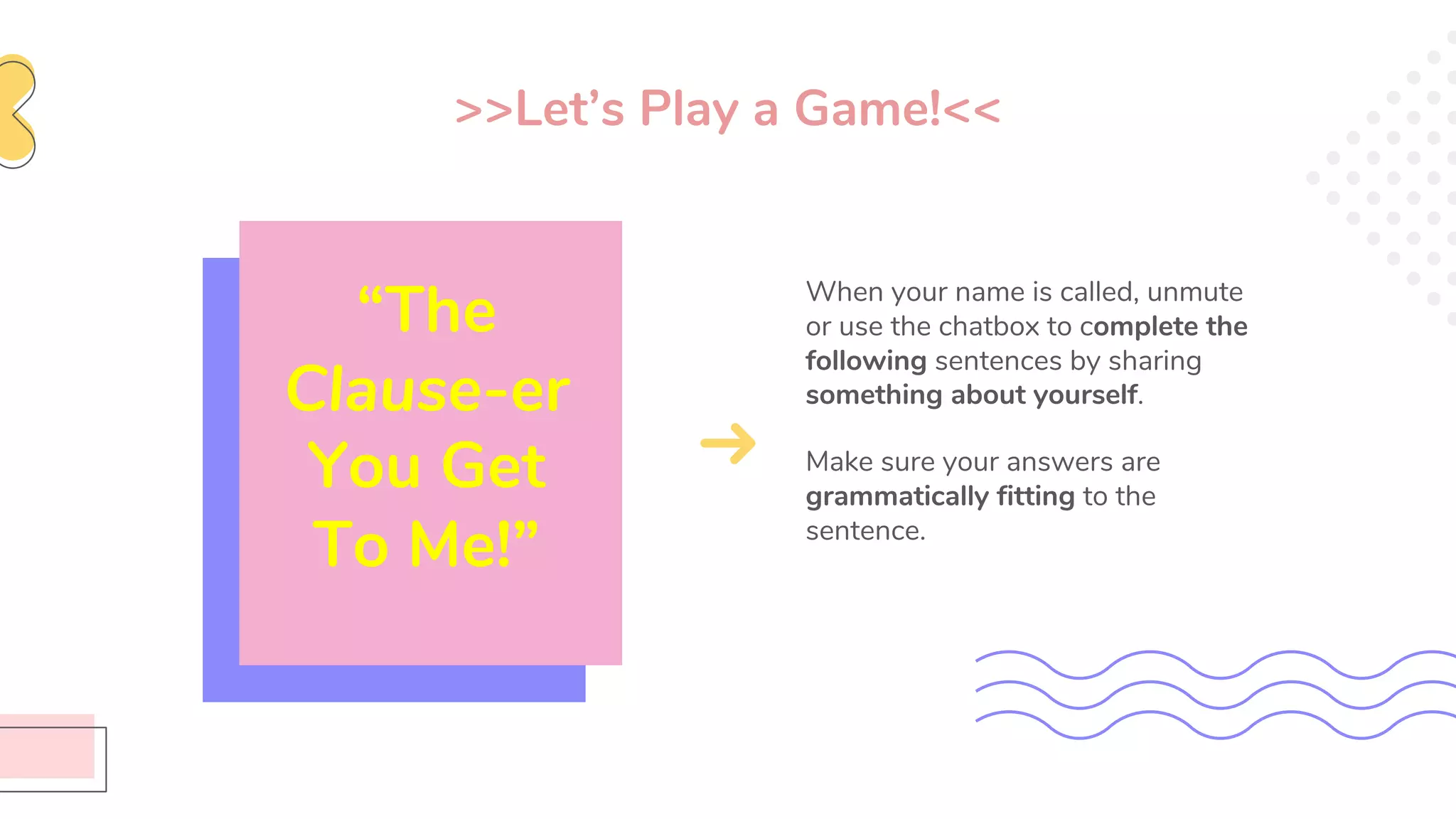
When your name is called, unmute
or use the chatbox to complete the
following sentences by sharing
something about yourself.
Make sure your answers are
grammatically fitting to the
sentence.
>>Let’s Play a Game!<<
“The
Clause-er
You Get
To Me!”
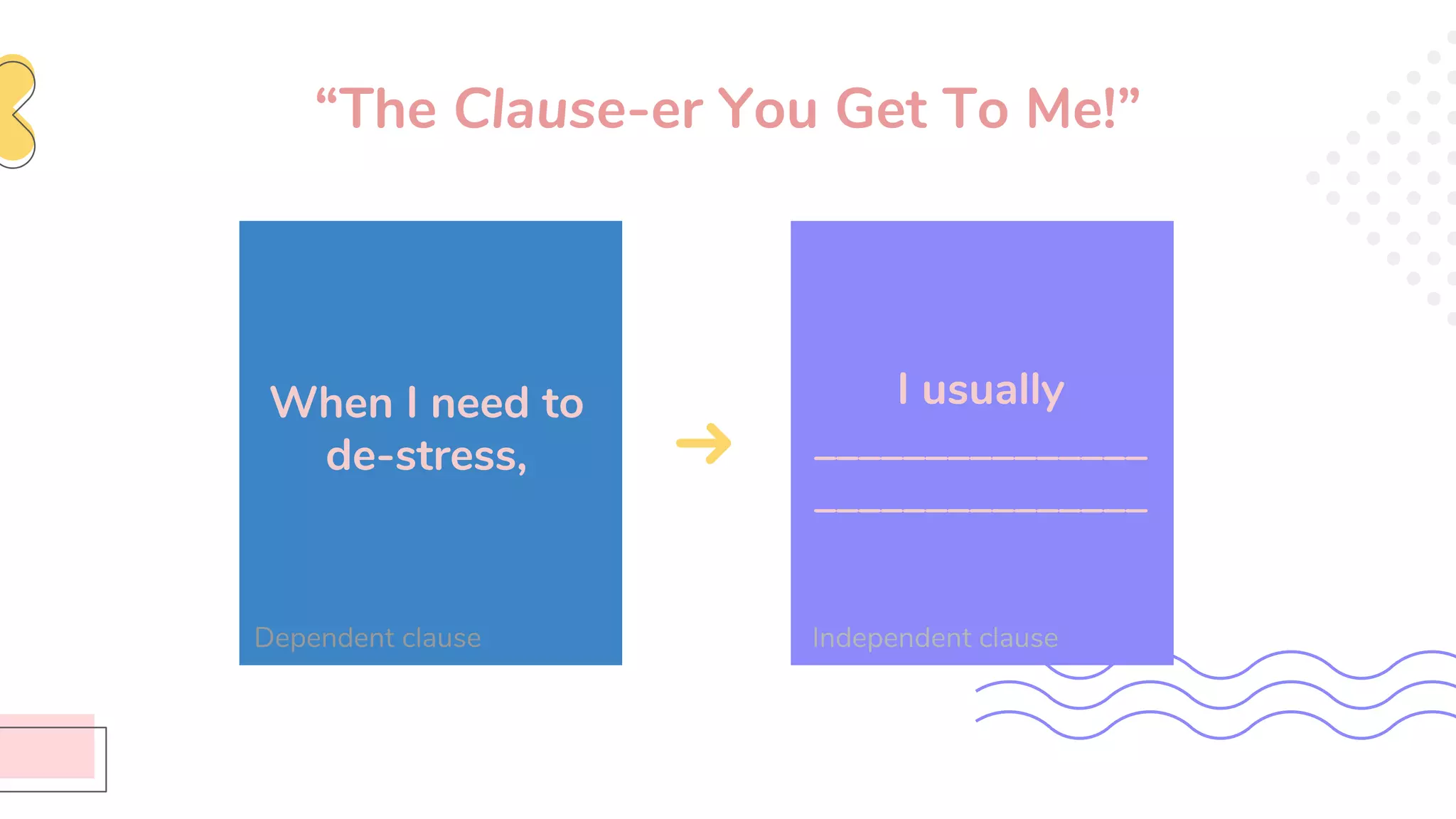
“The Clause-er You Get To Me!”
When I need to
de-stress,
Dependent clause Independent clause
I usually
_______________
_______________
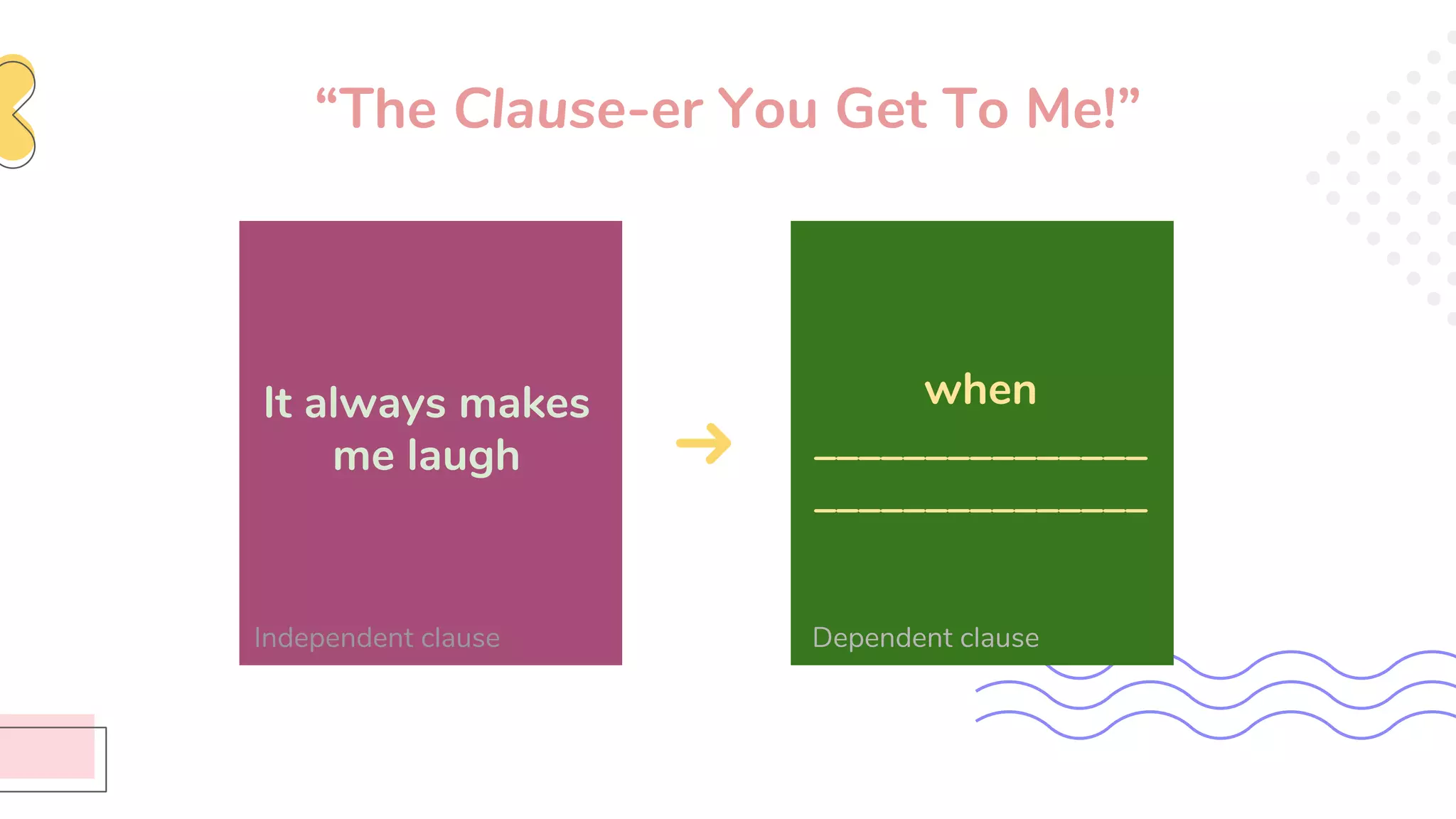
“The Clause-er You Get To Me!”
It always makes
me laugh
Independent clause Dependent clause
when
_______________
_______________
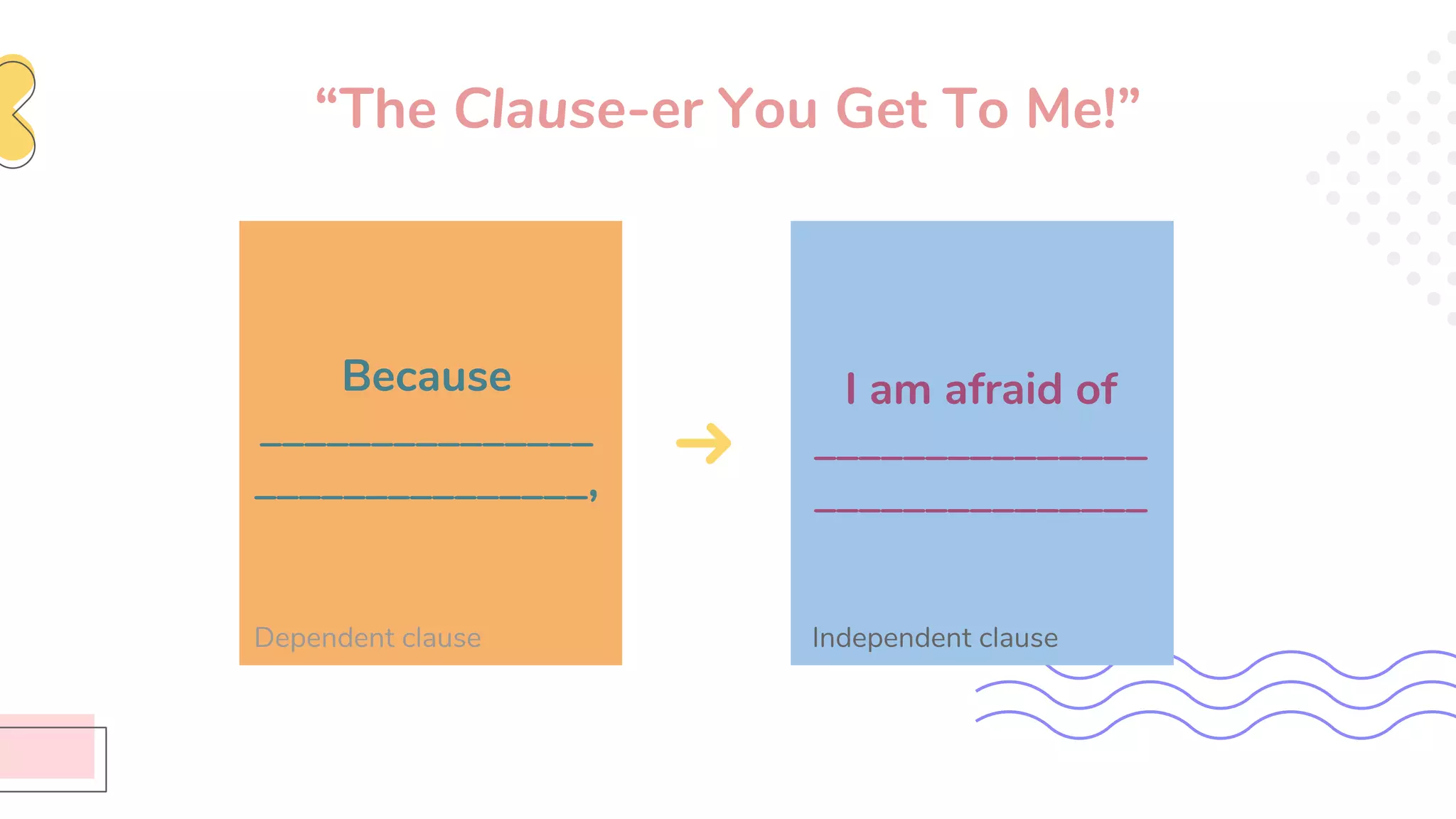
“The Clause-er You Get To Me!”
Because
_______________
_______________,
Dependent clause Independent clause
I am afraid of
_______________
_______________
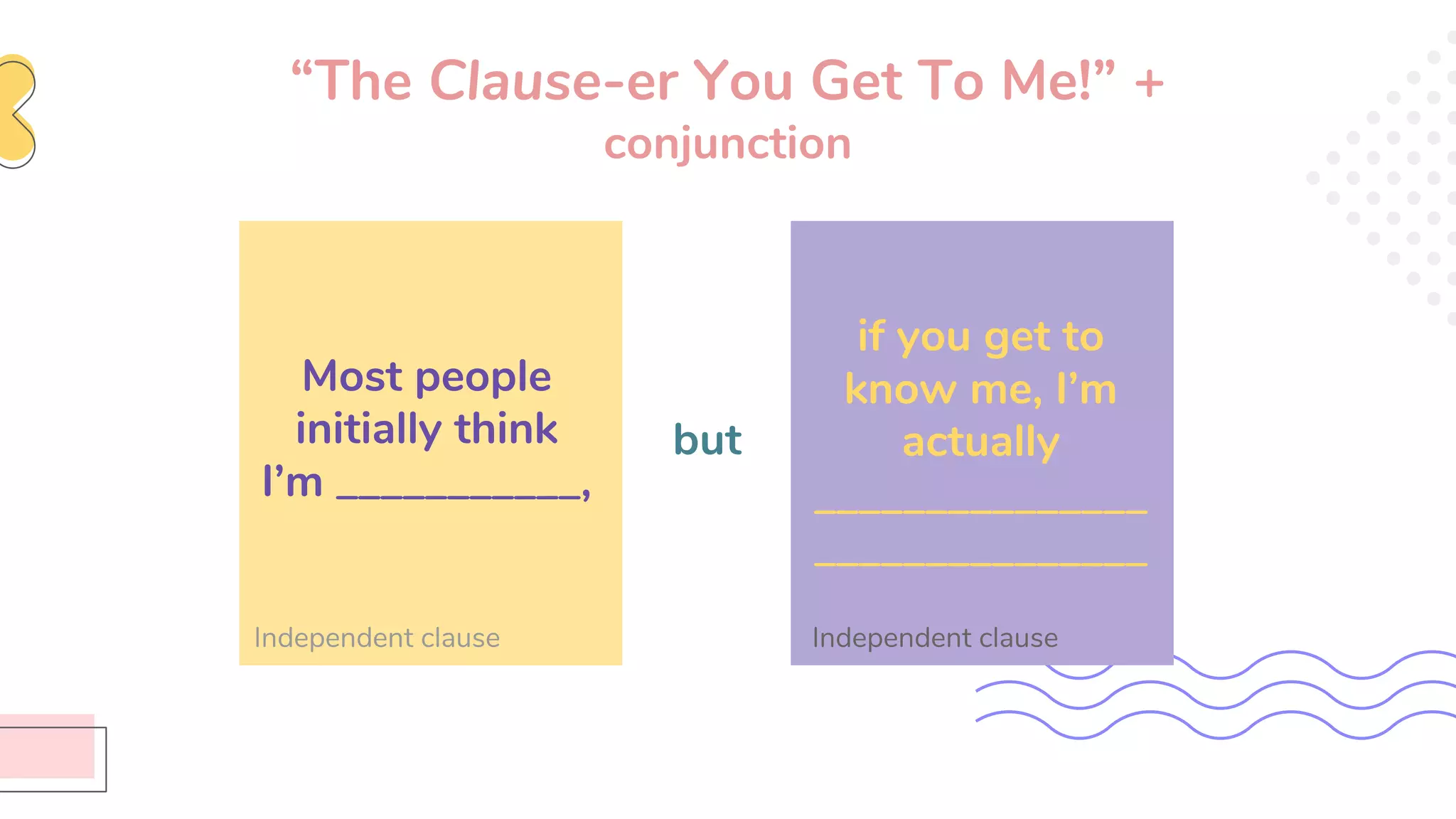
“The Clause-er You Get To Me!” +
conjunction
Most people
initially think
I’m ___________,
Independent clause Independent clause
if you get to
know me, I’m
actually
_______________
_______________
but
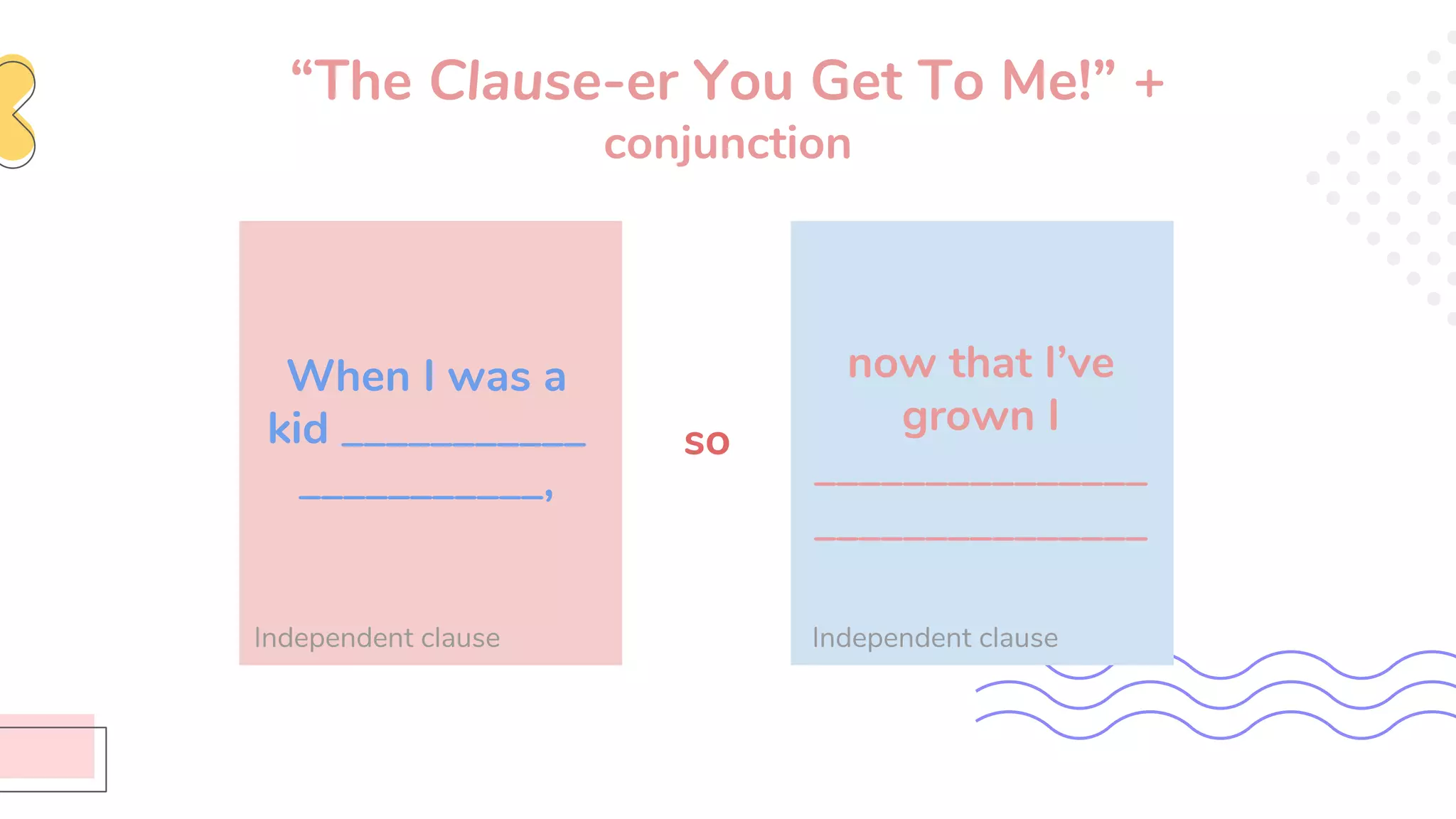
“The Clause-er You Get To Me!” +
conjunction
When I was a
kid ___________
___________,
Independent clause Independent clause
now that I’ve
grown I
_______________
_______________
so
Examples
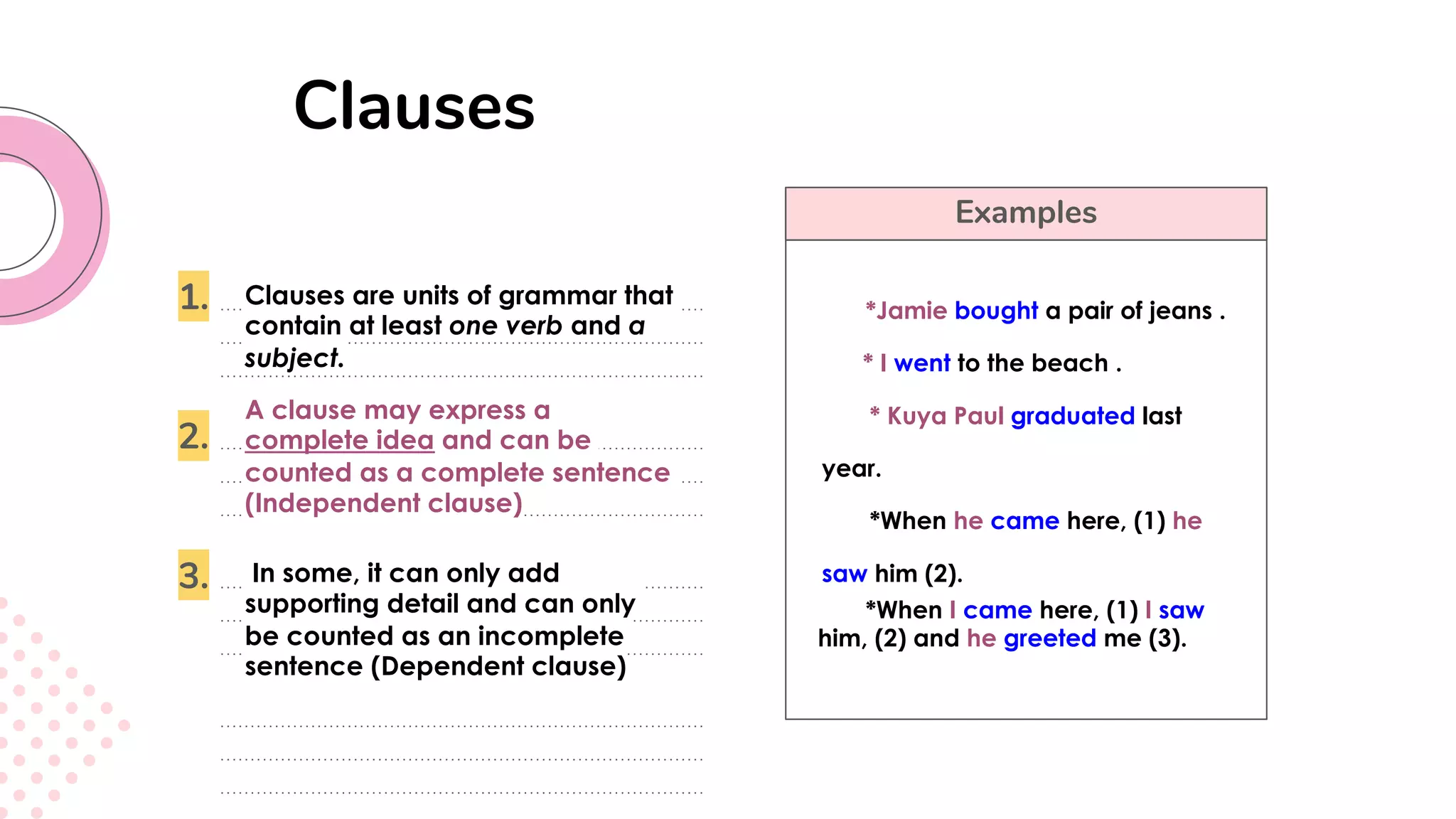
Clauses
1.
2.
3.
Clauses are units of grammar that
contain at least one verb and a
subject.
A clause may express a
complete idea and can be
counted as a complete sentence
(Independent clause)
In some, it can only add
supporting detail and can only
be counted as an incomplete
sentence (Dependent clause)
*Jamie bought a pair of jeans .
* I went to the beach .
* Kuya Paul graduated last
year.
*When he came here, (1) he
saw him (2).
*When I came here, (1) I saw
him, (2) and he greeted me (3).
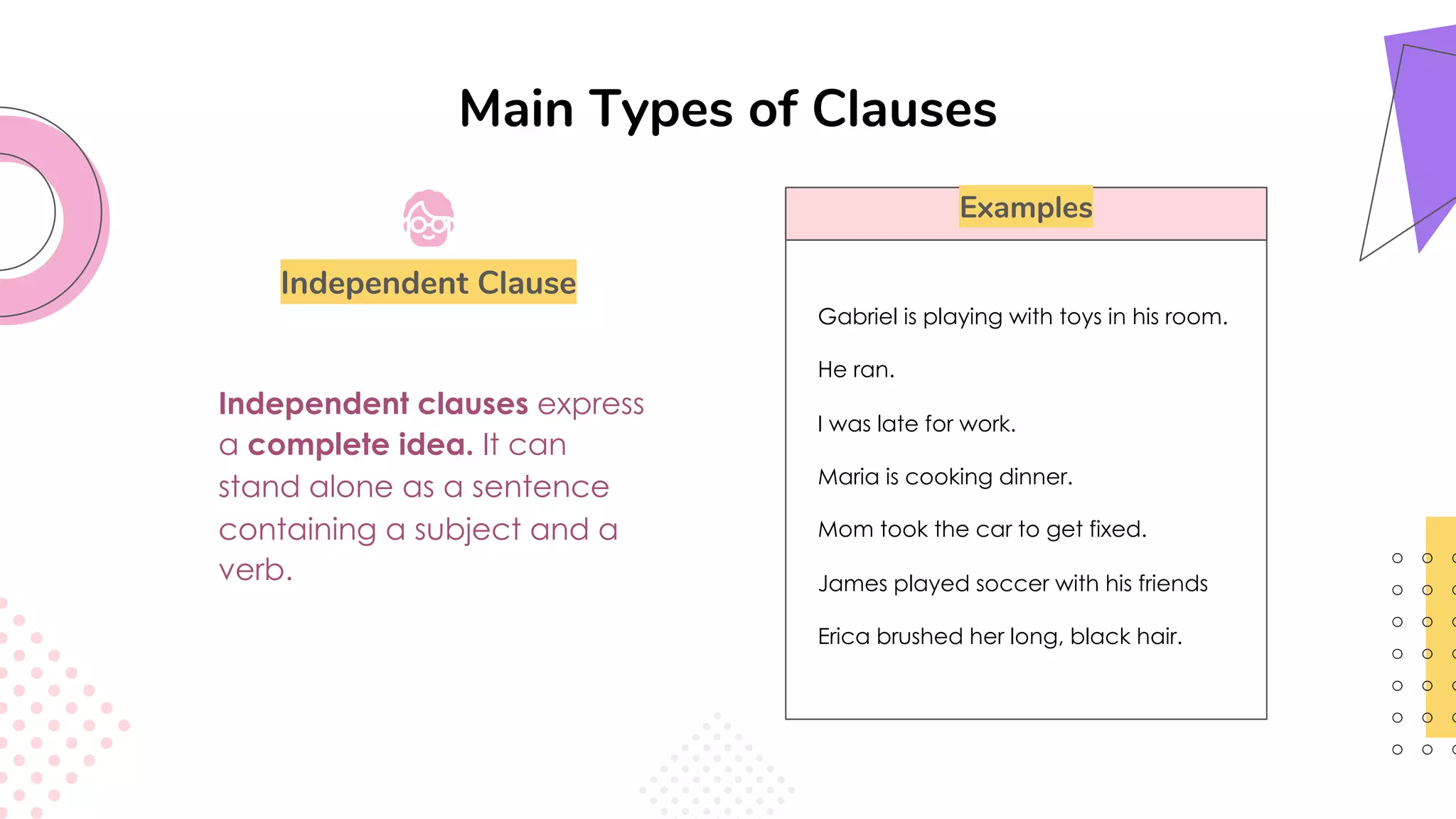
Main Types of Clauses
Independent Clause
Independent clauses express
a complete idea. It can
stand alone as a sentence
containing a subject and a
verb.
Gabriel is playing with toys in his room.
He ran.
I was late for work.
Maria is cooking dinner.
Mom took the car to get fixed.
James played soccer with his friends
Erica brushed her long, black hair.
Examples
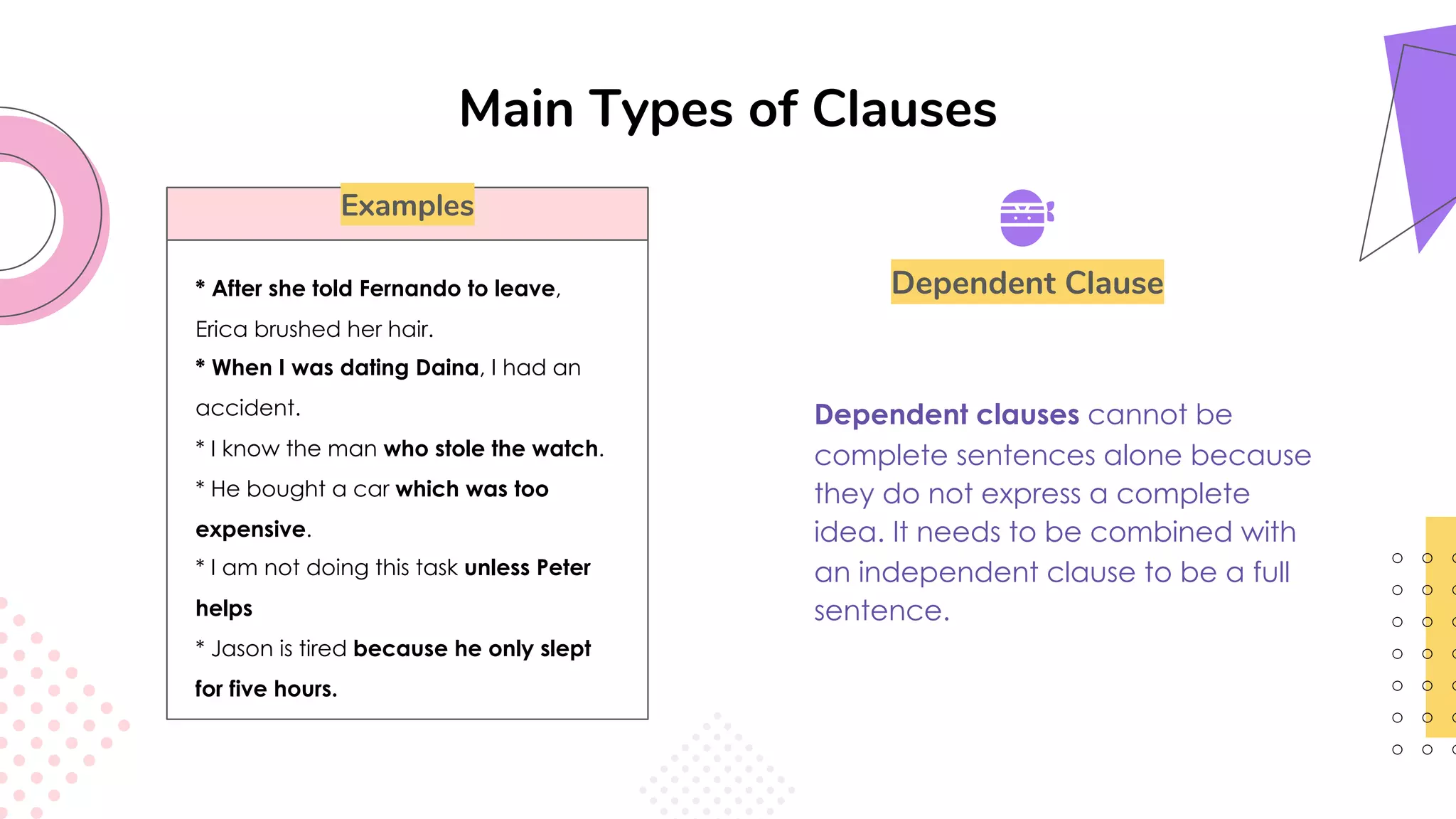
Main Types of Clauses
Dependent Clause
Dependent clauses cannot be
complete sentences alone because
they do not express a complete
idea. It needs to be combined with
an independent clause to be a full
sentence.
Examples
* After she told Fernando to leave,
Erica brushed her hair.
* When I was dating Daina, I had an
accident.
* I know the man who stole the watch.
* He bought a car which was too
expensive.
* I am not doing this task unless Peter
helps
* Jason is tired because he only slept
for five hours.
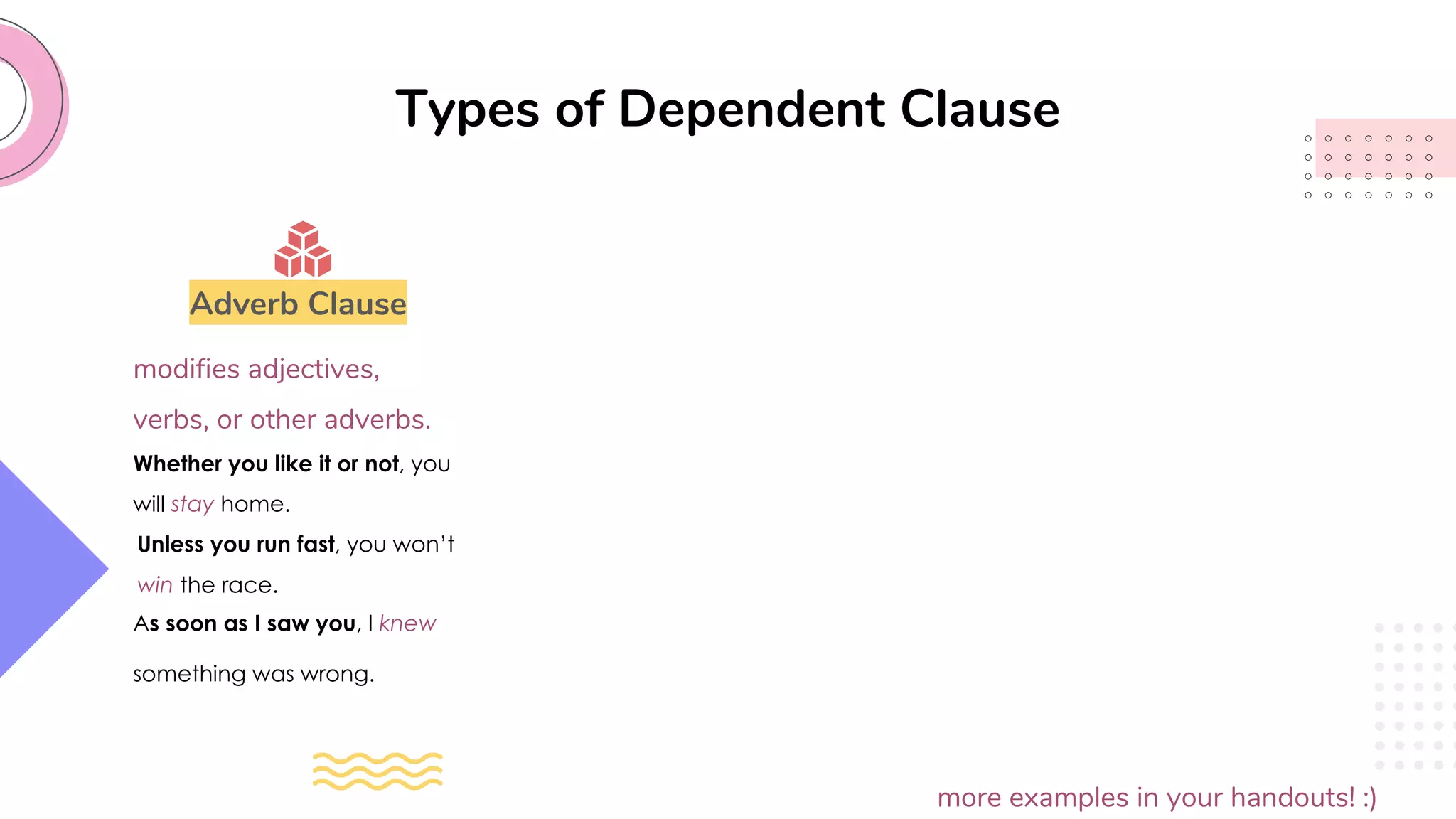
Types of Dependent Clause
Adverb Clause
modifies adjectives,
verbs, or other adverbs.
Whether you like it or not, you
will stay home.
Unless you run fast, you won’t
win the race.
As soon as I saw you, I knew
something was wrong.
more examples in your handouts! :)
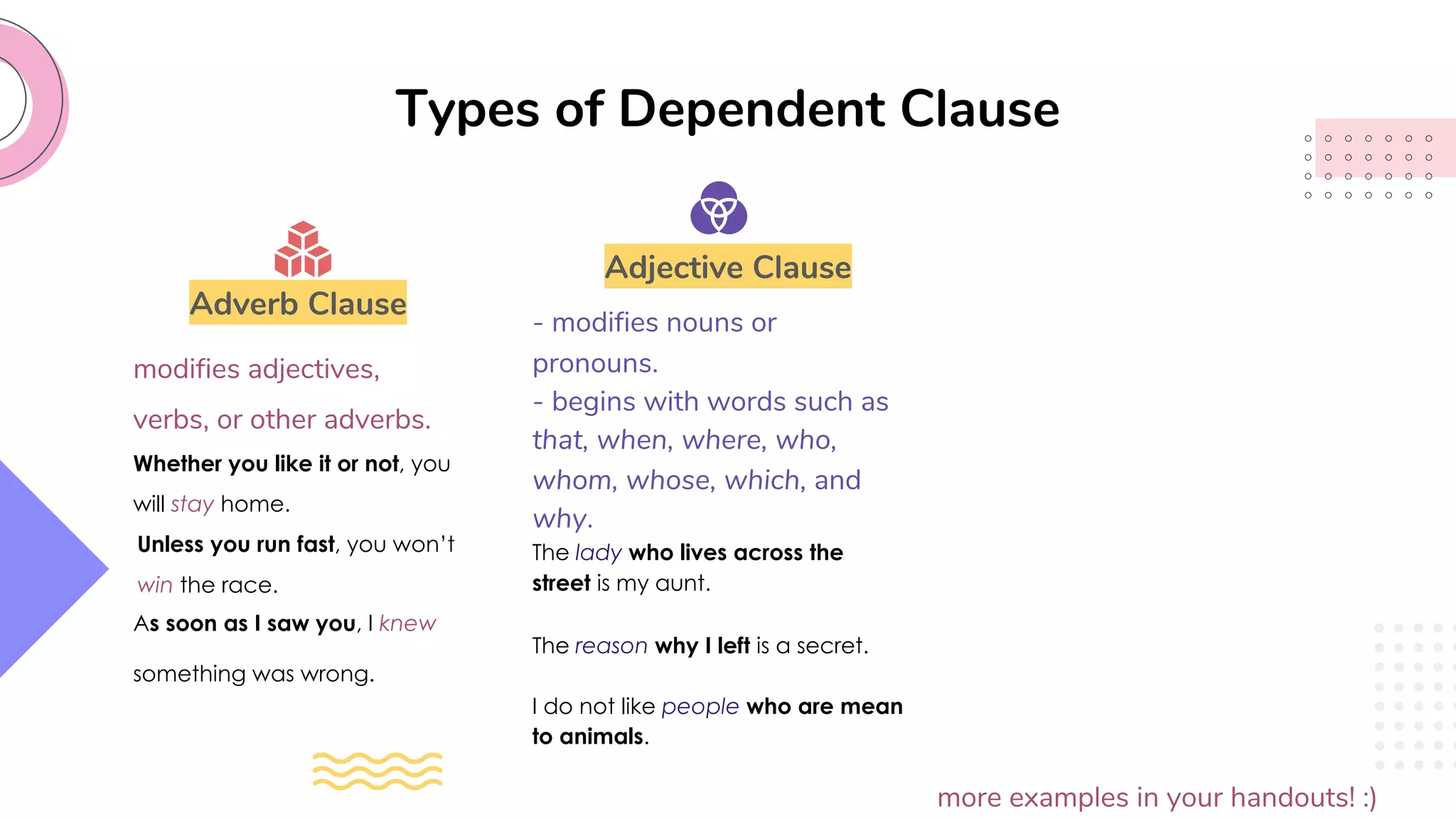
Adjective Clause
Types of Dependent Clause
Adverb Clause
modifies adjectives,
verbs, or other adverbs.
Whether you like it or not, you
will stay home.
Unless you run fast, you won’t
win the race.
As soon as I saw you, I knew
something was wrong.
more examples in your handouts! :)
- modifies nouns or
pronouns.
- begins with words such as
that, when, where, who,
whom, whose, which, and
why.
The lady who lives across the
street is my aunt.
The reason why I left is a secret.
I do not like people who are mean
to animals.
Adjective Clause
Types of Dependent Clause
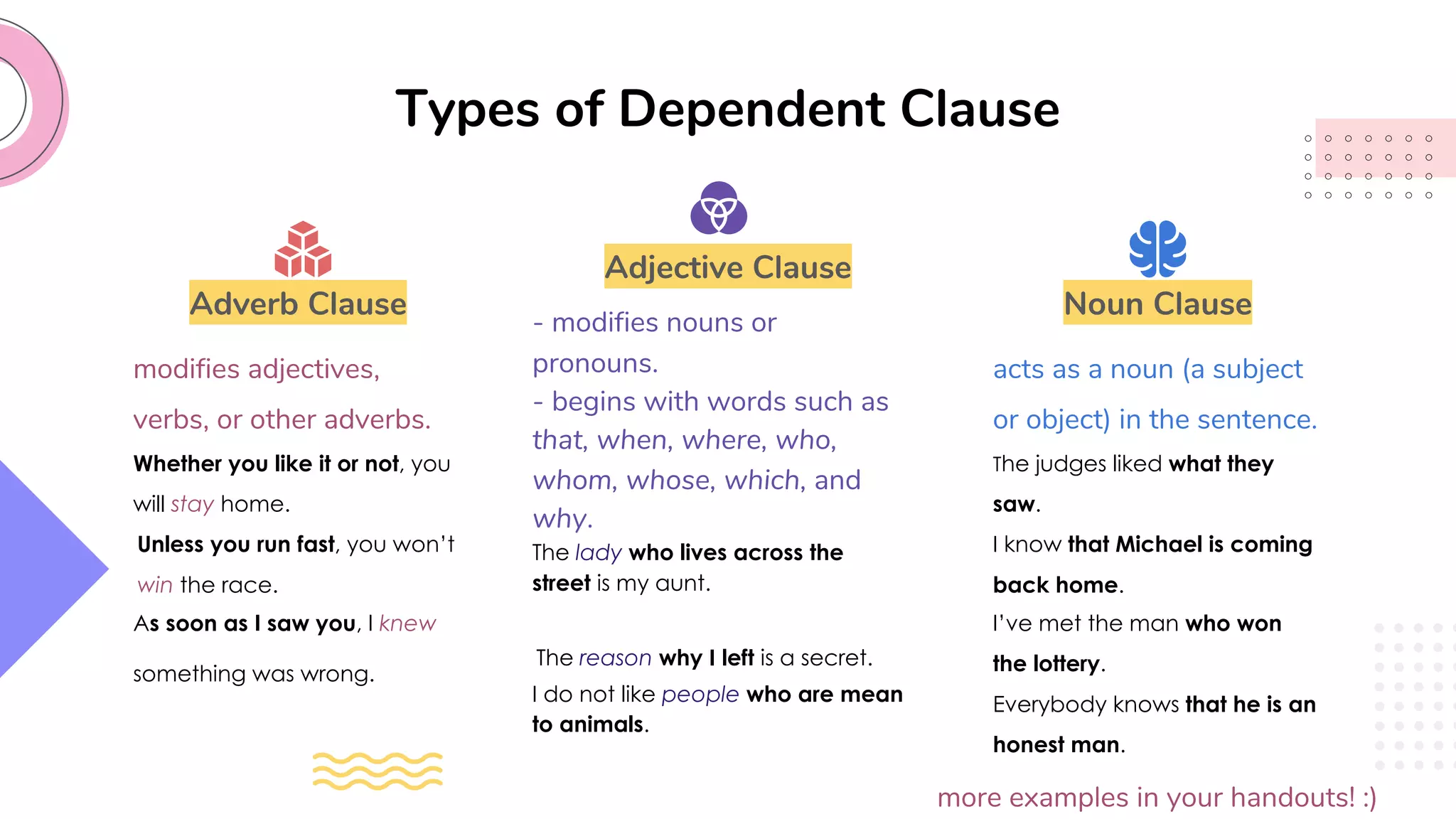
Adverb Clause Noun Clause
modifies adjectives,
verbs, or other adverbs.
Whether you like it or not, you
will stay home.
Unless you run fast, you won’t
win the race.
As soon as I saw you, I knew
something was wrong.
acts as a noun (a subject
or object) in the sentence.
The judges liked what they
saw.
I know that Michael is coming
back home.
I’ve met the man who won
the lottery.
Everybody knows that he is an
honest man.
more examples in your handouts! :)
- modifies nouns or
pronouns.
- begins with words such as
that, when, where, who,
whom, whose, which, and
why.
The lady who lives across the
street is my aunt.
The reason why I left is a secret.
I do not like people who are mean
to animals.
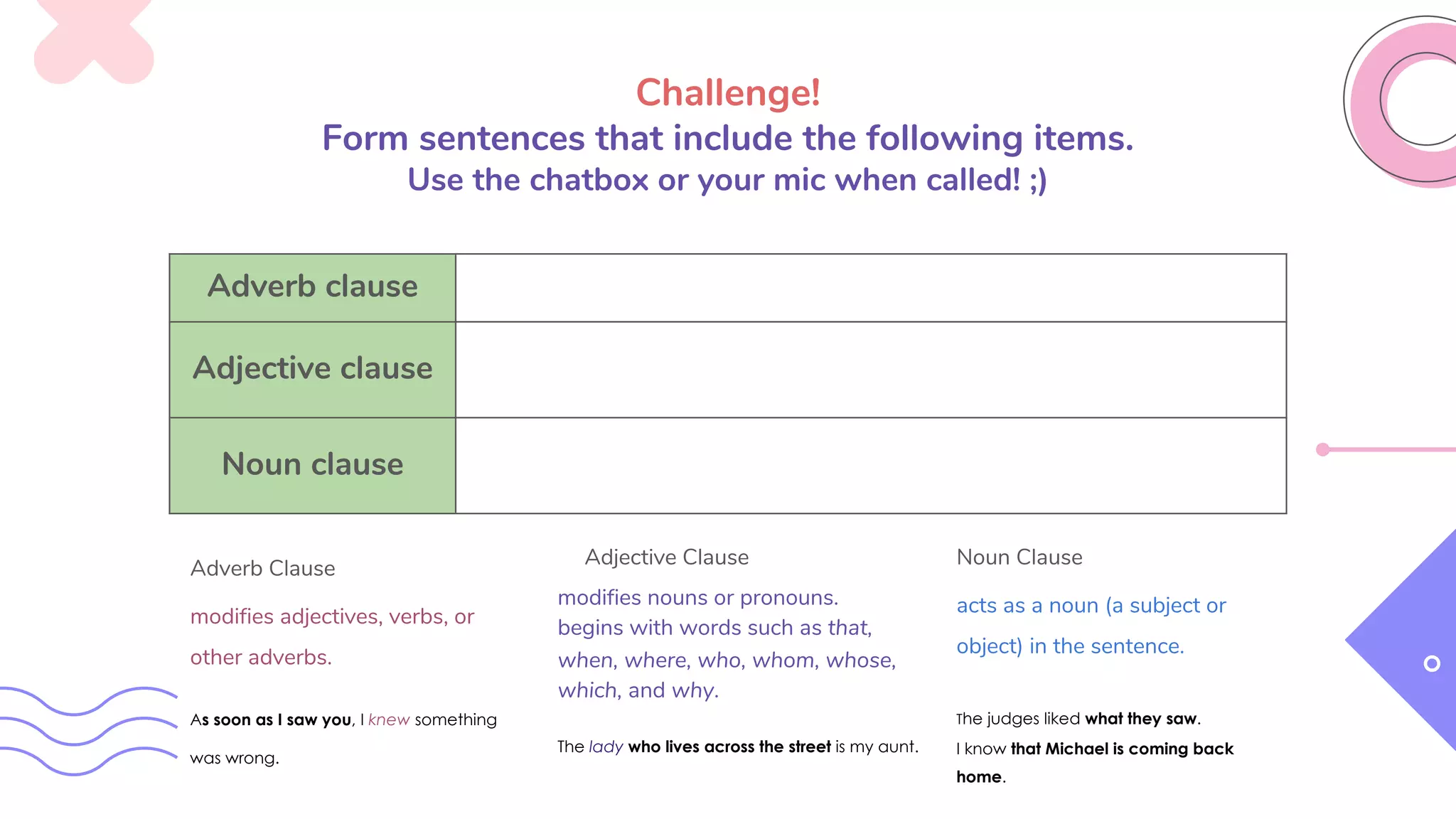
Challenge!
Form sentences that include the following items.
Use the chatbox or your mic when called! ;)
Adverb clause
Adjective clause
Noun clause
Adverb Clause
modifies adjectives, verbs, or
other adverbs.
As soon as I saw you, I knew something
was wrong.
Adjective Clause
modifies nouns or pronouns.
begins with words such as that,
when, where, who, whom, whose,
which, and why.
The lady who lives across the street is my aunt.
Noun Clause
acts as a noun (a subject or
object) in the sentence.
The judges liked what they saw.
I know that Michael is coming back
home.
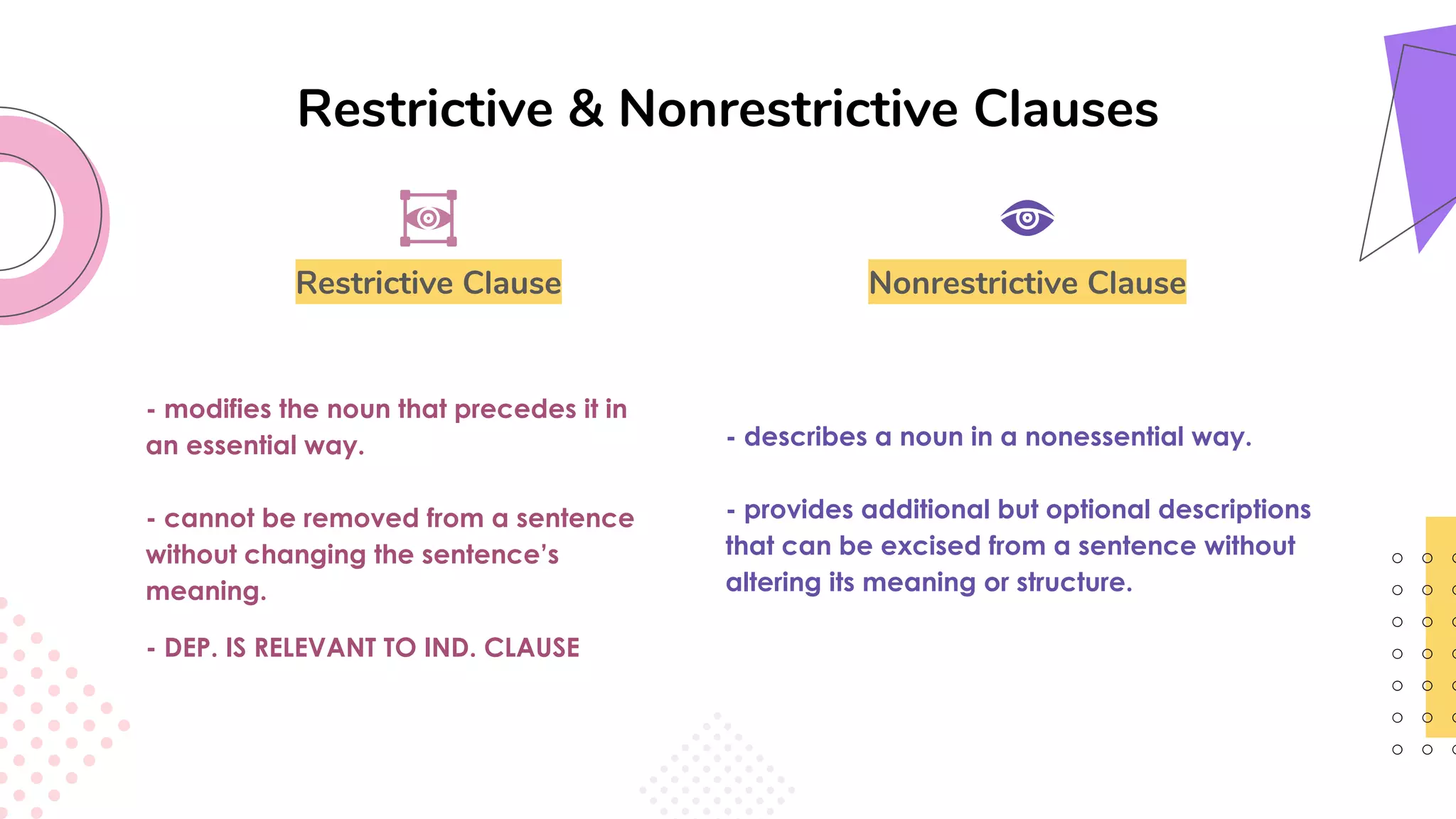
Restrictive & Nonrestrictive Clauses
Restrictive Clause Nonrestrictive Clause
- modifies the noun that precedes it in
an essential way.
- cannot be removed from a sentence
without changing the sentence’s
meaning.
- DEP. IS RELEVANT TO IND. CLAUSE
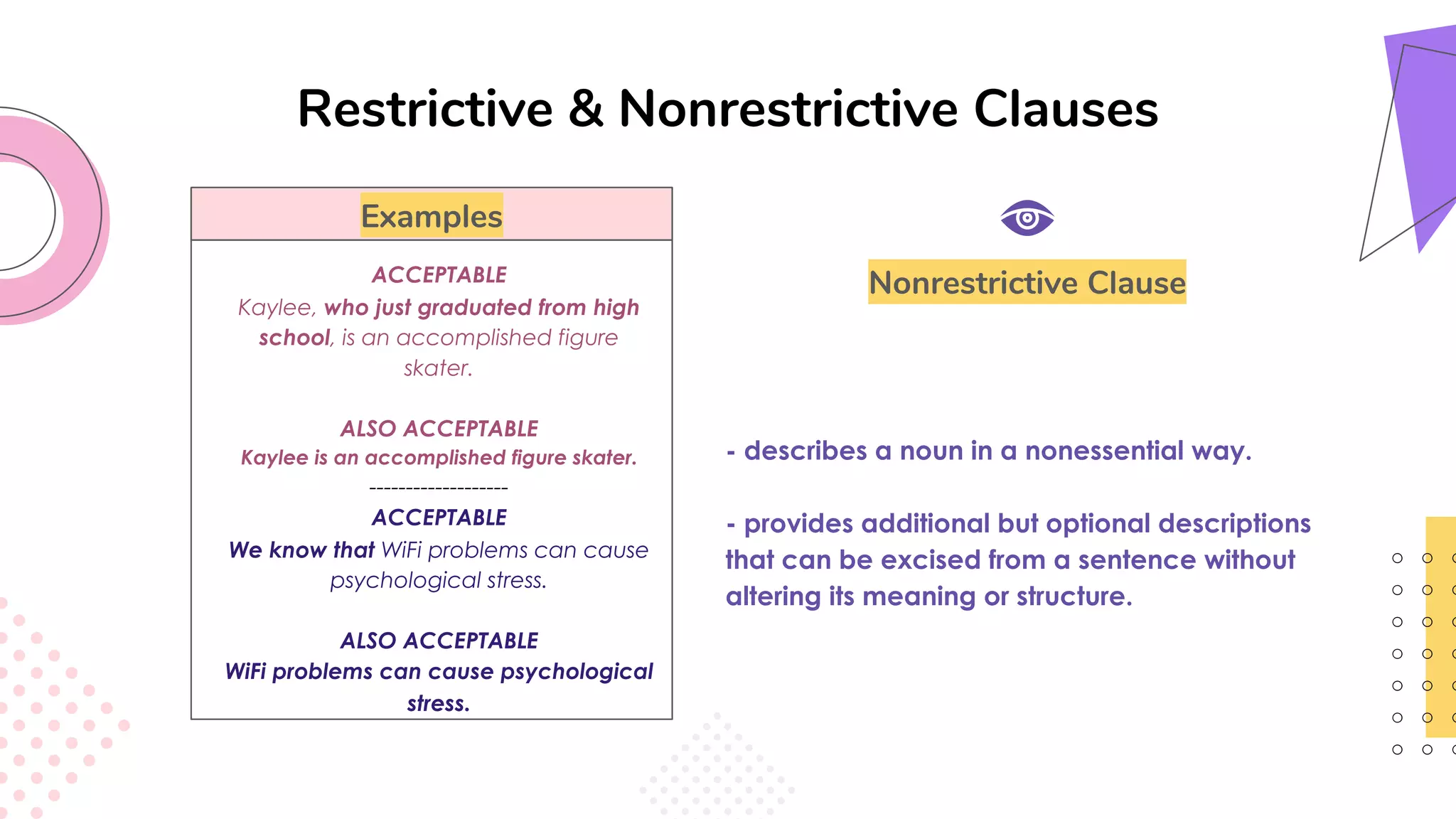
- describes a noun in a nonessential way.
- provides additional but optional descriptions
that can be excised from a sentence without
altering its meaning or structure.
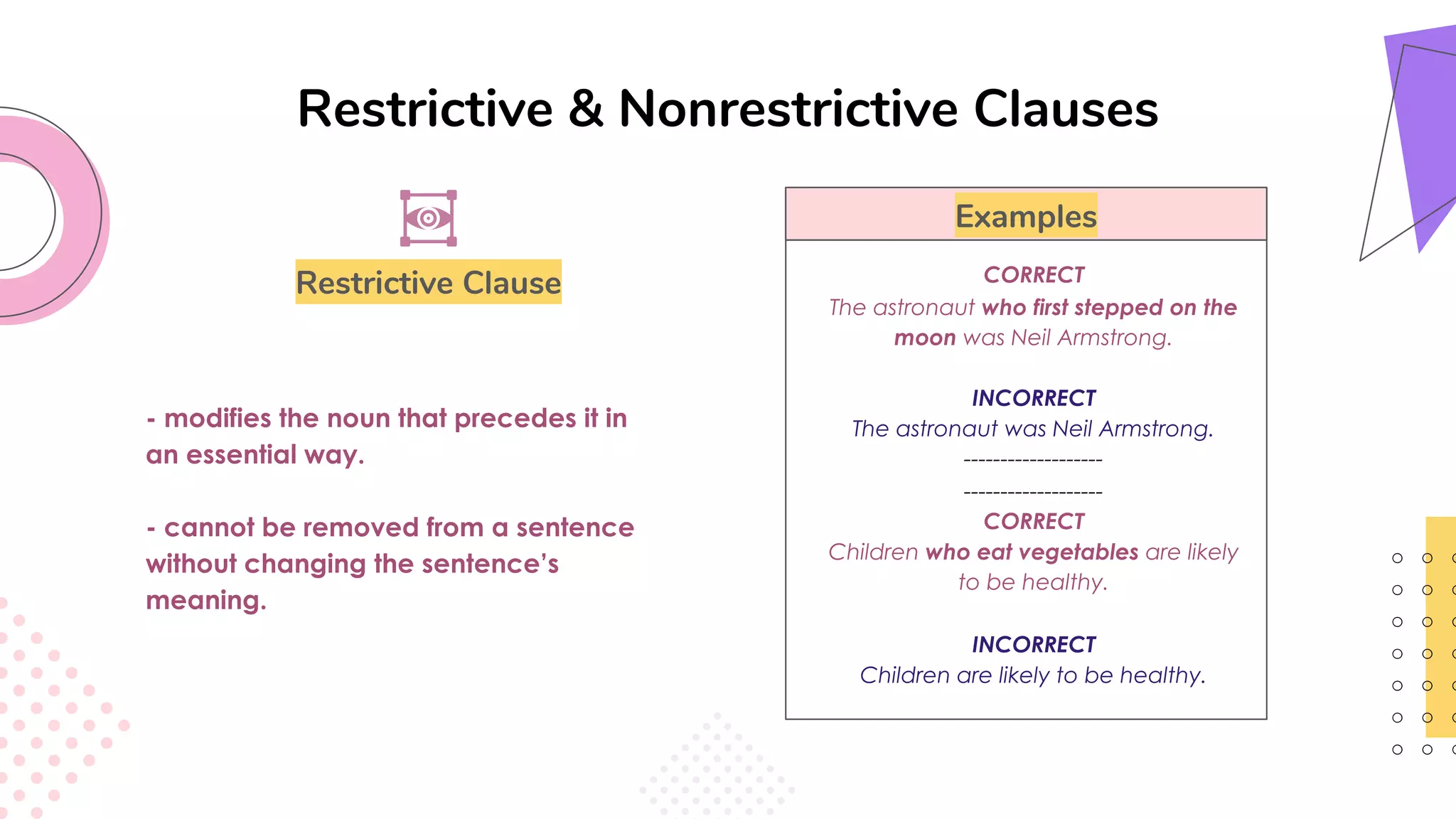
Restrictive & Nonrestrictive Clauses
- modifies the noun that precedes it in
an essential way.
- cannot be removed from a sentence
without changing the sentence’s
meaning.
Examples
CORRECT
The astronaut who first stepped on the
moon was Neil Armstrong.
INCORRECT
The astronaut was Neil Armstrong.
-------------------
-------------------
CORRECT
Children who eat vegetables are likely
to be healthy.
INCORRECT
Children are likely to be healthy.
Restrictive Clause
Restrictive & Nonrestrictive Clauses
- describes a noun in a nonessential way.
- provides additional but optional descriptions
that can be excised from a sentence without
altering its meaning or structure.
Examples
ACCEPTABLE
Kaylee, who just graduated from high
school, is an accomplished figure
skater.
ALSO ACCEPTABLE
Kaylee is an accomplished figure skater.
-------------------
ACCEPTABLE
We know that WiFi problems can cause
psychological stress.
ALSO ACCEPTABLE
WiFi problems can cause psychological
stress.
Nonrestrictive Clause
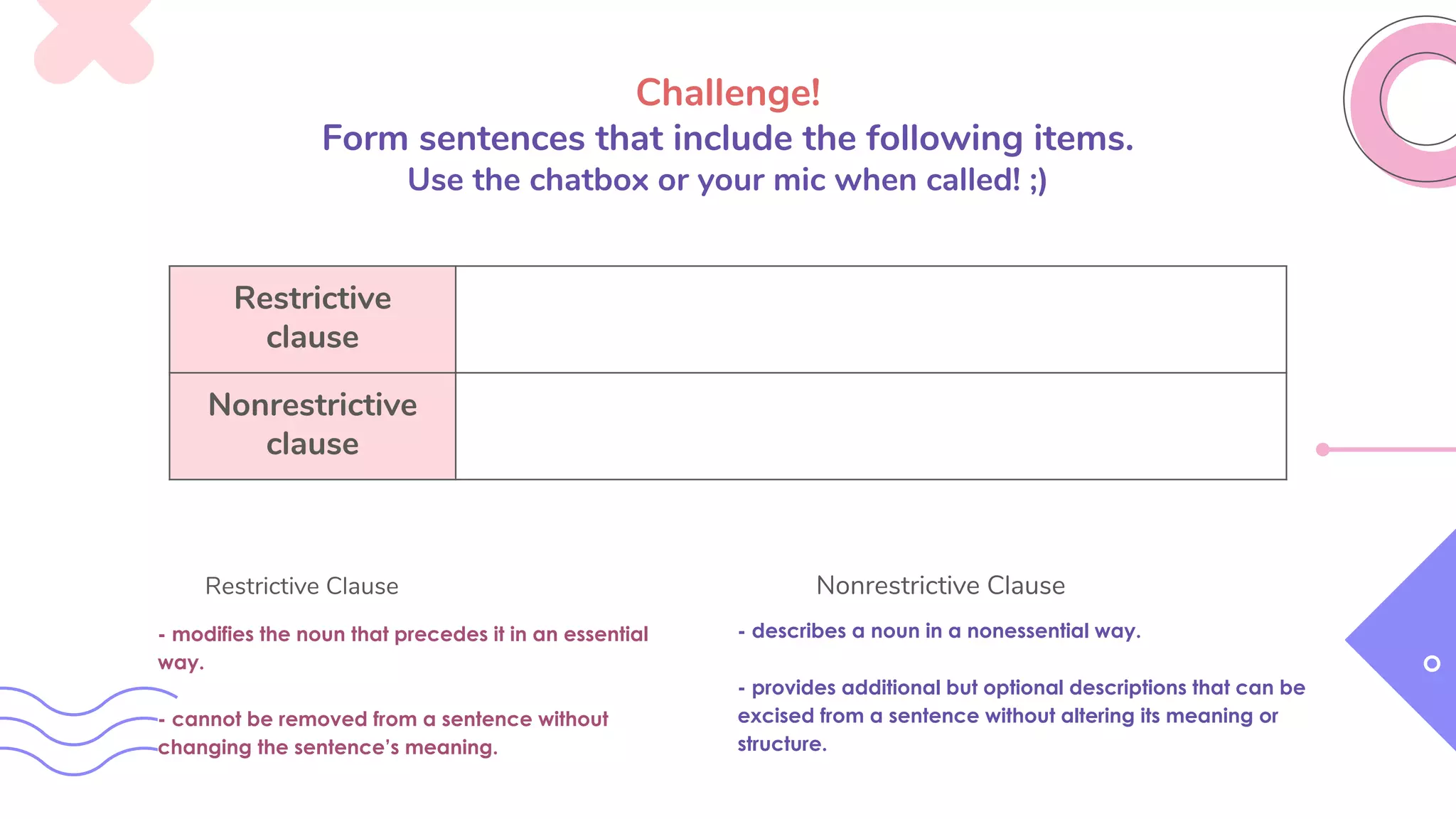
Challenge!
Form sentences that include the following items.
Use the chatbox or your mic when called! ;)
Restrictive
clause
Nonrestrictive
clause
- describes a noun in a nonessential way.
- provides additional but optional descriptions that can be
excised from a sentence without altering its meaning or
structure.
Nonrestrictive Clause
- modifies the noun that precedes it in an essential
way.
- cannot be removed from a sentence without
changing the sentence’s meaning.
Restrictive Clause
Examples
Conjunctions
1.
2.
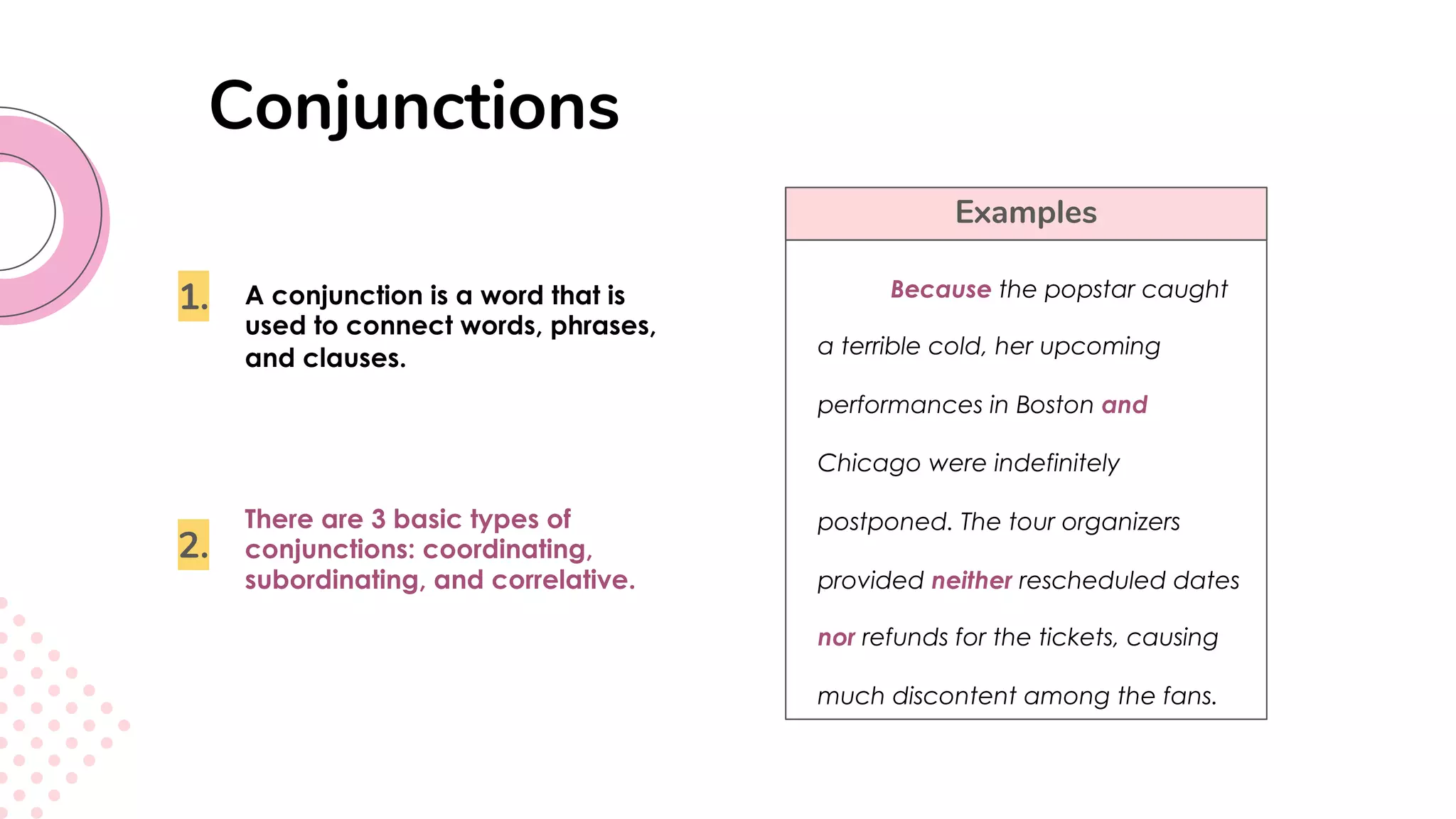
A conjunction is a word that is
used to connect words, phrases,
and clauses.
There are 3 basic types of
conjunctions: coordinating,
subordinating, and correlative.
Because the popstar caught
a terrible cold, her upcoming
performances in Boston and
Chicago were indefinitely
postponed. The tour organizers
provided neither rescheduled dates
nor refunds for the tickets, causing
much discontent among the fans.
Types of Conjunctions
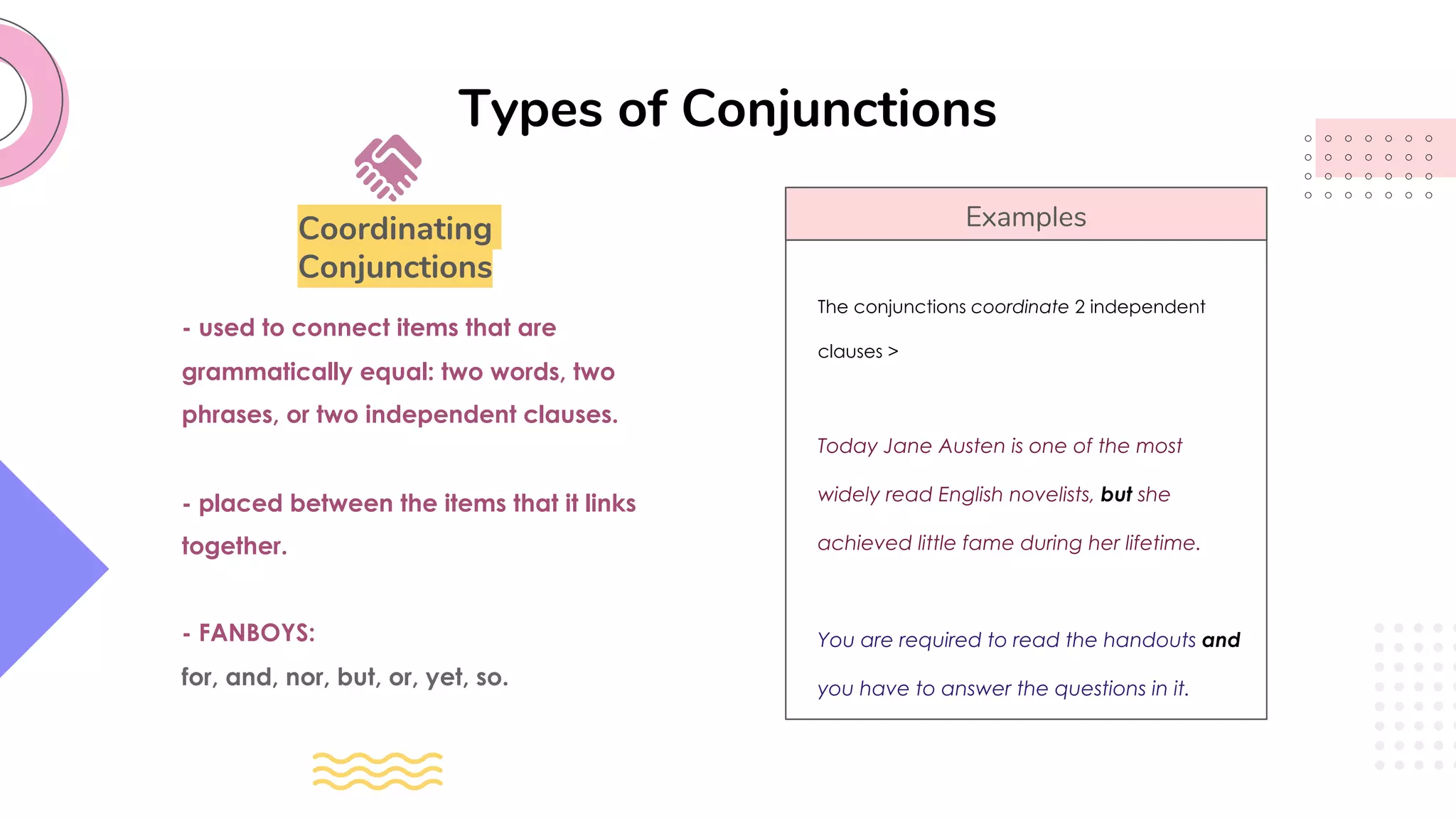
Coordinating
Conjunctions
- used to connect items that are
grammatically equal: two words, two
phrases, or two independent clauses.
- placed between the items that it links
together.
- FANBOYS:
for, and, nor, but, or, yet, so.
Examples
The conjunctions coordinate 2 independent
clauses >
Today Jane Austen is one of the most
widely read English novelists, but she
achieved little fame during her lifetime.
You are required to read the handouts and
you have to answer the questions in it.
Types of Conjunctions
more examples in your handouts! :)
Examples
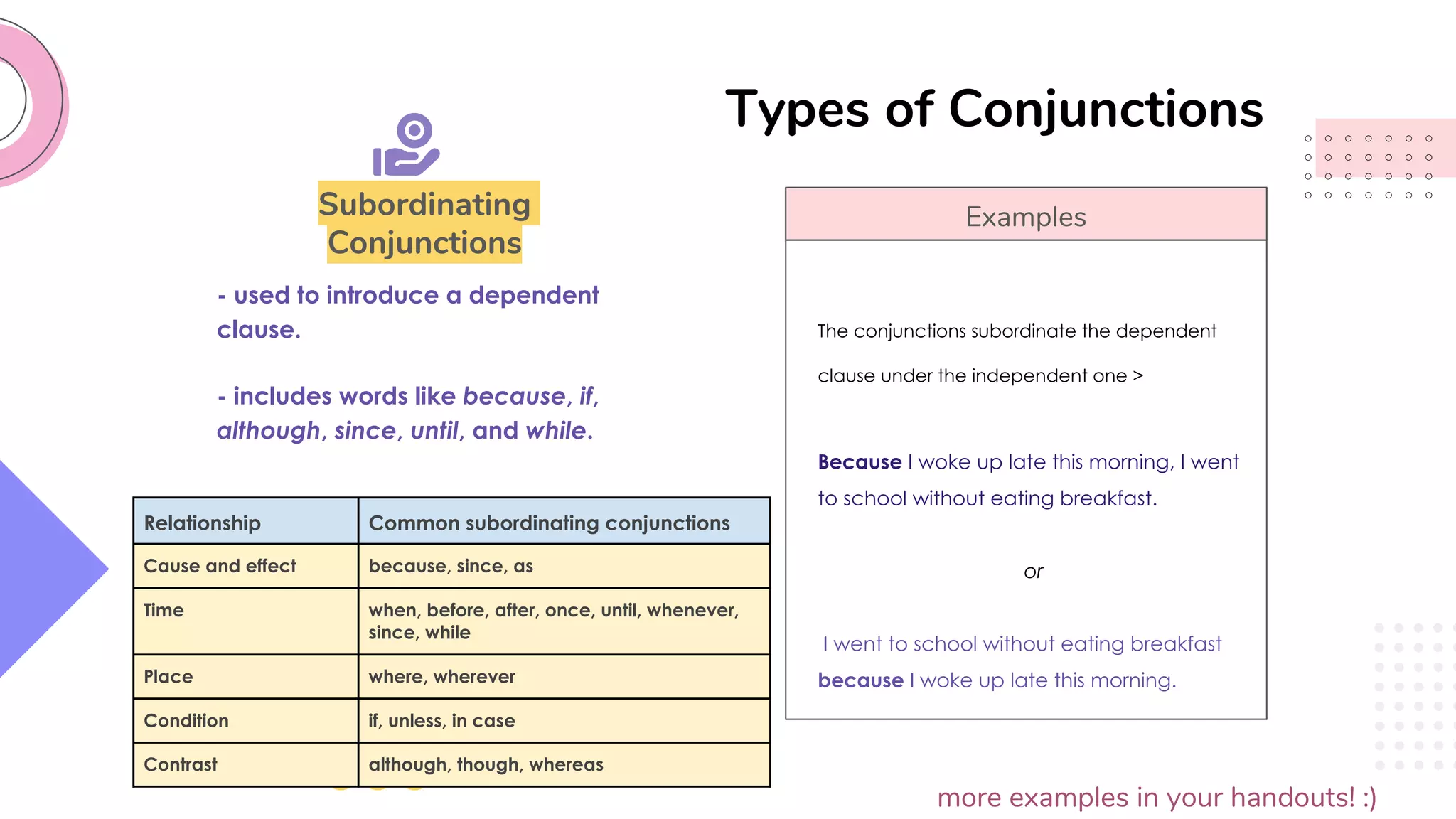
The conjunctions subordinate the dependent
clause under the independent one >
Because I woke up late this morning, I went
to school without eating breakfast.
or
I went to school without eating breakfast
because I woke up late this morning.
Subordinating
Conjunctions
- used to introduce a dependent
clause.
- includes words like because, if,
although, since, until, and while.
Relationship Common subordinating conjunctions
Cause and effect because, since, as
Time when, before, after, once, until, whenever,
since, while
Place where, wherever
Condition if, unless, in case
Contrast although, though, whereas
Examples
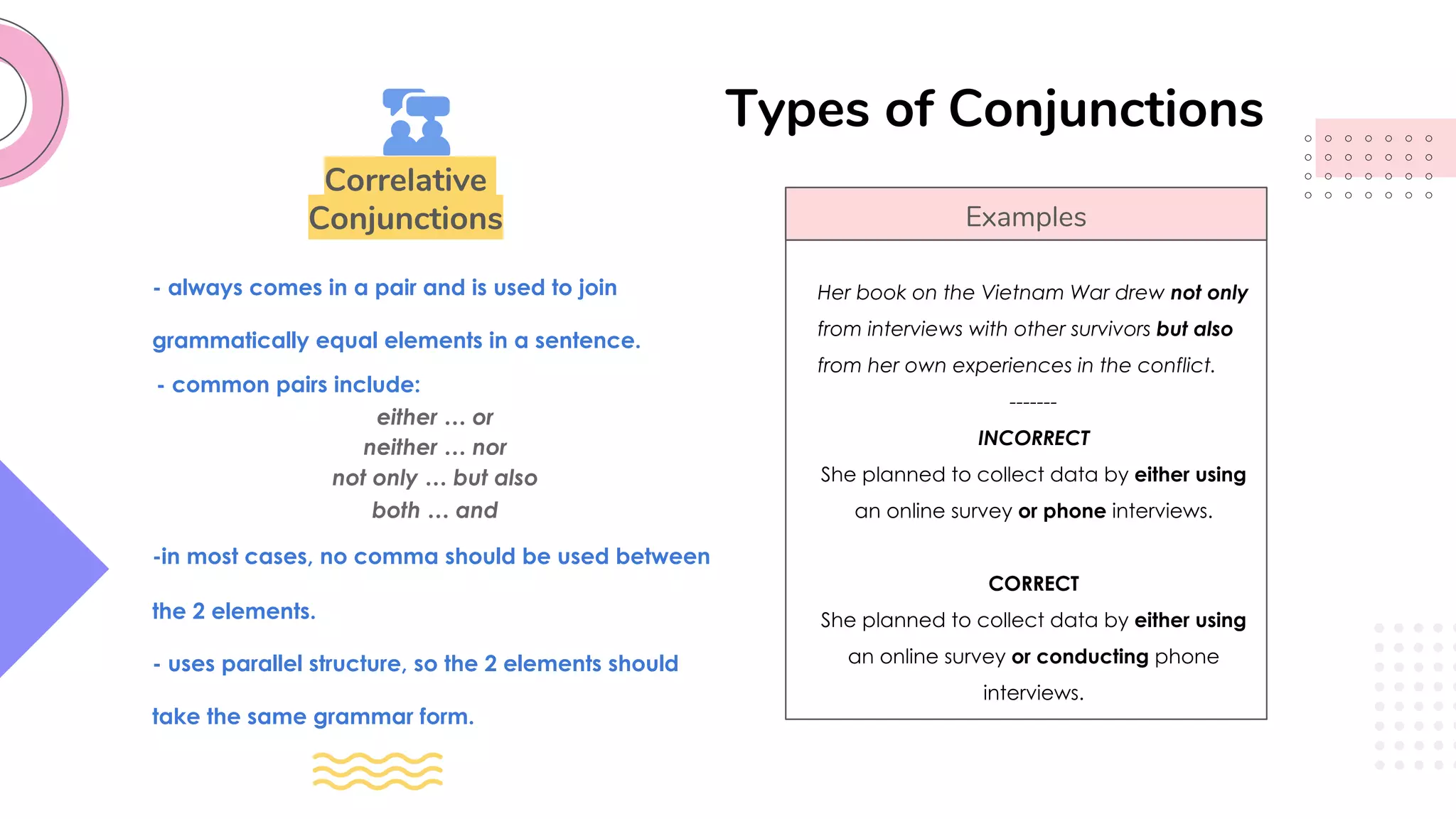
Her book on the Vietnam War drew not only
from interviews with other survivors but also
from her own experiences in the conflict.
-------
INCORRECT
She planned to collect data by either using
an online survey or phone interviews.
CORRECT
She planned to collect data by either using
an online survey or conducting phone
interviews.
Correlative
Conjunctions
- always comes in a pair and is used to join
grammatically equal elements in a sentence.
- common pairs include:
either … or
neither … nor
not only … but also
both … and
-in most cases, no comma should be used between
the 2 elements.
- uses parallel structure, so the 2 elements should
take the same grammar form.
Types of Conjunctions
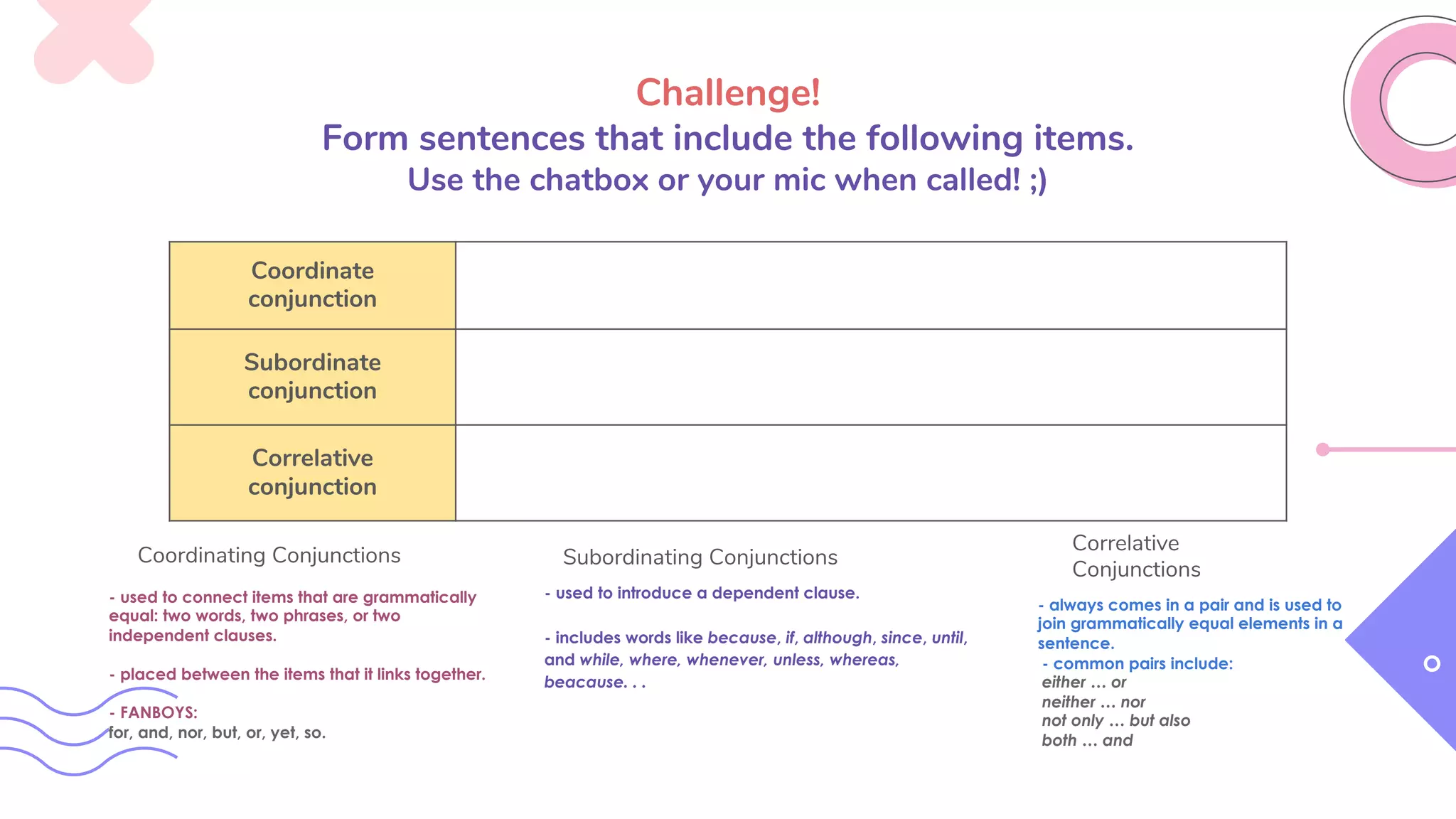
Challenge!
Form sentences that include the following items.
Use the chatbox or your mic when called! ;)
Coordinate
conjunction
Subordinate
conjunction
Correlative
conjunction
Correlative
Conjunctions
- always comes in a pair and is used to
join grammatically equal elements in a
sentence.
- common pairs include:
either … or
neither … nor
not only … but also
both … and
Subordinating Conjunctions
- used to introduce a dependent clause.
- includes words like because, if, although, since, until,
and while, where, whenever, unless, whereas,
beacause. . .
Coordinating Conjunctions
- used to connect items that are grammatically
equal: two words, two phrases, or two
independent clauses.
- placed between the items that it links together.
- FANBOYS:
for, and, nor, but, or, yet, so.
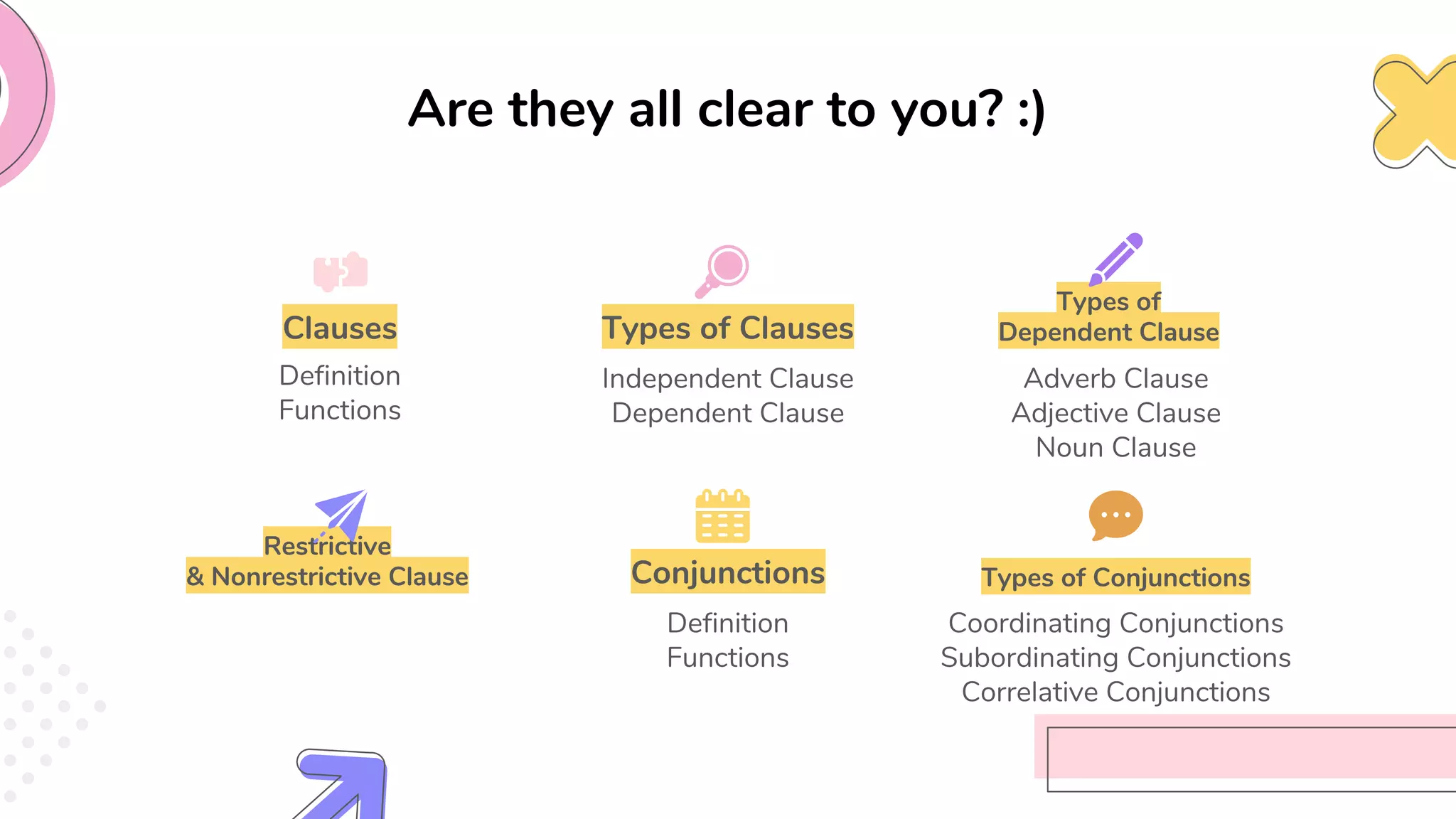
Are they all clear to you? :)
Clauses Types of Clauses
Independent Clause
Dependent Clause
Types of
Dependent Clause
Adverb Clause
Adjective Clause
Noun Clause
Restrictive
& Nonrestrictive Clause Conjunctions
Definition
Functions
Types of Conjunctions
Coordinating Conjunctions
Subordinating Conjunctions
Correlative Conjunctions
Definition
Functions
References
Luo, A. (2019). Using Conjunctions. Scribbr. Retrieved from
https://www.scribbr.com/language-rules/conjunctions/
Manuel, J. (2019). Types of Clauses with Examples. EnglishPost.org. Retrieved from
https://englishpost.org/types-of-clauses/
Traffic, C. (nd.) Restrictive and Nonrestrictive Clauses - What’s the Difference?. Grammarly.
Retrieved from https://www.grammarly.com/blog/using-that-and-which-is-all-about-restrictive-
and-non-restrictive-clauses/
CREDITS: This presentation template was
created by Slidesgo, including icons by
Flaticon, infographics & images by Freepik.
Thanks!
Do you have any questions?
addyouremail@freepik.com
+91 620 421 838
yourcompany.com
Please keep this slide for attribution.

Grammar - Clauses & Conjunctions

  • 1.
    Clauses & Conjunctions Connectingsentences. Connecting lives. (Wow!) Prepared by Ronuel del Rosario
  • 2.
    When your nameis called, unmute or use the chatbox to complete the following sentences by sharing something about yourself. Make sure your answers are grammatically fitting to the sentence. >>Let’s Play a Game!<< “The Clause-er You Get To Me!”
  • 3.
    “The Clause-er YouGet To Me!” When I need to de-stress, Dependent clause Independent clause I usually _______________ _______________
  • 4.
    “The Clause-er YouGet To Me!” It always makes me laugh Independent clause Dependent clause when _______________ _______________
  • 5.
    “The Clause-er YouGet To Me!” Because _______________ _______________, Dependent clause Independent clause I am afraid of _______________ _______________
  • 6.
    “The Clause-er YouGet To Me!” + conjunction Most people initially think I’m ___________, Independent clause Independent clause if you get to know me, I’m actually _______________ _______________ but
  • 7.
    “The Clause-er YouGet To Me!” + conjunction When I was a kid ___________ ___________, Independent clause Independent clause now that I’ve grown I _______________ _______________ so
  • 8.
    Examples Clauses 1. 2. 3. Clauses are unitsof grammar that contain at least one verb and a subject. A clause may express a complete idea and can be counted as a complete sentence (Independent clause) In some, it can only add supporting detail and can only be counted as an incomplete sentence (Dependent clause) *Jamie bought a pair of jeans . * I went to the beach . * Kuya Paul graduated last year. *When he came here, (1) he saw him (2). *When I came here, (1) I saw him, (2) and he greeted me (3).
  • 9.
    Main Types ofClauses Independent Clause Independent clauses express a complete idea. It can stand alone as a sentence containing a subject and a verb. Gabriel is playing with toys in his room. He ran. I was late for work. Maria is cooking dinner. Mom took the car to get fixed. James played soccer with his friends Erica brushed her long, black hair. Examples
  • 10.
    Main Types ofClauses Dependent Clause Dependent clauses cannot be complete sentences alone because they do not express a complete idea. It needs to be combined with an independent clause to be a full sentence. Examples * After she told Fernando to leave, Erica brushed her hair. * When I was dating Daina, I had an accident. * I know the man who stole the watch. * He bought a car which was too expensive. * I am not doing this task unless Peter helps * Jason is tired because he only slept for five hours.
  • 11.
    Types of DependentClause Adverb Clause modifies adjectives, verbs, or other adverbs. Whether you like it or not, you will stay home. Unless you run fast, you won’t win the race. As soon as I saw you, I knew something was wrong. more examples in your handouts! :)
  • 12.
    Adjective Clause Types ofDependent Clause Adverb Clause modifies adjectives, verbs, or other adverbs. Whether you like it or not, you will stay home. Unless you run fast, you won’t win the race. As soon as I saw you, I knew something was wrong. more examples in your handouts! :) - modifies nouns or pronouns. - begins with words such as that, when, where, who, whom, whose, which, and why. The lady who lives across the street is my aunt. The reason why I left is a secret. I do not like people who are mean to animals.
  • 13.
    Adjective Clause Types ofDependent Clause Adverb Clause Noun Clause modifies adjectives, verbs, or other adverbs. Whether you like it or not, you will stay home. Unless you run fast, you won’t win the race. As soon as I saw you, I knew something was wrong. acts as a noun (a subject or object) in the sentence. The judges liked what they saw. I know that Michael is coming back home. I’ve met the man who won the lottery. Everybody knows that he is an honest man. more examples in your handouts! :) - modifies nouns or pronouns. - begins with words such as that, when, where, who, whom, whose, which, and why. The lady who lives across the street is my aunt. The reason why I left is a secret. I do not like people who are mean to animals.
  • 14.
    Challenge! Form sentences thatinclude the following items. Use the chatbox or your mic when called! ;) Adverb clause Adjective clause Noun clause Adverb Clause modifies adjectives, verbs, or other adverbs. As soon as I saw you, I knew something was wrong. Adjective Clause modifies nouns or pronouns. begins with words such as that, when, where, who, whom, whose, which, and why. The lady who lives across the street is my aunt. Noun Clause acts as a noun (a subject or object) in the sentence. The judges liked what they saw. I know that Michael is coming back home.
  • 15.
    Restrictive & NonrestrictiveClauses Restrictive Clause Nonrestrictive Clause - modifies the noun that precedes it in an essential way. - cannot be removed from a sentence without changing the sentence’s meaning. - DEP. IS RELEVANT TO IND. CLAUSE - describes a noun in a nonessential way. - provides additional but optional descriptions that can be excised from a sentence without altering its meaning or structure.
  • 16.
    Restrictive & NonrestrictiveClauses - modifies the noun that precedes it in an essential way. - cannot be removed from a sentence without changing the sentence’s meaning. Examples CORRECT The astronaut who first stepped on the moon was Neil Armstrong. INCORRECT The astronaut was Neil Armstrong. ------------------- ------------------- CORRECT Children who eat vegetables are likely to be healthy. INCORRECT Children are likely to be healthy. Restrictive Clause
  • 17.
    Restrictive & NonrestrictiveClauses - describes a noun in a nonessential way. - provides additional but optional descriptions that can be excised from a sentence without altering its meaning or structure. Examples ACCEPTABLE Kaylee, who just graduated from high school, is an accomplished figure skater. ALSO ACCEPTABLE Kaylee is an accomplished figure skater. ------------------- ACCEPTABLE We know that WiFi problems can cause psychological stress. ALSO ACCEPTABLE WiFi problems can cause psychological stress. Nonrestrictive Clause
  • 18.
    Challenge! Form sentences thatinclude the following items. Use the chatbox or your mic when called! ;) Restrictive clause Nonrestrictive clause - describes a noun in a nonessential way. - provides additional but optional descriptions that can be excised from a sentence without altering its meaning or structure. Nonrestrictive Clause - modifies the noun that precedes it in an essential way. - cannot be removed from a sentence without changing the sentence’s meaning. Restrictive Clause
  • 19.
    Examples Conjunctions 1. 2. A conjunction isa word that is used to connect words, phrases, and clauses. There are 3 basic types of conjunctions: coordinating, subordinating, and correlative. Because the popstar caught a terrible cold, her upcoming performances in Boston and Chicago were indefinitely postponed. The tour organizers provided neither rescheduled dates nor refunds for the tickets, causing much discontent among the fans.
  • 20.
    Types of Conjunctions Coordinating Conjunctions -used to connect items that are grammatically equal: two words, two phrases, or two independent clauses. - placed between the items that it links together. - FANBOYS: for, and, nor, but, or, yet, so. Examples The conjunctions coordinate 2 independent clauses > Today Jane Austen is one of the most widely read English novelists, but she achieved little fame during her lifetime. You are required to read the handouts and you have to answer the questions in it.
  • 21.
    Types of Conjunctions moreexamples in your handouts! :) Examples The conjunctions subordinate the dependent clause under the independent one > Because I woke up late this morning, I went to school without eating breakfast. or I went to school without eating breakfast because I woke up late this morning. Subordinating Conjunctions - used to introduce a dependent clause. - includes words like because, if, although, since, until, and while. Relationship Common subordinating conjunctions Cause and effect because, since, as Time when, before, after, once, until, whenever, since, while Place where, wherever Condition if, unless, in case Contrast although, though, whereas
  • 22.
    Examples Her book onthe Vietnam War drew not only from interviews with other survivors but also from her own experiences in the conflict. ------- INCORRECT She planned to collect data by either using an online survey or phone interviews. CORRECT She planned to collect data by either using an online survey or conducting phone interviews. Correlative Conjunctions - always comes in a pair and is used to join grammatically equal elements in a sentence. - common pairs include: either … or neither … nor not only … but also both … and -in most cases, no comma should be used between the 2 elements. - uses parallel structure, so the 2 elements should take the same grammar form. Types of Conjunctions
  • 23.
    Challenge! Form sentences thatinclude the following items. Use the chatbox or your mic when called! ;) Coordinate conjunction Subordinate conjunction Correlative conjunction Correlative Conjunctions - always comes in a pair and is used to join grammatically equal elements in a sentence. - common pairs include: either … or neither … nor not only … but also both … and Subordinating Conjunctions - used to introduce a dependent clause. - includes words like because, if, although, since, until, and while, where, whenever, unless, whereas, beacause. . . Coordinating Conjunctions - used to connect items that are grammatically equal: two words, two phrases, or two independent clauses. - placed between the items that it links together. - FANBOYS: for, and, nor, but, or, yet, so.
  • 24.
    Are they allclear to you? :) Clauses Types of Clauses Independent Clause Dependent Clause Types of Dependent Clause Adverb Clause Adjective Clause Noun Clause Restrictive & Nonrestrictive Clause Conjunctions Definition Functions Types of Conjunctions Coordinating Conjunctions Subordinating Conjunctions Correlative Conjunctions Definition Functions
  • 25.
    References Luo, A. (2019).Using Conjunctions. Scribbr. Retrieved from https://www.scribbr.com/language-rules/conjunctions/ Manuel, J. (2019). Types of Clauses with Examples. EnglishPost.org. Retrieved from https://englishpost.org/types-of-clauses/ Traffic, C. (nd.) Restrictive and Nonrestrictive Clauses - What’s the Difference?. Grammarly. Retrieved from https://www.grammarly.com/blog/using-that-and-which-is-all-about-restrictive- and-non-restrictive-clauses/
  • 26.
    CREDITS: This presentationtemplate was created by Slidesgo, including icons by Flaticon, infographics & images by Freepik. Thanks! Do you have any questions? addyouremail@freepik.com +91 620 421 838 yourcompany.com Please keep this slide for attribution.