THE SELF
from Various
Philosophical
Perspectives
Lecture 1 in
UNDERSTANDING THE SELF
Prepared by Prof. Ronuel L. del Rosario
PHILOSOPHY
- study of the fundamental nature of
knowledge, reality, and existence,
especially in an academic discipline.
- a particular theory that someone
has about how to live or how to deal
with a particular situation.
PHILOSOPHY
- academic discipline concerned with
investigating the nature of significance of
ordinary and scientific beliefs
- investigates the legitimacy of
concepts by rational argument
concerning their implications,
relationships as well as
reality, knowledge, moral judgment,
etc.
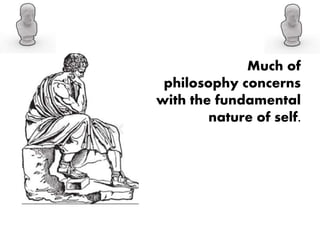
Much of
philosophy concerns
with the fundamental
nature of self.
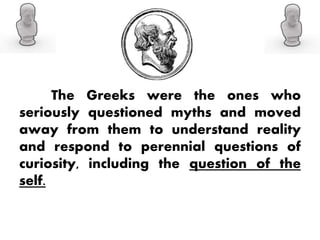
The Greeks were the ones who
seriously questioned myths and moved
away from them to understand reality
and respond to perennial questions of
curiosity, including the question of the
self.
The following are discussions of
different perspectives and under-
standings of the self according to its
prime movers. From philosophers of the
ancient times to the contemporary period.
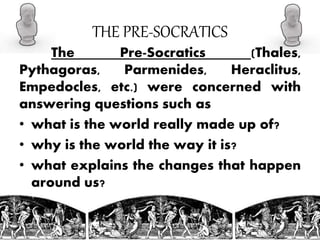
THE PRE-SOCRATICS
The Pre-Socratics (Thales,
Pythagoras, Parmenides, Heraclitus,
Empedocles, etc.) were concerned with
answering questions such as
‱ what is the world really made up of?
‱ why is the world the way it is?
‱ what explains the changes that happen
around us?
THE PRE-SOCRATICS
‱ archĂ©- origin or source/the “soul”/the
primal matter
‱ the soul’s movement is the ultimate
arché of all other movement
‱ archĂ© has no origin outside itself and
cannot be destroyed
‱ explains the multiplicity of things in the
world
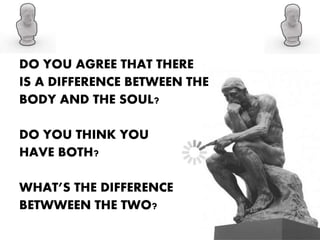
DO YOU AGREE THAT THERE
IS A DIFFERENCE BETWEEN THE
BODY AND THE SOUL?
DO YOU THINK YOU
HAVE BOTH?
WHAT’S THE DIFFERENCE
BETWWEEN THE TWO?
SOCRATES
‱ concerned with the problem of the self
‱ “the true task of the philosopher is to
know oneself”
‱ “the unexamined life is not worth
living”
‱ underwent a trial for ‘corrupting the
minds of the youth’
‱ succeeded made people think about
who they are
SOCRATES
‱ ‘the worst thing that
can happen to anyone
is to live but die inside’
‱ “every person is
dualistic”
SOCRATES
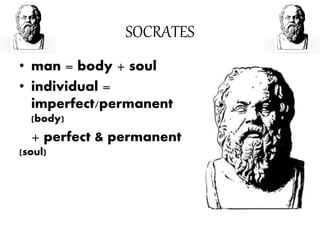
‱ man = body + soul
‱ individual =
imperfect/permanent
(body)
+ perfect & permanent
(soul)
PLATO
‱ 3 components to the soul
rational soul – reason & intellect to
govern affairs
spirited soul – emotions should be
kept at bay
appetitive soul – base desires (food,
drink, sleep, sexual needs, etc.)
‱ when these are attained, the human
person’s soul becomes just & virtuous
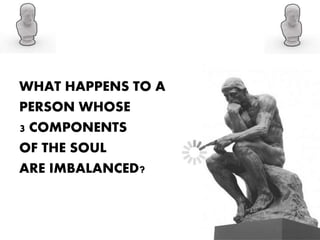
WHAT HAPPENS TO A
PERSON WHOSE
3 COMPONENTS
OF THE SOUL
ARE IMBALANCED?
(ST.) AUGUSTINE
‱ ‘spirit of man’ in medieval philosophy
‱ following view of Plato but adds
Christianity
‱ man is of a bifurcated nature
‱ part of man dwells in the world (imperfect)
and yearns to be with the Divine
‱ other part is capable of reaching
immortality
‱ body – dies on earth; soul – lives eternally
in spiritual bliss with “God” (#lifegoalz)
DO YOU BELIEVE IN THE
CONCEPT OF THE SOUL
COMING TO HEAVEN
AFTER DEATH?
WHAT MAKES US
PEOPLE DIFFERENT
FROM ANIMALS?
(ST) THOMAS AQUINAS
‱ man = matter + form
‱ matter (hyle) – “common stuff that
makes up everything in the universe”
‱ form (morphe) – “essence of a substance
or thing”; (what makes it what it is)
‱ the body of the human is similar to
animals/objects, but what makes a
human is his essence
‱ “the soul is what makes us humans”
MODERN PHILOSOPHY
Rene DESCARTES
‱ Father of Modern Philosophy
‱ human person = body + mind
‱ “there is so much that we should
doubt”
‱ “if something is so clear and lucid as
not to be doubted, that’s the only time
one should believe.”
‱ the only thing one can’t doubt is
existence of the self
Rene DESCARTES
‱ “I think, therefore I am”
‱ the self = cogito (the thing that thinks)
+ extenza (extension of mind/body)
‱ the body is a machine attached to the
mind
‱ it’s the mind that makes the man
‱ “I am a thinking thing. . . A thing that
doubts, understands, affirms, denies, wills,
refuses, imagines, perceives.”
DO YOU AGREE WITH
THE STATEMENTS ABOUT THE
SELF (body & soul)
SO FAR?
WHAT SEEMS TO BE
QUESTIONNABLE IN
THEIR CONJECTURES?
David HUME
‱ disagrees with the all the other
aforementioned philosophers
‱ “one can only know what comes from the
senses & experiences” (he is an empiricist)
‱ “the self is not an entity beyond the
physical body”
‱ you know that other people are humans
not because you have seen their soul, but
because you see them, hear them, feel
them etc
David HUME
‱ “the self is nothing but a bundle of
impressions and ideas”
‱ impression –
- basic objects of our
experience/sensation
- forms the core of our thoughts
‱ idea –
- copies of impressions
- not as “real” as impressions
- feeling mo lang yun!
David HUME
‱ self = a collection of different
perceptions which rapidly succeed each
other
‱ self = in a perpetual flux and
movement
‱ we want to believe that there is a
unified , coherent self, soul, mind, etc.
but ~~actually~~ it is all just a
combination of experiences.
Immanuel KANT
‱ agrees with HUME that everything
starts with perception/sensation of
impressions
‱ there is a MIND that regulates these
impressions
‱ “time, space, etc. are ideas that one
cannot find in the world, but is built in
our minds
‱ “apparatus of the mind”
Immanuel KANT
‱ the self organizes different impressions
that one gets in relation to his own
existence
‱ we need active intelligence to
synthesize all knowledge and
experience
‱ the self is not only personality but also
the seat of knowledge
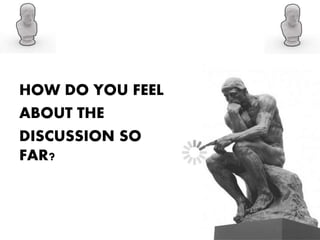
HOW DO YOU FEEL
ABOUT THE
DISCUSSION SO
FAR?
Gilbert RYLE
‱ denies the internal, non-physical self
‱ “what truly matters is the behavior that
a person manifests in his day-to-day
life.”
‱ looking for the self is like entering LU
and looking for the “university”
(explain!)
Gilbert RYLE
‱ the self is not an entity one can locate
and analyze but simply the convenient
name that we use to refer to the
behaviors that we make
MERLEAU-PONTY
‱ a phenomenologist who says the mind-
body bifurcation is an invalid problem
‱ mind and body are inseparable
‱ “one’s body is his opening toward his
existence to the world”
‱ the living body, his thoughts, emotions,
and experiences are all one.
MERLEAU-PONTY
‱ if you hate this subject, Merleau-Ponty
understands you.
ANY QUESTIONS?

Understanding the self lecture 1 - PHILOSOPHICAL PERSPECTIVES

  • 1.
    THE SELF from Various Philosophical Perspectives Lecture1 in UNDERSTANDING THE SELF Prepared by Prof. Ronuel L. del Rosario
  • 2.
    PHILOSOPHY - study ofthe fundamental nature of knowledge, reality, and existence, especially in an academic discipline. - a particular theory that someone has about how to live or how to deal with a particular situation.
  • 3.
    PHILOSOPHY - academic disciplineconcerned with investigating the nature of significance of ordinary and scientific beliefs - investigates the legitimacy of concepts by rational argument concerning their implications, relationships as well as reality, knowledge, moral judgment, etc.
  • 4.
    Much of philosophy concerns withthe fundamental nature of self.
  • 5.
    The Greeks werethe ones who seriously questioned myths and moved away from them to understand reality and respond to perennial questions of curiosity, including the question of the self.
  • 6.
    The following arediscussions of different perspectives and under- standings of the self according to its prime movers. From philosophers of the ancient times to the contemporary period.
  • 7.
    THE PRE-SOCRATICS The Pre-Socratics(Thales, Pythagoras, Parmenides, Heraclitus, Empedocles, etc.) were concerned with answering questions such as ‱ what is the world really made up of? ‱ why is the world the way it is? ‱ what explains the changes that happen around us?
  • 8.
    THE PRE-SOCRATICS ‱ archĂ©-origin or source/the “soul”/the primal matter ‱ the soul’s movement is the ultimate archĂ© of all other movement ‱ archĂ© has no origin outside itself and cannot be destroyed ‱ explains the multiplicity of things in the world
  • 9.
    DO YOU AGREETHAT THERE IS A DIFFERENCE BETWEEN THE BODY AND THE SOUL? DO YOU THINK YOU HAVE BOTH? WHAT’S THE DIFFERENCE BETWWEEN THE TWO?
  • 10.
    SOCRATES ‱ concerned withthe problem of the self ‱ “the true task of the philosopher is to know oneself” ‱ “the unexamined life is not worth living” ‱ underwent a trial for ‘corrupting the minds of the youth’ ‱ succeeded made people think about who they are
  • 11.
    SOCRATES ‱ ‘the worstthing that can happen to anyone is to live but die inside’ ‱ “every person is dualistic”
  • 12.
    SOCRATES ‱ man =body + soul ‱ individual = imperfect/permanent (body) + perfect & permanent (soul)
  • 13.
    PLATO ‱ 3 componentsto the soul rational soul – reason & intellect to govern affairs spirited soul – emotions should be kept at bay appetitive soul – base desires (food, drink, sleep, sexual needs, etc.) ‱ when these are attained, the human person’s soul becomes just & virtuous
  • 14.
    WHAT HAPPENS TOA PERSON WHOSE 3 COMPONENTS OF THE SOUL ARE IMBALANCED?
  • 15.
    (ST.) AUGUSTINE ‱ ‘spiritof man’ in medieval philosophy ‱ following view of Plato but adds Christianity ‱ man is of a bifurcated nature ‱ part of man dwells in the world (imperfect) and yearns to be with the Divine ‱ other part is capable of reaching immortality ‱ body – dies on earth; soul – lives eternally in spiritual bliss with “God” (#lifegoalz)
  • 16.
    DO YOU BELIEVEIN THE CONCEPT OF THE SOUL COMING TO HEAVEN AFTER DEATH?
  • 17.
    WHAT MAKES US PEOPLEDIFFERENT FROM ANIMALS?
  • 18.
    (ST) THOMAS AQUINAS ‱man = matter + form ‱ matter (hyle) – “common stuff that makes up everything in the universe” ‱ form (morphe) – “essence of a substance or thing”; (what makes it what it is) ‱ the body of the human is similar to animals/objects, but what makes a human is his essence ‱ “the soul is what makes us humans”
  • 19.
  • 20.
    Rene DESCARTES ‱ Fatherof Modern Philosophy ‱ human person = body + mind ‱ “there is so much that we should doubt” ‱ “if something is so clear and lucid as not to be doubted, that’s the only time one should believe.” ‱ the only thing one can’t doubt is existence of the self
  • 21.
    Rene DESCARTES ‱ “Ithink, therefore I am” ‱ the self = cogito (the thing that thinks) + extenza (extension of mind/body) ‱ the body is a machine attached to the mind ‱ it’s the mind that makes the man ‱ “I am a thinking thing. . . A thing that doubts, understands, affirms, denies, wills, refuses, imagines, perceives.”
  • 22.
    DO YOU AGREEWITH THE STATEMENTS ABOUT THE SELF (body & soul) SO FAR? WHAT SEEMS TO BE QUESTIONNABLE IN THEIR CONJECTURES?
  • 23.
    David HUME ‱ disagreeswith the all the other aforementioned philosophers ‱ “one can only know what comes from the senses & experiences” (he is an empiricist) ‱ “the self is not an entity beyond the physical body” ‱ you know that other people are humans not because you have seen their soul, but because you see them, hear them, feel them etc
  • 24.
    David HUME ‱ “theself is nothing but a bundle of impressions and ideas” ‱ impression – - basic objects of our experience/sensation - forms the core of our thoughts ‱ idea – - copies of impressions - not as “real” as impressions - feeling mo lang yun!
  • 25.
    David HUME ‱ self= a collection of different perceptions which rapidly succeed each other ‱ self = in a perpetual flux and movement ‱ we want to believe that there is a unified , coherent self, soul, mind, etc. but ~~actually~~ it is all just a combination of experiences.
  • 26.
    Immanuel KANT ‱ agreeswith HUME that everything starts with perception/sensation of impressions ‱ there is a MIND that regulates these impressions ‱ “time, space, etc. are ideas that one cannot find in the world, but is built in our minds ‱ “apparatus of the mind”
  • 27.
    Immanuel KANT ‱ theself organizes different impressions that one gets in relation to his own existence ‱ we need active intelligence to synthesize all knowledge and experience ‱ the self is not only personality but also the seat of knowledge
  • 28.
    HOW DO YOUFEEL ABOUT THE DISCUSSION SO FAR?
  • 29.
    Gilbert RYLE ‱ deniesthe internal, non-physical self ‱ “what truly matters is the behavior that a person manifests in his day-to-day life.” ‱ looking for the self is like entering LU and looking for the “university” (explain!)
  • 30.
    Gilbert RYLE ‱ theself is not an entity one can locate and analyze but simply the convenient name that we use to refer to the behaviors that we make
  • 31.
    MERLEAU-PONTY ‱ a phenomenologistwho says the mind- body bifurcation is an invalid problem ‱ mind and body are inseparable ‱ “one’s body is his opening toward his existence to the world” ‱ the living body, his thoughts, emotions, and experiences are all one.
  • 32.
    MERLEAU-PONTY ‱ if youhate this subject, Merleau-Ponty understands you.
  • 33.