The Present Tense of  Reflexive Verbs
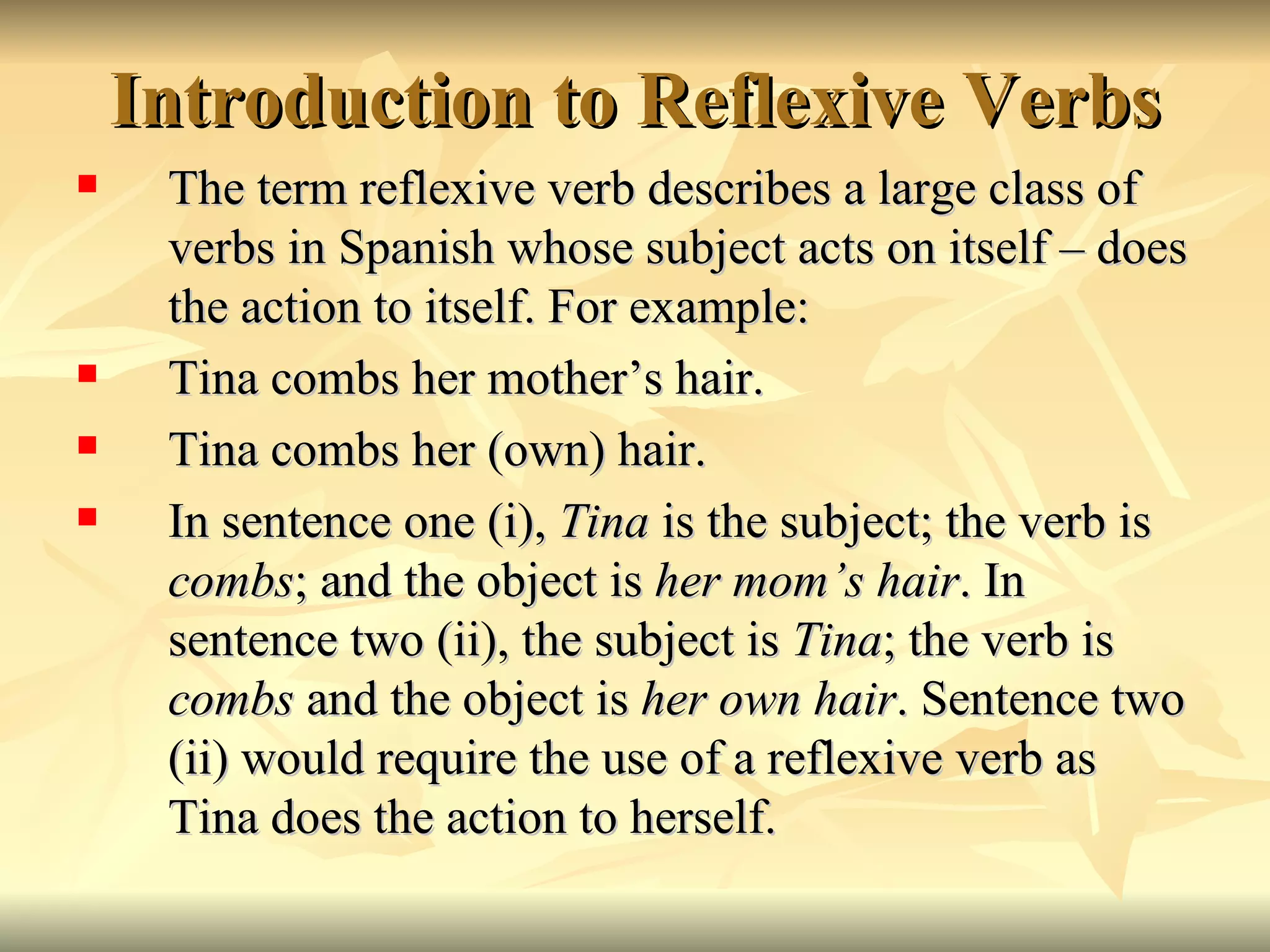
Introduction to Reflexive Verbs The term reflexive verb describes a large class of verbs in Spanish whose subject acts on itself – does the action to itself. For example: Tina combs her mother’s hair.  Tina combs her (own) hair. In sentence one (i),  Tina  is the subject; the verb is  combs ; and the object is  her mom’s hair . In sentence two (ii), the subject is  Tina ; the verb is  combs  and the object is  her own hair . Sentence two (ii) would require the use of a reflexive verb as Tina does the action to herself.
Reflexive Verbs  Reflexive verbs show what a person does to him/herself. These verbs are easily identified as they have  se  at the end. Reflexive verbs also use reflexive pronouns which refer to the same person or thing as the subject.
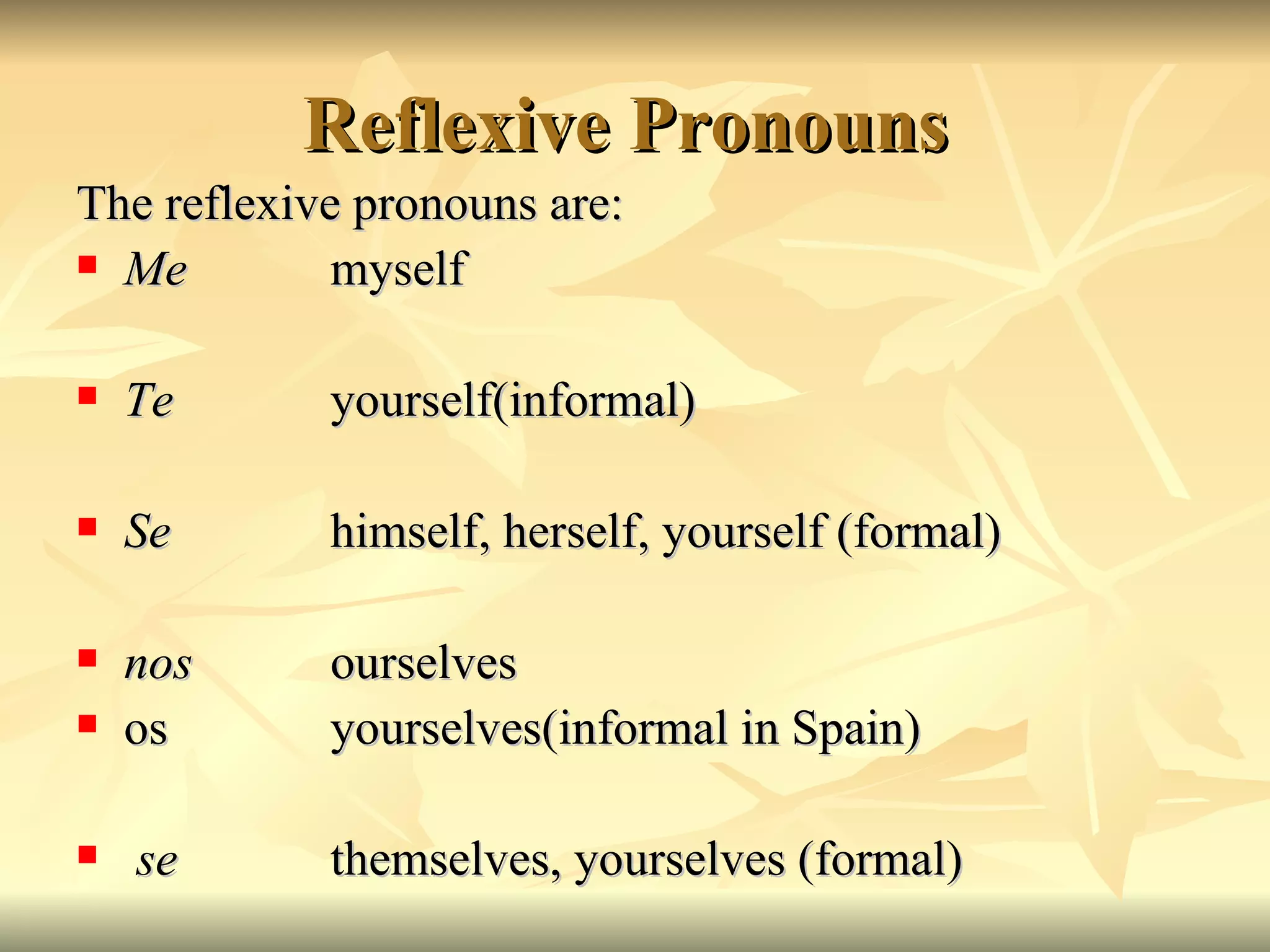
Reflexive Pronouns  The reflexive pronouns are: Me  myself Te  yourself(informal) Se  himself, herself, yourself (formal) nos  ourselves os yourselves(informal in Spain) se   themselves, yourselves (formal)
Reflexive Verbs The reflexive object pronoun precedes the conjugated  verb.  Before the conjugated verb: (1) Me acuesto a las diez y media cada noche. I go to bed at 10:30 each night. (2) Mi familia y yo nos desayunamos a las siete cada ma ñ ana My family and I have breakfast at 7:00 every morning.  In the two examples above, the reflexive pronouns (me and nos) go before the conjugated  verbs.
Reflexive Verbs  The reflexive verb is however attached to the infinitive and to the present participle of verbs. Examples: With the infinitive:  (1) Yo voy a cepillarme los dientes. I am going to brush my teeth. (2) T ú  vas a cepillarte los dientes. You are going to brush your teeth. *In the two examples above, the reflexive pronouns ‘me’ and ‘te’ are attached to the infinitive.
Reflexive Verbs With the present participle: (1)   Yo estoy cepillándome los dientes. I am brushing my teeth. (2) Carlos está cepillándose.  Carlos is brushing his teeth. * The reflexive pronouns ‘me’ and ‘se’ are attached to the present participles.
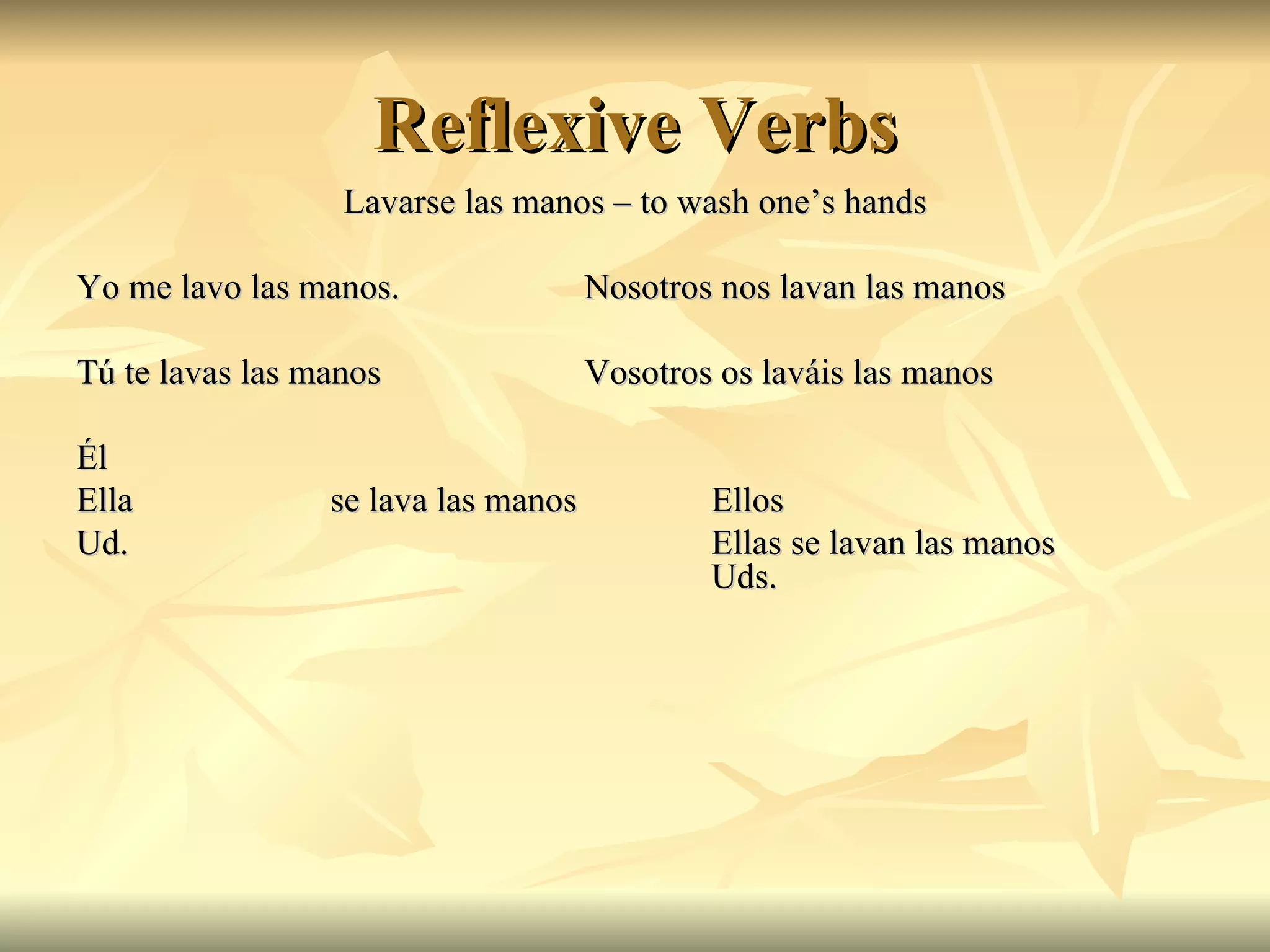
Reflexive Verbs Lavarse las manos  – to wash one’s hands Yo me lavo las manos. Nosotros nos lav an las manos Tú te lavas las manos Vosotros os lav áis las manos Él  Ella  se lava las manos Ellos  Ud.   Ellas se lavan las manos  Uds.
List of Reflexive Verbs ponerse + article of clothing – to put on bañarse – to bathe ducharse – to (take a) shower cepillarse los dientes – to brush one’s teeth afeitarse – to shave peinarse – to comb one’s hair levantarse – to get up despertarse (e-i) – to wake up
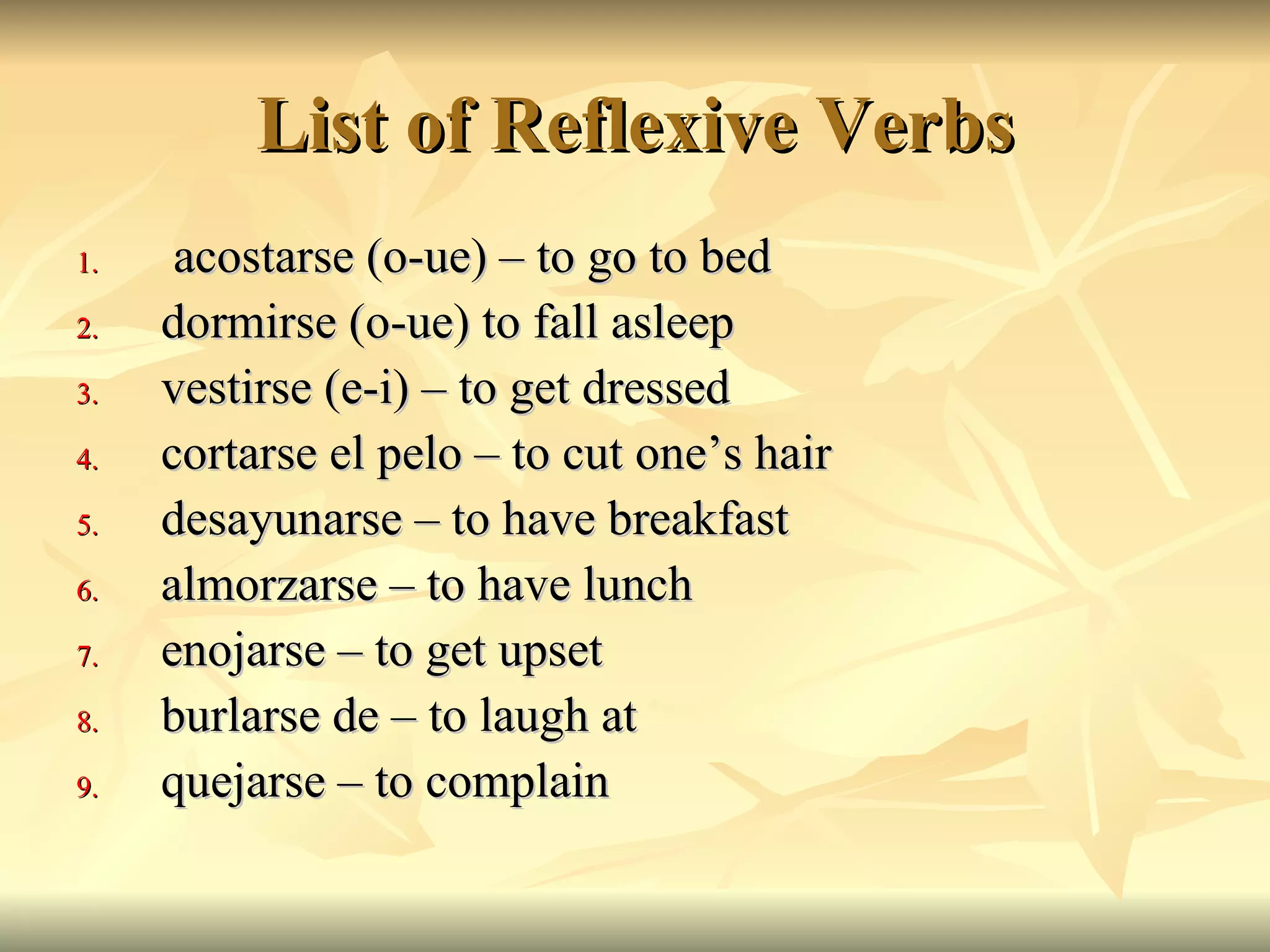
List of Reflexive Verbs acostarse (o-ue) – to go to bed dormirse (o-ue) to fall asleep vestirse (e-i) – to get dressed cortarse el pelo – to cut one’s hair desayunarse – to have breakfast almorzarse – to have lunch enojarse – to get upset burlarse de – to laugh at  quejarse – to complain

Reflexives

  • 1.
    The Present Tenseof Reflexive Verbs
  • 2.
    Introduction to ReflexiveVerbs The term reflexive verb describes a large class of verbs in Spanish whose subject acts on itself – does the action to itself. For example: Tina combs her mother’s hair. Tina combs her (own) hair. In sentence one (i), Tina is the subject; the verb is combs ; and the object is her mom’s hair . In sentence two (ii), the subject is Tina ; the verb is combs and the object is her own hair . Sentence two (ii) would require the use of a reflexive verb as Tina does the action to herself.
  • 3.
    Reflexive Verbs Reflexive verbs show what a person does to him/herself. These verbs are easily identified as they have se at the end. Reflexive verbs also use reflexive pronouns which refer to the same person or thing as the subject.
  • 4.
    Reflexive Pronouns The reflexive pronouns are: Me myself Te yourself(informal) Se himself, herself, yourself (formal) nos ourselves os yourselves(informal in Spain) se themselves, yourselves (formal)
  • 5.
    Reflexive Verbs Thereflexive object pronoun precedes the conjugated verb. Before the conjugated verb: (1) Me acuesto a las diez y media cada noche. I go to bed at 10:30 each night. (2) Mi familia y yo nos desayunamos a las siete cada ma ñ ana My family and I have breakfast at 7:00 every morning. In the two examples above, the reflexive pronouns (me and nos) go before the conjugated verbs.
  • 6.
    Reflexive Verbs The reflexive verb is however attached to the infinitive and to the present participle of verbs. Examples: With the infinitive: (1) Yo voy a cepillarme los dientes. I am going to brush my teeth. (2) T ú vas a cepillarte los dientes. You are going to brush your teeth. *In the two examples above, the reflexive pronouns ‘me’ and ‘te’ are attached to the infinitive.
  • 7.
    Reflexive Verbs Withthe present participle: (1) Yo estoy cepillándome los dientes. I am brushing my teeth. (2) Carlos está cepillándose. Carlos is brushing his teeth. * The reflexive pronouns ‘me’ and ‘se’ are attached to the present participles.
  • 8.
    Reflexive Verbs Lavarselas manos – to wash one’s hands Yo me lavo las manos. Nosotros nos lav an las manos Tú te lavas las manos Vosotros os lav áis las manos Él Ella se lava las manos Ellos Ud. Ellas se lavan las manos Uds.
  • 9.
    List of ReflexiveVerbs ponerse + article of clothing – to put on bañarse – to bathe ducharse – to (take a) shower cepillarse los dientes – to brush one’s teeth afeitarse – to shave peinarse – to comb one’s hair levantarse – to get up despertarse (e-i) – to wake up
  • 10.
    List of ReflexiveVerbs acostarse (o-ue) – to go to bed dormirse (o-ue) to fall asleep vestirse (e-i) – to get dressed cortarse el pelo – to cut one’s hair desayunarse – to have breakfast almorzarse – to have lunch enojarse – to get upset burlarse de – to laugh at quejarse – to complain