NORTHEAST SCHOOL OF
AGRICULTURE
tenses
PRACTICE ENGLISH II
ENGINEER OSCAR GARCIA
GROUP PRACTICE #1
MEMBER:
Chacón Guzmán Erickson Fernando
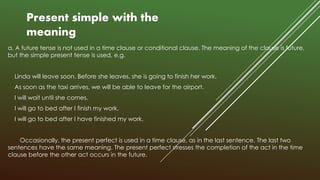
a. A future tense is not used in a time clause or conditional clause. The meaning of the clause is future,
but the simple present tense is used, e.g.
Linda will leave soon. Before she leaves, she is going to finish her work.
As soon as the taxi arrives, we will be able to leave for the airport.
I will wait until she comes.
I will go to bed after I finish my work.
I will go to bed after I have finished my work.
Occasionally, the present perfect is used in a time clause, as in the last sentence. The last two
sentences have the same meaning. The present perfect stresses the completion of the act in the time
clause before the other act occurs in the future.
Present simple with the
meaning
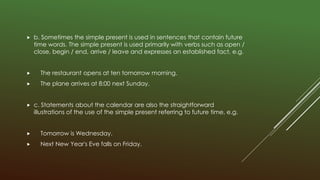
 b. Sometimes the simple present is used in sentences that contain future
time words. The simple present is used primarily with verbs such as open /
close, begin / end, arrive / leave and expresses an established fact, e.g.
 The restaurant opens at ten tomorrow morning.
 The plane arrives at 8:00 next Sunday.
 c. Statements about the calendar are also the straightforward
illustrations of the use of the simple present referring to future time, e.g.
 Tomorrow is Wednesday.
 Next New Year's Eve falls on Friday.
BE ABOUT + TO-infinitive
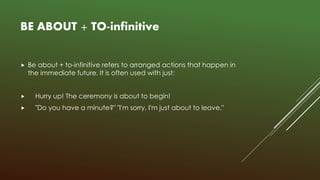
 Be about + to-infinitive refers to arranged actions that happen in
the immediate future. It is often used with just:
 Hurry up! The ceremony is about to begin!
 "Do you have a minute?" "I'm sorry, I'm just about to leave."
Infinitive Verb
 Do you know the difference between an infinitive verb and a base verb? Or, do you know
when and how do you use infinitive verbs? These questions, and their answers are the key to
understanding the uses of an infinitive verb.
Defining an Infinitive Verb
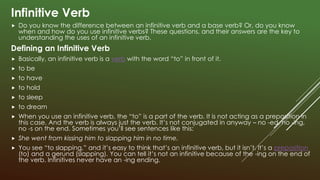
 Basically, an infinitive verb is a verb with the word “to” in front of it.
 to be
 to have
 to hold
 to sleep
 to dream
 When you use an infinitive verb, the “to” is a part of the verb. It is not acting as a preposition in
this case. And the verb is always just the verb. It’s not conjugated in anyway – no -ed, no -ing,
no -s on the end. Sometimes you’ll see sentences like this:
 She went from kissing him to slapping him in no time.
 You see “to slapping,” and it’s easy to think that’s an infinitive verb, but it isn’t. It’s a preposition
(to) and a gerund (slapping). You can tell it’s not an infinitive because of the -ing on the end of
the verb. Infinitives never have an -ing ending.
These words are often used with the present perfect tense although yet, still and
already can all be used with other tenses.
Just
 ‘Just’ is usually used only with the present perfect tense and it means ‘a short time
ago’.
 I’ve just seen Susan coming out of the cinema.
 Mike’s just called. Can you ring him back please?
 Have you just taken my pen? Where has it gone?
 In the present perfect, ‘just’ comes between the auxiliary verb (‘have’) and the
past participle.
 - See more at: http://learnenglish.britishcouncil.org/en/grammar-reference/just-
yet-still-already#sthash.QgII2i7m.dpuf
Present perfect simple + just/for/since
PRESENT PERFECT TENSE - FOR AND SINCE
We use Present Perfect tense to talk about action which started in the past and continues
up to the present.
 Examples
 I have had this computer for about a year.
 How long have you been at this school?
 I haven't seen Julia since September.
 Tip! For other uses of the Present Perfect tense, see the Present Perfect Tense - When To
Use.
 We use for with a period of time, for example: a few days, half an hour, two years. We
use since with the time when the action started, for example: last year, June 8, I met
you.
REPORTED SPEECH (INDIRECT SPEECH)
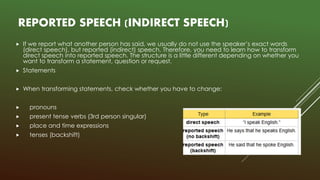
 If we report what another person has said, we usually do not use the speaker’s exact words
(direct speech), but reported (indirect) speech. Therefore, you need to learn how to transform
direct speech into reported speech. The structure is a little different depending on whether you
want to transform a statement, question or request.
 Statements
 When transforming statements, check whether you have to change:
 pronouns
 present tense verbs (3rd person singular)
 place and time expressions
 tenses (backshift)
PAST CONTINUOUS TENSE
FUNCTIONS OF THE PAST CONTINUOUS
 The past continuous describes actions or events in a time before now, which began in
the past and is still going on at the time of speaking. In other words, it expresses an
unfinished or incomplete action in the past.
It is used:
 Often, to describe the background in a story written in the past tense, e.g. "The sun was
shining and the birds were singing as the elephant came out of the jungle. The other
animals were relaxing in the shade of the trees, but the elephant moved very quickly.
She was looking for her baby, and she didn't notice the hunter who was watching her
through his binoculars. When the shot rang out, she was running towards the river..."
 to describe an unfinished action that was interrupted by another event or action, e.g.
"I was having a beautiful dream when the alarm clock rang."
 to express a change of mind: e.g. "I was going to spend the day at the beach
but I've decided to get my homework done instead."
 with 'wonder', to make a very polite request: e.g. "I was wondering if you
could baby-sit for me tonight.“
Examples
 They were waiting for the bus when the accident happened.
 Caroline was skiing when she broke her leg.
 When we arrived he was having a bath.
 When the fire started I was watching television.
PASSIVE VOICE
Use of Passive
Passive voice is used when the focus is on the action. It is not important or not known,
however, who or what is performing the action.
 Example: My bike was stolen.
 In the example above, the focus is on the fact that my bike was stolen. I do not know,
however, who did it.
Sometimes a statement in passive is more polite than active voice, as the following example
shows:
 Example: A mistake was made.
 In this case, I focus on the fact that a mistake was made, but I do
not blame anyone (e.g. You have made a mistake.).
 Form of Passive
 Subject + finite form of to be + Past Participle (3rd column of
irregular verbs)
 Example: A letter was written.
PRESENT SIMPLE PASSIVE
Passive Form
 In passive sentences, the thing receiving the action is the subject of the
sentence and the thing doing the action is optionally included near the
end of the sentence. You can use the passive form if you think that the
thing receiving the action is more important or should be emphasized.
You can also use the passive form if you do not know who is doing the
action or if you do not want to mention who is doing the action.
 [Thing receiving action] + [be] + [past participle of verb] + [by] + [thing
doing action]
http://www.englishpage.com/verbpage/activepassi
ve.html
EGRAFY
 http://202.114.32.200:8080/courseware/201302/20130211/unit19/web/14.htm

http://learnenglish.britishcouncil.org/en/grammar-reference/just-yet-still-already

http://grammar.yourdictionary.com/parts-of-speech/verbs/infinitive-verb.html

http://www.edufind.com/english-grammar/past-continuous-tense/.html

http://www.ego4u.com/en/cram-up/grammar/passive

http://www.englishpage.com/verbpage/activepassive.html


Practica5 chacon guzman

  • 1.
    NORTHEAST SCHOOL OF AGRICULTURE tenses PRACTICEENGLISH II ENGINEER OSCAR GARCIA GROUP PRACTICE #1 MEMBER: Chacón Guzmán Erickson Fernando
  • 2.
    a. A futuretense is not used in a time clause or conditional clause. The meaning of the clause is future, but the simple present tense is used, e.g. Linda will leave soon. Before she leaves, she is going to finish her work. As soon as the taxi arrives, we will be able to leave for the airport. I will wait until she comes. I will go to bed after I finish my work. I will go to bed after I have finished my work. Occasionally, the present perfect is used in a time clause, as in the last sentence. The last two sentences have the same meaning. The present perfect stresses the completion of the act in the time clause before the other act occurs in the future. Present simple with the meaning
  • 3.
     b. Sometimesthe simple present is used in sentences that contain future time words. The simple present is used primarily with verbs such as open / close, begin / end, arrive / leave and expresses an established fact, e.g.  The restaurant opens at ten tomorrow morning.  The plane arrives at 8:00 next Sunday.  c. Statements about the calendar are also the straightforward illustrations of the use of the simple present referring to future time, e.g.  Tomorrow is Wednesday.  Next New Year's Eve falls on Friday.
  • 4.
    BE ABOUT +TO-infinitive  Be about + to-infinitive refers to arranged actions that happen in the immediate future. It is often used with just:  Hurry up! The ceremony is about to begin!  "Do you have a minute?" "I'm sorry, I'm just about to leave."
  • 5.
    Infinitive Verb  Doyou know the difference between an infinitive verb and a base verb? Or, do you know when and how do you use infinitive verbs? These questions, and their answers are the key to understanding the uses of an infinitive verb. Defining an Infinitive Verb  Basically, an infinitive verb is a verb with the word “to” in front of it.  to be  to have  to hold  to sleep  to dream  When you use an infinitive verb, the “to” is a part of the verb. It is not acting as a preposition in this case. And the verb is always just the verb. It’s not conjugated in anyway – no -ed, no -ing, no -s on the end. Sometimes you’ll see sentences like this:  She went from kissing him to slapping him in no time.  You see “to slapping,” and it’s easy to think that’s an infinitive verb, but it isn’t. It’s a preposition (to) and a gerund (slapping). You can tell it’s not an infinitive because of the -ing on the end of the verb. Infinitives never have an -ing ending.
  • 6.
    These words areoften used with the present perfect tense although yet, still and already can all be used with other tenses. Just  ‘Just’ is usually used only with the present perfect tense and it means ‘a short time ago’.  I’ve just seen Susan coming out of the cinema.  Mike’s just called. Can you ring him back please?  Have you just taken my pen? Where has it gone?  In the present perfect, ‘just’ comes between the auxiliary verb (‘have’) and the past participle.  - See more at: http://learnenglish.britishcouncil.org/en/grammar-reference/just- yet-still-already#sthash.QgII2i7m.dpuf Present perfect simple + just/for/since
  • 7.
    PRESENT PERFECT TENSE- FOR AND SINCE We use Present Perfect tense to talk about action which started in the past and continues up to the present.  Examples  I have had this computer for about a year.  How long have you been at this school?  I haven't seen Julia since September.  Tip! For other uses of the Present Perfect tense, see the Present Perfect Tense - When To Use.  We use for with a period of time, for example: a few days, half an hour, two years. We use since with the time when the action started, for example: last year, June 8, I met you.
  • 8.
    REPORTED SPEECH (INDIRECTSPEECH)  If we report what another person has said, we usually do not use the speaker’s exact words (direct speech), but reported (indirect) speech. Therefore, you need to learn how to transform direct speech into reported speech. The structure is a little different depending on whether you want to transform a statement, question or request.  Statements  When transforming statements, check whether you have to change:  pronouns  present tense verbs (3rd person singular)  place and time expressions  tenses (backshift)
  • 9.
    PAST CONTINUOUS TENSE FUNCTIONSOF THE PAST CONTINUOUS  The past continuous describes actions or events in a time before now, which began in the past and is still going on at the time of speaking. In other words, it expresses an unfinished or incomplete action in the past. It is used:  Often, to describe the background in a story written in the past tense, e.g. "The sun was shining and the birds were singing as the elephant came out of the jungle. The other animals were relaxing in the shade of the trees, but the elephant moved very quickly. She was looking for her baby, and she didn't notice the hunter who was watching her through his binoculars. When the shot rang out, she was running towards the river..."  to describe an unfinished action that was interrupted by another event or action, e.g. "I was having a beautiful dream when the alarm clock rang."
  • 10.
     to expressa change of mind: e.g. "I was going to spend the day at the beach but I've decided to get my homework done instead."  with 'wonder', to make a very polite request: e.g. "I was wondering if you could baby-sit for me tonight.“ Examples  They were waiting for the bus when the accident happened.  Caroline was skiing when she broke her leg.  When we arrived he was having a bath.  When the fire started I was watching television.
  • 11.
    PASSIVE VOICE Use ofPassive Passive voice is used when the focus is on the action. It is not important or not known, however, who or what is performing the action.  Example: My bike was stolen.  In the example above, the focus is on the fact that my bike was stolen. I do not know, however, who did it. Sometimes a statement in passive is more polite than active voice, as the following example shows:  Example: A mistake was made.
  • 12.
     In thiscase, I focus on the fact that a mistake was made, but I do not blame anyone (e.g. You have made a mistake.).  Form of Passive  Subject + finite form of to be + Past Participle (3rd column of irregular verbs)  Example: A letter was written.
  • 13.
    PRESENT SIMPLE PASSIVE PassiveForm  In passive sentences, the thing receiving the action is the subject of the sentence and the thing doing the action is optionally included near the end of the sentence. You can use the passive form if you think that the thing receiving the action is more important or should be emphasized. You can also use the passive form if you do not know who is doing the action or if you do not want to mention who is doing the action.  [Thing receiving action] + [be] + [past participle of verb] + [by] + [thing doing action] http://www.englishpage.com/verbpage/activepassi ve.html
  • 14.