Bruno Peters
Spanish 3 Grammar Book
Table of Contents
1. Title Page
2. Table of contents
3.Conditional
4. Conditional irregulars
-Perfect Tenses
5. Present
6. Present perfect irregulars
7. Past
8. Subjunctive perfect
9. Tanto y Tan
10. Impersonal ‘se’
11. Saber vs. Conocer
-Los Mandatos
12. Informal
13. Formal
14. Nosotros commands
15.Subjunctive
16. Subjunctive irregulars
17. Trigger phrases
18. Demonstrative Adjectives
Conditional
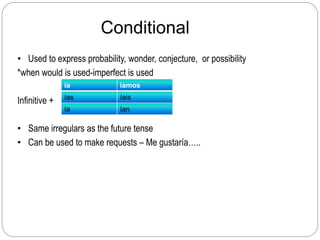
• Used to express probability, wonder, conjecture, or possibility
*when would is used-imperfect is used
Infinitive + =
• Same irregulars as the future tense
• Can be used to make requests – Me gustaría…..
ía íamos
ías íais
ía ían
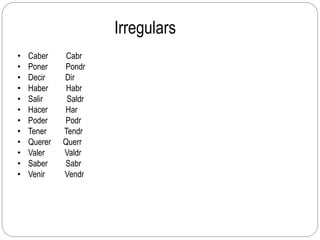
Irregulars
• Caber Cabr
• Poner Pondr
• Decir Dir
• Haber Habr
• Salir Saldr
• Hacer Har
• Poder Podr
• Tener Tendr
• Querer Querr
• Valer Valdr
• Saber Sabr
• Venir Vendr
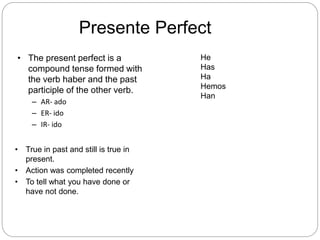
Presente Perfect
• The present perfect is a
compound tense formed with
the verb haber and the past
participle of the other verb.
– AR- ado
– ER- ido
– IR- ido
• True in past and still is true in
present.
• Action was completed recently
• To tell what you have done or
have not done.
He
Has
Ha
Hemos
Han
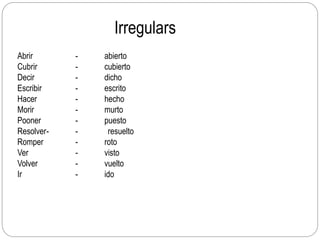
Irregulars
Abrir - abierto
Cubrir - cubierto
Decir - dicho
Escribir - escrito
Hacer - hecho
Morir - murto
Pooner - puesto
Resolver- - resuelto
Romper - roto
Ver - visto
Volver - vuelto
Ir - ido
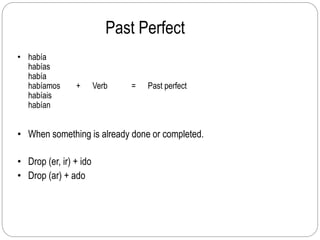
Past Perfect
• había
habías
había
habíamos + Verb = Past perfect
habíais
habían
• When something is already done or completed.
• Drop (er, ir) + ido
• Drop (ar) + ado
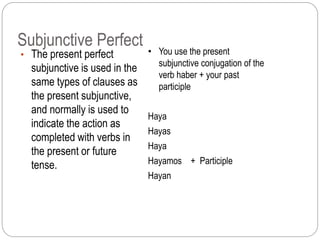
Subjunctive Perfect
• The present perfect
subjunctive is used in the
same types of clauses as
the present subjunctive,
and normally is used to
indicate the action as
completed with verbs in
the present or future
tense.
• You use the present
subjunctive conjugation of the
verb haber + your past
participle
Haya
Hayas
Haya
Hayamos + Participle
Hayan
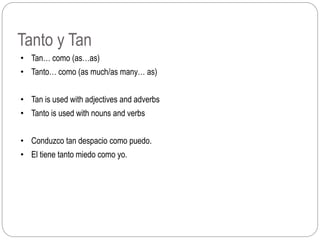
Tanto y Tan
• Tan… como (as…as)
• Tanto… como (as much/as many… as)
• Tan is used with adjectives and adverbs
• Tanto is used with nouns and verbs
• Conduzco tan despacio como puedo.
• El tiene tanto miedo como yo.
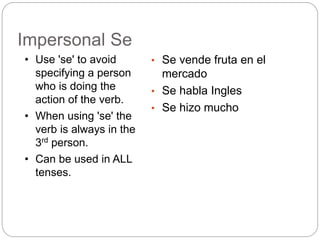
Impersonal Se
• Se vende fruta en el
mercado
• Se habla Ingles
• Se hizo mucho
• Use 'se' to avoid
specifying a person
who is doing the
action of the verb.
• When using 'se' the
verb is always in the
3rd person.
• Can be used in ALL
tenses.
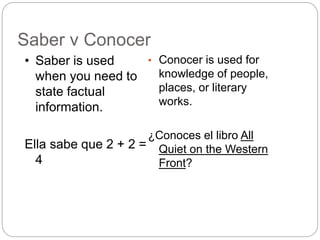
Saber v Conocer
• Conocer is used for
knowledge of people,
places, or literary
works.
¿Conoces el libro All
Quiet on the Western
Front?
• Saber is used
when you need to
state factual
information.
Ella sabe que 2 + 2 =
4
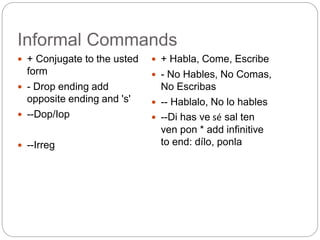
Informal Commands
 + Conjugate to the usted
form
 - Drop ending add
opposite ending and 's'
 --Dop/Iop
 --Irreg
 + Habla, Come, Escribe
 - No Hables, No Comas,
No Escribas
 -- Hablalo, No lo hables
 --Di has ve sé sal ten
ven pon * add infinitive
to end: dílo, ponla
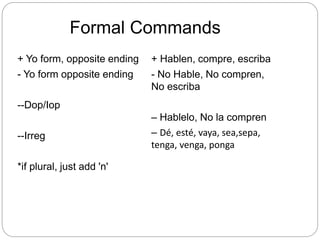
Formal Commands
+ Yo form, opposite ending
- Yo form opposite ending
--Dop/Iop
--Irreg
*if plural, just add 'n'
+ Hablen, compre, escriba
- No Hable, No compren,
No escriba
– Hablelo, No la compren
– Dé, esté, vaya, sea,sepa,
tenga, venga, ponga
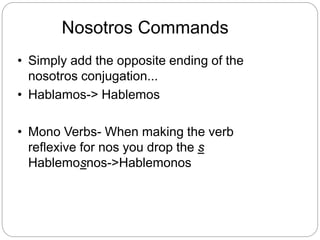
Nosotros Commands
• Simply add the opposite ending of the
nosotros conjugation...
• Hablamos-> Hablemos
• Mono Verbs- When making the verb
reflexive for nos you drop the s
Hablemosnos->Hablemonos
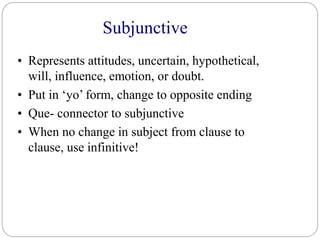
Subjunctive
• Represents attitudes, uncertain, hypothetical,
will, influence, emotion, or doubt.
• Put in ‘yo’ form, change to opposite ending
• Que- connector to subjunctive
• When no change in subject from clause to
clause, use infinitive!
Irregulars
• Car, Gar, Zar- formed same way as always
• Conducir, decir, oir- conduzca, diga, oiga
• Dar-> dé, des, den, demos
• Hay-> haya, hayas, hayan, hayamos
Trigger Phrases
Impersonal expressions
• Es bueno que, es malo que, es necesario que, etc. Express an
order, a need, a piece of advice, or a desire.
Expressions of emotion
• Alegrarse de que, esperar que, sentir que, temer que, etc.
Shows fear, happiness, anger, regret, surprise, joy, pity
Conjunctions of time
• Use the subjunctive after them after the subordinate clause is
habitual or in the past. Asi que, caundo, despues de que, en
cuanto, hasta que, luego que, tan pronto como.
Demonstrative Adjectives
este (this) esta
ese (that) esa
aquel (that over there) aquella
estos (these) estas
esos (those) esas
aquellos (those over there) aquellas
*when used as a pronoun, add an accent, esté

Spanish 3 grammar book

  • 1.
  • 2.
    Table of Contents 1.Title Page 2. Table of contents 3.Conditional 4. Conditional irregulars -Perfect Tenses 5. Present 6. Present perfect irregulars 7. Past 8. Subjunctive perfect 9. Tanto y Tan 10. Impersonal ‘se’ 11. Saber vs. Conocer -Los Mandatos 12. Informal 13. Formal 14. Nosotros commands 15.Subjunctive 16. Subjunctive irregulars 17. Trigger phrases 18. Demonstrative Adjectives
  • 3.
    Conditional • Used toexpress probability, wonder, conjecture, or possibility *when would is used-imperfect is used Infinitive + = • Same irregulars as the future tense • Can be used to make requests – Me gustaría….. ía íamos ías íais ía ían
  • 4.
    Irregulars • Caber Cabr •Poner Pondr • Decir Dir • Haber Habr • Salir Saldr • Hacer Har • Poder Podr • Tener Tendr • Querer Querr • Valer Valdr • Saber Sabr • Venir Vendr
  • 5.
    Presente Perfect • Thepresent perfect is a compound tense formed with the verb haber and the past participle of the other verb. – AR- ado – ER- ido – IR- ido • True in past and still is true in present. • Action was completed recently • To tell what you have done or have not done. He Has Ha Hemos Han
  • 6.
    Irregulars Abrir - abierto Cubrir- cubierto Decir - dicho Escribir - escrito Hacer - hecho Morir - murto Pooner - puesto Resolver- - resuelto Romper - roto Ver - visto Volver - vuelto Ir - ido
  • 7.
    Past Perfect • había habías había habíamos+ Verb = Past perfect habíais habían • When something is already done or completed. • Drop (er, ir) + ido • Drop (ar) + ado
  • 8.
    Subjunctive Perfect • Thepresent perfect subjunctive is used in the same types of clauses as the present subjunctive, and normally is used to indicate the action as completed with verbs in the present or future tense. • You use the present subjunctive conjugation of the verb haber + your past participle Haya Hayas Haya Hayamos + Participle Hayan
  • 9.
    Tanto y Tan •Tan… como (as…as) • Tanto… como (as much/as many… as) • Tan is used with adjectives and adverbs • Tanto is used with nouns and verbs • Conduzco tan despacio como puedo. • El tiene tanto miedo como yo.
  • 10.
    Impersonal Se • Sevende fruta en el mercado • Se habla Ingles • Se hizo mucho • Use 'se' to avoid specifying a person who is doing the action of the verb. • When using 'se' the verb is always in the 3rd person. • Can be used in ALL tenses.
  • 11.
    Saber v Conocer •Conocer is used for knowledge of people, places, or literary works. ¿Conoces el libro All Quiet on the Western Front? • Saber is used when you need to state factual information. Ella sabe que 2 + 2 = 4
  • 12.
    Informal Commands  +Conjugate to the usted form  - Drop ending add opposite ending and 's'  --Dop/Iop  --Irreg  + Habla, Come, Escribe  - No Hables, No Comas, No Escribas  -- Hablalo, No lo hables  --Di has ve sé sal ten ven pon * add infinitive to end: dílo, ponla
  • 13.
    Formal Commands + Yoform, opposite ending - Yo form opposite ending --Dop/Iop --Irreg *if plural, just add 'n' + Hablen, compre, escriba - No Hable, No compren, No escriba – Hablelo, No la compren – Dé, esté, vaya, sea,sepa, tenga, venga, ponga
  • 14.
    Nosotros Commands • Simplyadd the opposite ending of the nosotros conjugation... • Hablamos-> Hablemos • Mono Verbs- When making the verb reflexive for nos you drop the s Hablemosnos->Hablemonos
  • 15.
    Subjunctive • Represents attitudes,uncertain, hypothetical, will, influence, emotion, or doubt. • Put in ‘yo’ form, change to opposite ending • Que- connector to subjunctive • When no change in subject from clause to clause, use infinitive!
  • 16.
    Irregulars • Car, Gar,Zar- formed same way as always • Conducir, decir, oir- conduzca, diga, oiga • Dar-> dé, des, den, demos • Hay-> haya, hayas, hayan, hayamos
  • 17.
    Trigger Phrases Impersonal expressions •Es bueno que, es malo que, es necesario que, etc. Express an order, a need, a piece of advice, or a desire. Expressions of emotion • Alegrarse de que, esperar que, sentir que, temer que, etc. Shows fear, happiness, anger, regret, surprise, joy, pity Conjunctions of time • Use the subjunctive after them after the subordinate clause is habitual or in the past. Asi que, caundo, despues de que, en cuanto, hasta que, luego que, tan pronto como.
  • 18.
    Demonstrative Adjectives este (this)esta ese (that) esa aquel (that over there) aquella estos (these) estas esos (those) esas aquellos (those over there) aquellas *when used as a pronoun, add an accent, esté