present past future We use  tenses  of verbs to refer to actions or situations in the present, in the past and in the future
present past future There are different sorts of tenses: simple  tenses continuous  tenses perfect  tenses perfect continuous  tenses
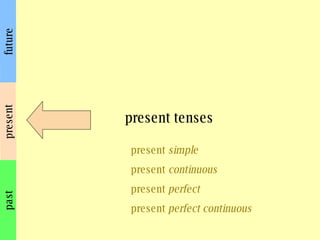
present past future present tenses present  simple present  continuous present  perfect present  perfect continuous
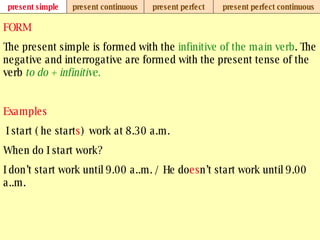
present simple present continuous present perfect present perfect continuous FORM The present simple is formed with the  infinitive of the main verb . The negative and interrogative are formed with the present tense of the verb  to do + infinitive. Examples   I start ( he start s )  work at 8.30 a.m.  When do I start work? I don’t start work until 9.00 a..m. / He do es n’t start work until 9.00 a..m.
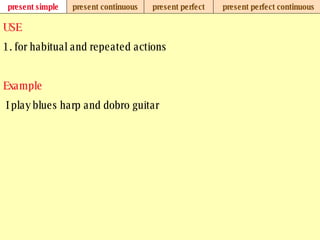
present simple present continuous present perfect present perfect continuous USE 1. for habitual and repeated actions Example   I play blues harp and dobro guitar
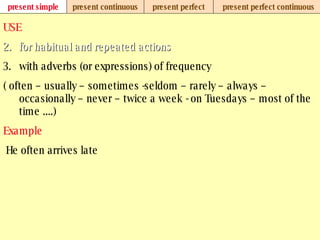
present simple present continuous present perfect present perfect continuous USE for habitual and repeated actions with adverbs (or expressions) of frequency ( often – usually – sometimes - seldom – rarely – always – occasionally – never   – twice a week - on Tuesdays – most of the time ....) Example   He often arrives late
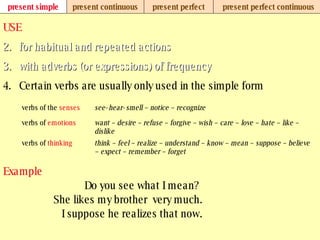
present simple present continuous present perfect present perfect continuous USE for habitual and repeated actions with adverbs (or expressions) of frequency Certain verbs are usually only used in the simple form   Example Do you see what I mean?  She likes my brother  very much. I suppose he realizes that now. think – feel – realize – understand – know – mean – suppose – believe – expect – remember – forget   verbs of  thinking want – desire – refuse – forgive – wish – care – love – hate – like – dislike verbs of  emotions see- hear- smell – notice – recognize verbs of the  senses
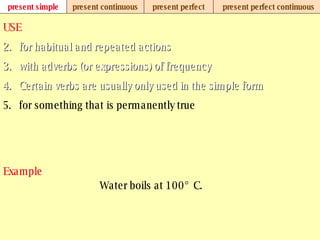
present simple present continuous present perfect present perfect continuous USE for habitual and repeated actions with adverbs (or expressions) of frequency Certain verbs are usually only used in the simple form for something that is permanently true Example Water boils at 100° C.
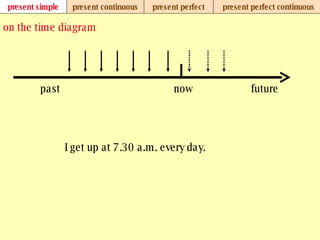
present simple present continuous present perfect present perfect continuous on the time diagram now past future I get up at 7.30 a.m. every day.
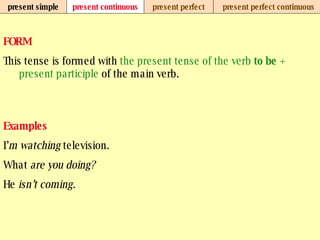
present simple present continuous present perfect present perfect continuous FORM This tense is formed with  the present tense of the verb  to be  +   present participle  of the main verb. Examples I’ m watching  television. What  are you doing? He  isn’t coming.
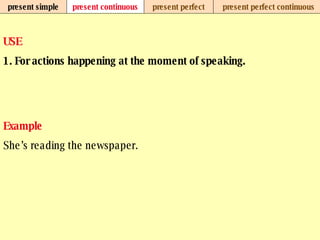
present simple present continuous present perfect present perfect continuous USE 1. For actions happening at the moment of speaking.   Example She’s reading the newspaper.
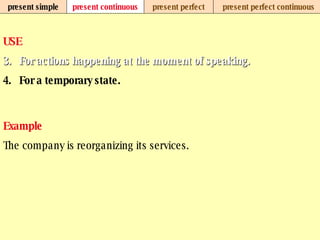
present simple present continuous present perfect present perfect continuous USE For actions happening at the moment of speaking.   For a temporary state.   Example The company is reorganizing its services.
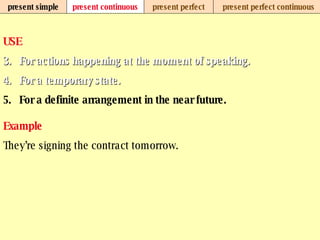
present simple present continuous present perfect present perfect continuous USE For actions happening at the moment of speaking.   For a temporary state.   For a definite arrangement in the near future.   Example They’re signing the contract tomorrow.
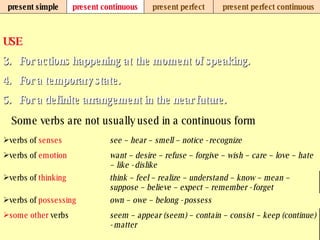
present simple present continuous present perfect present perfect continuous USE For actions happening at the moment of speaking.   For a temporary state.   For a definite arrangement in the near future.   Some verbs are not usually used in a continuous form seem – appear (seem) – contain – consist – keep (continue) - matter some   other  verbs  own – owe – belong - possess verbs of  possessing think – feel – realize – understand – know – mean – suppose – believe – expect – remember - forget verbs of  thinking want – desire – refuse – forgive – wish – care – love – hate – like - dislike verbs of  emotion see – hear – smell – notice - recognize verbs of  senses
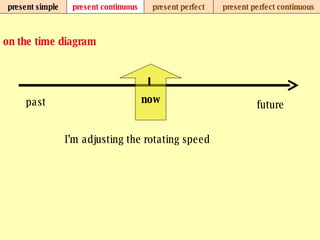
present simple present continuous present perfect present perfect continuous on the time diagram now I’m adjusting the rotating speed past future
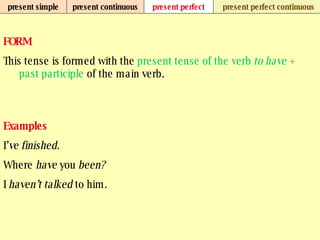
present simple present continuous present perfect present perfect continuous FORM This tense is formed with the  present tense of the verb  to have  +   past participle  of the main verb. Examples I’ ve finished. Where  have  you  been? I  haven’t talked  to him.
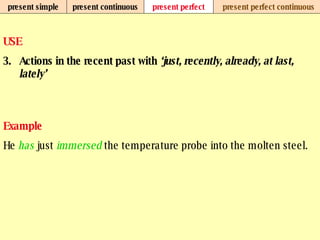
present simple present continuous present perfect present perfect continuous USE Actions in the recent past with  ‘just, recently, already, at last, lately’ Example He  has  just  immersed  the temperature probe into the molten steel.
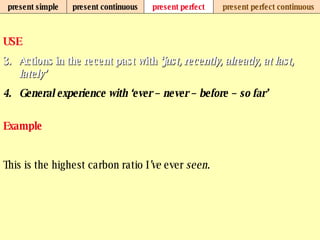
present simple present continuous present perfect present perfect continuous USE Actions in the recent past with  ‘just, recently, already, at last, lately’ General experience with ‘ever – never – before – so far’   Example This is the highest carbon ratio I ’ve  ever  seen .
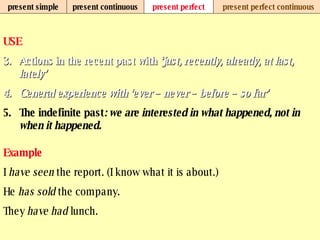
present simple present continuous present perfect present perfect continuous USE Actions in the recent past with  ‘just, recently, already, at last, lately’ General experience with ‘ever – never – before – so far’   The indefinite past : we are interested in what happened, not in when it happened.   Example I  have seen  the report. (I know what it is about.) He  has sold  the company. They  have had  lunch.
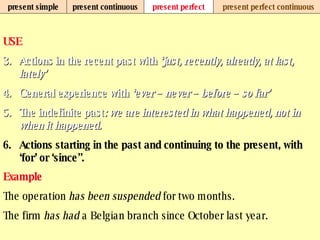
present simple present continuous present perfect present perfect continuous USE Actions in the recent past with  ‘just, recently, already, at last, lately’ General experience with  ‘ever – never – before – so far’   The indefinite past : we are interested in what happened, not in when it happened.   Actions starting in the past and continuing to the present, with ‘for’ or ‘since”.   Example The operation  has been suspended  for two months. The firm  has had  a Belgian branch since October last year.
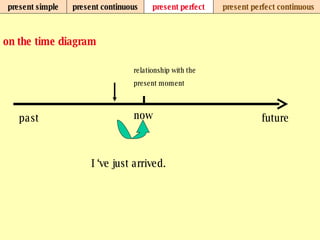
present simple present continuous present perfect present perfect continuous on the time diagram now past future I ‘ve just arrived. relationship with the  present moment
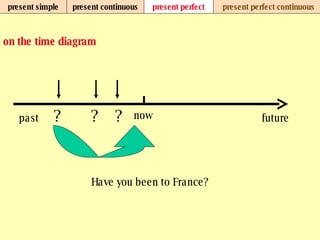
present simple present continuous present perfect present perfect continuous on the time diagram now past future Have you been to France? ? ? ?
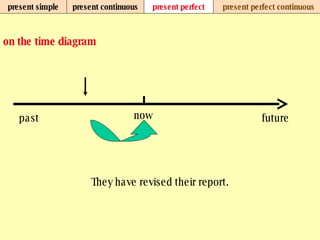
present simple present continuous present perfect present perfect continuous on the time diagram now past future They have revised their report.
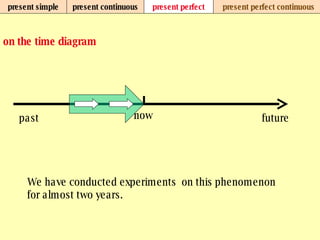
present simple present continuous present perfect present perfect continuous on the time diagram now past future We have conducted experiments  on this phenomenon for almost two years.
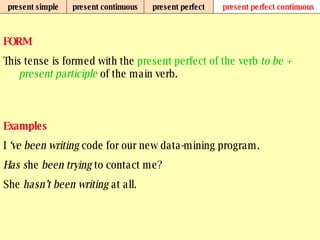
present simple present continuous present perfect present perfect continuous FORM This tense is formed with the  present perfect of the verb  to be +   present participle  of the main verb. Examples I  ‘ve been writing  code for our new data-mining program. Has s he  been trying  to contact me? She  hasn’t been writing  at all.
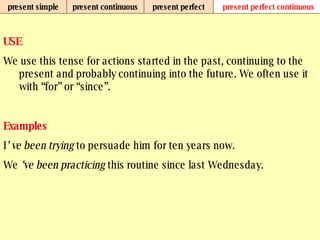
present simple present continuous present perfect present perfect continuous USE We use this tense for actions started in the past, continuing to the present and probably continuing into the future. We often use it with “for” or “since”.   Examples I ’ ve been trying  to persuade him for ten years now. We  ‘ve been practicing  this routine since last Wednesday.
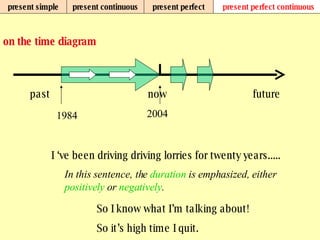
present simple present continuous present perfect present perfect continuous on the time diagram now 2004 past future I ‘ve been driving driving lorries for twenty years..... 1984 In this sentence, the  duration  is emphasized, either  positively  or  negatively . So I know what I’m talking about! So it’s high time I quit.
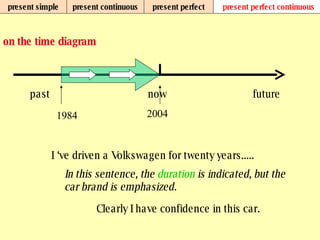
present simple present continuous present perfect present perfect continuous on the time diagram now 2004 past future I ‘ve driven a Volkswagen for twenty years..... 1984 In this sentence, the  duration  is indicated, but the car brand is emphasized. Clearly I have confidence in this car.
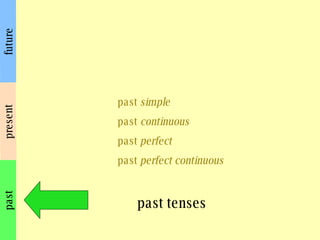
present past future past tenses past  simple past  continuous past  perfect past  perfect continuous
past simple past continuous past perfect past perfect continuous FORM This tense is formed by adding   -ed to the infinitive .  The negative and interrogative are formed with the   past tense of the verb  to do   +  infinitive   of the main verb   Examples   They  arrived  at head quarters an hour ago. When  did  he  finalize  this deal? I  didn’t finish  until 12 o’clock.
past simple past continuous past perfect past perfect continuous USE 1. For actions completed at a definite time in the past.   Example   We signed the contract last Friday at 2 o’clock.
past simple past continuous past perfect past perfect continuous USE For actions completed at a definite time in the past. For actions which are already completed in the past: the time is understood but not stated. Example   Did you arrive in time?
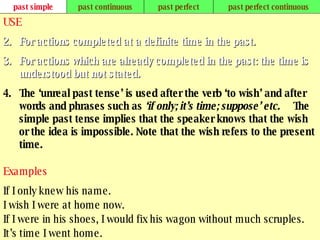
past simple past continuous past perfect past perfect continuous USE For actions completed at a definite time in the past. For actions which are already completed in the past: the time is understood but not stated.   The ‘unreal past tense’ is used after the verb ‘to wish’ and after words and phrases such as  ‘if only; it’s time; suppose’ etc.   The simple past tense implies that the speaker knows that the wish or the idea is impossible. Note that the wish refers to the present time.   Examples If I only knew his name. I wish I were at home now. If I were in his shoes, I would fix his wagon without much scruples. It’s time I went home.
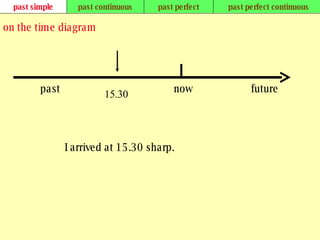
past simple past continuous past perfect past perfect continuous on the time diagram now past future I arrived at 15.30 sharp.   15.30
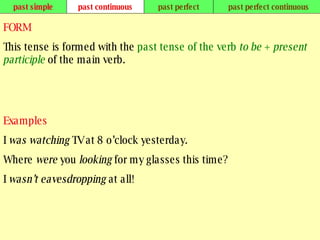
past simple past continuous past perfect past perfect continuous FORM This tense is formed with the  past tense of the verb  to be  +  present participle  of the main verb. Examples I  was watching  TV at 8 o’clock yesterday. Where  were  you  looking  for my glasses this time? I  wasn’t eavesdropping  at all!
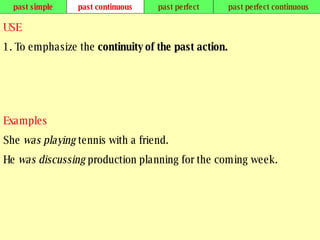
past simple past continuous past perfect past perfect continuous USE 1. To emphasize the  continuity of the past action.   Examples She  was playing  tennis with a friend. He  was discussing  production planning for the coming week.
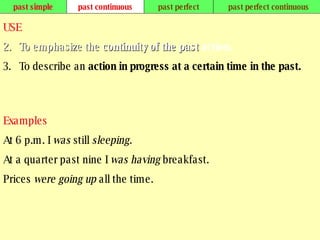
past simple past continuous past perfect past perfect continuous USE To emphasize the  continuity of the past  action.   To describe an  action in progress at a certain time in the past.   Examples At 6 p.m. I  was  still  sleeping. At a quarter past nine I  was having  breakfast. Prices  were going up  all the time.
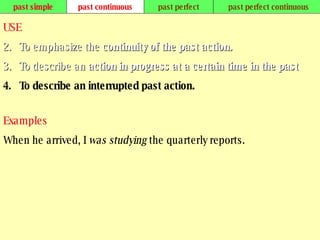
past simple past continuous past perfect past perfect continuous USE To emphasize the  continuity of the past action.   To describe an  action in progress at a certain time in the past .   To describe an interrupted past action.   Examples When he arrived, I  was studying  the quarterly reports.
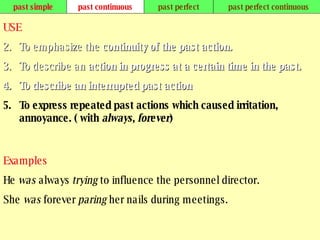
past simple past continuous past perfect past perfect continuous USE To emphasize the  continuity of the past action.   To describe an  action in progress at a certain time in the past.   To describe an interrupted past action .   To express repeated past actions which caused irritation, annoyance. ( with  always ,  forever )   Examples He  was  always  trying  to influence the personnel director. She  was  forever  paring  her nails during meetings.
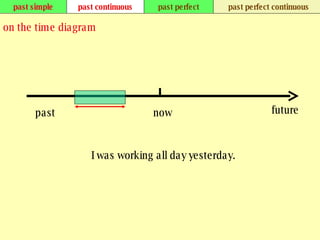
past simple past continuous past perfect past perfect continuous on the time diagram now past future I was working all day yesterday.
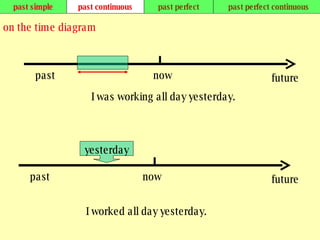
past simple past continuous past perfect past perfect continuous on the time diagram now past future I was working all day yesterday. past now future I worked all day yesterday. yesterday
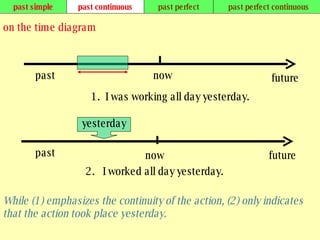
past simple past continuous past perfect past perfect continuous on the time diagram now past future 1.  I was working all day yesterday. past now future 2.  I worked all day yesterday. yesterday While (1) emphasizes the continuity of the action, (2) only indicates that the action took place yesterday.
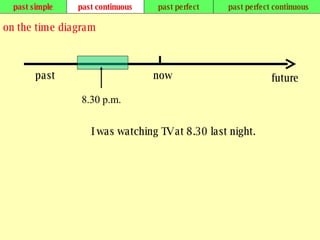
past simple past continuous past perfect past perfect continuous on the time diagram now past future I was watching TV at 8.30 last night. 8.30 p.m.
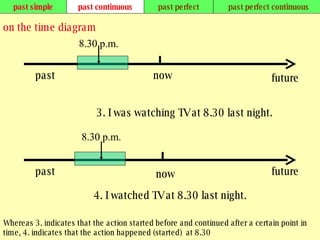
past simple past continuous past perfect past perfect continuous on the time diagram now past future 3. I was watching TV at 8.30 last night. 8.30 p.m. 8.30 p.m. now future past 4. I watched TV at 8.30 last night. Whereas 3. indicates that the action started before and continued after a certain point in time, 4. indicates that the action happened (started)  at 8.30
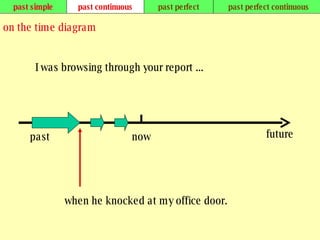
past simple past continuous past perfect past perfect continuous on the time diagram now past future I was browsing through your report ... when he knocked at my office door.
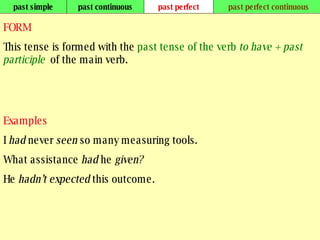
past simple past continuous past perfect past perfect continuous FORM This tense is formed with the  past tense of the verb  to have   + past participle   of the main verb. Examples I  had  never  seen  so many measuring tools. What assistance  had  he  given? He  hadn’t expected  this outcome.
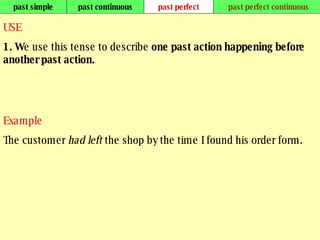
past simple past continuous past perfect past perfect continuous USE 1. W e use this tense to describe  one past action happening before another past action.  Example The customer  had left  the shop by the time I found his order form.
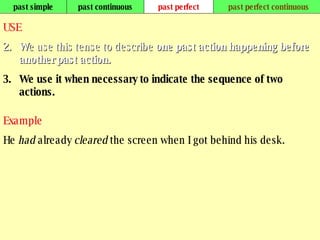
past simple past continuous past perfect past perfect continuous USE W e use this tense to describe  one past action happening before another past action.  We use it when necessary to indicate the sequence of two actions. Example He  had  already  cleared  the screen when I got behind his desk.
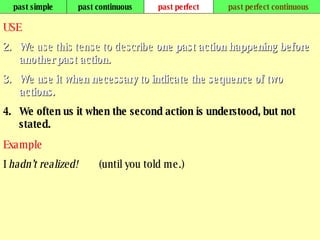
past simple past continuous past perfect past perfect continuous USE W e use this tense to describe  one past action happening before another past action.  We use it when necessary to indicate the sequence of two actions.  We often us it when the second action is understood, but not stated. Example I  hadn’t realized!   (until you told me.)
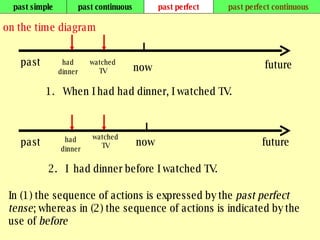
past simple past continuous past perfect past perfect continuous on the time diagram now past future had dinner watched TV 1.  When I had had dinner, I watched TV. had dinner watched TV past now future 2.  I  had dinner before I watched TV. In (1) the sequence of actions is expressed by the  past perfect tense ; whereas in (2) the sequence of actions is indicated by the use of  before
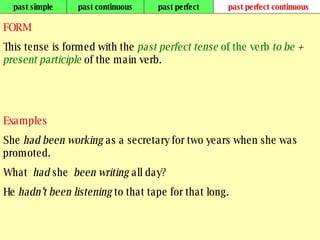
past simple past continuous past perfect past perfect continuous FORM This tense is formed with the  past perfect tense  of the verb  to be  +  present participle  of the main verb. Examples She  had been working  as a secretary for two years when she was promoted. What  had  she  been writing  all day? He  hadn’t been listening  to that tape for that long.
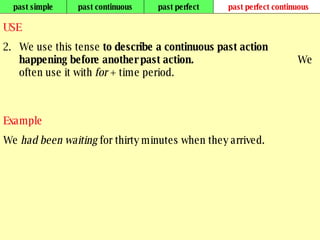
past simple past continuous past perfect past perfect continuous USE We use this tense  to describe a continuous past action happening before another past action.  We often use it with  for  + time period.   Example We  had been waiting  for thirty minutes when they arrived.  
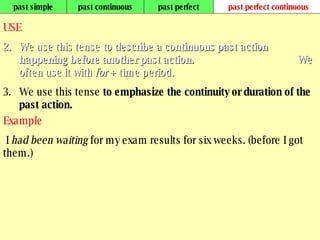
past simple past continuous past perfect past perfect continuous USE We use this tense  to describe a continuous past action happening before another past action.  We often use it with  for  + time period.   We use this tense  to emphasize the continuity or duration of the past action. Example   I  had been waiting  for my exam results for six weeks. (before I got them.)
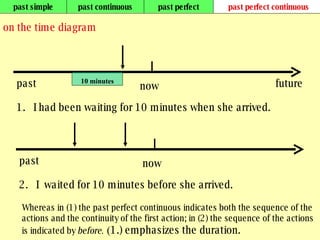
past simple past continuous past perfect past perfect continuous on the time diagram now past future 10 minutes 1.  I had been waiting for 10 minutes when she arrived. now past 2.  I  waited for 10 minutes before she arrived. Whereas in (1) the past perfect continuous indicates both the sequence of the actions and the continuity of the first action; in (2) the sequence of the actions is indicated by  before .  ( 1.) emphasizes the duration.
present past future future tenses future  simple future  continuous future  perfect future  perfect continuous going to present continuous present simple
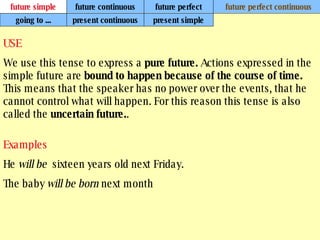
future simple future continuous future perfect future perfect continuous USE We use this tense to express a  pure future.  Actions expressed in the simple future are  bound to happen because of the course of time.  This means that the speaker has no power over the events, that he cannot control what will happen. For this reason this tense is also called the  uncertain future. .   Examples He  will be  sixteen years old next Friday. The baby  will be born  next month going to ... present continuous present simple
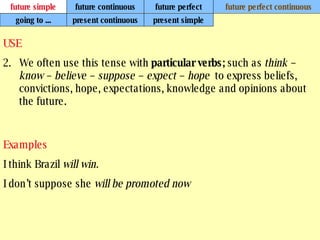
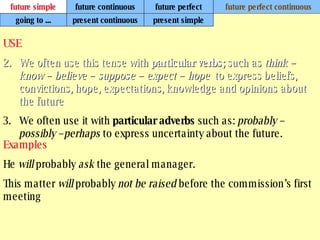
future simple future continuous future perfect future perfect continuous USE We often use this tense with  particular verbs;  such as  think – know – believe – suppose – expect – hope  to express beliefs, convictions, hope, expectations, knowledge and opinions about the future. Examples I think Brazil  will win. I don’t suppose she  will be promoted now   going to ... present continuous present simple
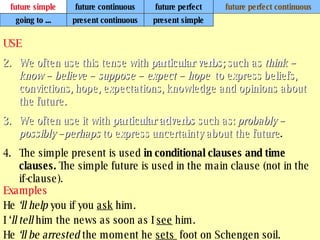
future simple future continuous future perfect future perfect continuous USE We often use this tense with  particular verbs;  such as  think – know – believe – suppose – expect – hope  to express beliefs, convictions, hope, expectations, knowledge and opinions about the future .   We often use it with  particular adverbs  such as:  probably – possibly –perhaps  to express uncertainty about the future.   Examples He  will  probably  ask  the general manager. This matter  will  probably  not be raised  before the commission’s first meeting   going to ... present continuous present simple
future simple future continuous future perfect future perfect continuous USE We often use this tense with  particular verbs;  such as  think – know – believe – suppose – expect – hope  to express beliefs, convictions, hope, expectations, knowledge and opinions about the future.   We often use it with  particular adverbs  such as:  probably – possibly –perhaps  to express uncertainty about the future .   The simple present is used  in conditional clauses and time clauses.  The simple future is used in the main clause (not in the if-clause).   Examples He  ‘ll help  you if you  ask  him. I ‘ ll tell  him the news as soon as I  see  him. He  ‘ll be arrested  the moment he  sets  foot on Schengen soil. going to ... present continuous present simple
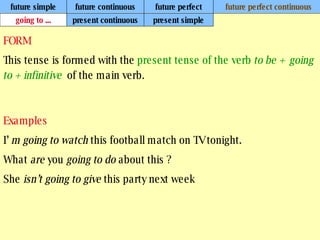
future simple future continuous future perfect future perfect continuous FORM This tense is formed with the  present tense of the verb  to be +  going to + infinitive   of the main verb. Examples I’  m going to watch  this football match on TV tonight. What  are  you  going to do  about this ? She  isn’t going to give  this party next week   going to ... present continuous present simple
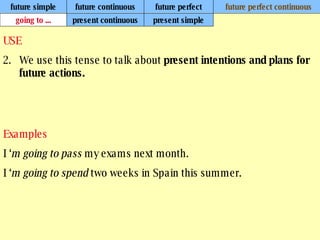
future simple future continuous future perfect future perfect continuous USE We use this tense to talk about  present intentions and plans for future actions. Examples I ‘ m going to pass  my exams next month. I ‘ m going to spend  two weeks in Spain this summer. going to ... present continuous present simple
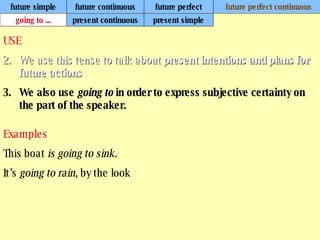
future simple future continuous future perfect future perfect continuous USE We use this tense to talk about  present intentions and plans for future actions .   We also use  going to  in order to express subjective certainty on the part of the speaker. Examples This boat  is going to sink. It’s  going to rain,  by the look  going to ... present continuous present simple
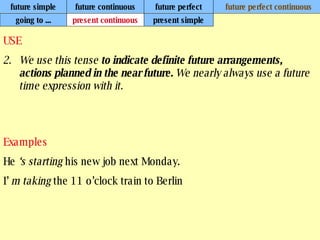
future simple future continuous future perfect future perfect continuous USE We use this tense  to indicate definite future arrangements, actions planned in the near future.  We nearly always use a future time expression with it. Examples He  ‘s starting  his new job next Monday. I’  m taking  the 11 o’clock train to Berlin   going to ... present continuous present simple
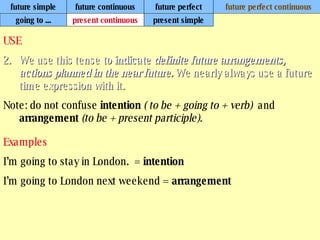
future simple future continuous future perfect future perfect continuous USE We use this tense  to indicate  definite future arrangements, actions planned in the near future.   We nearly always use a future time expression with it. Note: do not confuse  intention  ( to be + going to + verb)  and  arrangement  (to be + present participle).   Examples I’m going to stay in London.  =  intention I’m going to London next weekend =  arrangement   going to ... present continuous present simple
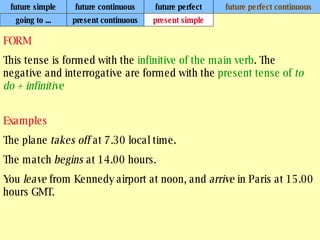
future simple future continuous future perfect future perfect continuous FORM This tense is formed with the  infinitive of the main verb . The negative and interrogative are formed with the  present tense of  to do + infinitive   Examples The plane  takes off  at 7.30 local time. The match  begins  at 14.00 hours. You  leave  from Kennedy airport at noon, and  arrive  in Paris at 15.00 hours GMT. going to ... present continuous present simple
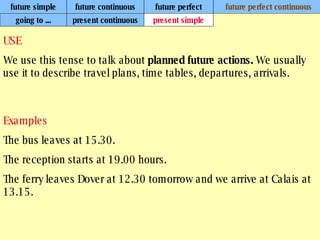
future simple future continuous future perfect future perfect continuous USE We use this tense to talk about  planned future actions.  We usually use it to describe travel plans, time tables, departures, arrivals.   Examples The bus leaves at 15.30. The reception starts at 19.00 hours. The ferry leaves Dover at 12.30 tomorrow and we arrive at Calais at 13.15. going to ... present continuous present simple
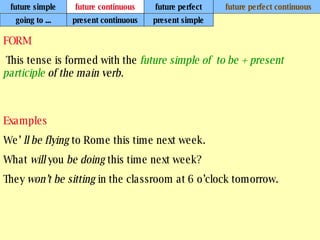
future simple future continuous future perfect future perfect continuous FORM   This tense is formed with the  future simple of   to be + present participle  of the main verb. Examples We’  ll be flying  to Rome this time next week. What  will  you  be doing  this time next week? They  won’t be sitting  in the classroom at 6 o’clock tomorrow. going to ... present continuous present simple
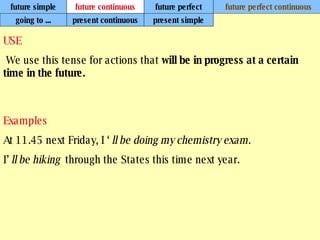
future simple future continuous future perfect future perfect continuous USE   We use this tense for actions that  will be in progress at a certain time in the future.   Examples At 11.45 next Friday, I ‘  ll be doing my chemistry exam. I’  ll be hiking  through the States this time next year. going to ... present continuous present simple
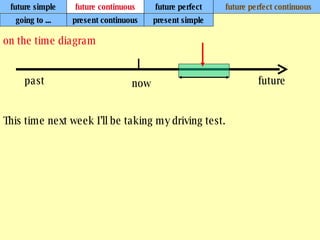
future simple future continuous future perfect future perfect continuous on the time diagram   This time next week I’ll be taking my driving test. going to ... present continuous present simple now past future
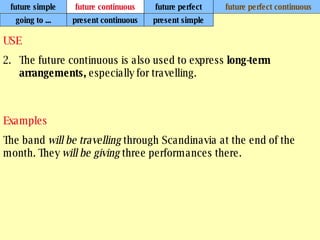
future simple future continuous future perfect future perfect continuous USE The future continuous is also used to express  long-term arrangements,  especially for travelling. Examples The band  will be travelling  through Scandinavia at the end of the month. They  will be giving  three performances there. going to ... present continuous present simple
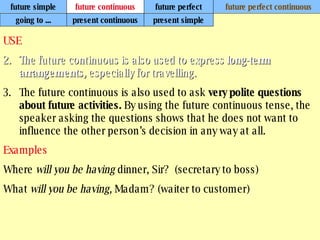
future simple future continuous future perfect future perfect continuous USE The future continuous is also used to express  long-term arrangements,  especially for travelling.  The future continuous is also used to ask  very polite questions about future activities.  By using the future continuous tense, the speaker asking the questions shows that he does not want to influence the other person’s decision in any way at all. Examples Where  will you be having  dinner, Sir?  (secretary to boss) What  will you be having,  Madam? (waiter to customer) going to ... present continuous present simple
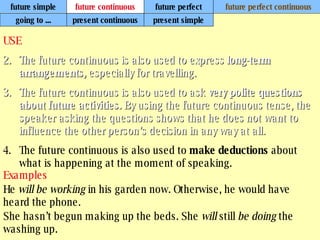
future simple future continuous future perfect future perfect continuous USE The future continuous is also used to express  long-term arrangements,  especially for travelling.  The future continuous is also used to ask  very polite questions about future activities.  By using the future continuous tense, the speaker asking the questions shows that he does not want to influence the other person’s decision in any way at all.   The future continuous is also used to  make deductions  about what is happening at the moment of speaking. Examples He  will be working  in his garden now. Otherwise, he would have heard the phone. She hasn’t begun making up the beds. She  will  still  be doing  the washing up. going to ... present continuous present simple
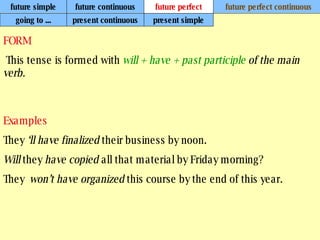
future simple future continuous future perfect future perfect continuous FORM   This tense is formed with  will + have + past participle  of the main verb. Examples They  ‘ll have finalized  their business by noon. Will  they  have copied  all that material by Friday morning? They  won’t have organized  this course by the end of this year.   going to ... present continuous present simple
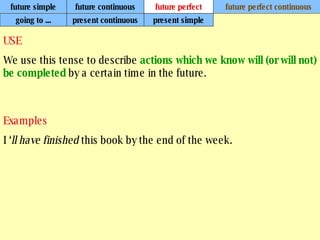
future simple future continuous future perfect future perfect continuous USE We use this tense to describe  actions which we know will (or will not) be completed  by a certain time in the future. Examples I ‘ ll have finished  this book by the end of the week. going to ... present continuous present simple
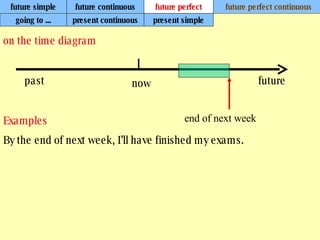
future simple future continuous future perfect future perfect continuous on the time diagram Examples By the end of next week, I’ll have finished my exams. going to ... present continuous present simple now past future end of next week
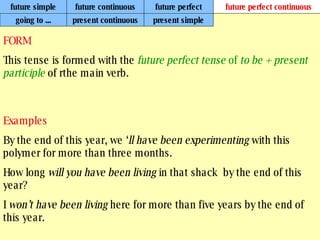
future simple future continuous future perfect future perfect continuous FORM This tense is formed with the  future perfect tense  of  to be + present participle   of rthe main verb. Examples By the end of this year, we ‘ ll have been experimenting  with this polymer for more than three months. How long  will you have been living  in that shack  by the end of this year? I  won’t have been living  here for more than five years by the end of this year. going to ... present continuous present simple
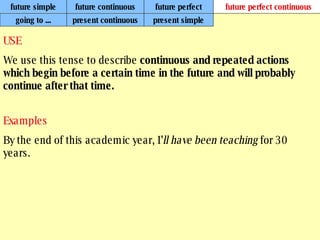
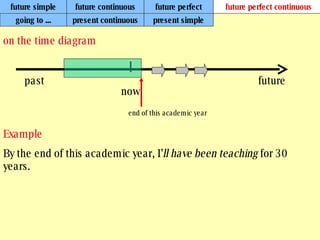
future simple future continuous future perfect future perfect continuous USE We use this tense to describe  continuous and repeated actions which begin before a certain time in the future and will probably continue after that time. Example s By the end of this academic year, I’ ll have been teaching  for 30 years. going to ... present continuous present simple
future simple future continuous future perfect future perfect continuous on the time diagram Example By the end of this academic year, I’ ll have been teaching  for 30 years. going to ... present continuous present simple past future now end of this academic year

Grammar Tenses

  • 1.
    present past futureWe use tenses of verbs to refer to actions or situations in the present, in the past and in the future
  • 2.
    present past futureThere are different sorts of tenses: simple tenses continuous tenses perfect tenses perfect continuous tenses
  • 3.
    present past futurepresent tenses present simple present continuous present perfect present perfect continuous
  • 4.
    present simple presentcontinuous present perfect present perfect continuous FORM The present simple is formed with the infinitive of the main verb . The negative and interrogative are formed with the present tense of the verb to do + infinitive. Examples   I start ( he start s ) work at 8.30 a.m. When do I start work? I don’t start work until 9.00 a..m. / He do es n’t start work until 9.00 a..m.
  • 5.
    present simple presentcontinuous present perfect present perfect continuous USE 1. for habitual and repeated actions Example   I play blues harp and dobro guitar
  • 6.
    present simple presentcontinuous present perfect present perfect continuous USE for habitual and repeated actions with adverbs (or expressions) of frequency ( often – usually – sometimes - seldom – rarely – always – occasionally – never – twice a week - on Tuesdays – most of the time ....) Example   He often arrives late
  • 7.
    present simple presentcontinuous present perfect present perfect continuous USE for habitual and repeated actions with adverbs (or expressions) of frequency Certain verbs are usually only used in the simple form   Example Do you see what I mean? She likes my brother very much. I suppose he realizes that now. think – feel – realize – understand – know – mean – suppose – believe – expect – remember – forget verbs of thinking want – desire – refuse – forgive – wish – care – love – hate – like – dislike verbs of emotions see- hear- smell – notice – recognize verbs of the senses
  • 8.
    present simple presentcontinuous present perfect present perfect continuous USE for habitual and repeated actions with adverbs (or expressions) of frequency Certain verbs are usually only used in the simple form for something that is permanently true Example Water boils at 100° C.
  • 9.
    present simple presentcontinuous present perfect present perfect continuous on the time diagram now past future I get up at 7.30 a.m. every day.
  • 10.
    present simple presentcontinuous present perfect present perfect continuous FORM This tense is formed with the present tense of the verb to be + present participle of the main verb. Examples I’ m watching television. What are you doing? He isn’t coming.
  • 11.
    present simple presentcontinuous present perfect present perfect continuous USE 1. For actions happening at the moment of speaking. Example She’s reading the newspaper.
  • 12.
    present simple presentcontinuous present perfect present perfect continuous USE For actions happening at the moment of speaking. For a temporary state. Example The company is reorganizing its services.
  • 13.
    present simple presentcontinuous present perfect present perfect continuous USE For actions happening at the moment of speaking. For a temporary state. For a definite arrangement in the near future. Example They’re signing the contract tomorrow.
  • 14.
    present simple presentcontinuous present perfect present perfect continuous USE For actions happening at the moment of speaking. For a temporary state. For a definite arrangement in the near future. Some verbs are not usually used in a continuous form seem – appear (seem) – contain – consist – keep (continue) - matter some other verbs own – owe – belong - possess verbs of possessing think – feel – realize – understand – know – mean – suppose – believe – expect – remember - forget verbs of thinking want – desire – refuse – forgive – wish – care – love – hate – like - dislike verbs of emotion see – hear – smell – notice - recognize verbs of senses
  • 15.
    present simple presentcontinuous present perfect present perfect continuous on the time diagram now I’m adjusting the rotating speed past future
  • 16.
    present simple presentcontinuous present perfect present perfect continuous FORM This tense is formed with the present tense of the verb to have + past participle of the main verb. Examples I’ ve finished. Where have you been? I haven’t talked to him.
  • 17.
    present simple presentcontinuous present perfect present perfect continuous USE Actions in the recent past with ‘just, recently, already, at last, lately’ Example He has just immersed the temperature probe into the molten steel.
  • 18.
    present simple presentcontinuous present perfect present perfect continuous USE Actions in the recent past with ‘just, recently, already, at last, lately’ General experience with ‘ever – never – before – so far’ Example This is the highest carbon ratio I ’ve ever seen .
  • 19.
    present simple presentcontinuous present perfect present perfect continuous USE Actions in the recent past with ‘just, recently, already, at last, lately’ General experience with ‘ever – never – before – so far’ The indefinite past : we are interested in what happened, not in when it happened. Example I have seen the report. (I know what it is about.) He has sold the company. They have had lunch.
  • 20.
    present simple presentcontinuous present perfect present perfect continuous USE Actions in the recent past with ‘just, recently, already, at last, lately’ General experience with ‘ever – never – before – so far’ The indefinite past : we are interested in what happened, not in when it happened. Actions starting in the past and continuing to the present, with ‘for’ or ‘since”. Example The operation has been suspended for two months. The firm has had a Belgian branch since October last year.
  • 21.
    present simple presentcontinuous present perfect present perfect continuous on the time diagram now past future I ‘ve just arrived. relationship with the present moment
  • 22.
    present simple presentcontinuous present perfect present perfect continuous on the time diagram now past future Have you been to France? ? ? ?
  • 23.
    present simple presentcontinuous present perfect present perfect continuous on the time diagram now past future They have revised their report.
  • 24.
    present simple presentcontinuous present perfect present perfect continuous on the time diagram now past future We have conducted experiments on this phenomenon for almost two years.
  • 25.
    present simple presentcontinuous present perfect present perfect continuous FORM This tense is formed with the present perfect of the verb to be + present participle of the main verb. Examples I ‘ve been writing code for our new data-mining program. Has s he been trying to contact me? She hasn’t been writing at all.
  • 26.
    present simple presentcontinuous present perfect present perfect continuous USE We use this tense for actions started in the past, continuing to the present and probably continuing into the future. We often use it with “for” or “since”. Examples I ’ ve been trying to persuade him for ten years now. We ‘ve been practicing this routine since last Wednesday.
  • 27.
    present simple presentcontinuous present perfect present perfect continuous on the time diagram now 2004 past future I ‘ve been driving driving lorries for twenty years..... 1984 In this sentence, the duration is emphasized, either positively or negatively . So I know what I’m talking about! So it’s high time I quit.
  • 28.
    present simple presentcontinuous present perfect present perfect continuous on the time diagram now 2004 past future I ‘ve driven a Volkswagen for twenty years..... 1984 In this sentence, the duration is indicated, but the car brand is emphasized. Clearly I have confidence in this car.
  • 29.
    present past futurepast tenses past simple past continuous past perfect past perfect continuous
  • 30.
    past simple pastcontinuous past perfect past perfect continuous FORM This tense is formed by adding -ed to the infinitive . The negative and interrogative are formed with the past tense of the verb to do + infinitive of the main verb Examples   They arrived at head quarters an hour ago. When did he finalize this deal? I didn’t finish until 12 o’clock.
  • 31.
    past simple pastcontinuous past perfect past perfect continuous USE 1. For actions completed at a definite time in the past. Example   We signed the contract last Friday at 2 o’clock.
  • 32.
    past simple pastcontinuous past perfect past perfect continuous USE For actions completed at a definite time in the past. For actions which are already completed in the past: the time is understood but not stated. Example   Did you arrive in time?
  • 33.
    past simple pastcontinuous past perfect past perfect continuous USE For actions completed at a definite time in the past. For actions which are already completed in the past: the time is understood but not stated. The ‘unreal past tense’ is used after the verb ‘to wish’ and after words and phrases such as ‘if only; it’s time; suppose’ etc. The simple past tense implies that the speaker knows that the wish or the idea is impossible. Note that the wish refers to the present time. Examples If I only knew his name. I wish I were at home now. If I were in his shoes, I would fix his wagon without much scruples. It’s time I went home.
  • 34.
    past simple pastcontinuous past perfect past perfect continuous on the time diagram now past future I arrived at 15.30 sharp. 15.30
  • 35.
    past simple pastcontinuous past perfect past perfect continuous FORM This tense is formed with the past tense of the verb to be + present participle of the main verb. Examples I was watching TV at 8 o’clock yesterday. Where were you looking for my glasses this time? I wasn’t eavesdropping at all!
  • 36.
    past simple pastcontinuous past perfect past perfect continuous USE 1. To emphasize the continuity of the past action. Examples She was playing tennis with a friend. He was discussing production planning for the coming week.
  • 37.
    past simple pastcontinuous past perfect past perfect continuous USE To emphasize the continuity of the past action. To describe an action in progress at a certain time in the past. Examples At 6 p.m. I was still sleeping. At a quarter past nine I was having breakfast. Prices were going up all the time.
  • 38.
    past simple pastcontinuous past perfect past perfect continuous USE To emphasize the continuity of the past action. To describe an action in progress at a certain time in the past . To describe an interrupted past action. Examples When he arrived, I was studying the quarterly reports.
  • 39.
    past simple pastcontinuous past perfect past perfect continuous USE To emphasize the continuity of the past action. To describe an action in progress at a certain time in the past. To describe an interrupted past action . To express repeated past actions which caused irritation, annoyance. ( with always , forever ) Examples He was always trying to influence the personnel director. She was forever paring her nails during meetings.
  • 40.
    past simple pastcontinuous past perfect past perfect continuous on the time diagram now past future I was working all day yesterday.
  • 41.
    past simple pastcontinuous past perfect past perfect continuous on the time diagram now past future I was working all day yesterday. past now future I worked all day yesterday. yesterday
  • 42.
    past simple pastcontinuous past perfect past perfect continuous on the time diagram now past future 1. I was working all day yesterday. past now future 2. I worked all day yesterday. yesterday While (1) emphasizes the continuity of the action, (2) only indicates that the action took place yesterday.
  • 43.
    past simple pastcontinuous past perfect past perfect continuous on the time diagram now past future I was watching TV at 8.30 last night. 8.30 p.m.
  • 44.
    past simple pastcontinuous past perfect past perfect continuous on the time diagram now past future 3. I was watching TV at 8.30 last night. 8.30 p.m. 8.30 p.m. now future past 4. I watched TV at 8.30 last night. Whereas 3. indicates that the action started before and continued after a certain point in time, 4. indicates that the action happened (started) at 8.30
  • 45.
    past simple pastcontinuous past perfect past perfect continuous on the time diagram now past future I was browsing through your report ... when he knocked at my office door.
  • 46.
    past simple pastcontinuous past perfect past perfect continuous FORM This tense is formed with the past tense of the verb to have + past participle of the main verb. Examples I had never seen so many measuring tools. What assistance had he given? He hadn’t expected this outcome.
  • 47.
    past simple pastcontinuous past perfect past perfect continuous USE 1. W e use this tense to describe one past action happening before another past action. Example The customer had left the shop by the time I found his order form.
  • 48.
    past simple pastcontinuous past perfect past perfect continuous USE W e use this tense to describe one past action happening before another past action. We use it when necessary to indicate the sequence of two actions. Example He had already cleared the screen when I got behind his desk.
  • 49.
    past simple pastcontinuous past perfect past perfect continuous USE W e use this tense to describe one past action happening before another past action. We use it when necessary to indicate the sequence of two actions. We often us it when the second action is understood, but not stated. Example I hadn’t realized! (until you told me.)
  • 50.
    past simple pastcontinuous past perfect past perfect continuous on the time diagram now past future had dinner watched TV 1. When I had had dinner, I watched TV. had dinner watched TV past now future 2. I had dinner before I watched TV. In (1) the sequence of actions is expressed by the past perfect tense ; whereas in (2) the sequence of actions is indicated by the use of before
  • 51.
    past simple pastcontinuous past perfect past perfect continuous FORM This tense is formed with the past perfect tense of the verb to be + present participle of the main verb. Examples She had been working as a secretary for two years when she was promoted. What had she been writing all day? He hadn’t been listening to that tape for that long.
  • 52.
    past simple pastcontinuous past perfect past perfect continuous USE We use this tense to describe a continuous past action happening before another past action. We often use it with for + time period. Example We had been waiting for thirty minutes when they arrived.  
  • 53.
    past simple pastcontinuous past perfect past perfect continuous USE We use this tense to describe a continuous past action happening before another past action. We often use it with for + time period. We use this tense to emphasize the continuity or duration of the past action. Example   I had been waiting for my exam results for six weeks. (before I got them.)
  • 54.
    past simple pastcontinuous past perfect past perfect continuous on the time diagram now past future 10 minutes 1. I had been waiting for 10 minutes when she arrived. now past 2. I waited for 10 minutes before she arrived. Whereas in (1) the past perfect continuous indicates both the sequence of the actions and the continuity of the first action; in (2) the sequence of the actions is indicated by before . ( 1.) emphasizes the duration.
  • 55.
    present past futurefuture tenses future simple future continuous future perfect future perfect continuous going to present continuous present simple
  • 56.
    future simple futurecontinuous future perfect future perfect continuous USE We use this tense to express a pure future. Actions expressed in the simple future are bound to happen because of the course of time. This means that the speaker has no power over the events, that he cannot control what will happen. For this reason this tense is also called the uncertain future. . Examples He will be sixteen years old next Friday. The baby will be born next month going to ... present continuous present simple
  • 57.
    future simple futurecontinuous future perfect future perfect continuous USE We often use this tense with particular verbs; such as think – know – believe – suppose – expect – hope to express beliefs, convictions, hope, expectations, knowledge and opinions about the future. Examples I think Brazil will win. I don’t suppose she will be promoted now going to ... present continuous present simple
  • 58.
    future simple futurecontinuous future perfect future perfect continuous USE We often use this tense with particular verbs; such as think – know – believe – suppose – expect – hope to express beliefs, convictions, hope, expectations, knowledge and opinions about the future . We often use it with particular adverbs such as: probably – possibly –perhaps to express uncertainty about the future. Examples He will probably ask the general manager. This matter will probably not be raised before the commission’s first meeting going to ... present continuous present simple
  • 59.
    future simple futurecontinuous future perfect future perfect continuous USE We often use this tense with particular verbs; such as think – know – believe – suppose – expect – hope to express beliefs, convictions, hope, expectations, knowledge and opinions about the future. We often use it with particular adverbs such as: probably – possibly –perhaps to express uncertainty about the future . The simple present is used in conditional clauses and time clauses. The simple future is used in the main clause (not in the if-clause). Examples He ‘ll help you if you ask him. I ‘ ll tell him the news as soon as I see him. He ‘ll be arrested the moment he sets foot on Schengen soil. going to ... present continuous present simple
  • 60.
    future simple futurecontinuous future perfect future perfect continuous FORM This tense is formed with the present tense of the verb to be + going to + infinitive of the main verb. Examples I’ m going to watch this football match on TV tonight. What are you going to do about this ? She isn’t going to give this party next week going to ... present continuous present simple
  • 61.
    future simple futurecontinuous future perfect future perfect continuous USE We use this tense to talk about present intentions and plans for future actions. Examples I ‘ m going to pass my exams next month. I ‘ m going to spend two weeks in Spain this summer. going to ... present continuous present simple
  • 62.
    future simple futurecontinuous future perfect future perfect continuous USE We use this tense to talk about present intentions and plans for future actions . We also use going to in order to express subjective certainty on the part of the speaker. Examples This boat is going to sink. It’s going to rain, by the look going to ... present continuous present simple
  • 63.
    future simple futurecontinuous future perfect future perfect continuous USE We use this tense to indicate definite future arrangements, actions planned in the near future. We nearly always use a future time expression with it. Examples He ‘s starting his new job next Monday. I’ m taking the 11 o’clock train to Berlin going to ... present continuous present simple
  • 64.
    future simple futurecontinuous future perfect future perfect continuous USE We use this tense to indicate definite future arrangements, actions planned in the near future. We nearly always use a future time expression with it. Note: do not confuse intention ( to be + going to + verb) and arrangement (to be + present participle). Examples I’m going to stay in London. = intention I’m going to London next weekend = arrangement going to ... present continuous present simple
  • 65.
    future simple futurecontinuous future perfect future perfect continuous FORM This tense is formed with the infinitive of the main verb . The negative and interrogative are formed with the present tense of to do + infinitive Examples The plane takes off at 7.30 local time. The match begins at 14.00 hours. You leave from Kennedy airport at noon, and arrive in Paris at 15.00 hours GMT. going to ... present continuous present simple
  • 66.
    future simple futurecontinuous future perfect future perfect continuous USE We use this tense to talk about planned future actions. We usually use it to describe travel plans, time tables, departures, arrivals.   Examples The bus leaves at 15.30. The reception starts at 19.00 hours. The ferry leaves Dover at 12.30 tomorrow and we arrive at Calais at 13.15. going to ... present continuous present simple
  • 67.
    future simple futurecontinuous future perfect future perfect continuous FORM   This tense is formed with the future simple of to be + present participle of the main verb. Examples We’ ll be flying to Rome this time next week. What will you be doing this time next week? They won’t be sitting in the classroom at 6 o’clock tomorrow. going to ... present continuous present simple
  • 68.
    future simple futurecontinuous future perfect future perfect continuous USE   We use this tense for actions that will be in progress at a certain time in the future.   Examples At 11.45 next Friday, I ‘ ll be doing my chemistry exam. I’ ll be hiking through the States this time next year. going to ... present continuous present simple
  • 69.
    future simple futurecontinuous future perfect future perfect continuous on the time diagram   This time next week I’ll be taking my driving test. going to ... present continuous present simple now past future
  • 70.
    future simple futurecontinuous future perfect future perfect continuous USE The future continuous is also used to express long-term arrangements, especially for travelling. Examples The band will be travelling through Scandinavia at the end of the month. They will be giving three performances there. going to ... present continuous present simple
  • 71.
    future simple futurecontinuous future perfect future perfect continuous USE The future continuous is also used to express long-term arrangements, especially for travelling. The future continuous is also used to ask very polite questions about future activities. By using the future continuous tense, the speaker asking the questions shows that he does not want to influence the other person’s decision in any way at all. Examples Where will you be having dinner, Sir? (secretary to boss) What will you be having, Madam? (waiter to customer) going to ... present continuous present simple
  • 72.
    future simple futurecontinuous future perfect future perfect continuous USE The future continuous is also used to express long-term arrangements, especially for travelling. The future continuous is also used to ask very polite questions about future activities. By using the future continuous tense, the speaker asking the questions shows that he does not want to influence the other person’s decision in any way at all. The future continuous is also used to make deductions about what is happening at the moment of speaking. Examples He will be working in his garden now. Otherwise, he would have heard the phone. She hasn’t begun making up the beds. She will still be doing the washing up. going to ... present continuous present simple
  • 73.
    future simple futurecontinuous future perfect future perfect continuous FORM   This tense is formed with will + have + past participle of the main verb. Examples They ‘ll have finalized their business by noon. Will they have copied all that material by Friday morning? They won’t have organized this course by the end of this year. going to ... present continuous present simple
  • 74.
    future simple futurecontinuous future perfect future perfect continuous USE We use this tense to describe actions which we know will (or will not) be completed by a certain time in the future. Examples I ‘ ll have finished this book by the end of the week. going to ... present continuous present simple
  • 75.
    future simple futurecontinuous future perfect future perfect continuous on the time diagram Examples By the end of next week, I’ll have finished my exams. going to ... present continuous present simple now past future end of next week
  • 76.
    future simple futurecontinuous future perfect future perfect continuous FORM This tense is formed with the future perfect tense of to be + present participle of rthe main verb. Examples By the end of this year, we ‘ ll have been experimenting with this polymer for more than three months. How long will you have been living in that shack by the end of this year? I won’t have been living here for more than five years by the end of this year. going to ... present continuous present simple
  • 77.
    future simple futurecontinuous future perfect future perfect continuous USE We use this tense to describe continuous and repeated actions which begin before a certain time in the future and will probably continue after that time. Example s By the end of this academic year, I’ ll have been teaching for 30 years. going to ... present continuous present simple
  • 78.
    future simple futurecontinuous future perfect future perfect continuous on the time diagram Example By the end of this academic year, I’ ll have been teaching for 30 years. going to ... present continuous present simple past future now end of this academic year