{
The Subjunctive
Past, Present and Future
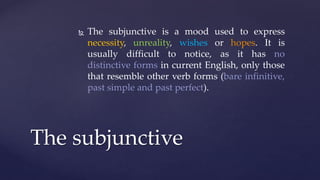
 The subjunctive is a mood used to express
necessity, unreality, wishes or hopes. It is
usually difficult to notice, as it has no
distinctive forms in current English, only those
that resemble other verb forms (bare infinitive,
past simple and past perfect).
The subjunctive
{ {
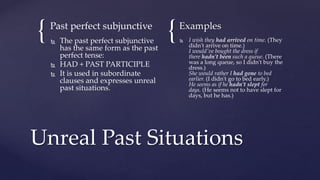
Past perfect subjunctive
 The past perfect subjunctive
has the same form as the past
perfect tense:
 HAD + PAST PARTICIPLE
 It is used in subordinate
clauses and expresses unreal
past situations.
Examples
 I wish they had arrived on time. (They
didn't arrive on time.)
I would've bought the dress if
there hadn't been such a queue. (There
was a long queue, so I didn't buy the
dress.)
She would rather I had gone to bed
earlier. (I didn't go to bed early.)
He seems as if he hadn't slept for
days. (He seems not to have slept for
days, but he has.)
Unreal Past Situations
{ {
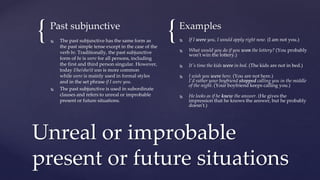
Past subjunctive
 The past subjunctive has the same form as
the past simple tense except in the case of the
verb be. Traditionally, the past subjunctive
form of be is were for all persons, including
the first and third person singular. However,
today I/he/she/it was is more common
while were is mainly used in formal styles
and in the set phrase if I were you.
 The past subjunctive is used in subordinate
clauses and refers to unreal or improbable
present or future situations.
Examples
 If I were you, I would apply right now. (I am not you.)
 What would you do if you won the lottery? (You probably
won't win the lottery.)
 It's time the kids were in bed. (The kids are not in bed.)
 I wish you were here. (You are not here.)
I'd rather your boyfriend stopped calling you in the middle
of the night. (Your boyfriend keeps calling you.)
 He looks as if he knew the answer. (He gives the
impression that he knows the answer, but he probably
doesn't.)
Unreal or improbable
present or future situations
{ {
Present subjunctive
 The present subjunctive is identical to
the bare infinitive form of the verb in
all persons, including the third person
singular (no final -s). It is usually used
in formal or literary styles as shown in
the following:
In exclamations that express
a wish or hope
 Rest in peace!
Bless you!
God save the King!
Formal or literary styles
{ {
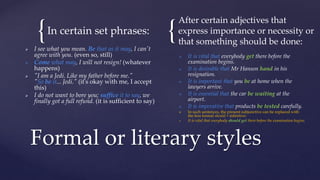
In certain set phrases:
 I see what you mean. Be that as it may, I can't
agree with you. (even so, still)
 Come what may, I will not resign! (whatever
happens)
 "I am a Jedi. Like my father before me."
"So be it... Jedi." (it's okay with me, I accept
this)
 I do not want to bore you; suffice it to say, we
finally got a full refund. (it is sufficient to say)
After certain adjectives that
express importance or necessity or
that something should be done:
 It is vital that everybody get there before the
examination begins.
 It is desirable that Mr Hanson hand in his
resignation.
 It is important that you be at home when the
lawyers arrive.
 It is essential that the car be waiting at the
airport.
 It is imperative that products be tested carefully.
 In such sentences, the present subjunctive can be replaced with
the less formal should + infinitive:
 It is vital that everybody should get there before the examination begins.
Formal or literary styles
{ {
After verbs such as INSIST, SUGGEST, RECOMMEND etc.
 Mike insisted that I try his new muffin recipe.
 I suggest that your cousin apply at once.
 Carl was injured last week, and the doctor recommended that he not
play in the next match.
 Again, the present subjunctive can be replaced with should +
infinitive in less formal styles:
 I suggest that your cousin should apply at once.
Formal or literary styles

The subjunctive

  • 1.
  • 2.
     The subjunctiveis a mood used to express necessity, unreality, wishes or hopes. It is usually difficult to notice, as it has no distinctive forms in current English, only those that resemble other verb forms (bare infinitive, past simple and past perfect). The subjunctive
  • 3.
    { { Past perfectsubjunctive  The past perfect subjunctive has the same form as the past perfect tense:  HAD + PAST PARTICIPLE  It is used in subordinate clauses and expresses unreal past situations. Examples  I wish they had arrived on time. (They didn't arrive on time.) I would've bought the dress if there hadn't been such a queue. (There was a long queue, so I didn't buy the dress.) She would rather I had gone to bed earlier. (I didn't go to bed early.) He seems as if he hadn't slept for days. (He seems not to have slept for days, but he has.) Unreal Past Situations
  • 4.
    { { Past subjunctive The past subjunctive has the same form as the past simple tense except in the case of the verb be. Traditionally, the past subjunctive form of be is were for all persons, including the first and third person singular. However, today I/he/she/it was is more common while were is mainly used in formal styles and in the set phrase if I were you.  The past subjunctive is used in subordinate clauses and refers to unreal or improbable present or future situations. Examples  If I were you, I would apply right now. (I am not you.)  What would you do if you won the lottery? (You probably won't win the lottery.)  It's time the kids were in bed. (The kids are not in bed.)  I wish you were here. (You are not here.) I'd rather your boyfriend stopped calling you in the middle of the night. (Your boyfriend keeps calling you.)  He looks as if he knew the answer. (He gives the impression that he knows the answer, but he probably doesn't.) Unreal or improbable present or future situations
  • 5.
    { { Present subjunctive The present subjunctive is identical to the bare infinitive form of the verb in all persons, including the third person singular (no final -s). It is usually used in formal or literary styles as shown in the following: In exclamations that express a wish or hope  Rest in peace! Bless you! God save the King! Formal or literary styles
  • 6.
    { { In certainset phrases:  I see what you mean. Be that as it may, I can't agree with you. (even so, still)  Come what may, I will not resign! (whatever happens)  "I am a Jedi. Like my father before me." "So be it... Jedi." (it's okay with me, I accept this)  I do not want to bore you; suffice it to say, we finally got a full refund. (it is sufficient to say) After certain adjectives that express importance or necessity or that something should be done:  It is vital that everybody get there before the examination begins.  It is desirable that Mr Hanson hand in his resignation.  It is important that you be at home when the lawyers arrive.  It is essential that the car be waiting at the airport.  It is imperative that products be tested carefully.  In such sentences, the present subjunctive can be replaced with the less formal should + infinitive:  It is vital that everybody should get there before the examination begins. Formal or literary styles
  • 7.
    { { After verbssuch as INSIST, SUGGEST, RECOMMEND etc.  Mike insisted that I try his new muffin recipe.  I suggest that your cousin apply at once.  Carl was injured last week, and the doctor recommended that he not play in the next match.  Again, the present subjunctive can be replaced with should + infinitive in less formal styles:  I suggest that your cousin should apply at once. Formal or literary styles