Presented by:
Althea Rowenn D. Bucaloy
-the way the text is read or processed by
an individual. Experts call this pattern of
reading a material as reading path.
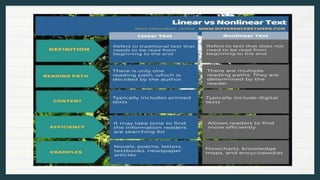
- refers to traditional text that needs to be
read from beginning to end in order to
make sense of its content. It follows a
sequential reading path where the reader
tries to make sense of the text through
grammatical arrangement and relationship
of words.
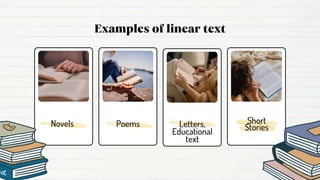
Poems Letters,
Educational
text
Novels Short
Stories
A non-linear text, on the other hand, is
non-sequential. This means that the
readers, not the author, decide how the
text is to be read without necessarily
following a prescribed pattern.
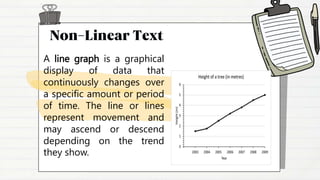
A line graph is a graphical
display of data that
continuously changes over
a specific amount or period
of time. The line or lines
represent movement and
may ascend or descend
depending on the trend
they show.
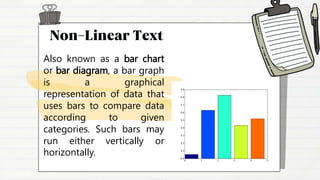
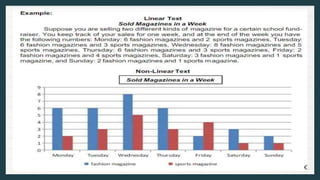
Also known as a bar chart
or bar diagram, a bar graph
is a graphical
representation of data that
uses bars to compare data
according to given
categories. Such bars may
run either vertically or
horizontally.
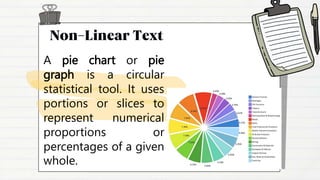
A pie chart or pie
graph is a circular
statistical tool. It uses
portions or slices to
represent numerical
proportions or
percentages of a given
whole.
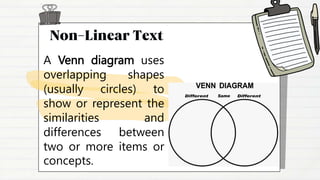
A Venn diagram uses
overlapping shapes
(usually circles) to
show or represent the
similarities and
differences between
two or more items or
concepts.
Transcoding Linear to Non-Linear
Texts and Vice Versa
To transcode means to transform something from one
form to another. In order to transcode a linear to a non-
linear text or the other way around, one must first be
able to fully understand what the source text is about.
This way, deciding on the proper text type to be used in
the transcoding process will be easier
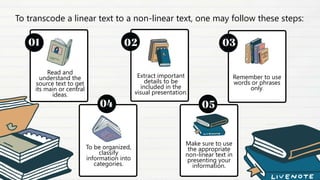
To transcode a linear text to a non-linear text, one may follow these steps:
Read and
understand the
source text to get
its main or central
ideas.
Extract important
details to be
included in the
visual presentation.
Remember to use
words or phrases
only.
To be organized,
classify
information into
categories.
Make sure to use
the appropriate
non-linear text in
presenting your
information.
Grade 7- Linear and Non-Linear Text.pptx

Grade 7- Linear and Non-Linear Text.pptx

  • 1.
  • 3.
    -the way thetext is read or processed by an individual. Experts call this pattern of reading a material as reading path.
  • 4.
    - refers totraditional text that needs to be read from beginning to end in order to make sense of its content. It follows a sequential reading path where the reader tries to make sense of the text through grammatical arrangement and relationship of words.
  • 5.
  • 6.
    A non-linear text,on the other hand, is non-sequential. This means that the readers, not the author, decide how the text is to be read without necessarily following a prescribed pattern.
  • 7.
    A line graphis a graphical display of data that continuously changes over a specific amount or period of time. The line or lines represent movement and may ascend or descend depending on the trend they show.
  • 8.
    Also known asa bar chart or bar diagram, a bar graph is a graphical representation of data that uses bars to compare data according to given categories. Such bars may run either vertically or horizontally.
  • 9.
    A pie chartor pie graph is a circular statistical tool. It uses portions or slices to represent numerical proportions or percentages of a given whole.
  • 10.
    A Venn diagramuses overlapping shapes (usually circles) to show or represent the similarities and differences between two or more items or concepts.
  • 11.
    Transcoding Linear toNon-Linear Texts and Vice Versa To transcode means to transform something from one form to another. In order to transcode a linear to a non- linear text or the other way around, one must first be able to fully understand what the source text is about. This way, deciding on the proper text type to be used in the transcoding process will be easier
  • 12.
    To transcode alinear text to a non-linear text, one may follow these steps: Read and understand the source text to get its main or central ideas. Extract important details to be included in the visual presentation. Remember to use words or phrases only. To be organized, classify information into categories. Make sure to use the appropriate non-linear text in presenting your information.