as thinking technology
Lawrence O. Rapanan
What is Graphic Organizers?
 A graphic organizer, also known as knowledge
map, concept map, story map, cognitive
organizer, advance organizer, or concept
diagram, is a communication tool that uses visual
symbols to express knowledge, concepts, thoughts,
or ideas, and the relationships between them.
Why Graphic Organizers?
What do effective educators
had to learn to enhance
students understanding and
retention of lessons taken in
class?
What are the uses of
Graphic Organizers?
 Help students sequence information
 Help students organize their thoughts in a logical
way
 Help students organize information visually
 Help students develop analysis skills to be able to
formulate plans, processes
 Help students evaluate criteria for decision making
 Help students analyze and prioritize information
 Help students determine cause-effect relationship
 Help students cluster and brainstorm ideas and
information
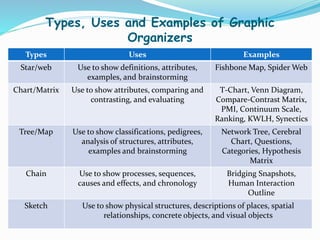
Types, Uses and Examples of Graphic
Organizers
Types Uses Examples
Star/web Use to show definitions, attributes,
examples, and brainstorming
Fishbone Map, Spider Web
Chart/Matrix Use to show attributes, comparing and
contrasting, and evaluating
T-Chart, Venn Diagram,
Compare-Contrast Matrix,
PMI, Continuum Scale,
Ranking, KWLH, Synectics
Tree/Map Use to show classifications, pedigrees,
analysis of structures, attributes,
examples and brainstorming
Network Tree, Cerebral
Chart, Questions,
Categories, Hypothesis
Matrix
Chain Use to show processes, sequences,
causes and effects, and chronology
Bridging Snapshots,
Human Interaction
Outline
Sketch Use to show physical structures, descriptions of places, spatial
relationships, concrete objects, and visual objects
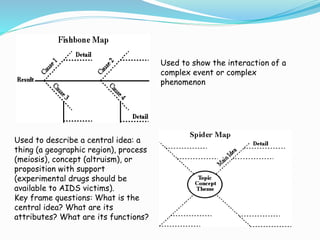
Used to show the interaction of a
complex event or complex
phenomenon
Used to describe a central idea: a
thing (a geographic region), process
(meiosis), concept (altruism), or
proposition with support
(experimental drugs should be
available to AIDS victims).
Key frame questions: What is the
central idea? What are its
attributes? What are its functions?
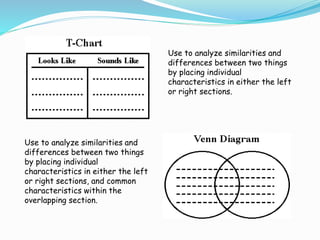
Use to analyze similarities and
differences between two things
by placing individual
characteristics in either the left
or right sections.
Use to analyze similarities and
differences between two things
by placing individual
characteristics in either the left
or right sections, and common
characteristics within the
overlapping section.
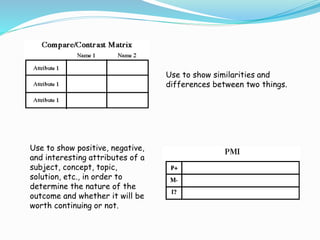
Use to show similarities and
differences between two things.
Use to show positive, negative,
and interesting attributes of a
subject, concept, topic,
solution, etc., in order to
determine the nature of the
outcome and whether it will be
worth continuing or not.
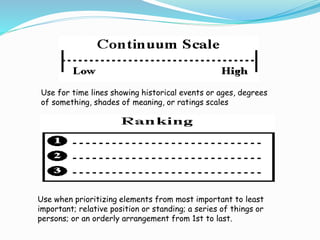
Use for time lines showing historical events or ages, degrees
of something, shades of meaning, or ratings scales
Use when prioritizing elements from most important to least
important; relative position or standing; a series of things or
persons; or an orderly arrangement from 1st to last.
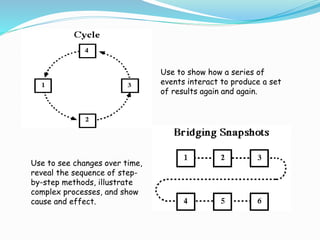
Use to show how a series of
events interact to produce a set
of results again and again.
Use to see changes over time,
reveal the sequence of step-
by-step methods, illustrate
complex processes, and show
cause and effect.
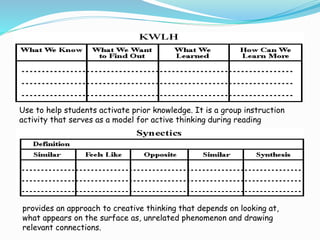
Use to help students activate prior knowledge. It is a group instruction
activity that serves as a model for active thinking during reading
provides an approach to creative thinking that depends on looking at,
what appears on the surface as, unrelated phenomenon and drawing
relevant connections.
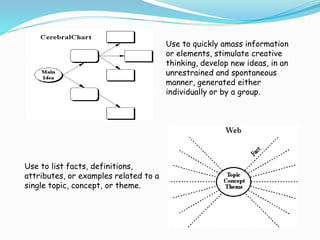
Use to quickly amass information
or elements, stimulate creative
thinking, develop new ideas, in an
unrestrained and spontaneous
manner, generated either
individually or by a group.
Use to list facts, definitions,
attributes, or examples related to a
single topic, concept, or theme.
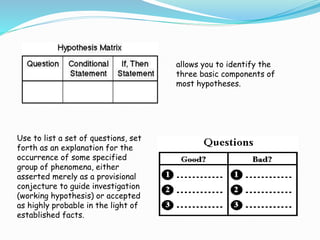
allows you to identify the
three basic components of
most hypotheses.
Use to list a set of questions, set
forth as an explanation for the
occurrence of some specified
group of phenomena, either
asserted merely as a provisional
conjecture to guide investigation
(working hypothesis) or accepted
as highly probable in the light of
established facts.
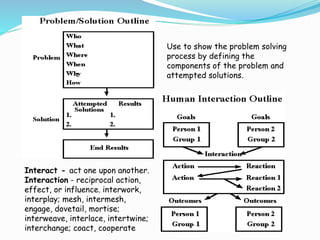
Use to show the problem solving
process by defining the
components of the problem and
attempted solutions.
Interact - act one upon another.
Interaction - reciprocal action,
effect, or influence. interwork,
interplay; mesh, intermesh,
engage, dovetail, mortise;
interweave, interlace, intertwine;
interchange; coact, cooperate
How to use Graphic
Organizers?
 Choose one type of organizer to introduce to the
class.
 Introduce the concept of a graphic organizer.
 Present the chosen graphic organizer.
 Model using graphic organizer to the class.
 Guide the class through another example using
the same type of graphic organizer.
 Assign an independent exercise that allows
students to complete a graphic organizer.
How to read Graphic
Organizers?
 Start in the center or at the top.
 Look for arrows.
 Determine the organizational structure.
 Consider relationship
And for the last
slide…
Thank You..
For listening 
-Lawrence Rapanan

Graphic Organizers

  • 1.
  • 2.
    What is GraphicOrganizers?  A graphic organizer, also known as knowledge map, concept map, story map, cognitive organizer, advance organizer, or concept diagram, is a communication tool that uses visual symbols to express knowledge, concepts, thoughts, or ideas, and the relationships between them.
  • 3.
    Why Graphic Organizers? Whatdo effective educators had to learn to enhance students understanding and retention of lessons taken in class?
  • 4.
    What are theuses of Graphic Organizers?  Help students sequence information  Help students organize their thoughts in a logical way  Help students organize information visually  Help students develop analysis skills to be able to formulate plans, processes  Help students evaluate criteria for decision making  Help students analyze and prioritize information  Help students determine cause-effect relationship  Help students cluster and brainstorm ideas and information
  • 5.
    Types, Uses andExamples of Graphic Organizers Types Uses Examples Star/web Use to show definitions, attributes, examples, and brainstorming Fishbone Map, Spider Web Chart/Matrix Use to show attributes, comparing and contrasting, and evaluating T-Chart, Venn Diagram, Compare-Contrast Matrix, PMI, Continuum Scale, Ranking, KWLH, Synectics Tree/Map Use to show classifications, pedigrees, analysis of structures, attributes, examples and brainstorming Network Tree, Cerebral Chart, Questions, Categories, Hypothesis Matrix Chain Use to show processes, sequences, causes and effects, and chronology Bridging Snapshots, Human Interaction Outline Sketch Use to show physical structures, descriptions of places, spatial relationships, concrete objects, and visual objects
  • 6.
    Used to showthe interaction of a complex event or complex phenomenon Used to describe a central idea: a thing (a geographic region), process (meiosis), concept (altruism), or proposition with support (experimental drugs should be available to AIDS victims). Key frame questions: What is the central idea? What are its attributes? What are its functions?
  • 7.
    Use to analyzesimilarities and differences between two things by placing individual characteristics in either the left or right sections. Use to analyze similarities and differences between two things by placing individual characteristics in either the left or right sections, and common characteristics within the overlapping section.
  • 8.
    Use to showsimilarities and differences between two things. Use to show positive, negative, and interesting attributes of a subject, concept, topic, solution, etc., in order to determine the nature of the outcome and whether it will be worth continuing or not.
  • 9.
    Use for timelines showing historical events or ages, degrees of something, shades of meaning, or ratings scales Use when prioritizing elements from most important to least important; relative position or standing; a series of things or persons; or an orderly arrangement from 1st to last.
  • 10.
    Use to showhow a series of events interact to produce a set of results again and again. Use to see changes over time, reveal the sequence of step- by-step methods, illustrate complex processes, and show cause and effect.
  • 11.
    Use to helpstudents activate prior knowledge. It is a group instruction activity that serves as a model for active thinking during reading provides an approach to creative thinking that depends on looking at, what appears on the surface as, unrelated phenomenon and drawing relevant connections.
  • 12.
    Use to quicklyamass information or elements, stimulate creative thinking, develop new ideas, in an unrestrained and spontaneous manner, generated either individually or by a group. Use to list facts, definitions, attributes, or examples related to a single topic, concept, or theme.
  • 13.
    allows you toidentify the three basic components of most hypotheses. Use to list a set of questions, set forth as an explanation for the occurrence of some specified group of phenomena, either asserted merely as a provisional conjecture to guide investigation (working hypothesis) or accepted as highly probable in the light of established facts.
  • 14.
    Use to showthe problem solving process by defining the components of the problem and attempted solutions. Interact - act one upon another. Interaction - reciprocal action, effect, or influence. interwork, interplay; mesh, intermesh, engage, dovetail, mortise; interweave, interlace, intertwine; interchange; coact, cooperate
  • 15.
    How to useGraphic Organizers?  Choose one type of organizer to introduce to the class.  Introduce the concept of a graphic organizer.  Present the chosen graphic organizer.  Model using graphic organizer to the class.  Guide the class through another example using the same type of graphic organizer.  Assign an independent exercise that allows students to complete a graphic organizer.
  • 16.
    How to readGraphic Organizers?  Start in the center or at the top.  Look for arrows.  Determine the organizational structure.  Consider relationship
  • 17.
    And for thelast slide…
  • 18.
    Thank You.. For listening -Lawrence Rapanan