Copyreading & Headline Writing
(CRHW)
Pagwawasto at Pag-uulo ng Balita
Lilifreda P. Almazan
Presenter
Look at sentences carefully. Improve each by
correcting its grammar, spelling and/or structure.
1. philippines is my country.
2. Reorien them with our values.
3. He is here to talked about journalism.
4. Nagkaisa ukol kami sa pagsugpo ng droga.
5. Lamang sila sa koreograpya.
6. Panig kami sa inyo
�It is much like the work of an English
teacher correcting compositions,
except that the copyreader uses
appropriate copyreading symbols
universally known by printers.
Source: Ceciliano-Jose Cruz
Definition
� 1. Straighten out ungrammatical
constructions.
� 2. Shorten sentences and tighten
paragraphs.
� 3. Check names, addresses, titles,
designations, identifications, figures and
others.
Duties of a Copyreader
� 4. Delete all opinion, speculations and
statements which are without attribution or
sources.
� 5. Cross out adjectives which may tend to
make the story sound overwritten.
� 6. Check slug lines and paging
sequences.
� 7. Write headlines.
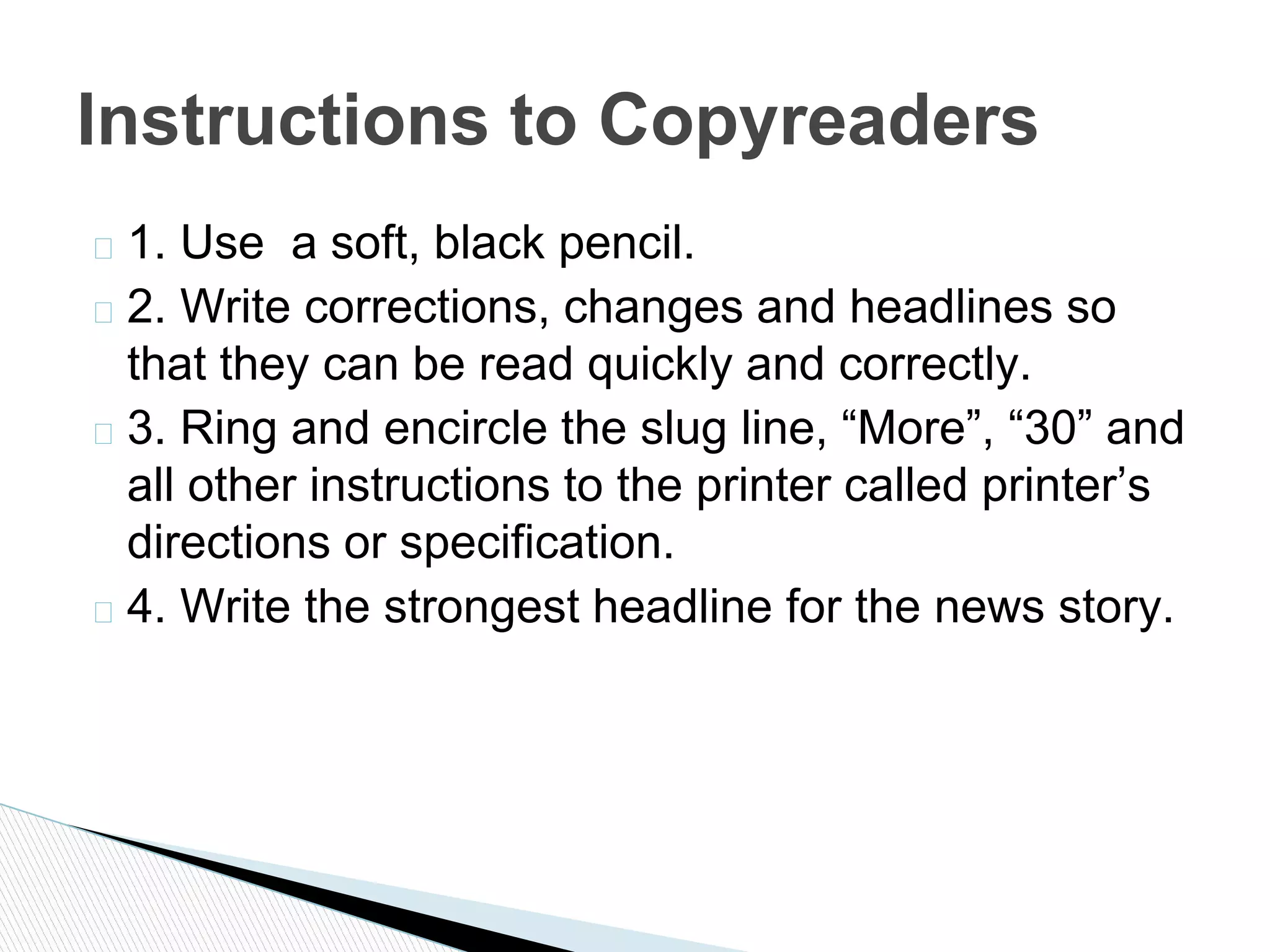
� 1. Use a soft, black pencil.
� 2. Write corrections, changes and headlines so
that they can be read quickly and correctly.
� 3. Ring and encircle the slug line, “More”, “30” and
all other instructions to the printer called printer’s
directions or specification.
� 4. Write the strongest headline for the news story.
Instructions to Copyreaders
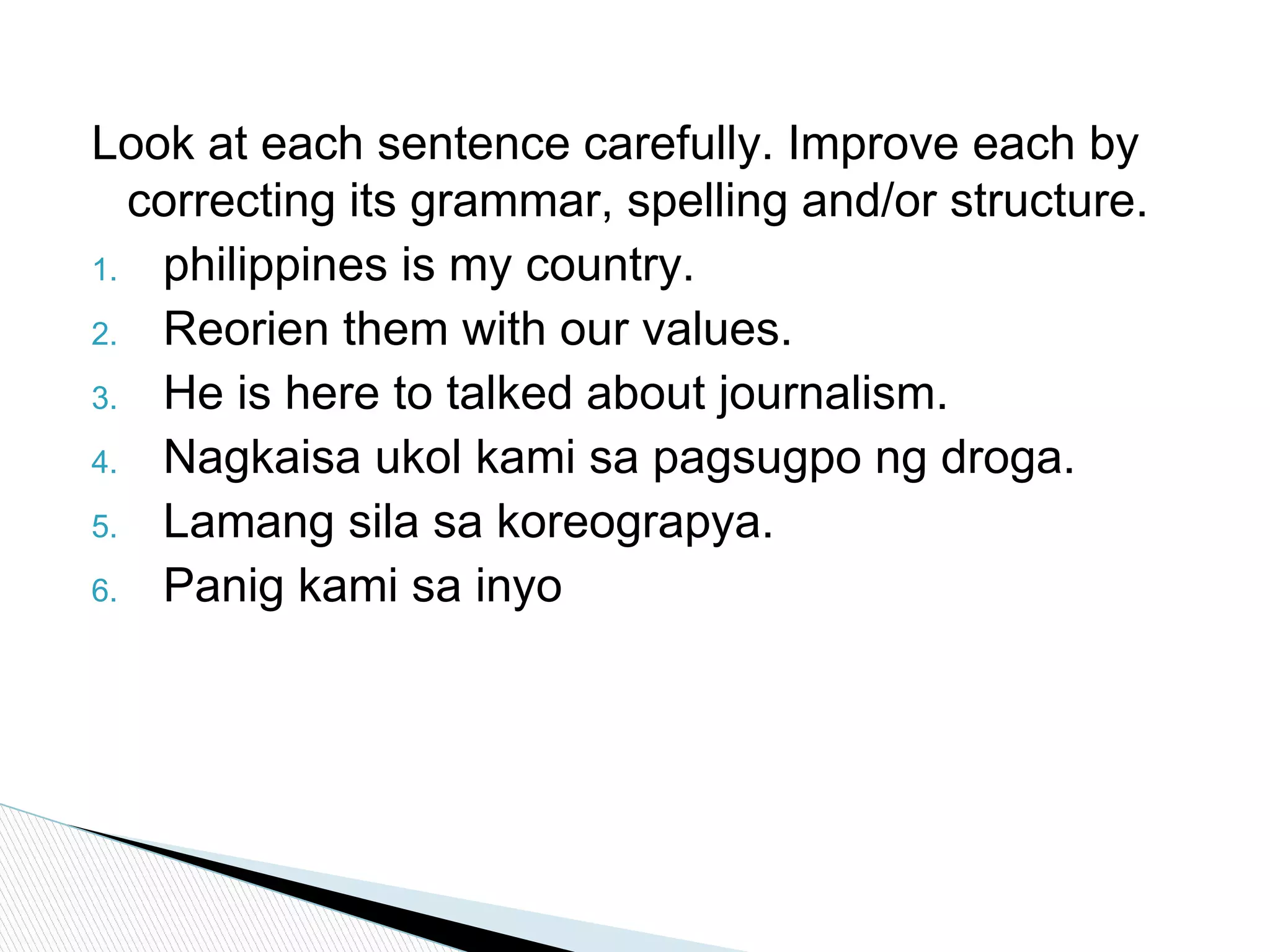
Look at each sentence carefully. Improve each by
correcting its grammar, spelling and/or structure.
1. philippines is my country.
2. Reorien them with our values.
3. He is here to talked about journalism.
4. Nagkaisa ukol kami sa pagsugpo ng droga.
5. Lamang sila sa koreograpya.
6. Panig kami sa inyo
Headline Writing
Headlines
▪ windows of the newspapers as they serve as
the quick source of information for busy
readers.
▪ summarizes complex story
▪ arranged in a limited space on the page
entails the creative skill of the copy editor.
Source: Gelly Elegio Alkuino
Headlines
▪ persuade the readers
▪ break up the page
▪ excite the readers
Good headlines do three (3) things:
1. Tell the reader what the story is all about.
2. Give this information in quick and easy form.
3. Entice the reader to follow the story and “read all
about it.”
Source: CRHW by Ana Marie Contreras-Calapit
Steps in Headline Writing
1. Read the whole story to understand its
message.
2. Underline the key words from the lead, which to
base the headline.
3. Using the key words from the lead, write a short
telegraphic sentence summary of the news.
4. Use the shortest word possible. Substitute
simple effective synonyms to fit the headline
within the allotted space.
5. Divide it according to unit of thoughts and into the
number required lines or decks.
6. Use colorful noun and vigorous and active verb.
7. Start with noun followed by a verb.
Guidelines in Headline writing
1. It should tell the gist of the story
immediately and accurately.
2. It should contain a verb, but do not start
the headline with it.
3. Be in the active voice.
4. Be in the present, the historical present
or the future tense.
5. Never repeat words.
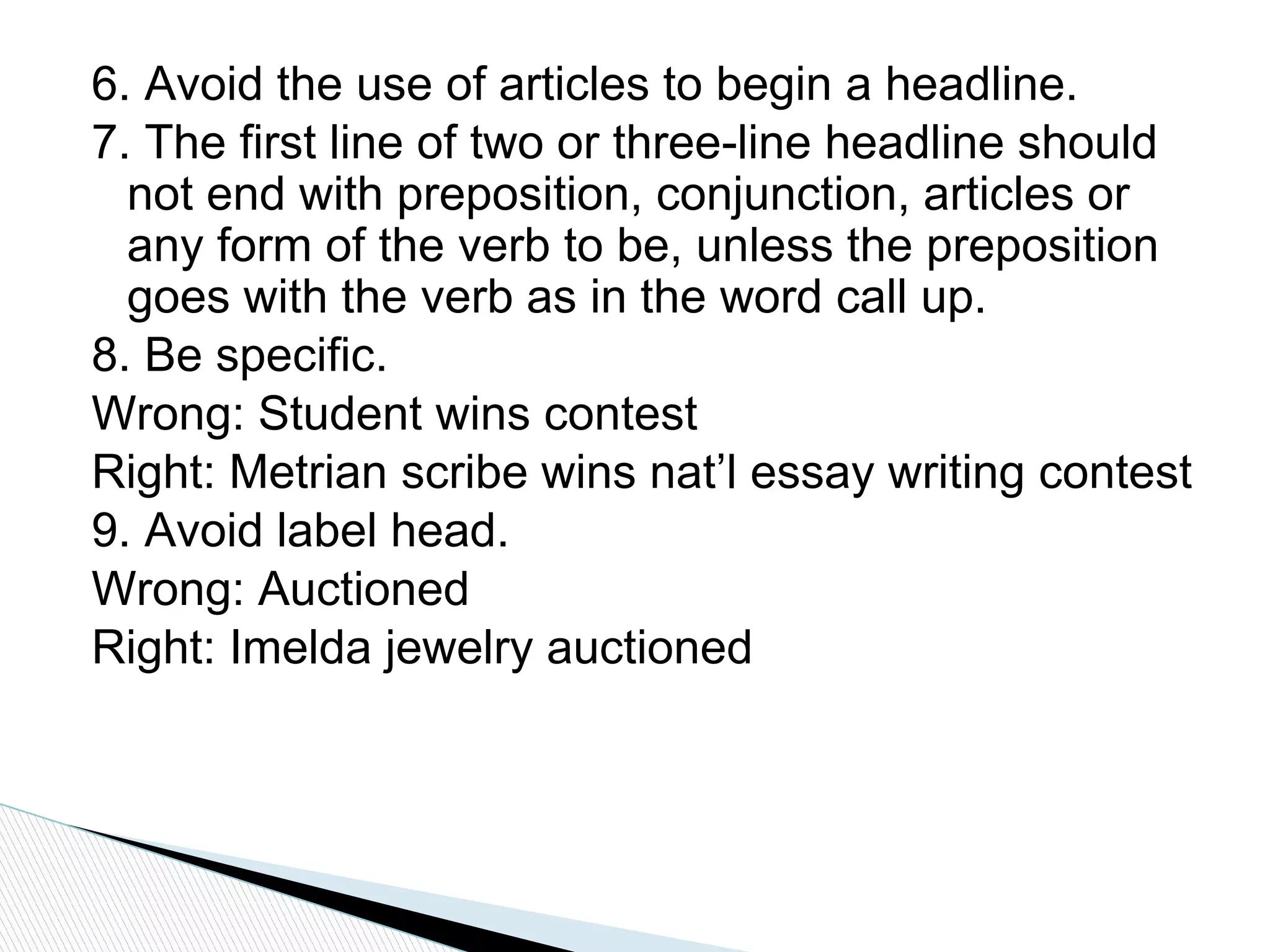
6. Avoid the use of articles to begin a headline.
7. The first line of two or three-line headline should
not end with preposition, conjunction, articles or
any form of the verb to be, unless the preposition
goes with the verb as in the word call up.
8. Be specific.
Wrong: Student wins contest
Right: Metrian scribe wins nat’l essay writing contest
9. Avoid label head.
Wrong: Auctioned
Right: Imelda jewelry auctioned
10. Do not editorialize your headline.
Wrong: Metrian show great performance in DSPC
Right: Metrian wins 6 out of 7
in DSPC writing contest
11. Do not use the same word twice in the headline or
kicker.
Ex.: Gun haul
GenSan cops seize 24 guns
from suspected bandits
12. Not be in the negative.
Wrong: Metrian festival won’t be held
Right: Metrian festival cancelled
13. Use the infinitive for future events.
14. Avoid splitting compound words.
15. Do not end the headline with a period.
Use the present tense
Bohol food crisis feared
vs
Bohol dads fear food crisis
Clark Airport Dev’t Fund sought
vs
Solons bat for airport fund
Misuari trial transferred to Taguig
vs
SC moves Misuari trial to Taguig
ASEAN, US held
Special meeting
vs
ASEAN, US hold
Special meeting
Three drug pushers arrested
vs
Drug sting nets 3
Use active voice
1 dead, 7 hurt in Zambo blast
vs
Zambo blast kills 1, hurts 7
Grocery robbed by children
vs
Children rob grocer
Future tense – use infinitive ‘to’
Surigao to boost seaweed industry
DOJ panel to pursue raps vs Misuari et al.
Is, are, the & a
The mayor’s wife is hurt in a car crash
Mayor’s wife hurt in car crash
The cop in lawyer’s slay surrenders
Cop in lawyer’s slay surrenders
The forensic experts arrive in Manila
Forensic experts arrive Manila
1. Ang bata nahuli sa shabu
Bata, huli sa shabu
2. Senado at Kamara, nagbalik-sesyon
Senado, Kamara balik-sesyon
3. DAP gagawin nang legal
DAP gagawing legal
4. Si Napoles ay nasa Bicutan na
Napoles, nasa Bicutan na
Ang, Si, Ng, At, Nang
� Ika-100 milyong Pinoy isinilang
� Nawawalang P90-B savings hinahanap
kay Abad
� 38K pirma pabor sa FOI bill isiunumite
sa Palasyo
Subject – active verb - object
Formula
HEADLINE VOCABULARY
•Due
•Allay
•Nix
•Row
•To bat
•Slate
•Urge
•Foil
Prod
OK
Eye
Nod
Probe
Clinches
Cited
Press
� SIMPLICITY IS THE KEY
� •Witnessed –saw
� •Depart –go
� •Consultations –talks
� •Commence –start
� •Purchase –buy
� •Line-up –slate
� •Recommend –urge
� •Appropriate –due
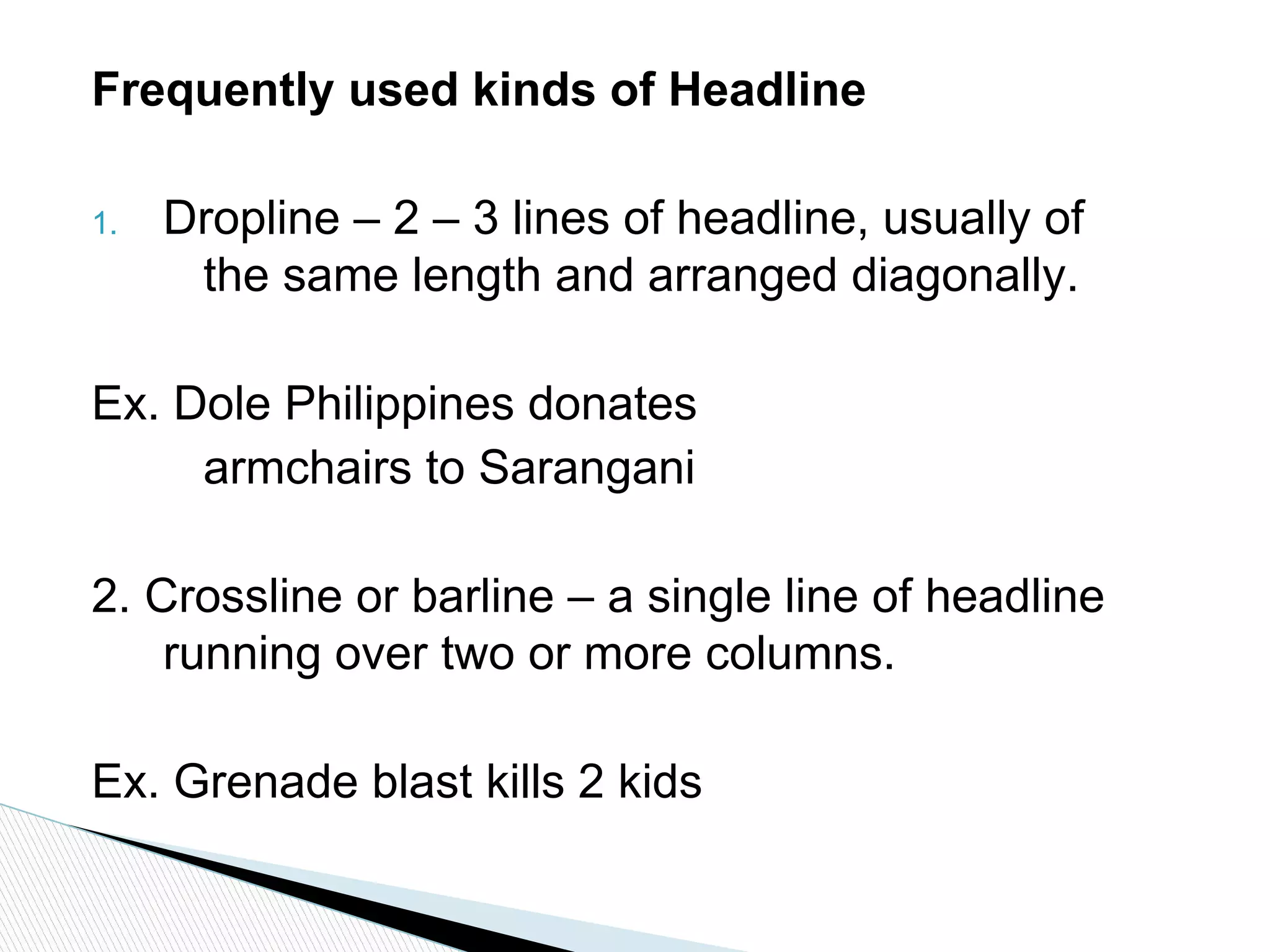
Frequently used kinds of Headline
1. Dropline – 2 – 3 lines of headline, usually of
the same length and arranged diagonally.
Ex. Dole Philippines donates
armchairs to Sarangani
2. Crossline or barline – a single line of headline
running over two or more columns.
Ex. Grenade blast kills 2 kids
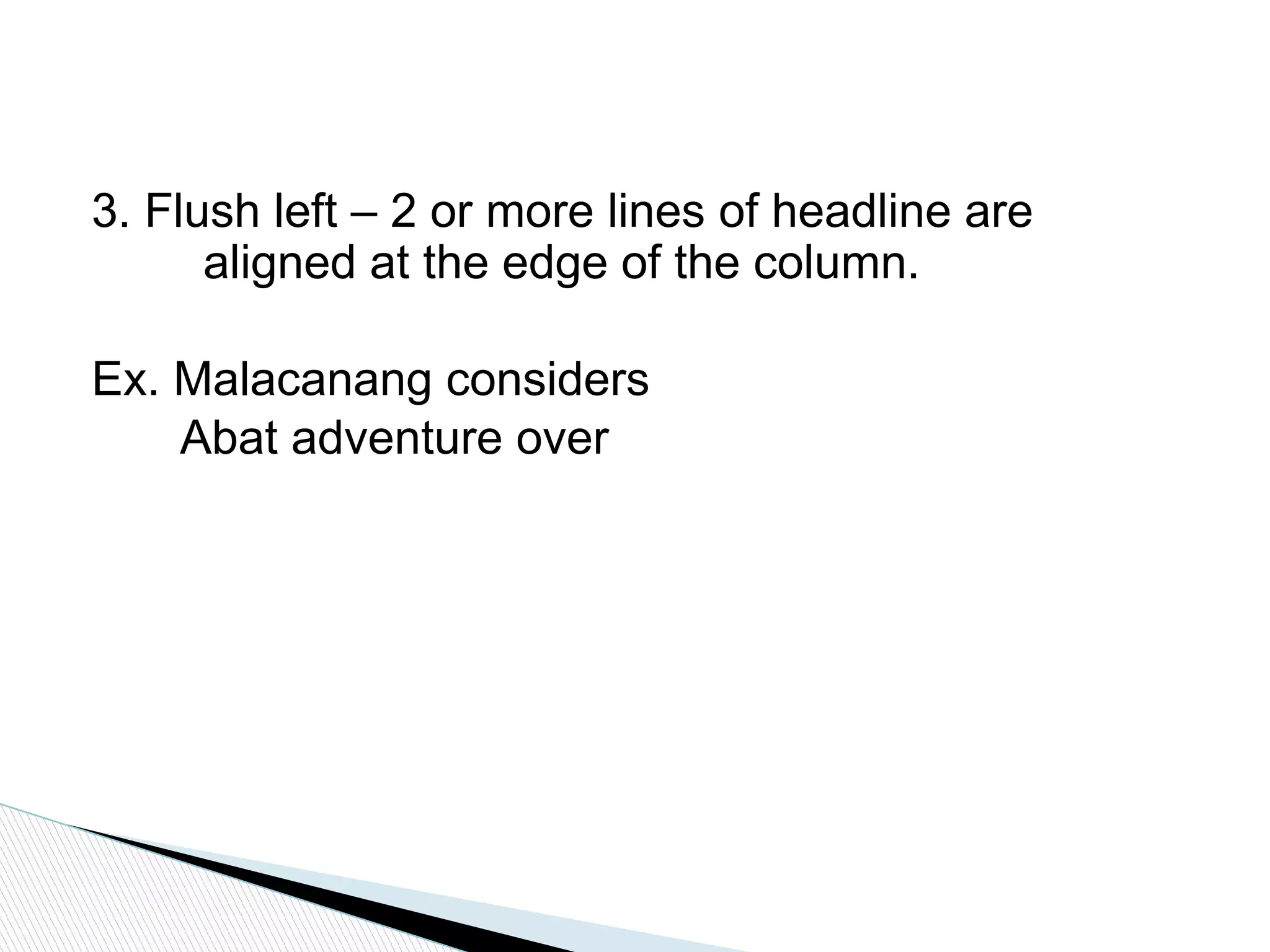
3. Flush left – 2 or more lines of headline are
aligned at the edge of the column.
Ex. Malacanang considers
Abat adventure over
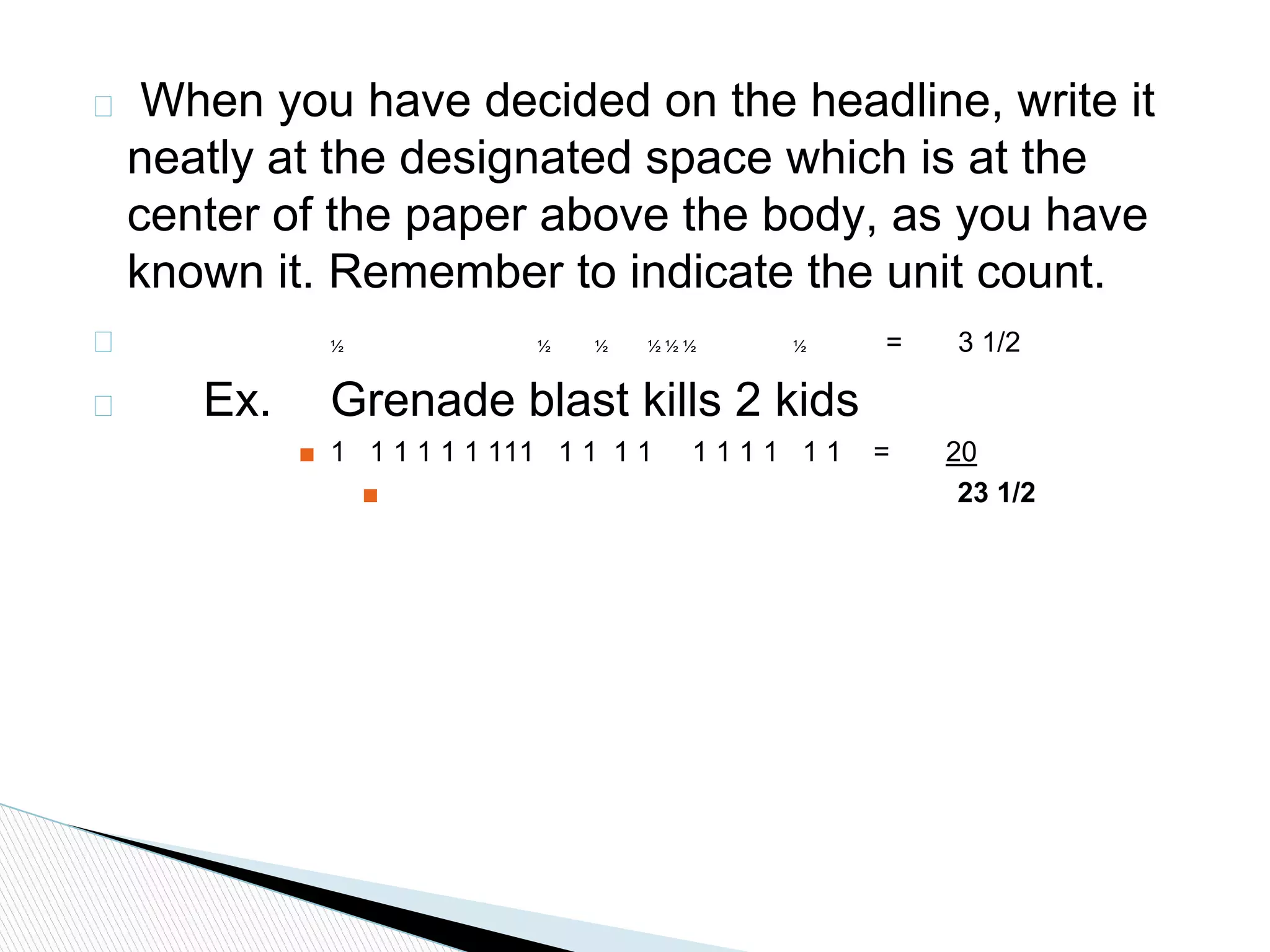
� When you have decided on the headline, write it
neatly at the designated space which is at the
center of the paper above the body, as you have
known it. Remember to indicate the unit count.
� ½ ½ ½ ½ ½ ½ ½ = 3 1/2
� Ex. Grenade blast kills 2 kids
■ 1 1 1 1 1 1 111 1 1 1 1 1 1 1 1 1 1 = 20
■ 23 1/2
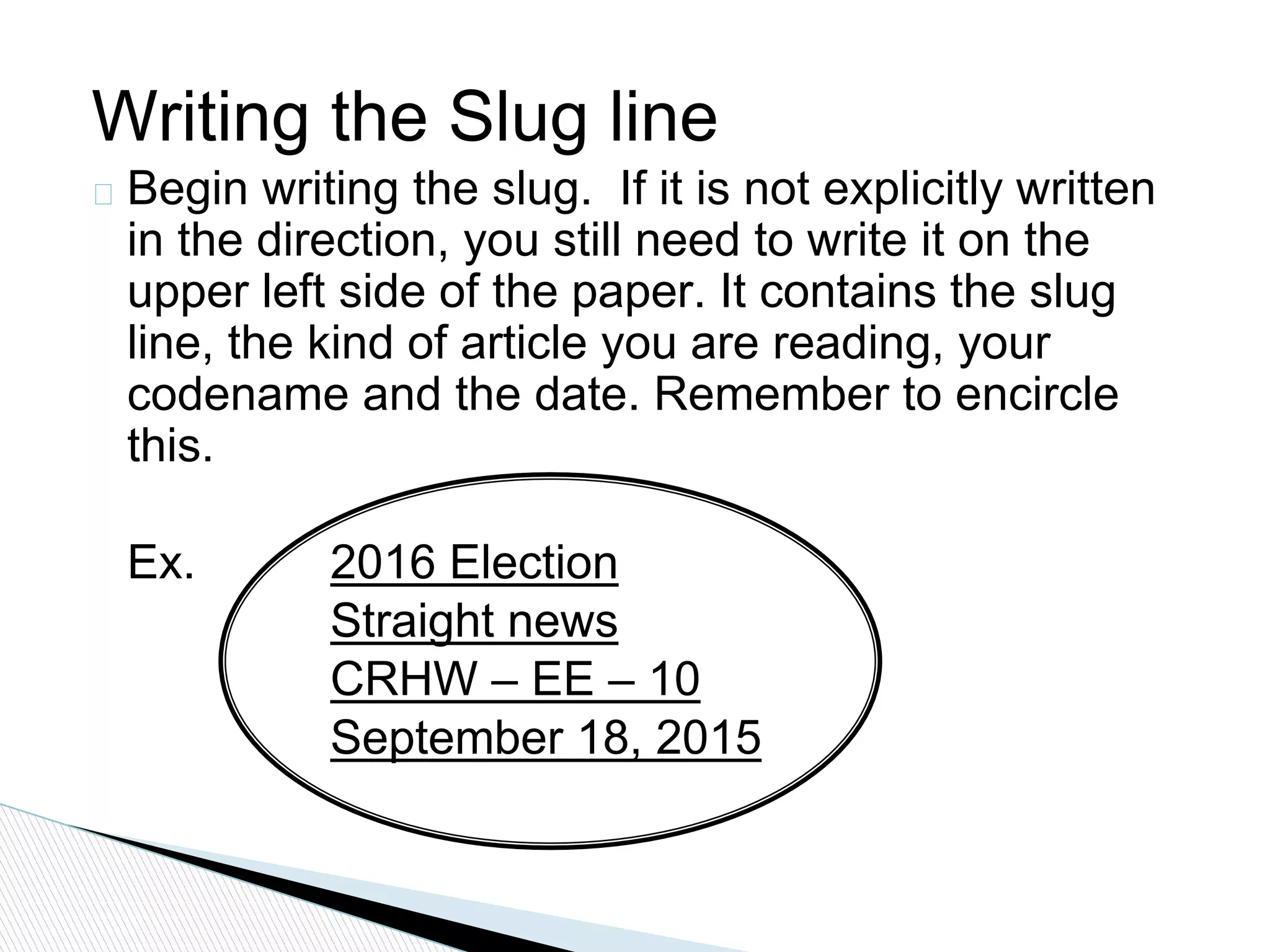
Writing the Slug line
� Begin writing the slug. If it is not explicitly written
in the direction, you still need to write it on the
upper left side of the paper. It contains the slug
line, the kind of article you are reading, your
codename and the date. Remember to encircle
this.
Ex. 2016 Election
Straight news
CRHW – EE – 10
September 18, 2015
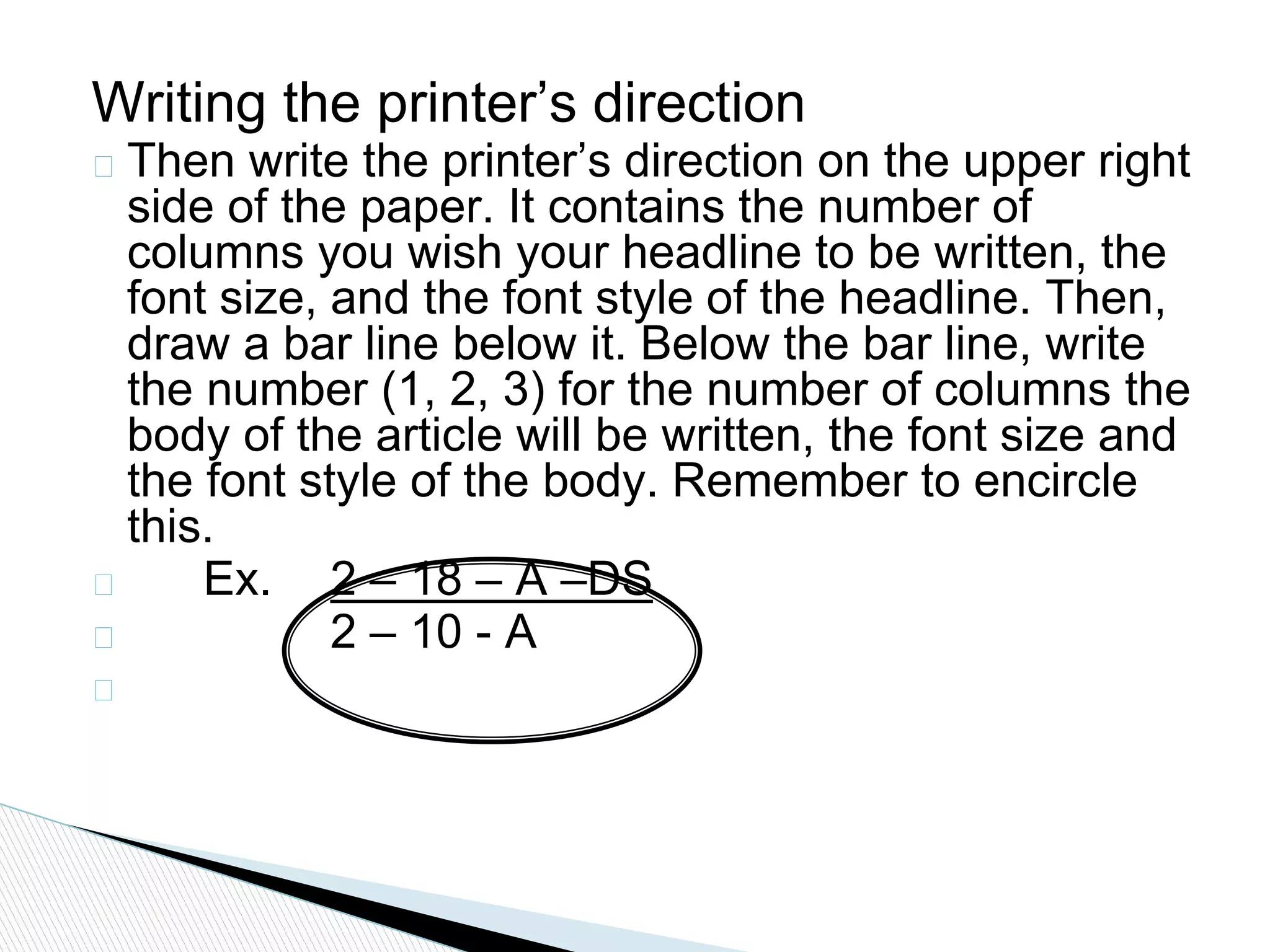
Writing the printer’s direction
� Then write the printer’s direction on the upper right
side of the paper. It contains the number of
columns you wish your headline to be written, the
font size, and the font style of the headline. Then,
draw a bar line below it. Below the bar line, write
the number (1, 2, 3) for the number of columns the
body of the article will be written, the font size and
the font style of the body. Remember to encircle
this.
� Ex. 2 – 18 – A –DS
� 2 – 10 - A
�
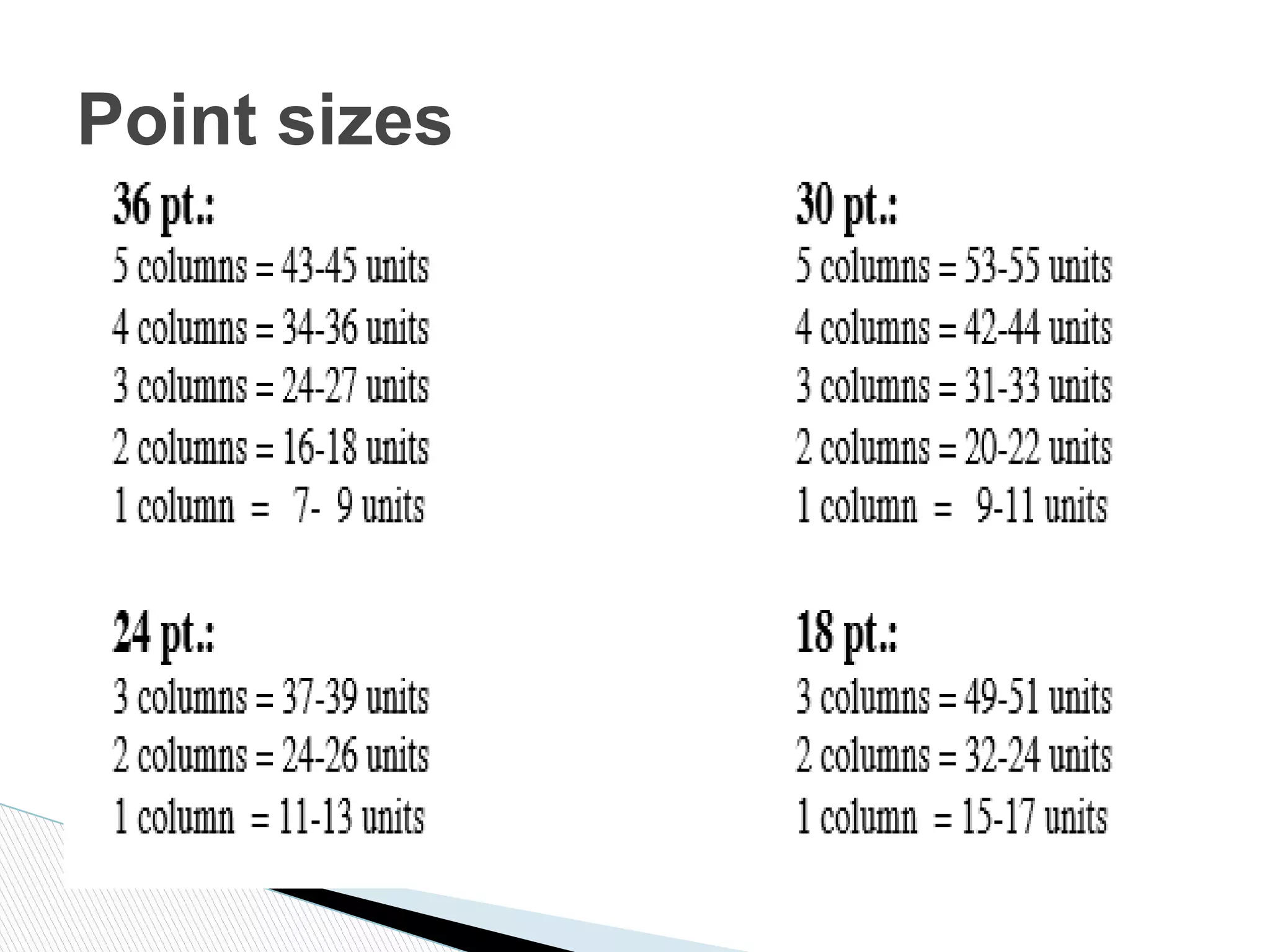
Point sizes
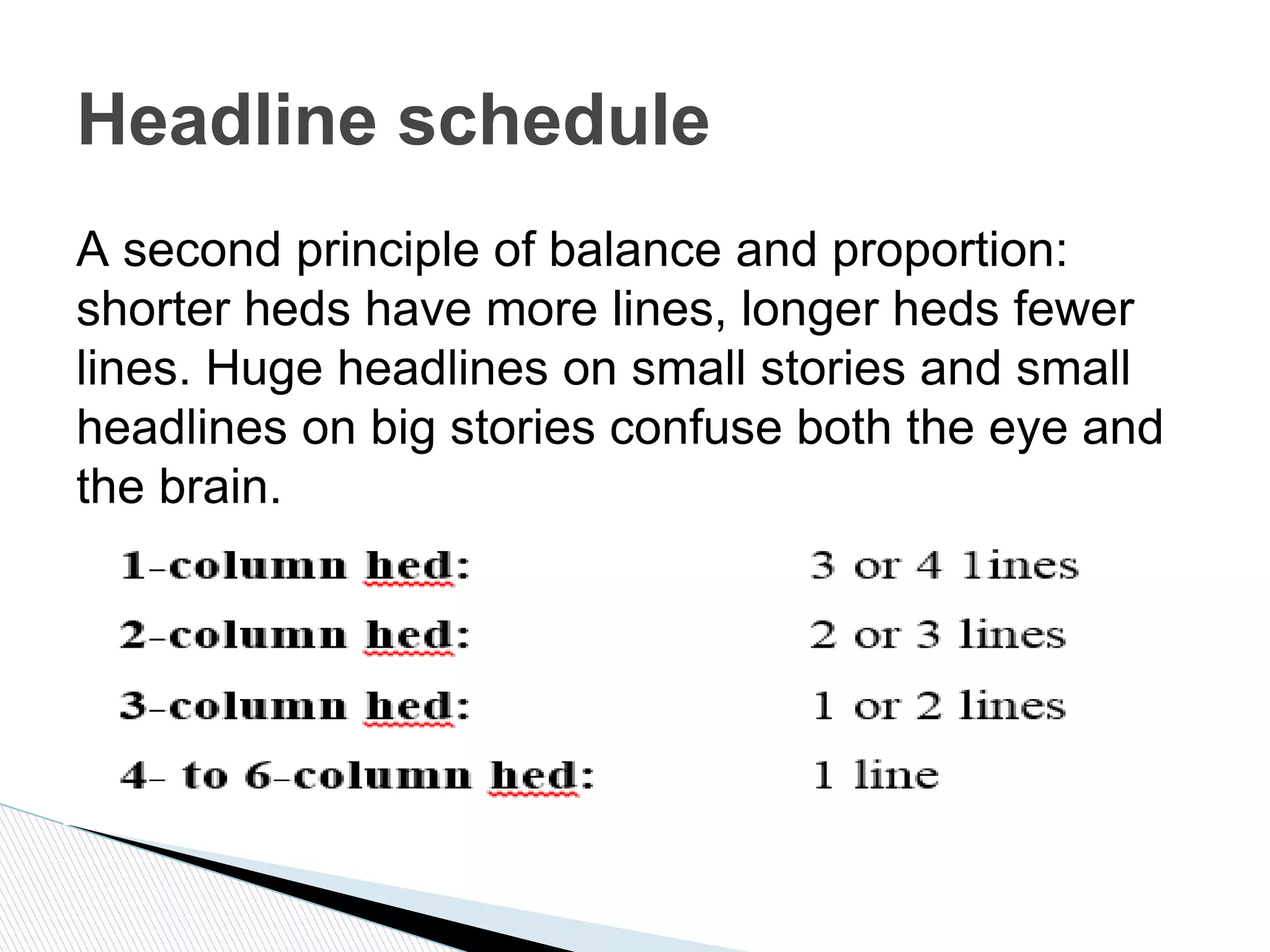
Headline schedule
Headline schedule
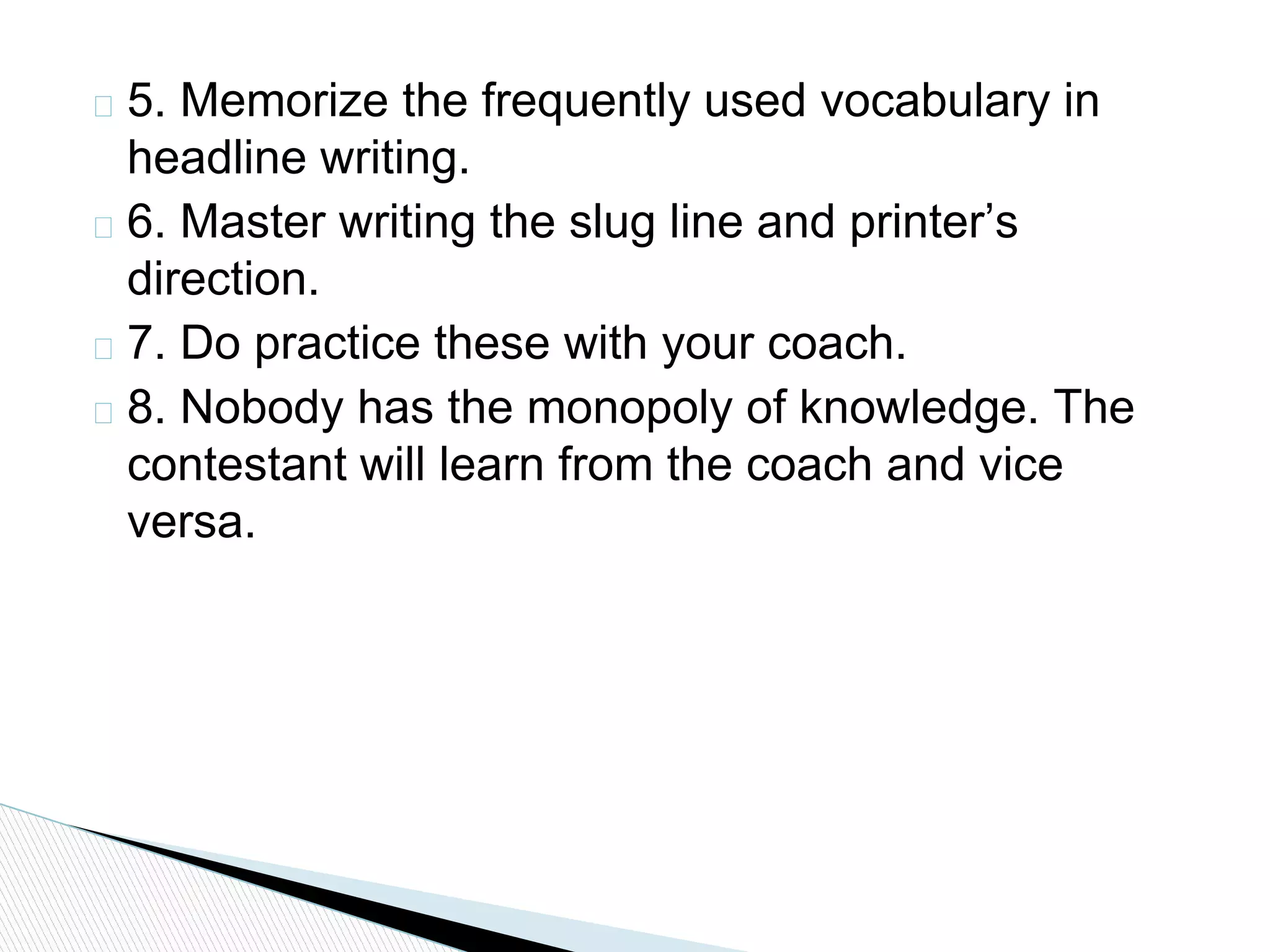
A second principle of balance and proportion:
shorter heds have more lines, longer heds fewer
lines. Huge headlines on small stories and small
headlines on big stories confuse both the eye and
the brain.
� TIPS FOR CONTESTANTS AND COACHES
in Copyreading and Headline Writing (CRHW)
and Pagwawasto at Pag-uulo ng Balita
� BEFORE THE ACTUAL CONTEST
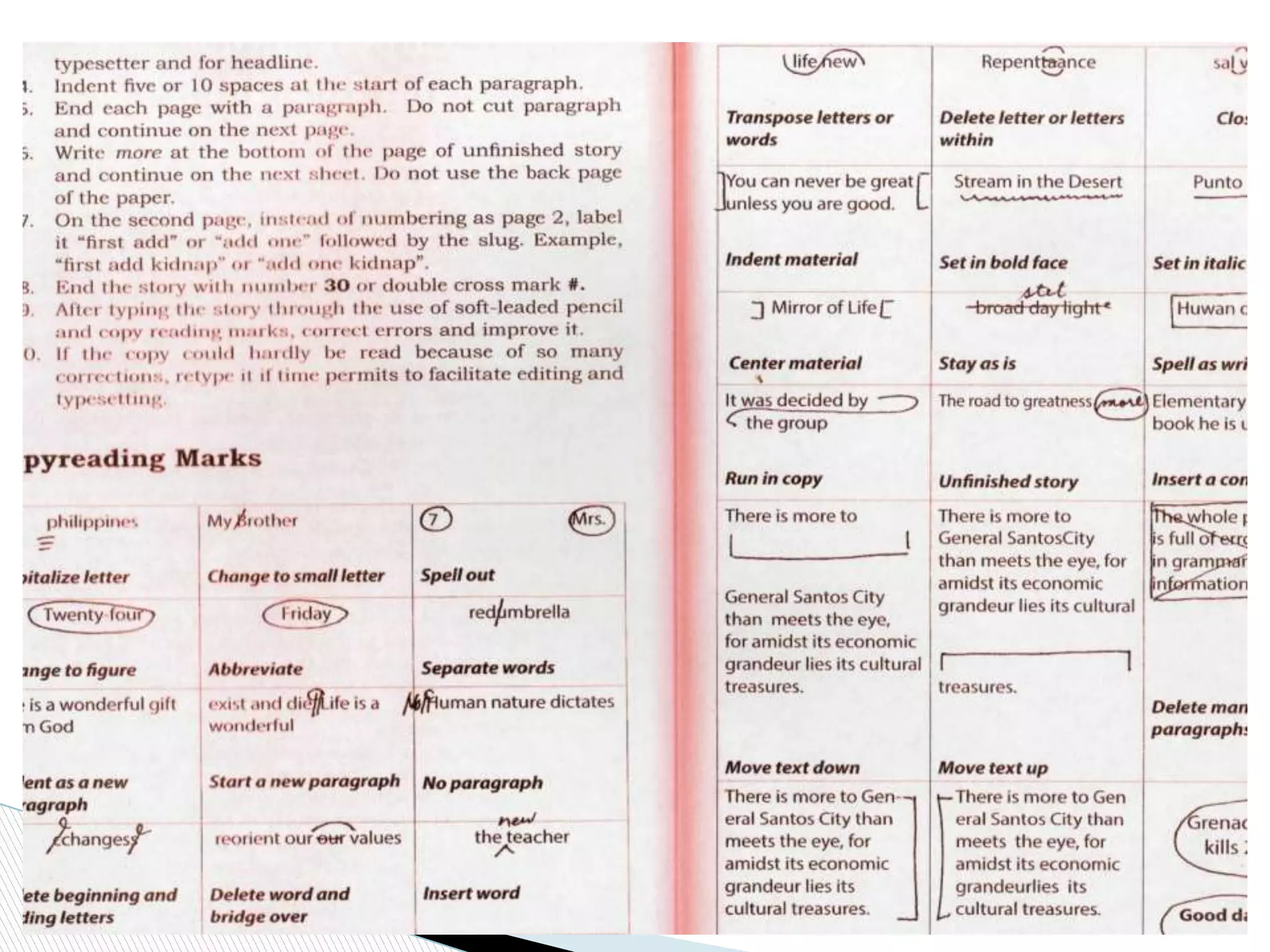
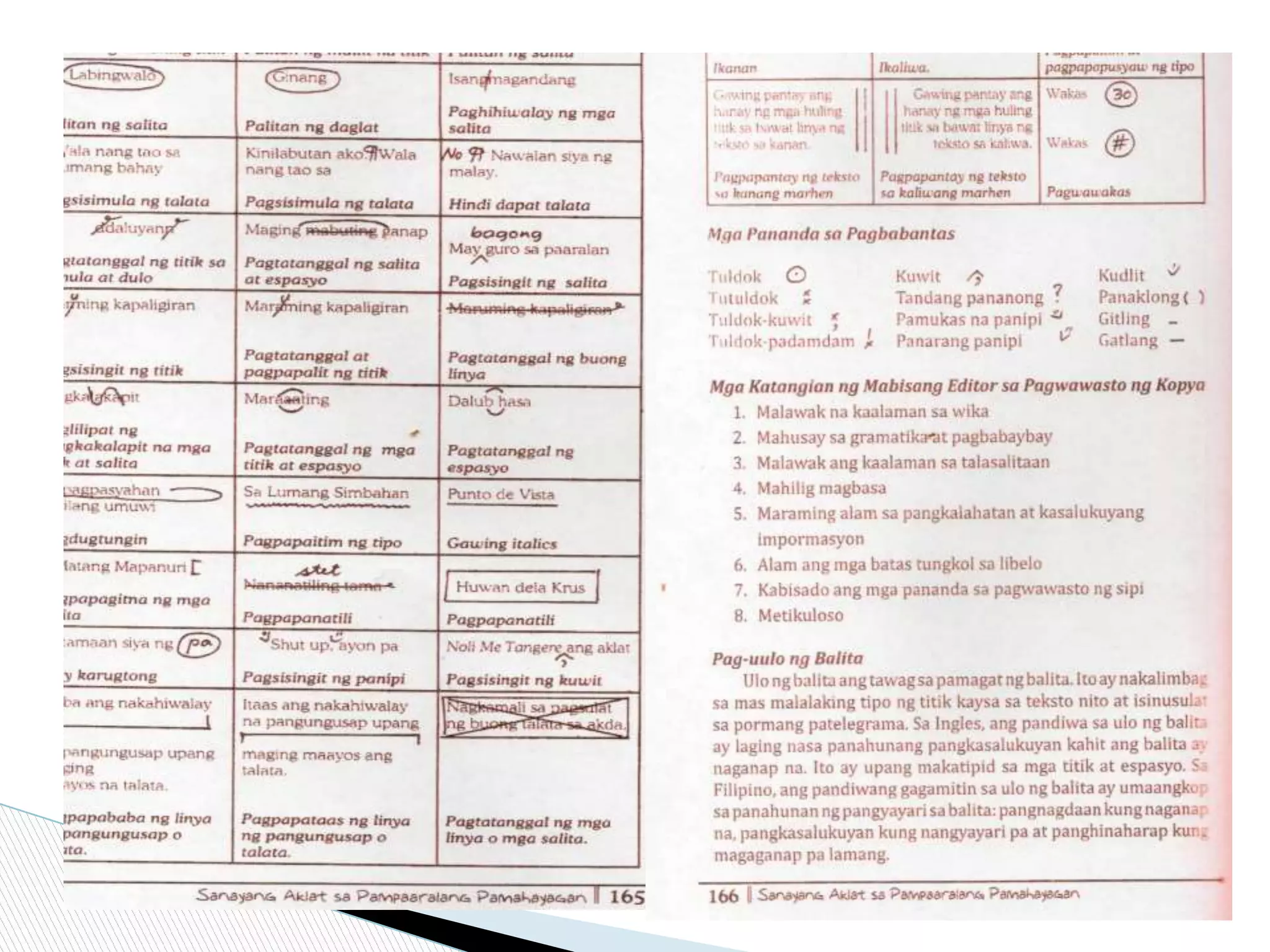
� 1. Master the copy reading symbols.
� 2. Collect newspapers. Then read the news articles and
copy all the headlines you come across.
� 3. Practice unit counting with the headlines you have listed.
� 4. Read the news articles and connect it to its headline.
These will give you clues on why the headline is written as
such.
� 5. Memorize the frequently used vocabulary in
headline writing.
� 6. Master writing the slug line and printer’s
direction.
� 7. Do practice these with your coach.
� 8. Nobody has the monopoly of knowledge. The
contestant will learn from the coach and vice
versa.
� DURING THE ACTUAL CONTEST
� 1. Be prepared with all necessary things – pencils with
erasers, ruler, and food, when needed.
� 2. Listen to the last-minute instructions of the resource
speaker. Almost always, the resource speaker is the
judge. Therefore, it is imperative to follow what he so
desires.
� 3. Listen to the instructions of the proctor/examiner.
He may be of great help.
� 4. Read the instructions and the article/write-up for
copy reading slowly. Do not expect that you will
understand the whole story the first time you read it.
� 5. Read again the article/write-up. This time, you need
to understand what you are reading.
� 6. Read again the article/write-up and begin copy
reading. Read again and again, scrutinizing each
word, each sentence and each paragraph of the
article.
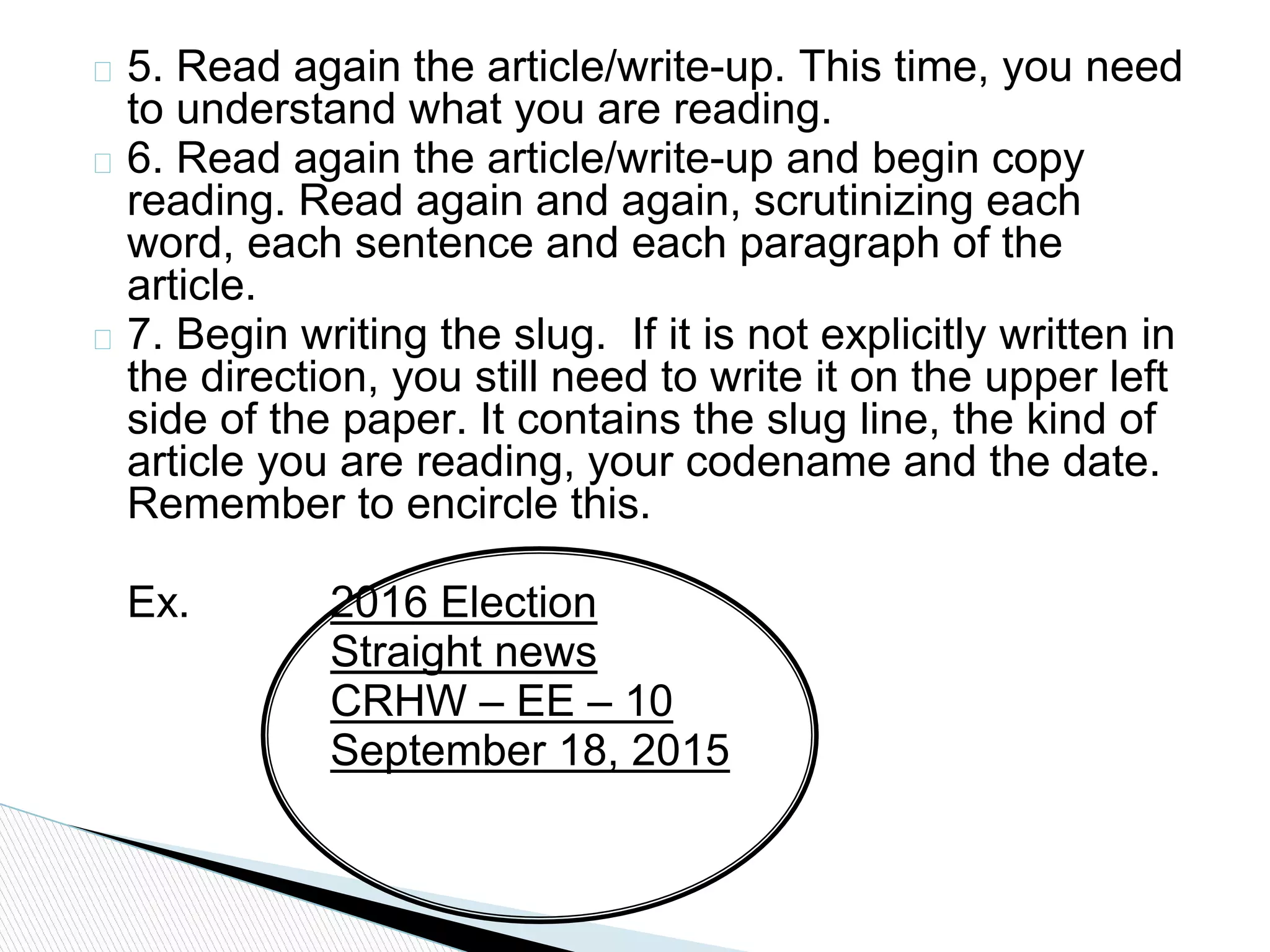
� 7. Begin writing the slug. If it is not explicitly written in
the direction, you still need to write it on the upper left
side of the paper. It contains the slug line, the kind of
article you are reading, your codename and the date.
Remember to encircle this.
Ex. 2016 Election
Straight news
CRHW – EE – 10
September 18, 2015
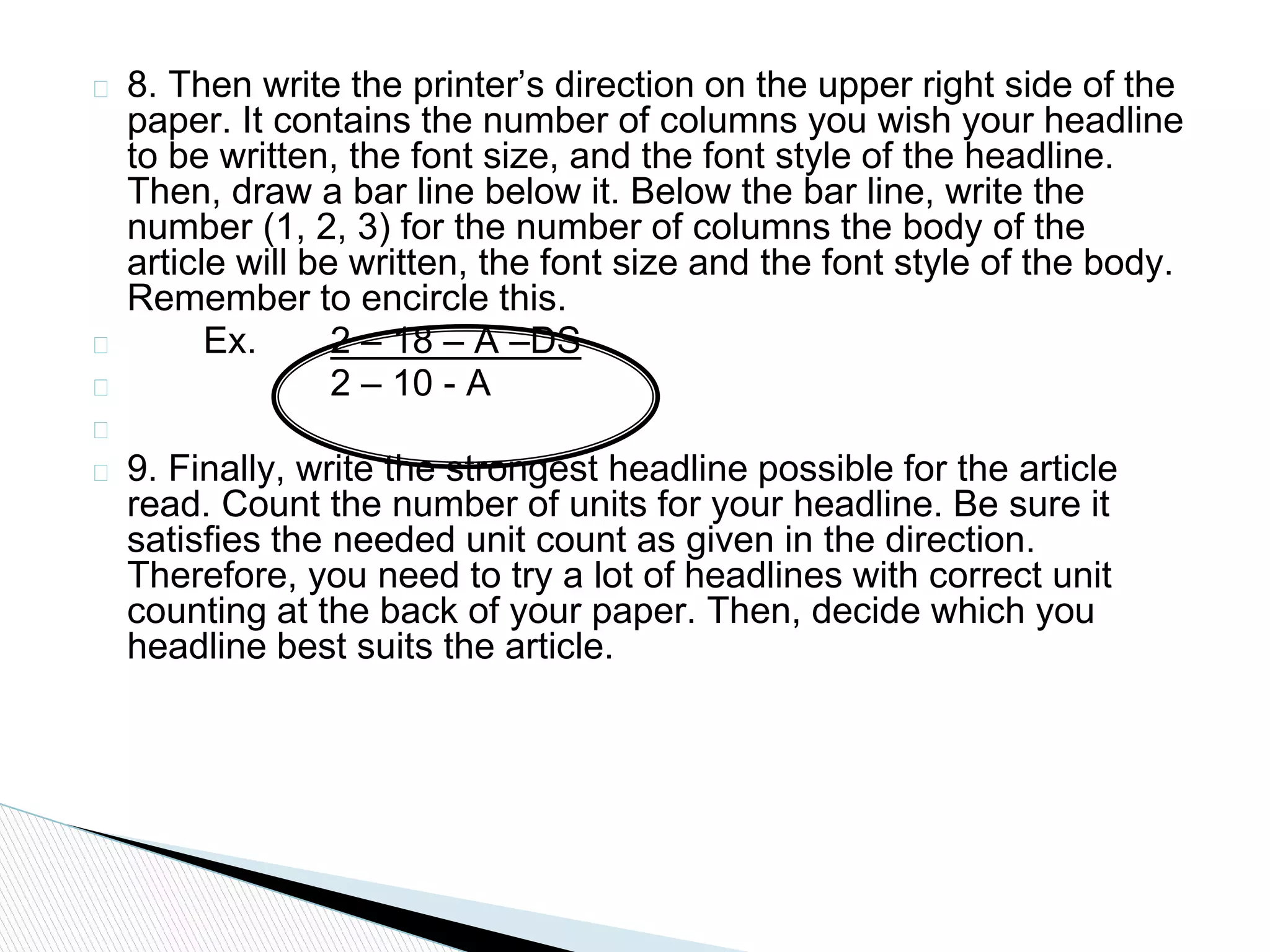
� 8. Then write the printer’s direction on the upper right side of the
paper. It contains the number of columns you wish your headline
to be written, the font size, and the font style of the headline.
Then, draw a bar line below it. Below the bar line, write the
number (1, 2, 3) for the number of columns the body of the
article will be written, the font size and the font style of the body.
Remember to encircle this.
� Ex. 2 – 18 – A –DS
� 2 – 10 - A
�
� 9. Finally, write the strongest headline possible for the article
read. Count the number of units for your headline. Be sure it
satisfies the needed unit count as given in the direction.
Therefore, you need to try a lot of headlines with correct unit
counting at the back of your paper. Then, decide which you
headline best suits the article.
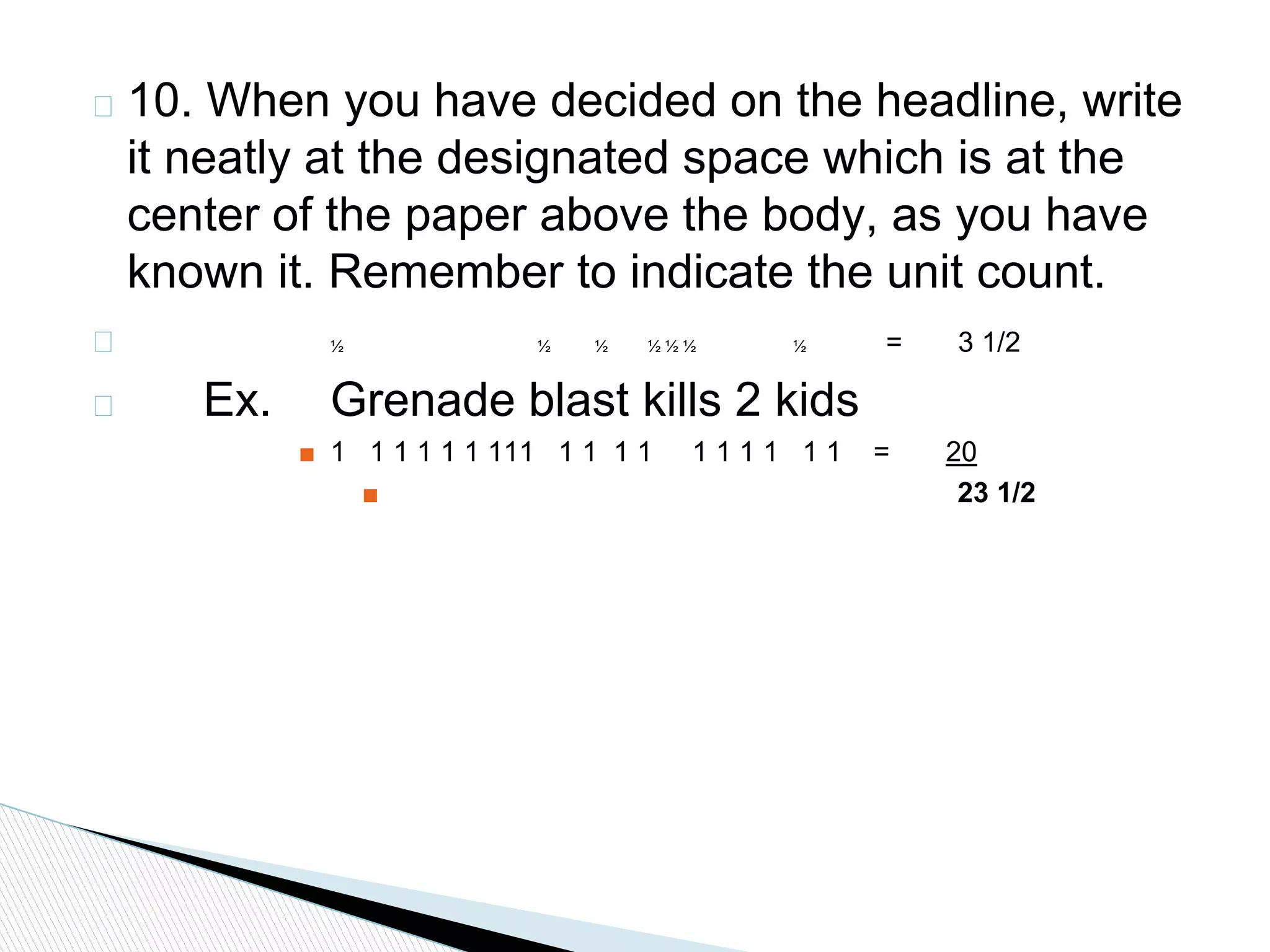
� 10. When you have decided on the headline, write
it neatly at the designated space which is at the
center of the paper above the body, as you have
known it. Remember to indicate the unit count.
� ½ ½ ½ ½ ½ ½ ½ = 3 1/2
� Ex. Grenade blast kills 2 kids
■ 1 1 1 1 1 1 111 1 1 1 1 1 1 1 1 1 1 = 20
■ 23 1/2
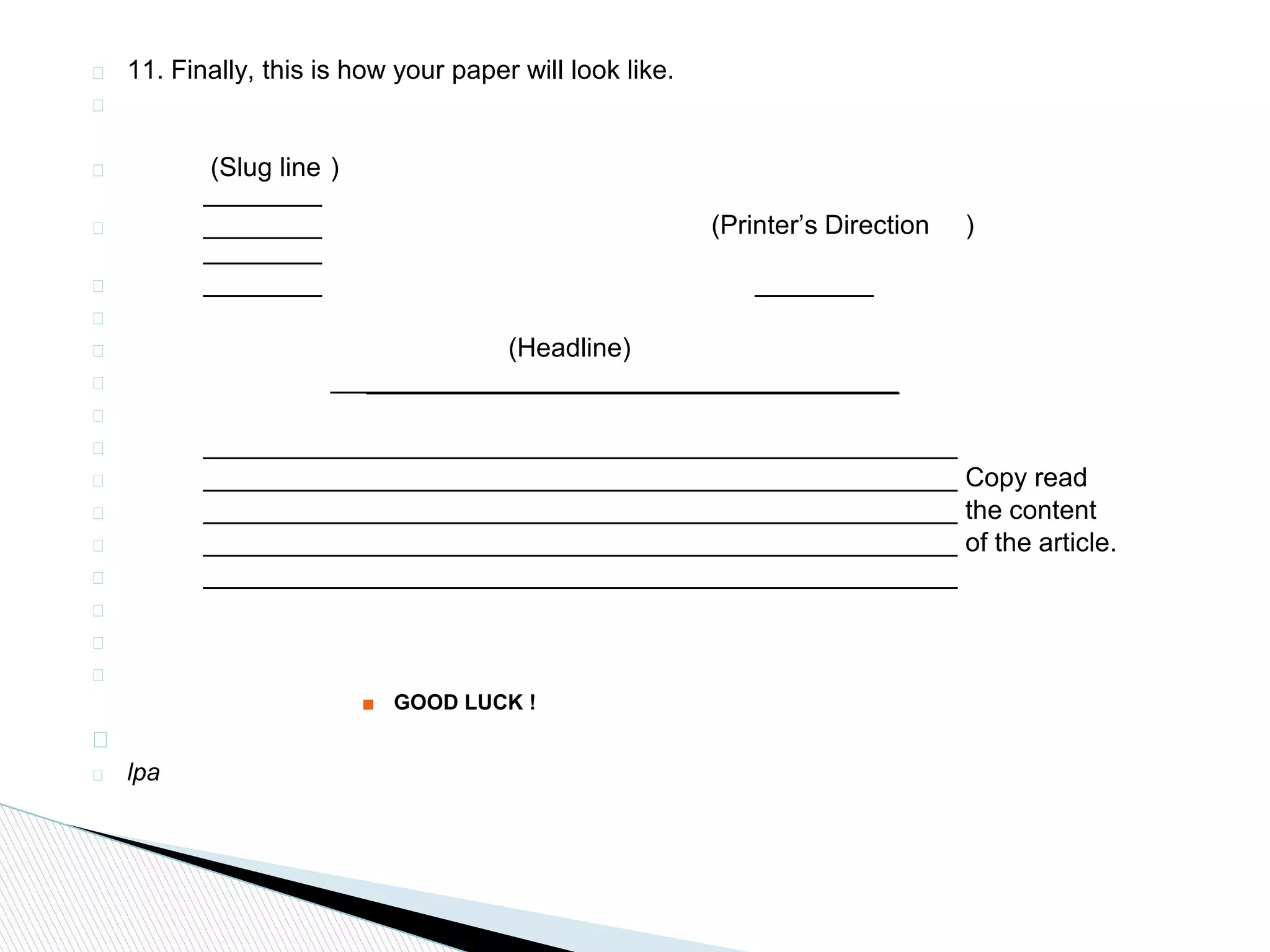
� 11. Finally, this is how your paper will look like.
�
� (Slug line )
________
� ________ (Printer’s Direction )
________
� ________ ________
�
� (Headline)
� ____________________________________
�
� ___________________________________________________
� ___________________________________________________ Copy read
� ___________________________________________________ the content
� ___________________________________________________ of the article.
� ___________________________________________________
�
�
�
■ GOOD LUCK !
�
� lpa

Copyreading & Headline Writing by LPA.pptx

  • 1.
    Copyreading & HeadlineWriting (CRHW) Pagwawasto at Pag-uulo ng Balita Lilifreda P. Almazan Presenter
  • 2.
    Look at sentencescarefully. Improve each by correcting its grammar, spelling and/or structure. 1. philippines is my country. 2. Reorien them with our values. 3. He is here to talked about journalism. 4. Nagkaisa ukol kami sa pagsugpo ng droga. 5. Lamang sila sa koreograpya. 6. Panig kami sa inyo
  • 3.
    �It is muchlike the work of an English teacher correcting compositions, except that the copyreader uses appropriate copyreading symbols universally known by printers. Source: Ceciliano-Jose Cruz Definition
  • 4.
    � 1. Straightenout ungrammatical constructions. � 2. Shorten sentences and tighten paragraphs. � 3. Check names, addresses, titles, designations, identifications, figures and others. Duties of a Copyreader
  • 5.
    � 4. Deleteall opinion, speculations and statements which are without attribution or sources. � 5. Cross out adjectives which may tend to make the story sound overwritten. � 6. Check slug lines and paging sequences. � 7. Write headlines.
  • 6.
    � 1. Usea soft, black pencil. � 2. Write corrections, changes and headlines so that they can be read quickly and correctly. � 3. Ring and encircle the slug line, “More”, “30” and all other instructions to the printer called printer’s directions or specification. � 4. Write the strongest headline for the news story. Instructions to Copyreaders
  • 10.
    Look at eachsentence carefully. Improve each by correcting its grammar, spelling and/or structure. 1. philippines is my country. 2. Reorien them with our values. 3. He is here to talked about journalism. 4. Nagkaisa ukol kami sa pagsugpo ng droga. 5. Lamang sila sa koreograpya. 6. Panig kami sa inyo
  • 11.
    Headline Writing Headlines ▪ windowsof the newspapers as they serve as the quick source of information for busy readers. ▪ summarizes complex story ▪ arranged in a limited space on the page entails the creative skill of the copy editor. Source: Gelly Elegio Alkuino
  • 12.
    Headlines ▪ persuade thereaders ▪ break up the page ▪ excite the readers Good headlines do three (3) things: 1. Tell the reader what the story is all about. 2. Give this information in quick and easy form. 3. Entice the reader to follow the story and “read all about it.” Source: CRHW by Ana Marie Contreras-Calapit
  • 13.
    Steps in HeadlineWriting 1. Read the whole story to understand its message. 2. Underline the key words from the lead, which to base the headline. 3. Using the key words from the lead, write a short telegraphic sentence summary of the news. 4. Use the shortest word possible. Substitute simple effective synonyms to fit the headline within the allotted space.
  • 14.
    5. Divide itaccording to unit of thoughts and into the number required lines or decks. 6. Use colorful noun and vigorous and active verb. 7. Start with noun followed by a verb.
  • 15.
    Guidelines in Headlinewriting 1. It should tell the gist of the story immediately and accurately. 2. It should contain a verb, but do not start the headline with it. 3. Be in the active voice. 4. Be in the present, the historical present or the future tense. 5. Never repeat words.
  • 16.
    6. Avoid theuse of articles to begin a headline. 7. The first line of two or three-line headline should not end with preposition, conjunction, articles or any form of the verb to be, unless the preposition goes with the verb as in the word call up. 8. Be specific. Wrong: Student wins contest Right: Metrian scribe wins nat’l essay writing contest 9. Avoid label head. Wrong: Auctioned Right: Imelda jewelry auctioned
  • 17.
    10. Do noteditorialize your headline. Wrong: Metrian show great performance in DSPC Right: Metrian wins 6 out of 7 in DSPC writing contest 11. Do not use the same word twice in the headline or kicker. Ex.: Gun haul GenSan cops seize 24 guns from suspected bandits 12. Not be in the negative. Wrong: Metrian festival won’t be held Right: Metrian festival cancelled
  • 18.
    13. Use theinfinitive for future events. 14. Avoid splitting compound words. 15. Do not end the headline with a period.
  • 19.
    Use the presenttense Bohol food crisis feared vs Bohol dads fear food crisis Clark Airport Dev’t Fund sought vs Solons bat for airport fund Misuari trial transferred to Taguig vs SC moves Misuari trial to Taguig
  • 20.
    ASEAN, US held Specialmeeting vs ASEAN, US hold Special meeting Three drug pushers arrested vs Drug sting nets 3
  • 21.
    Use active voice 1dead, 7 hurt in Zambo blast vs Zambo blast kills 1, hurts 7 Grocery robbed by children vs Children rob grocer
  • 22.
    Future tense –use infinitive ‘to’ Surigao to boost seaweed industry DOJ panel to pursue raps vs Misuari et al. Is, are, the & a The mayor’s wife is hurt in a car crash Mayor’s wife hurt in car crash
  • 23.
    The cop inlawyer’s slay surrenders Cop in lawyer’s slay surrenders The forensic experts arrive in Manila Forensic experts arrive Manila
  • 24.
    1. Ang batanahuli sa shabu Bata, huli sa shabu 2. Senado at Kamara, nagbalik-sesyon Senado, Kamara balik-sesyon 3. DAP gagawin nang legal DAP gagawing legal 4. Si Napoles ay nasa Bicutan na Napoles, nasa Bicutan na Ang, Si, Ng, At, Nang
  • 25.
    � Ika-100 milyongPinoy isinilang � Nawawalang P90-B savings hinahanap kay Abad � 38K pirma pabor sa FOI bill isiunumite sa Palasyo
  • 26.
    Subject – activeverb - object Formula
  • 27.
  • 28.
    � SIMPLICITY ISTHE KEY � •Witnessed –saw � •Depart –go � •Consultations –talks � •Commence –start � •Purchase –buy � •Line-up –slate � •Recommend –urge � •Appropriate –due
  • 29.
    Frequently used kindsof Headline 1. Dropline – 2 – 3 lines of headline, usually of the same length and arranged diagonally. Ex. Dole Philippines donates armchairs to Sarangani 2. Crossline or barline – a single line of headline running over two or more columns. Ex. Grenade blast kills 2 kids
  • 30.
    3. Flush left– 2 or more lines of headline are aligned at the edge of the column. Ex. Malacanang considers Abat adventure over
  • 31.
    � When youhave decided on the headline, write it neatly at the designated space which is at the center of the paper above the body, as you have known it. Remember to indicate the unit count. � ½ ½ ½ ½ ½ ½ ½ = 3 1/2 � Ex. Grenade blast kills 2 kids ■ 1 1 1 1 1 1 111 1 1 1 1 1 1 1 1 1 1 = 20 ■ 23 1/2
  • 32.
    Writing the Slugline � Begin writing the slug. If it is not explicitly written in the direction, you still need to write it on the upper left side of the paper. It contains the slug line, the kind of article you are reading, your codename and the date. Remember to encircle this. Ex. 2016 Election Straight news CRHW – EE – 10 September 18, 2015
  • 33.
    Writing the printer’sdirection � Then write the printer’s direction on the upper right side of the paper. It contains the number of columns you wish your headline to be written, the font size, and the font style of the headline. Then, draw a bar line below it. Below the bar line, write the number (1, 2, 3) for the number of columns the body of the article will be written, the font size and the font style of the body. Remember to encircle this. � Ex. 2 – 18 – A –DS � 2 – 10 - A �
  • 34.
  • 35.
  • 36.
    Headline schedule A secondprinciple of balance and proportion: shorter heds have more lines, longer heds fewer lines. Huge headlines on small stories and small headlines on big stories confuse both the eye and the brain.
  • 37.
    � TIPS FORCONTESTANTS AND COACHES in Copyreading and Headline Writing (CRHW) and Pagwawasto at Pag-uulo ng Balita � BEFORE THE ACTUAL CONTEST � 1. Master the copy reading symbols. � 2. Collect newspapers. Then read the news articles and copy all the headlines you come across. � 3. Practice unit counting with the headlines you have listed. � 4. Read the news articles and connect it to its headline. These will give you clues on why the headline is written as such.
  • 38.
    � 5. Memorizethe frequently used vocabulary in headline writing. � 6. Master writing the slug line and printer’s direction. � 7. Do practice these with your coach. � 8. Nobody has the monopoly of knowledge. The contestant will learn from the coach and vice versa.
  • 39.
    � DURING THEACTUAL CONTEST � 1. Be prepared with all necessary things – pencils with erasers, ruler, and food, when needed. � 2. Listen to the last-minute instructions of the resource speaker. Almost always, the resource speaker is the judge. Therefore, it is imperative to follow what he so desires. � 3. Listen to the instructions of the proctor/examiner. He may be of great help. � 4. Read the instructions and the article/write-up for copy reading slowly. Do not expect that you will understand the whole story the first time you read it.
  • 40.
    � 5. Readagain the article/write-up. This time, you need to understand what you are reading. � 6. Read again the article/write-up and begin copy reading. Read again and again, scrutinizing each word, each sentence and each paragraph of the article. � 7. Begin writing the slug. If it is not explicitly written in the direction, you still need to write it on the upper left side of the paper. It contains the slug line, the kind of article you are reading, your codename and the date. Remember to encircle this. Ex. 2016 Election Straight news CRHW – EE – 10 September 18, 2015
  • 41.
    � 8. Thenwrite the printer’s direction on the upper right side of the paper. It contains the number of columns you wish your headline to be written, the font size, and the font style of the headline. Then, draw a bar line below it. Below the bar line, write the number (1, 2, 3) for the number of columns the body of the article will be written, the font size and the font style of the body. Remember to encircle this. � Ex. 2 – 18 – A –DS � 2 – 10 - A � � 9. Finally, write the strongest headline possible for the article read. Count the number of units for your headline. Be sure it satisfies the needed unit count as given in the direction. Therefore, you need to try a lot of headlines with correct unit counting at the back of your paper. Then, decide which you headline best suits the article.
  • 42.
    � 10. Whenyou have decided on the headline, write it neatly at the designated space which is at the center of the paper above the body, as you have known it. Remember to indicate the unit count. � ½ ½ ½ ½ ½ ½ ½ = 3 1/2 � Ex. Grenade blast kills 2 kids ■ 1 1 1 1 1 1 111 1 1 1 1 1 1 1 1 1 1 = 20 ■ 23 1/2
  • 43.
    � 11. Finally,this is how your paper will look like. � � (Slug line ) ________ � ________ (Printer’s Direction ) ________ � ________ ________ � � (Headline) � ____________________________________ � � ___________________________________________________ � ___________________________________________________ Copy read � ___________________________________________________ the content � ___________________________________________________ of the article. � ___________________________________________________ � � � ■ GOOD LUCK ! � � lpa