8/30/09   Elkhart Community Schools   1
You Use This Strategy ...
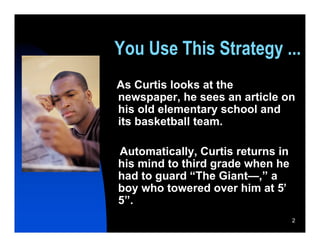
As Curtis looks at the
newspaper, he sees an article on
his old elementary school and
its basketball team.

Automatically, Curtis returns in
his mind to third grade when he
had to guard “The Giant—,” a
boy who towered over him at 5’
5”.
                                   2
You Make Connections
All of the Time..

   Curtis really CAN’T stop himself.
    The brain is wired to connect
    new information with the old
    knowledge that is in the brain.
   It’s a way of making sense of the
    environment.


                                    3
Brain Research Tells Us That. .
.
         Connecting the text to your own
          experience allows you to
          understand more.
         When you ask yourself, “What
          does this remind me of?” you
          have “opened” a mental file in
          your brain where new
          information can go.


                                            4
Did you know that…?

“To every text, a reader brings
his/her personality, present
mood, and memories, making
each person’s experience of text
almost as unique as a
fingerprint.”
                     - Laura Robb

                                    5
Strategic readers . . .
             Connect rapidly with the
              text without thinking about
              it.

             Stick new information in
              their short and long term
              memory by hooking old
              information with the new.


                                            6
With this strategy, you can . . .
              relate to characters
              visualize -- have a clearer picture in
               your head
              avoid boredom
              pay attention
              listen to others. What are their
               stories?
              read actively
              remember what you’ve read
              ask questions

                                                        7
Three Ways to
   “Hook Up”
      with the Text…

          Text to Self
          Text to Text
          Text to World
                           8
When Do You Use the Strategy of
    Making Connections?

          Before Reading
          During Reading
          After Reading


                                  9
You can connect . . .
       to the characters
       to the plot
       to the setting or place
       to visualize, taste, smell, feel, or
        hear the text
       to predict or infer what will
        happen in the text
       to what you know about a topic or
        word
       to help feel emotions related to
        the text
       to what you know about the text
        organization and text structure
                                               10
Before You Start to Read…

       You can activate your background
        knowledge.

       Ask yourself: What do I already know
        about this subject?

       Think about what you know about
        they type of text you’ll be reading.


                                               11
Stop Isolating Information!
    Realize that your background
    knowledge is a storehouse of
    information with memories,
    experiences, and facts. It sees a
    larger picture.


                                        12
Open Your Brain
   You have something in common
    with the text!

   Take all of your life experiences--
    even those outside of the
    classroom-- and bring it into the
    text in front of you.


                                     13
Text to Self
   What does this text remind me of?
   Did I have a similar experience in
    any way?
   What did I see and hear?
   How did I feel?
   Am I bringing meaning to the
    words to help me read better?


                                     14
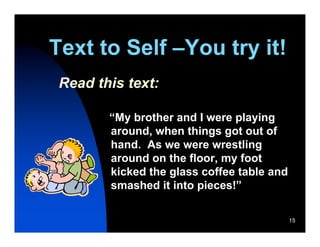
Text to Self –You try it!
 Read this text:

        “My brother and I were playing
        around, when things got out of
        hand. As we were wrestling
        around on the floor, my foot
        kicked the glass coffee table and
        smashed it into pieces!”

                                            15
That Reminds Me….
    Did I ever fight with a relative?
    Did we ever break an object?
    What was it?
    How did it happen?
    How did an adult react?


                                         16
Stay Focused!
       You might want to say, “I have a
       brother,” and end your
       connection with that statement.

      BUT…
           Be more specific and relate
           your experience of fighting
           with your brother and also
           breaking something.

                                      17
Be a Thoughtful Reader
           Remember, some connections
            are more relevant or helpful
            than others.

           Ask yourself, “Does this
            connection help me understand
            the text?”


                                           18
Text to Text
   What connections can you make
    with a book, article, picture or
    movie that you have read or
    seen?
   Is the information similar or
    different from what you would
    expect?
   How does this connection help
    you understand the new material
    you are reading?
                                   19
You Already Know So Much!
         In a fiction story:

            What literary elements would
             you expect to find? Examples:
             setting, characters, conflict
            What dialogue would you
             expect?
            What problems would be likely?

                                          20
You Already Know So Much!
       In a nonfiction story:
          What text forms would it have?
           Example: table of contents,
           glossary, bold-faced words,
           graphs, tables, chapter summary
          What terms would you expect to
           find?
          How could the information be
           organized? Time-order? Cause-
           effect?
                                             21
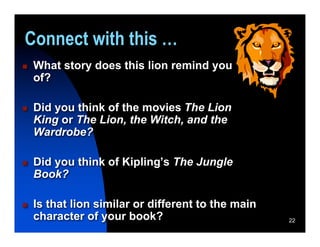
Connect with this …
   What story does this lion remind you
    of?

   Did you think of the movies The Lion
    King or The Lion, the Witch, and the
    Wardrobe?

   Did you think of Kipling’s The Jungle
    Book?

   Is that lion similar or different to the main
    character of your book?                         22
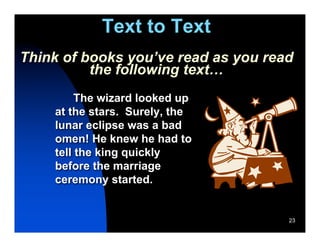
Text to Text
Think of books you’ve read as you read
          the following text…
         The wizard looked up
    at the stars. Surely, the
    lunar eclipse was a bad
    omen! He knew he had to
    tell the king quickly
    before the marriage
    ceremony started.


                                     23
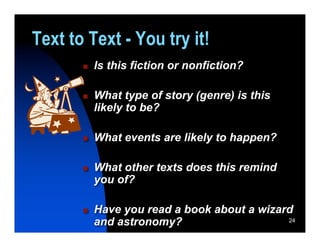
Text to Text - You try it!
          Is this fiction or nonfiction?

          What type of story (genre) is this
           likely to be?

          What events are likely to happen?

          What other texts does this remind
           you of?

          Have you read a book about a wizard
           and astronomy?                    24
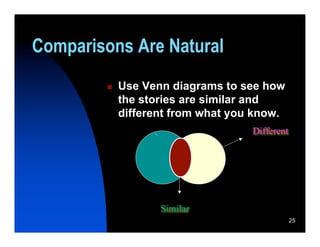
Comparisons Are Natural
            Use Venn diagrams to see how
             the stories are similar and
             different from what you know.
                                    Different


                    Similar
                                                25
Text to World

              What specific facts
               do you know about
               the subject?

              Make a web.

              Begin a KWL+ chart.


                                     26
Text to World

  You may have read about the
  topic or heard about it in a class,
  at home, in a newspaper on
  television, or on the Internet.


                                   27
Connect with this …

       “Unlike Iraq, which most experts
       agreed was five to seven years
       away from developing its own
       nuclear weapons, there is broad
       agreement that North Korea is only
       months away.”

                      - Klurfield-Newsday


                                            28
What Do You Know?
       President Bush was concerned
        about weapons of mass
        destruction in Iraq.
       North Korea became a security
        threat when it announced its
        intention to to do nuclear
        testing.
       United States dropped nuclear
        bombs in Japan in World War II.
                                        29
Dig Deeper…
   The dictator Kim Jong IIl threatened
    to turn old fuel rods into weapons-
    grade plutonium.
   The world realizes that the risk of
    more nuclear weapons affects
    everyone.
   If North Korea has nuclear devices, it
    could sell the weapons to terrorists.


                                             30
As You Read….

    Don’t be shy!
       Connect  with the text.
       Copy quotes and make notes.

       “This reminds me of ….”


                                  31
Strategy #1
        Text to Self
        Text to Text

        Text to World


Be a strategic reader!!!   32

Making Connections

  • 1.
    8/30/09 Elkhart Community Schools 1
  • 2.
    You Use ThisStrategy ... As Curtis looks at the newspaper, he sees an article on his old elementary school and its basketball team. Automatically, Curtis returns in his mind to third grade when he had to guard “The Giant—,” a boy who towered over him at 5’ 5”. 2
  • 3.
    You Make Connections Allof the Time..  Curtis really CAN’T stop himself. The brain is wired to connect new information with the old knowledge that is in the brain.  It’s a way of making sense of the environment. 3
  • 4.
    Brain Research TellsUs That. . .  Connecting the text to your own experience allows you to understand more.  When you ask yourself, “What does this remind me of?” you have “opened” a mental file in your brain where new information can go. 4
  • 5.
    Did you knowthat…? “To every text, a reader brings his/her personality, present mood, and memories, making each person’s experience of text almost as unique as a fingerprint.” - Laura Robb 5
  • 6.
    Strategic readers .. .  Connect rapidly with the text without thinking about it.  Stick new information in their short and long term memory by hooking old information with the new. 6
  • 7.
    With this strategy,you can . . .  relate to characters  visualize -- have a clearer picture in your head  avoid boredom  pay attention  listen to others. What are their stories?  read actively  remember what you’ve read  ask questions 7
  • 8.
    Three Ways to “Hook Up” with the Text…  Text to Self  Text to Text  Text to World 8
  • 9.
    When Do YouUse the Strategy of Making Connections? Before Reading During Reading After Reading 9
  • 10.
    You can connect. . .  to the characters  to the plot  to the setting or place  to visualize, taste, smell, feel, or hear the text  to predict or infer what will happen in the text  to what you know about a topic or word  to help feel emotions related to the text  to what you know about the text organization and text structure 10
  • 11.
    Before You Startto Read…  You can activate your background knowledge.  Ask yourself: What do I already know about this subject?  Think about what you know about they type of text you’ll be reading. 11
  • 12.
    Stop Isolating Information! Realize that your background knowledge is a storehouse of information with memories, experiences, and facts. It sees a larger picture. 12
  • 13.
    Open Your Brain  You have something in common with the text!  Take all of your life experiences-- even those outside of the classroom-- and bring it into the text in front of you. 13
  • 14.
    Text to Self  What does this text remind me of?  Did I have a similar experience in any way?  What did I see and hear?  How did I feel?  Am I bringing meaning to the words to help me read better? 14
  • 15.
    Text to Self–You try it! Read this text: “My brother and I were playing around, when things got out of hand. As we were wrestling around on the floor, my foot kicked the glass coffee table and smashed it into pieces!” 15
  • 16.
    That Reminds Me….  Did I ever fight with a relative?  Did we ever break an object?  What was it?  How did it happen?  How did an adult react? 16
  • 17.
    Stay Focused! You might want to say, “I have a brother,” and end your connection with that statement. BUT… Be more specific and relate your experience of fighting with your brother and also breaking something. 17
  • 18.
    Be a ThoughtfulReader  Remember, some connections are more relevant or helpful than others.  Ask yourself, “Does this connection help me understand the text?” 18
  • 19.
    Text to Text  What connections can you make with a book, article, picture or movie that you have read or seen?  Is the information similar or different from what you would expect?  How does this connection help you understand the new material you are reading? 19
  • 20.
    You Already KnowSo Much! In a fiction story:  What literary elements would you expect to find? Examples: setting, characters, conflict  What dialogue would you expect?  What problems would be likely? 20
  • 21.
    You Already KnowSo Much! In a nonfiction story:  What text forms would it have? Example: table of contents, glossary, bold-faced words, graphs, tables, chapter summary  What terms would you expect to find?  How could the information be organized? Time-order? Cause- effect? 21
  • 22.
    Connect with this…  What story does this lion remind you of?  Did you think of the movies The Lion King or The Lion, the Witch, and the Wardrobe?  Did you think of Kipling’s The Jungle Book?  Is that lion similar or different to the main character of your book? 22
  • 23.
    Text to Text Thinkof books you’ve read as you read the following text… The wizard looked up at the stars. Surely, the lunar eclipse was a bad omen! He knew he had to tell the king quickly before the marriage ceremony started. 23
  • 24.
    Text to Text- You try it!  Is this fiction or nonfiction?  What type of story (genre) is this likely to be?  What events are likely to happen?  What other texts does this remind you of?  Have you read a book about a wizard and astronomy? 24
  • 25.
    Comparisons Are Natural  Use Venn diagrams to see how the stories are similar and different from what you know. Different Similar 25
  • 26.
    Text to World  What specific facts do you know about the subject?  Make a web.  Begin a KWL+ chart. 26
  • 27.
    Text to World You may have read about the topic or heard about it in a class, at home, in a newspaper on television, or on the Internet. 27
  • 28.
    Connect with this… “Unlike Iraq, which most experts agreed was five to seven years away from developing its own nuclear weapons, there is broad agreement that North Korea is only months away.” - Klurfield-Newsday 28
  • 29.
    What Do YouKnow?  President Bush was concerned about weapons of mass destruction in Iraq.  North Korea became a security threat when it announced its intention to to do nuclear testing.  United States dropped nuclear bombs in Japan in World War II. 29
  • 30.
    Dig Deeper…  The dictator Kim Jong IIl threatened to turn old fuel rods into weapons- grade plutonium.  The world realizes that the risk of more nuclear weapons affects everyone.  If North Korea has nuclear devices, it could sell the weapons to terrorists. 30
  • 31.
    As You Read…. Don’t be shy!  Connect with the text.  Copy quotes and make notes.  “This reminds me of ….” 31
  • 32.
    Strategy #1  Text to Self  Text to Text  Text to World Be a strategic reader!!! 32