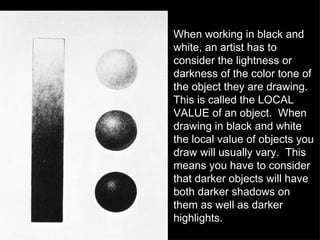
When working in black and white, an artist has to consider the lightness or darkness of the color tone of the object they are drawing.  This is called the LOCAL VALUE of an object.  When drawing in black and white the local value of objects you draw will usually vary.  This means you have to consider that darker objects will have both darker shadows on them as well as darker highlights.
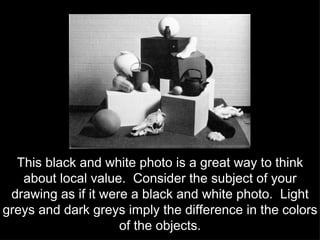
This black and white photo is a great way to think about local value.  Consider the subject of your drawing as if it were a black and white photo.  Light greys and dark greys imply the difference in the colors of the objects.
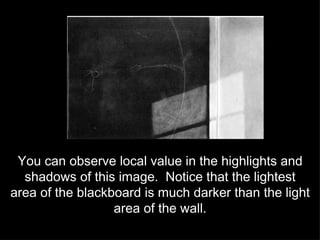
You can observe local value in the highlights and shadows of this image.  Notice that the lightest area of the blackboard is much darker than the light area of the wall.
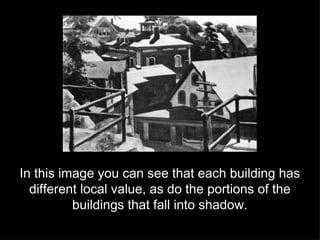
In this image you can see that each building has different local value, as do the portions of the buildings that fall into shadow.
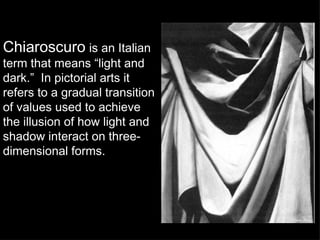
Chiaroscuro   is an Italian term that means “light and dark.”  In pictorial arts it refers to a gradual transition of values used to achieve the illusion of how light and shadow interact on three-dimensional forms.
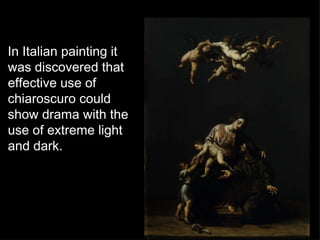
In Italian painting it was discovered that effective use of chiaroscuro could show drama with the use of extreme light and dark.
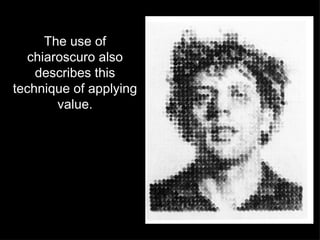
The use of chiaroscuro also describes this technique of applying value.
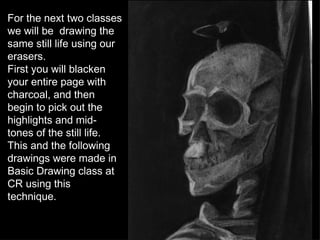
For the next two classes we will be  drawing the same still life using our erasers. First you will blacken your entire page with charcoal, and then begin to pick out the highlights and mid-tones of the still life. This and the following drawings were made in Basic Drawing class at CR using this technique.
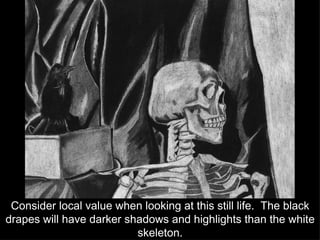
Consider local value when looking at this still life.  The black drapes will have darker shadows and highlights than the white skeleton.
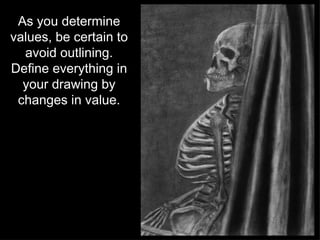
As you determine values, be certain to avoid outlining. Define everything in your drawing by changes in value.
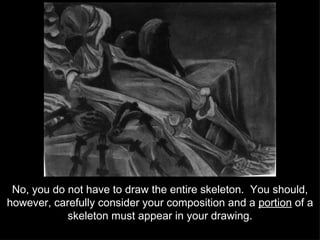
No, you do not have to draw the entire skeleton.  You should, however, carefully consider your composition and a  portion  of a skeleton must appear in your drawing.
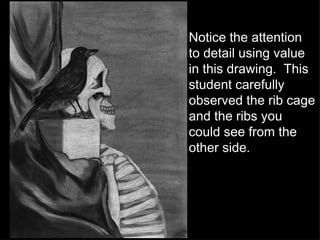
Notice the attention to detail using value in this drawing.  This student carefully observed the rib cage and the ribs you could see from the other side.
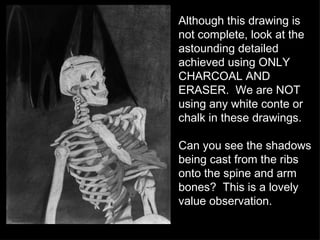
Although this drawing is not complete, look at the astounding detailed achieved using ONLY CHARCOAL AND ERASER.  We are NOT using any white conte or chalk in these drawings. Can you see the shadows being cast from the ribs onto the spine and arm bones?  This is a lovely value observation.

Local value

  • 1.
  • 2.
    When working inblack and white, an artist has to consider the lightness or darkness of the color tone of the object they are drawing. This is called the LOCAL VALUE of an object. When drawing in black and white the local value of objects you draw will usually vary. This means you have to consider that darker objects will have both darker shadows on them as well as darker highlights.
  • 3.
    This black andwhite photo is a great way to think about local value. Consider the subject of your drawing as if it were a black and white photo. Light greys and dark greys imply the difference in the colors of the objects.
  • 4.
    You can observelocal value in the highlights and shadows of this image. Notice that the lightest area of the blackboard is much darker than the light area of the wall.
  • 5.
    In this imageyou can see that each building has different local value, as do the portions of the buildings that fall into shadow.
  • 6.
    Chiaroscuro is an Italian term that means “light and dark.” In pictorial arts it refers to a gradual transition of values used to achieve the illusion of how light and shadow interact on three-dimensional forms.
  • 7.
    In Italian paintingit was discovered that effective use of chiaroscuro could show drama with the use of extreme light and dark.
  • 8.
    The use ofchiaroscuro also describes this technique of applying value.
  • 9.
    For the nexttwo classes we will be drawing the same still life using our erasers. First you will blacken your entire page with charcoal, and then begin to pick out the highlights and mid-tones of the still life. This and the following drawings were made in Basic Drawing class at CR using this technique.
  • 10.
    Consider local valuewhen looking at this still life. The black drapes will have darker shadows and highlights than the white skeleton.
  • 11.
    As you determinevalues, be certain to avoid outlining. Define everything in your drawing by changes in value.
  • 12.
    No, you donot have to draw the entire skeleton. You should, however, carefully consider your composition and a portion of a skeleton must appear in your drawing.
  • 13.
    Notice the attentionto detail using value in this drawing. This student carefully observed the rib cage and the ribs you could see from the other side.
  • 14.
    Although this drawingis not complete, look at the astounding detailed achieved using ONLY CHARCOAL AND ERASER. We are NOT using any white conte or chalk in these drawings. Can you see the shadows being cast from the ribs onto the spine and arm bones? This is a lovely value observation.