Art AppreciationChapter 8Prints
4 basic methodsReliefIntaglioLithographyScreenprinting
What is a print?Courtesy of momahttp://www.moma.org/interactives/projects/2001/whatisaprint/print.html
websitesColored woodblock prints in the japanese stylehttp://www.youtube.com/watch?v=dliF74ojOho4 color woodblock print, a stamping methodhttp://www.youtube.com/watch?v=Ej0D_qxBd2wThe best video, 3 color reduction process (with Bridget Mary Henry)http://www.youtube.com/watch?v=qSoRnKXpjU0MC Escher, doing his woodblock print of Snakeshttp://www.youtube.com/watch?v=cEQcuIRROzM
ReliefThe background image is cut awayThe raised areas hold ink
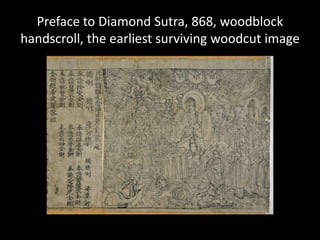
Preface to Diamond Sutra, 868, woodblock handscroll, the earliest surviving woodcut image
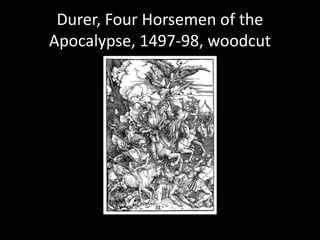
Durer, Four Horsemen of the Apocalypse, 1497-98, woodcut
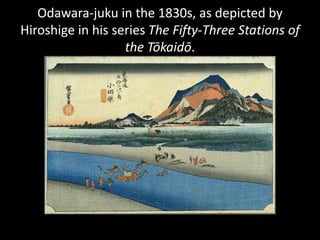
Odawara-juku in the 1830s, as depicted by Hiroshige in his series The Fifty-Three Stations of the Tōkaidō.
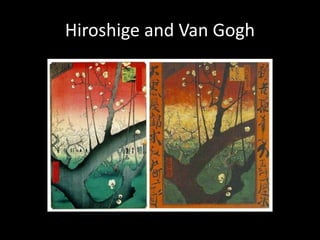
Hiroshige and Van Gogh
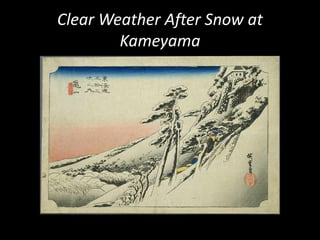
Clear Weather After Snow at Kameyama
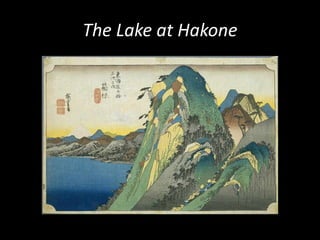
The Lake at Hakone
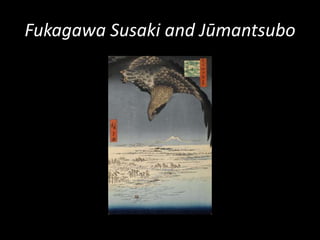
FukagawaSusaki and Jūmantsubo
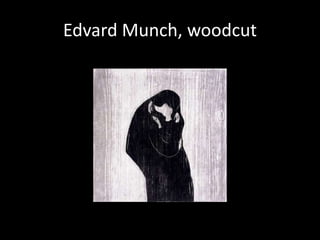
Edvard Munchhttp://romanjaster.com/edvard-munch/gallery/wood/index.htm
Edvard Munch, woodcut
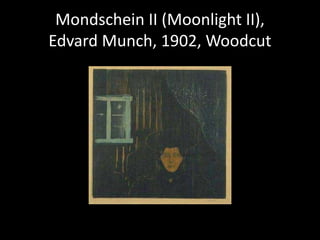
Mondschein II (Moonlight II), Edvard Munch, 1902, Woodcut
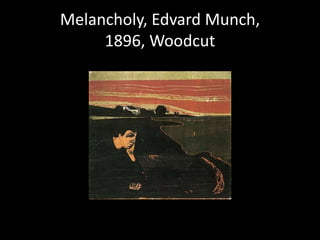
Melancholy, Edvard Munch, 1896, Woodcut
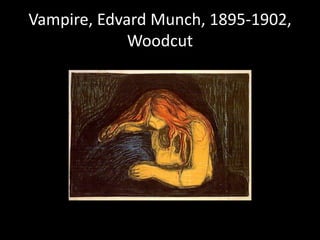
Vampire, Edvard Munch, 1895-1902,Woodcut
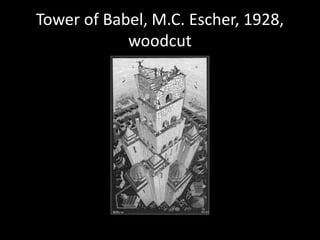
Tower of Babel, M.C. Escher, 1928, woodcut
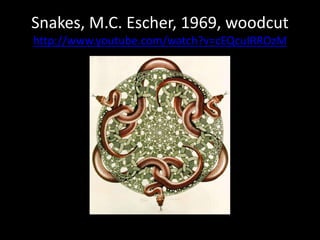
Snakes, M.C. Escher, 1969, woodcuthttp://www.youtube.com/watch?v=cEQcuIRROzM
Wood engravingUses the end grain of the boardUses harder woodMore highly detailedQuick video showing fine detailhttp://www.youtube.com/watch?v=UzZ26udfPs0&feature=player_embedded
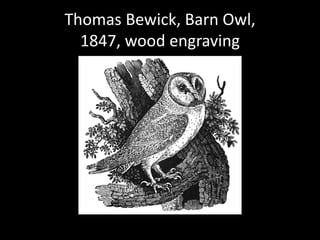
Thomas Bewick, Barn Owl, 1847, wood engraving
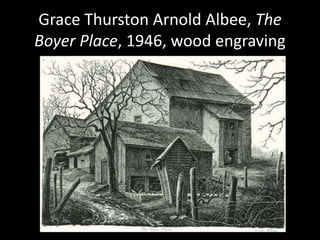
Grace Thurston Arnold Albee, The Boyer Place, 1946, wood engraving
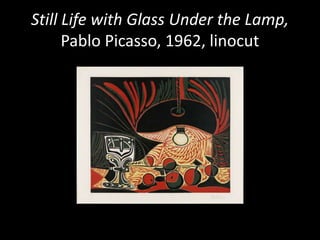
Still Life with Glass Under the Lamp, Pablo Picasso, 1962, linocut
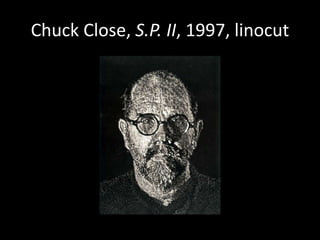
Chuck Close, S.P. II, 1997, linocut
intaglioRefers to 5 techniquesEngravingDrypointMezzotintEtchingAquatintOpposite of relief, the ink goes into the grooves on the surface.Artist makes lines or grooves into a metal plate using a sharp tool or acidThe entire surface is inked and then the plate is wiped cleanThe paper is used damp and then pressed onto the plate under pressure
Intaglio demohttp://www.youtube.com/watch?v=SNKn4PORGBIMC Escher Mezzotinthttp://www.mcescher.com/Film/Eschermezotintprint.mpgLithography demohttp://www.youtube.com/watch?v=JHw5_1HopscScreenprinting demohttp://www.youtube.com/watch?v=wogKeYH2wEE
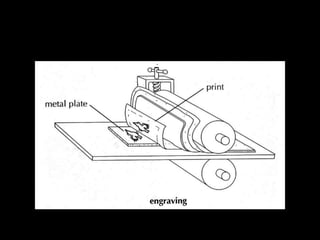
engravingBegan from the practice of incising designs into armorA sharp V-shaped tool called a burin is used to cut lines into a metal plateShallow cuts make a light, thin line and deeper gouges make a darker, thicker lineThe result is similar to drawingEngravings were a popular way of making reproductions of major paintings
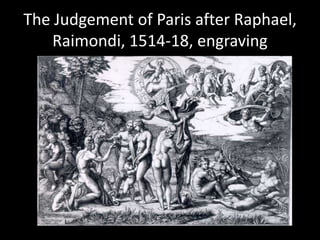
The Judgement of Paris after Raphael, Raimondi, 1514-18, engraving
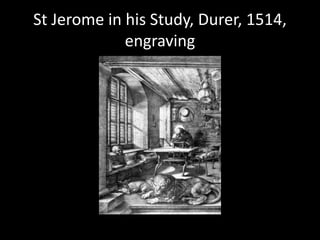
St Jerome in his Study, Durer, 1514, engraving
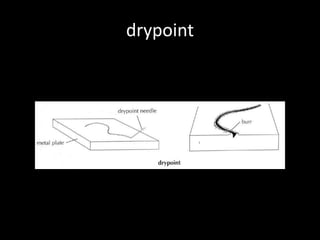
drypointSimilar to etching, except it uses a sharp pointed drypoint needle instead of a V-shaped burinThe artist draws on the metal plate similar to drawing on paper
drypoint
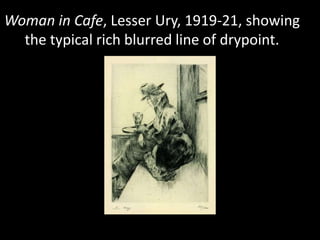
Woman in Cafe, Lesser Ury, 1919-21, showing the typical rich blurred line of drypoint.
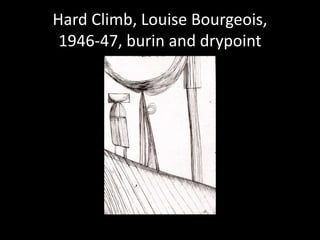
Hard Climb, Louise Bourgeois, 1946-47, burin and drypoint
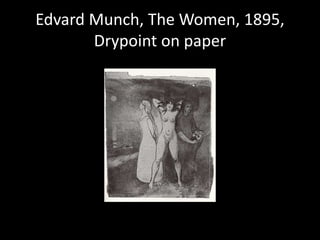
Edvard Munch, The Women, 1895,Drypoint on paper
mezzotintThis is a reverse process, working from dark to lightFirst the entire metal plate is roughened using a sharp tool called a rockerThe entire plate would make a black print at this point because the burrs hold the inkThe artist uses a burnisher (a smoothing tool) to smooth and rub out areas to create lighter values.In the lightest areas, the burrs are smoothed out entirely
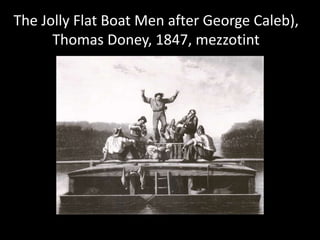
The Jolly Flat Boat Men after George Caleb), Thomas Doney, 1847, mezzotint
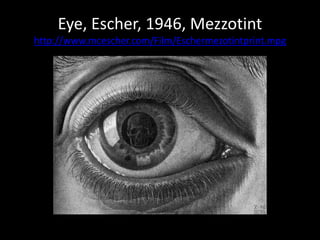
Eye, Escher, 1946, Mezzotinthttp://www.mcescher.com/Film/Eschermezotintprint.mpg
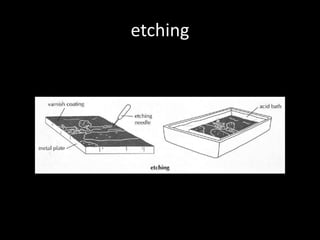
EtchingThe entire plate is covered with a ground, like beeswax or asphaltThe artist draws through the ground on the plate using an etching needleThe entire plate is dipped into acidAcid eats away the linesThe ground is removedThe plate is inked and printed
etching
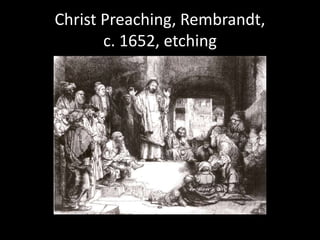
Christ Preaching, Rembrandt, c. 1652, etching
aquatintDifferent in that it does not print lines but rather  areas of toneIt is good for creating value changesMost often used with another techniqueThe artist dusts the plate with powder resin in various thicknesses, then heats the plate to make the resin stickPlate is dipped into acid
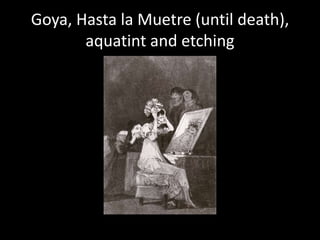
Goya, Hasta la Muetre(until death),aquatint and etching
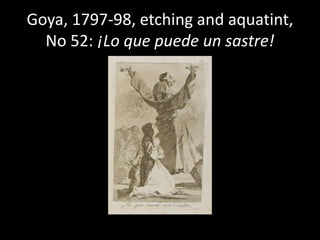
Goya, 1797-98, etching and aquatint,No 52: ¡Lo que puede un sastre!
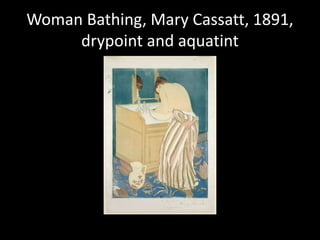
Woman Bathing, Mary Cassatt, 1891, drypoint and aquatint
midpoint
lithographyMuch different that intaglio, it is a planographic processLithography artists draw onto smooth limestone surface using a greasy materialLithographic crayonTusche, a greasy inkIt works based on the idea that oil and water do not mixThe stone is treated with acid to fix the drawing in placeThen it is  damped with water, the water goes to areas without greaseThe stone is inked and the ink sticks to the grease and is repelled by the watery areasLithographs are often mistaken for drawings
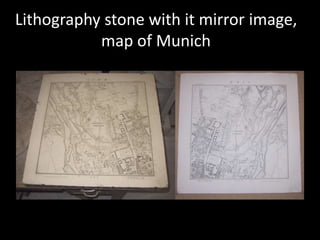
Lithography stone with it mirror image,map of Munich
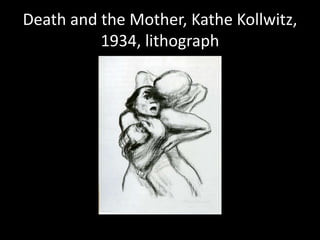
Death and the Mother, Kathe Kollwitz, 1934, lithograph
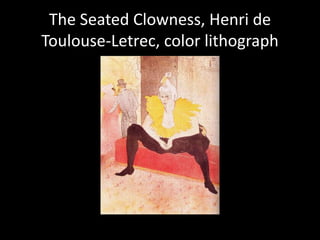
The Seated Clowness, Henri de Toulouse-Letrec, color lithograph
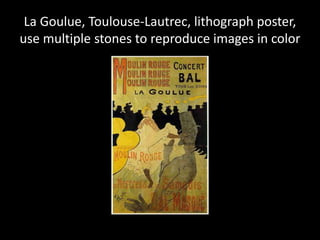
La Goulue, Toulouse-Lautrec, lithograph poster,use multiple stones to reproduce images in color
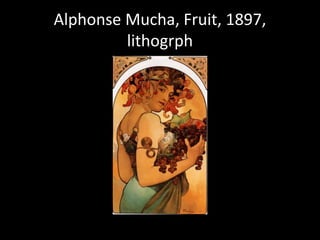
Alphonse Mucha, Fruit, 1897, lithogrph
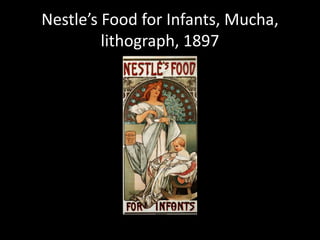
Nestle’s Food for Infants, Mucha, lithograph, 1897
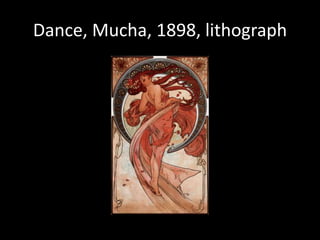
Dance, Mucha, 1898, lithograph
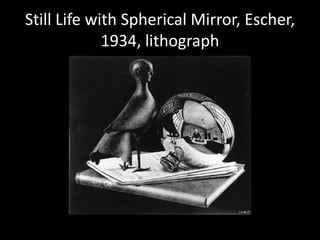
Still Life with Spherical Mirror, Escher, 1934, lithograph
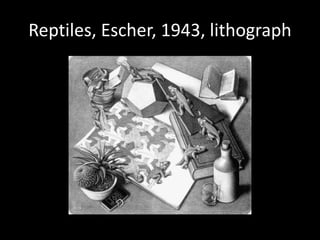
Reptiles, Escher, 1943, lithograph
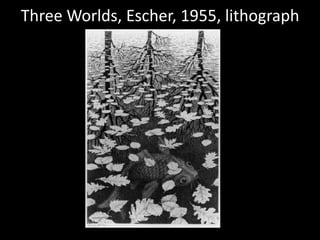
Three Worlds, Escher, 1955, lithograph
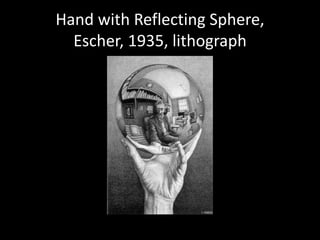
Hand with Reflecting Sphere,Escher, 1935, lithograph
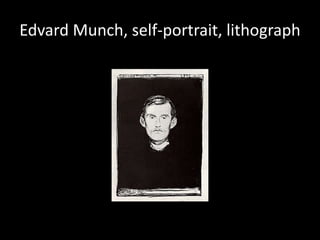
Edvard Munch, self-portrait, lithograph
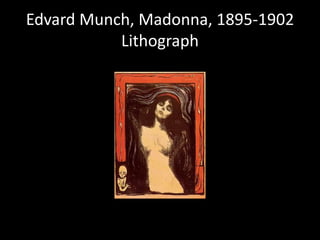
Edvard Munch, Madonna, 1895-1902Lithograph
ScreenprintingThe artist uses a screenTraditionally silkSilkscreenSerigraphyThey block out certain areas that are not meant to be printedUsing various methods and materialsPlace the screen over paper and force ink thru the screen using a squegeeTo use multiple colors, a screen is prepared for each color and the paper is registered for each printing
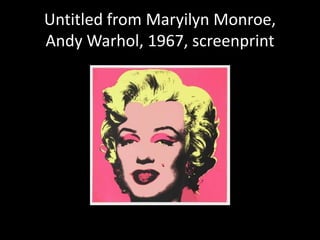
Untitled from Maryilyn Monroe, Andy Warhol, 1967, screenprint
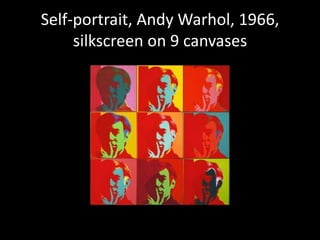
Self-portrait, Andy Warhol, 1966, silkscreen on 9 canvases
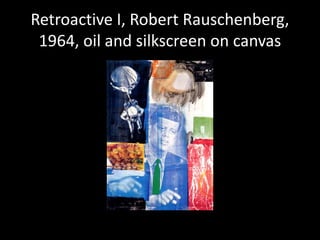
Retroactive I, Robert Rauschenberg, 1964, oil and silkscreen on canvas
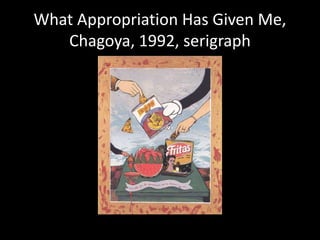
What Appropriation Has Given Me, Chagoya, 1992, serigraph
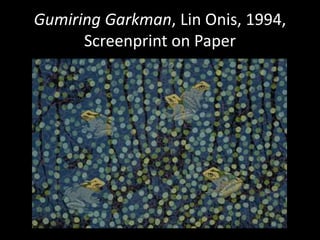
GumiringGarkman, Lin Onis, 1994,Screenprint on Paper
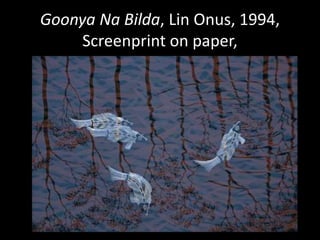
Goonya Na Bilda, Lin Onus, 1994,Screenprint on paper,
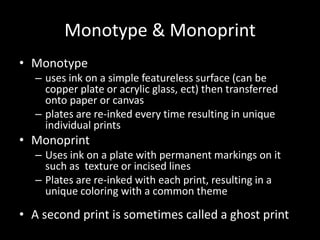
Monotype &MonoprintMonotype uses ink on a simple featureless surface (can be copper plate or acrylic glass, ect) then transferred onto paper or canvasplates are re-inked every time resulting in unique individual printsMonoprintUses ink on a plate with permanent markings on it such as  texture or incised linesPlates are re-inked with each print, resulting in a unique coloring with a common theme A second print is sometimes called a ghost print
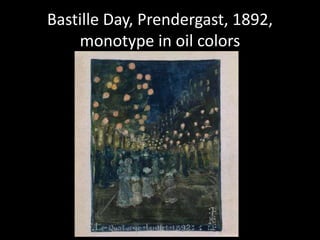
Bastille Day, Prendergast, 1892, monotype in oil colors
End of chapter 8

Art apprec ch8