GPS
Hani Ali
Ghaith Thabit
Dhurgham Fahem
OUTLINOUTLIN
What is GPS
Evolution of GPS
GPS segments
Works of GPS
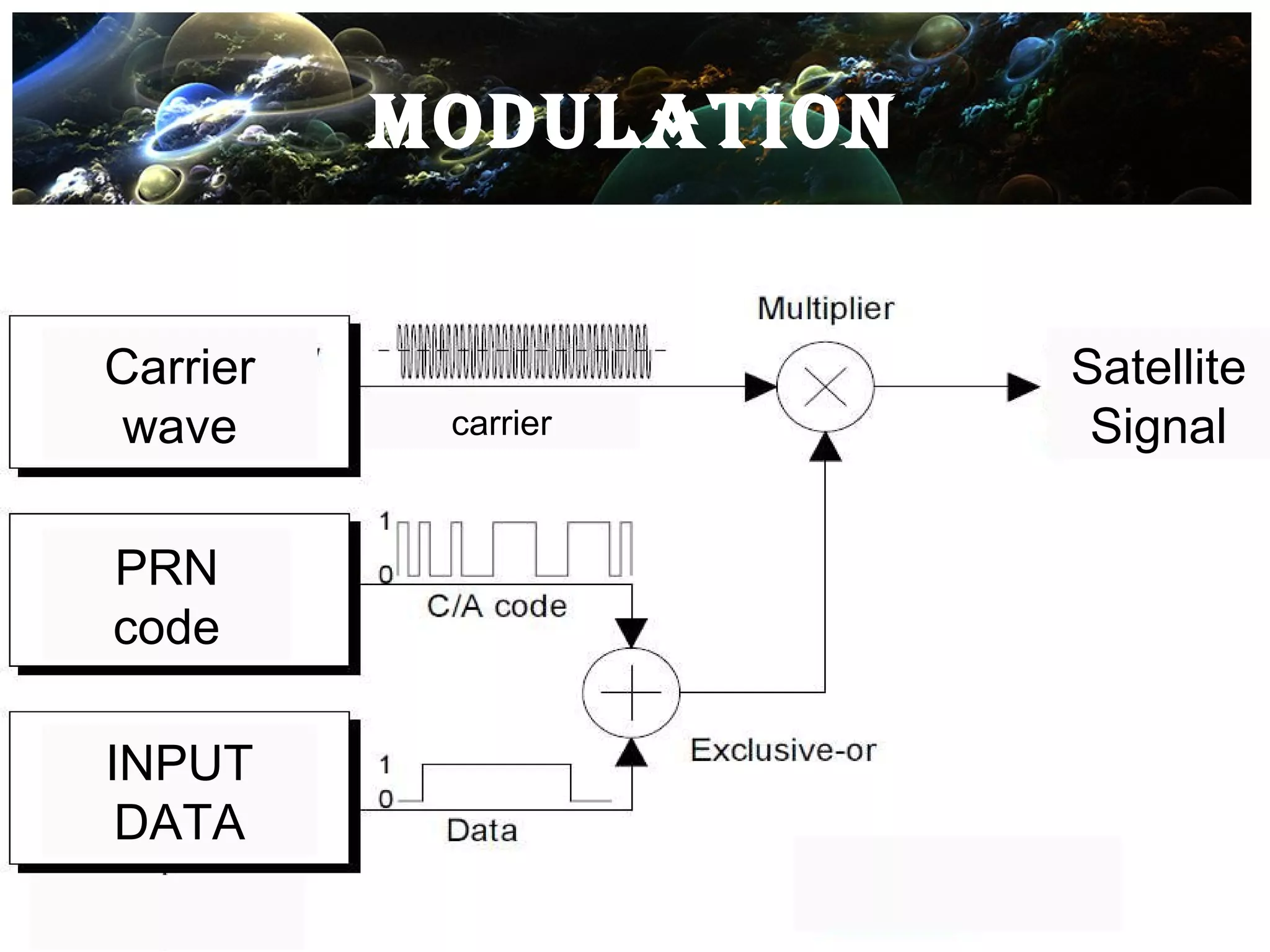
Modulation
Demodulation
GPS frequencies
Applications
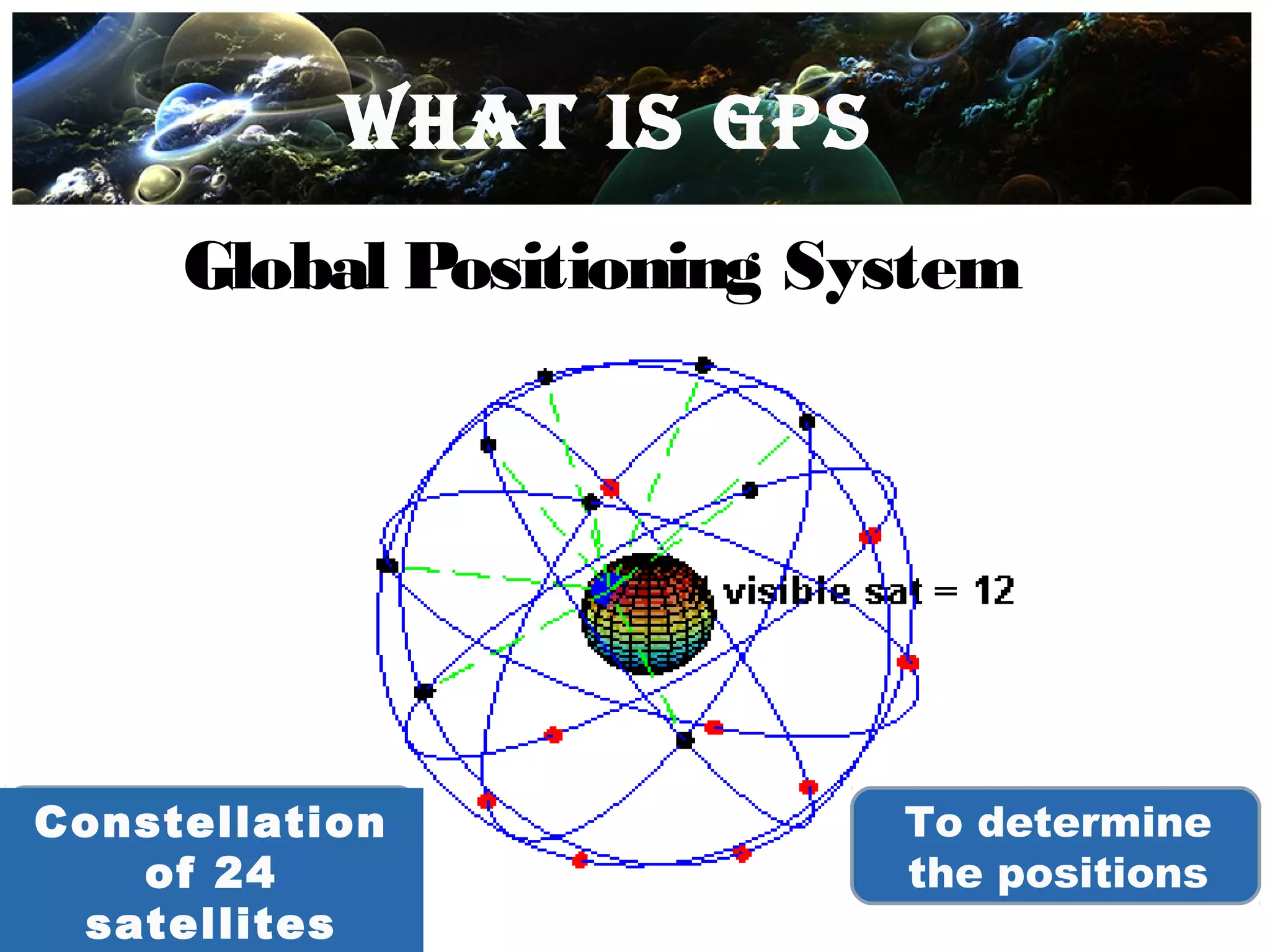
Global Positioning System
WHAT IS GPS
Constellation
of 24
satellites
To determine
the positions
• Developed by US Department of Defense
• 1969—Defense Navigation Satellite System
(DNSS) formed
• 1973—NAVSTAR Global Positioning System
developed
• 1978—first 4 satellites launched
• 1993—24th satellite launched; initial operational
capability
• 1995—full operational capability
• May 2000—Military accuracy available to all users
EVOLUTION OF GPS
Satellite
segment
User
segment
Control
segment
GPS SeGmentS
The GPS uses technique of (triangulation) to find
location.
WORKS OF GPS
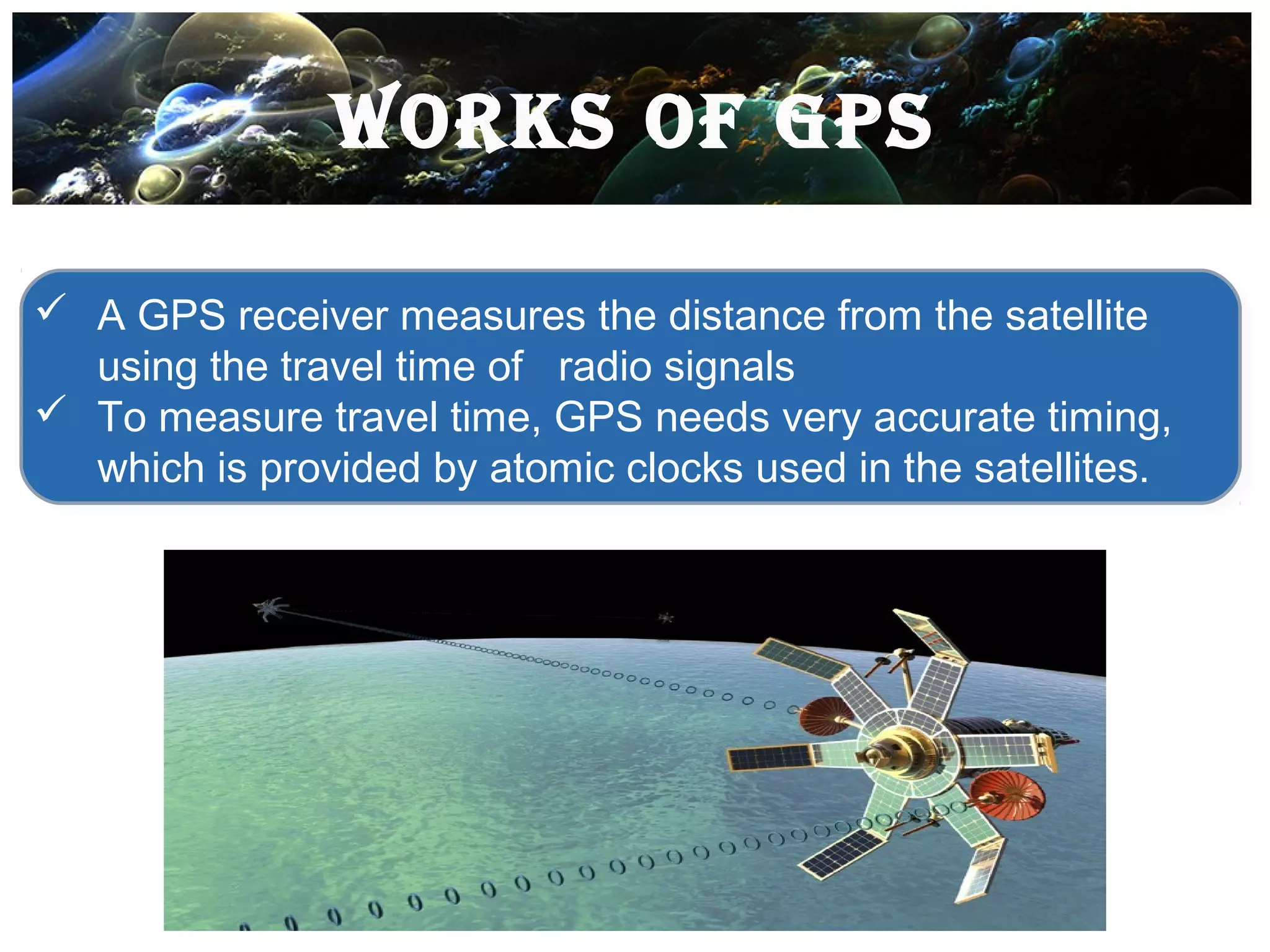
 A GPS receiver measures the distance from the satellite
using the travel time of radio signals
 To measure travel time, GPS needs very accurate timing,
which is provided by atomic clocks used in the satellites.
WORKS OF GPS
Carrier
wave
PRN
code
INPUT
DATA
Satellite
Signalcarrier
mODULAtIOn
Satellite
Signal
Carrier wave PRN code
UOTPUT
DATA
DEMODULATION
(1575.42 MHz)
(1381.05 MHz)
(1379.92 MHz)
(1227.60 MHz)
(1176.45 MHz)
GPS FrEqUENcIES
• Navigation
• Target tracking
• Search and Rescue
 MILITARY
APPLIcATIONS
• GPS for surveying
• Mapping
• Finding lost
vehicles
 CIVILIAN
APPLIcATIONS
 Outdoor Navigation with GPS by Stephen W. Hinch
 The GPS Handbook by Robert I. Egbert
 Satellite Communication by T.PrattandC.W.Bostain-John Wiley and
Sons.
 http://www.gpsinformation.net
 http://www.AllGPS.com
 http://garmin.com
 http://colorado.edu/geography/gcraft/notes/gps
 http://trimble.com
 http://www.slideshare.net/gps
references
GPS (global positioning system )

GPS (global positioning system )