GP IIb/IIIaInhibitors
• Dr. Ashishkumar Baheti
• 14/02/2020
Contets :
1. History
2. Gp IIb/IIIa
3. Gp IIb/IIIa inhibitors
4. ABCIXIMAB
5. EPTIFIBATIDE
6. TIROFIBAN
7. Summary
History
• The study of a rare bleeding diathesis, Glanzmann thrombasthenia, first
described in 1918, led to a greater understanding of platelet activation and
aggregation mechanisms, including the function of the glycoprotein (GP)
IIb/IIIa complex, which allowed the development of a new class of
medications.
• Patients with Glanzmann thrombasthenia inherit an absence or deficiency of
GP IIb/IIIa in an autosomal recessive pattern.
History
• Their platelets are of normal size and undergo normal activation-related
secretion and shape changes; however, they do not bind fibrinogen and
cannot form aggregates.
• The pharmacologic agents that temporarily mimic this pathologic state are
the GP IIb/IIIa antagonists.
GP IIb/IIIa
• It is an integrin complex on platelet-surface.
• Glycoprotein IIb/IIIa is also known as αIIbβ3
• This dimeric glycoprotein is a receptor for fibrinogen and von
Willebrand factor.
• It aids in platelet activation and aggregation.
• The integrin heterodimer/receptor is activated by platelet agonists like
collagen, thrombin, TXA2, ADP to develop binding sites for its ligands,
which do not bind to resting platelets.
GP IIb/IIIa
• Defective in cases of Glanzmanns thromboasthenia. (GT)
• Targeted by autoantibodies in immune thrombocytopenic purpura
(ITP)
• Targeted by different medicines collectively called as GP IIb/IIIa
Inhibitors.
GP IIb/IIIa Inhibitors
 Inhibition of binding to GP IIb/IIIa receptor blocks platelet
aggregation induced by any agonist.
 GP IIb/IIIa antagonists are a new class of potent platelet aggregation
inhibitor which act by blocking key receptor involved in platelet
aggregation.
Classification of GP IIb/IIIa Inhibitors
GP IIb/IIIa-receptor antagonists –
mechanism of action
• The glycoprotein IIb/IIIa
receptor is exposed on
the platelet membrane
after activation and is
responsible for
mediating platelet
aggregation.
GP IIb/IIIa-receptor antagonists –
mechanism of action
• Once activated, the
receptor becomes
functional and binds
fibrinogen, leading to the
formation of platelet
aggregates.
• Glycoprotein IIb/IIIa
receptors therefore
mediate the final
common pathway of
platelet aggregation.
GP IIb/IIIa-receptor antagonists –
mechanism of action
• GPIIb/IIIa antagonists
hava a high affinity for
the fibrinogen receptor…
GP IIb/IIIa-receptor antagonists –
mechanism of action
• …and when binding is
completed…
GP IIb/IIIa-receptor antagonists –
mechanism of action
• …they will prevent
fibrinogen from binding
to the receptors.
GP IIb/IIIa-receptor antagonists – pharmacokinetics
• Available only for intravenous administration
• Intravenous administration of a bolus dose followed by continuous
infusion produces constant free plasma concentration throughout
the infusion.
• At the temination of the infusion period, free plasma concentrations
fall rapidly for approximately six hours then decline at a slower rate.
• Platelet function generally recovers over the course of 48 hours,
although the GP IIb/IIIa antagonist remains in the circulation for 15
days or more in a platelet-bound state.
GP IIb/IIIa-receptor antagonists – major use
Prevention of ischaemic cardiac complications in patients with acute
coronary syndrome (ACS) without percutaneous coronary intervention,
depending on TIMI risk.
During percutaneous coronary interventions (PCI), in combination
with aspirin and heparin. (angioplasty with or without
intracoronary stent placement).
GP IIb/IIIa-receptor antagonists – major drawbacks
Can only be administered by intravenous injection or infusion and
are complicated to manufacture
Oral drugs have been investigated but were not effective and have
therefore not reached the market
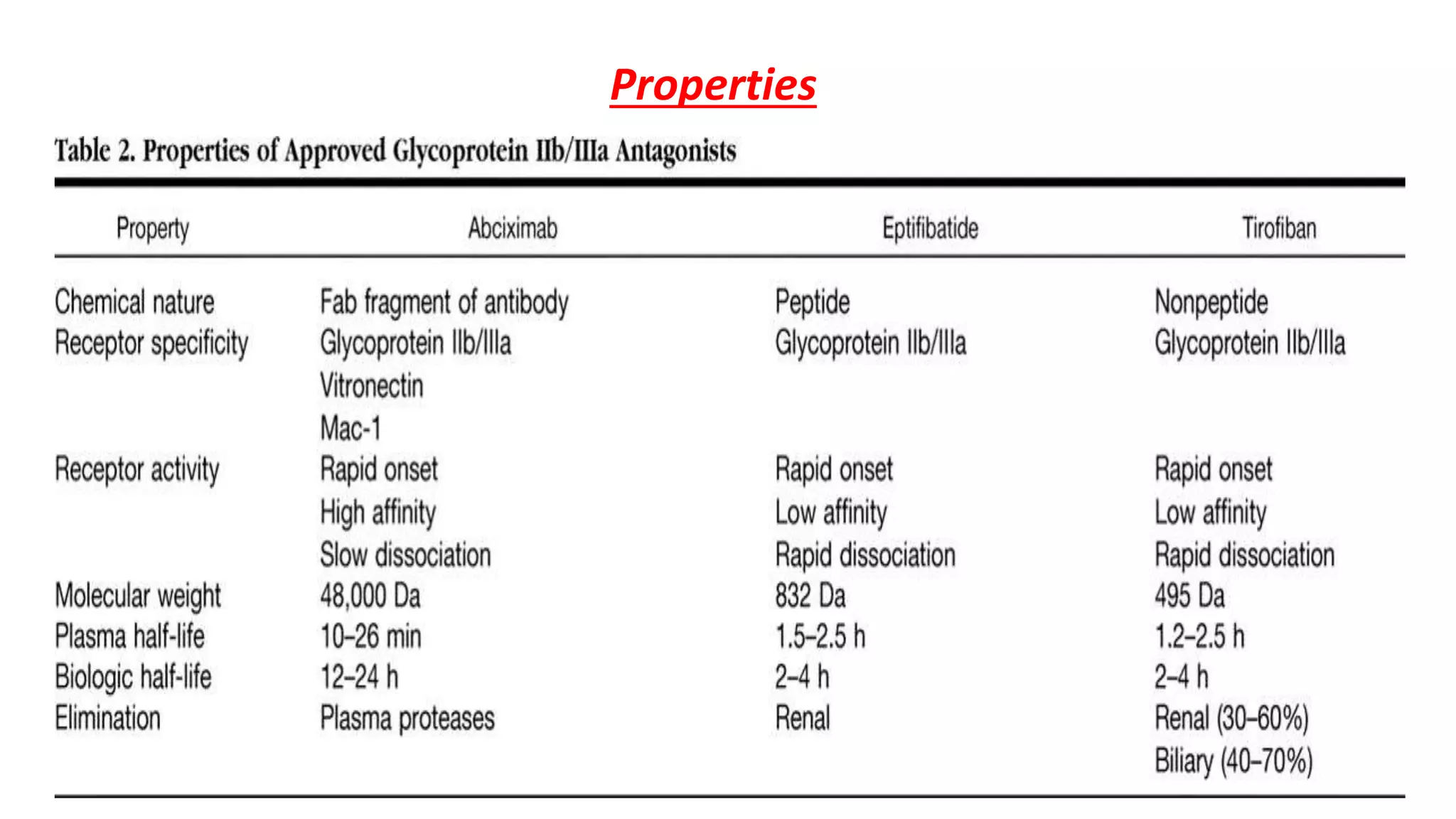
Properties
1. ABCIXIMAB
• It is the Fab fragment of a chimeric monoclonal antibody against
GPIIb/IIIa receptor.
• GP IIb/IIIa Inhibitor – no platelet aggregation – no blood coagulation
• It also binds to the vitronectin receptor on platelets, vascular
endothelial cells, and smooth muscle cells.
ABCIXIMAB-Uses
•The antibody is used in conjunction with percutaneous angioplasty for
coronary thrombosis
•When used along with aspirin and heparin during PCI it is markely reduce
the incidence of restenosis, recurrent MI and death.
• After a bolus dose platelet aggregation remain inhibited for 12-24 hr, while
the remaining antibody is cleared from blood with a t ½ of 10 – 30 min.
• It is given as a 0.25 mg/kg bolus followed by 0.125ug/kg/min for 12 hours or
longer
ABCIXIMAB – Adverse effects
• The major side effect of abciximab is bleeding. The frequency of major
hemorrhage in clinical trials varies from 1-10%, depending on the
intensity of anticoagulation with heparin.
• Thrombocytopenia with a platelet count <50,000 occurs in about 2%
of patients and may be due to development of neo-epitopes induced
by bound antibody. Since the duration of action is long, if major
bleeding or emergent surgery occurs, platelet transfusions can reverse
the aggregation defect because free antibody concentrations fall
rapidly afer cessation of infusion.
• Readministration of antibody has been performed in a small number of
patients without evidence of decreased efficacy or allergic reactions.
• The expense of the antibody limits its use.
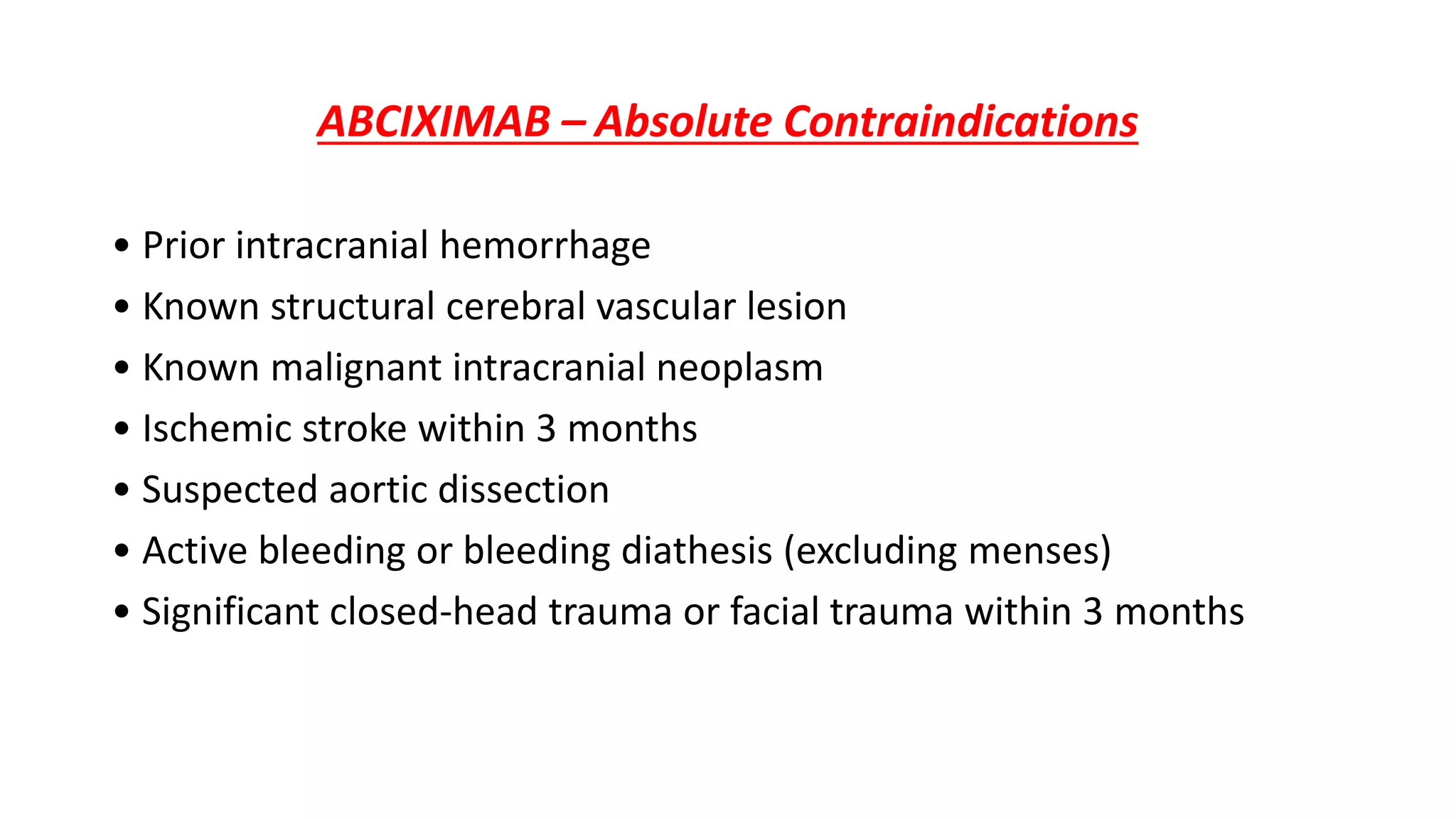
ABCIXIMAB – Absolute Contraindications
• Prior intracranial hemorrhage
• Known structural cerebral vascular lesion
• Known malignant intracranial neoplasm
• Ischemic stroke within 3 months
• Suspected aortic dissection
• Active bleeding or bleeding diathesis (excluding menses)
• Significant closed-head trauma or facial trauma within 3 months
ABCIXIMAB -Relative Contraindications
• Uncontrolled hypertension (systolic blood pressure >180 mm Hg or
diastolic blood pressure >110 mm Hg)
• Traumatic or prolonged CPR or major surgery within 3 weeks
• Recent (within 2-4 weeks) internal bleeding
• Pregnancy
• Active peptic ulcer
• Current use of warfarin and INR >1.7
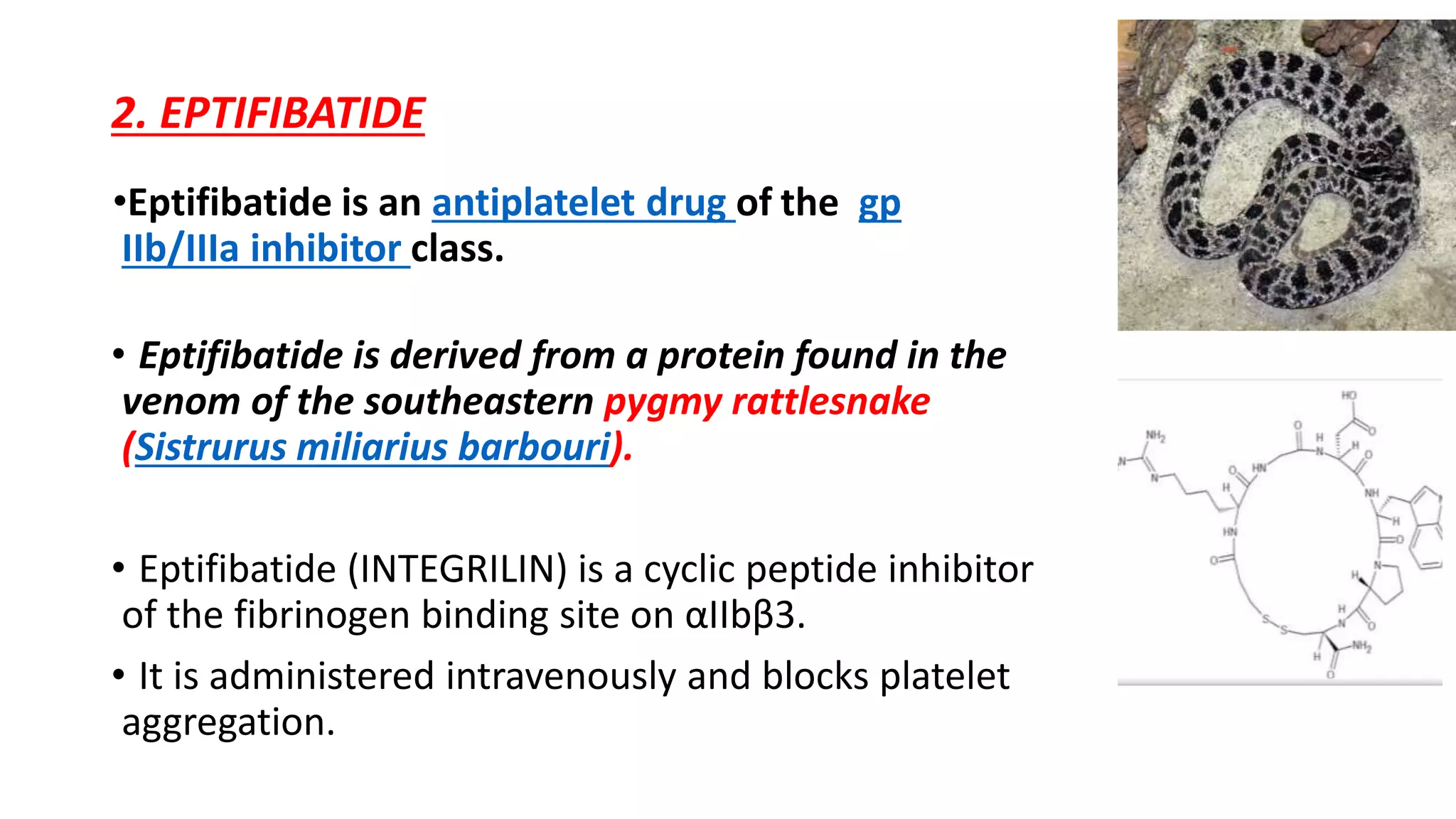
2. EPTIFIBATIDE
•Eptifibatide is an antiplatelet drug of the gp
IIb/IIIa inhibitor class.
• Eptifibatide is derived from a protein found in the
venom of the southeastern pygmy rattlesnake
(Sistrurus miliarius barbouri).
• Eptifibatide (INTEGRILIN) is a cyclic peptide inhibitor
of the fibrinogen binding site on αIIbβ3.
• It is administered intravenously and blocks platelet
aggregation.
EPTIFIBATIDE – doses
• Eptifibatide is given as a bolus of 180 μg/kg followed by 2
μg/kg/min for up to 96 hours.
• The duration of action of the drug is relatively short, and platelet
aggregation is restored within 6-12 hours after cessation of infusion.
EPTIFIBATIDE-Indications
• Acute coronary syndromes
• Myocardial infarction
• Unstable angina
• Percutaneous coronary intervention (PCI). In PCI myocardial infarction
and death have been reduced by ∼20%. Although the drug has not been
compared directly to abciximab, it appears that its benefit is somewhat
less than that obtained with the antibody, perhaps because eptifibatide is
specific for αIIbβ3 and does not react with the vitronectin receptor.
• The drug is generally administered together with aspirin or clopidogrel
and heparin.
EPTIFIBATIDE – Adverse effects
• The major side effect is bleeding, as is the case with abciximab. The
frequency of major bleeding in trials was about 10%, compared with
∼9% in a placebo group, which included heparin.
• Thrombocytopenia has been seen in 0.5-1% of patients.
3. TIROFIBAN
• TIROFIBAN belongs to a class of antiplatelet - GP
IIb/IIIa inhibitors.
• Tirofiban is the first drug candidate whose origins can
be traced to a pharmacophore-based virtual screening
lead.
• It is a modified version of an anticoagulant found in
the venom of the saw-scaled viper Echis carinatus
• Tirofiban (AGGRASTAT) is a nonpeptide, small-
molecule inhibitor of αIIbβ3 that appears to have a
mechanism of action similar to eptifibatide.
TIROFIBAN
• TIROFIBAN has a short duration of action and has efficacy in non-Q-
wave myocardial infarction and unstable angina. Reductions in death
and myocardial infarction have been ∼20% compared to placebo, results
similar to those with eptifibatide.
• TIROFIBAN is administered intravenously at an initial rate of 0.4
μg/kg/min for 30 minutes, and then continued at 0.1 mg/kg/min for 12-
24 hours after angioplasty or atherectomy. It is used in conjunction with
heparin.
• Side effects also are similar to those of EPTIFIBATIDE.
• The agent is specific to αIIbβ3 and does not react with the vitronectin
receptor.
• Meta-analysis of trials using αIIbβ3 inhibitors suggests that their
value in antiplatelet therapy after acute myocardial infarction is
limited.
Summary
• GP IIb/IIIa antagonists are a new class of potent platelet
aggregation inhibitor
• GP IIb/IIIa receptor inhibitors may be beneficial as an
adjunct in acute MI
• Safe and well tolerated
• Further large-scale trials are needed to better delineate a
long-term benefit
T H A N K
Y O U
Gp i ib final

Gp i ib final

  • 1.
    GP IIb/IIIaInhibitors • Dr.Ashishkumar Baheti • 14/02/2020
  • 2.
    Contets : 1. History 2.Gp IIb/IIIa 3. Gp IIb/IIIa inhibitors 4. ABCIXIMAB 5. EPTIFIBATIDE 6. TIROFIBAN 7. Summary
  • 3.
    History • The studyof a rare bleeding diathesis, Glanzmann thrombasthenia, first described in 1918, led to a greater understanding of platelet activation and aggregation mechanisms, including the function of the glycoprotein (GP) IIb/IIIa complex, which allowed the development of a new class of medications. • Patients with Glanzmann thrombasthenia inherit an absence or deficiency of GP IIb/IIIa in an autosomal recessive pattern.
  • 4.
    History • Their plateletsare of normal size and undergo normal activation-related secretion and shape changes; however, they do not bind fibrinogen and cannot form aggregates. • The pharmacologic agents that temporarily mimic this pathologic state are the GP IIb/IIIa antagonists.
  • 5.
    GP IIb/IIIa • Itis an integrin complex on platelet-surface. • Glycoprotein IIb/IIIa is also known as αIIbβ3 • This dimeric glycoprotein is a receptor for fibrinogen and von Willebrand factor. • It aids in platelet activation and aggregation. • The integrin heterodimer/receptor is activated by platelet agonists like collagen, thrombin, TXA2, ADP to develop binding sites for its ligands, which do not bind to resting platelets.
  • 6.
    GP IIb/IIIa • Defectivein cases of Glanzmanns thromboasthenia. (GT) • Targeted by autoantibodies in immune thrombocytopenic purpura (ITP) • Targeted by different medicines collectively called as GP IIb/IIIa Inhibitors.
  • 7.
    GP IIb/IIIa Inhibitors Inhibition of binding to GP IIb/IIIa receptor blocks platelet aggregation induced by any agonist.  GP IIb/IIIa antagonists are a new class of potent platelet aggregation inhibitor which act by blocking key receptor involved in platelet aggregation.
  • 8.
    Classification of GPIIb/IIIa Inhibitors
  • 9.
    GP IIb/IIIa-receptor antagonists– mechanism of action • The glycoprotein IIb/IIIa receptor is exposed on the platelet membrane after activation and is responsible for mediating platelet aggregation.
  • 10.
    GP IIb/IIIa-receptor antagonists– mechanism of action • Once activated, the receptor becomes functional and binds fibrinogen, leading to the formation of platelet aggregates. • Glycoprotein IIb/IIIa receptors therefore mediate the final common pathway of platelet aggregation.
  • 11.
    GP IIb/IIIa-receptor antagonists– mechanism of action • GPIIb/IIIa antagonists hava a high affinity for the fibrinogen receptor…
  • 12.
    GP IIb/IIIa-receptor antagonists– mechanism of action • …and when binding is completed…
  • 13.
    GP IIb/IIIa-receptor antagonists– mechanism of action • …they will prevent fibrinogen from binding to the receptors.
  • 14.
    GP IIb/IIIa-receptor antagonists– pharmacokinetics • Available only for intravenous administration • Intravenous administration of a bolus dose followed by continuous infusion produces constant free plasma concentration throughout the infusion. • At the temination of the infusion period, free plasma concentrations fall rapidly for approximately six hours then decline at a slower rate. • Platelet function generally recovers over the course of 48 hours, although the GP IIb/IIIa antagonist remains in the circulation for 15 days or more in a platelet-bound state.
  • 15.
    GP IIb/IIIa-receptor antagonists– major use Prevention of ischaemic cardiac complications in patients with acute coronary syndrome (ACS) without percutaneous coronary intervention, depending on TIMI risk. During percutaneous coronary interventions (PCI), in combination with aspirin and heparin. (angioplasty with or without intracoronary stent placement).
  • 16.
    GP IIb/IIIa-receptor antagonists– major drawbacks Can only be administered by intravenous injection or infusion and are complicated to manufacture Oral drugs have been investigated but were not effective and have therefore not reached the market
  • 17.
  • 18.
    1. ABCIXIMAB • Itis the Fab fragment of a chimeric monoclonal antibody against GPIIb/IIIa receptor. • GP IIb/IIIa Inhibitor – no platelet aggregation – no blood coagulation • It also binds to the vitronectin receptor on platelets, vascular endothelial cells, and smooth muscle cells.
  • 19.
    ABCIXIMAB-Uses •The antibody isused in conjunction with percutaneous angioplasty for coronary thrombosis •When used along with aspirin and heparin during PCI it is markely reduce the incidence of restenosis, recurrent MI and death. • After a bolus dose platelet aggregation remain inhibited for 12-24 hr, while the remaining antibody is cleared from blood with a t ½ of 10 – 30 min. • It is given as a 0.25 mg/kg bolus followed by 0.125ug/kg/min for 12 hours or longer
  • 20.
    ABCIXIMAB – Adverseeffects • The major side effect of abciximab is bleeding. The frequency of major hemorrhage in clinical trials varies from 1-10%, depending on the intensity of anticoagulation with heparin. • Thrombocytopenia with a platelet count <50,000 occurs in about 2% of patients and may be due to development of neo-epitopes induced by bound antibody. Since the duration of action is long, if major bleeding or emergent surgery occurs, platelet transfusions can reverse the aggregation defect because free antibody concentrations fall rapidly afer cessation of infusion. • Readministration of antibody has been performed in a small number of patients without evidence of decreased efficacy or allergic reactions. • The expense of the antibody limits its use.
  • 21.
    ABCIXIMAB – AbsoluteContraindications • Prior intracranial hemorrhage • Known structural cerebral vascular lesion • Known malignant intracranial neoplasm • Ischemic stroke within 3 months • Suspected aortic dissection • Active bleeding or bleeding diathesis (excluding menses) • Significant closed-head trauma or facial trauma within 3 months
  • 22.
    ABCIXIMAB -Relative Contraindications •Uncontrolled hypertension (systolic blood pressure >180 mm Hg or diastolic blood pressure >110 mm Hg) • Traumatic or prolonged CPR or major surgery within 3 weeks • Recent (within 2-4 weeks) internal bleeding • Pregnancy • Active peptic ulcer • Current use of warfarin and INR >1.7
  • 23.
    2. EPTIFIBATIDE •Eptifibatide isan antiplatelet drug of the gp IIb/IIIa inhibitor class. • Eptifibatide is derived from a protein found in the venom of the southeastern pygmy rattlesnake (Sistrurus miliarius barbouri). • Eptifibatide (INTEGRILIN) is a cyclic peptide inhibitor of the fibrinogen binding site on αIIbβ3. • It is administered intravenously and blocks platelet aggregation.
  • 24.
    EPTIFIBATIDE – doses •Eptifibatide is given as a bolus of 180 μg/kg followed by 2 μg/kg/min for up to 96 hours. • The duration of action of the drug is relatively short, and platelet aggregation is restored within 6-12 hours after cessation of infusion.
  • 25.
    EPTIFIBATIDE-Indications • Acute coronarysyndromes • Myocardial infarction • Unstable angina • Percutaneous coronary intervention (PCI). In PCI myocardial infarction and death have been reduced by ∼20%. Although the drug has not been compared directly to abciximab, it appears that its benefit is somewhat less than that obtained with the antibody, perhaps because eptifibatide is specific for αIIbβ3 and does not react with the vitronectin receptor. • The drug is generally administered together with aspirin or clopidogrel and heparin.
  • 26.
    EPTIFIBATIDE – Adverseeffects • The major side effect is bleeding, as is the case with abciximab. The frequency of major bleeding in trials was about 10%, compared with ∼9% in a placebo group, which included heparin. • Thrombocytopenia has been seen in 0.5-1% of patients.
  • 27.
    3. TIROFIBAN • TIROFIBANbelongs to a class of antiplatelet - GP IIb/IIIa inhibitors. • Tirofiban is the first drug candidate whose origins can be traced to a pharmacophore-based virtual screening lead. • It is a modified version of an anticoagulant found in the venom of the saw-scaled viper Echis carinatus • Tirofiban (AGGRASTAT) is a nonpeptide, small- molecule inhibitor of αIIbβ3 that appears to have a mechanism of action similar to eptifibatide.
  • 28.
    TIROFIBAN • TIROFIBAN hasa short duration of action and has efficacy in non-Q- wave myocardial infarction and unstable angina. Reductions in death and myocardial infarction have been ∼20% compared to placebo, results similar to those with eptifibatide. • TIROFIBAN is administered intravenously at an initial rate of 0.4 μg/kg/min for 30 minutes, and then continued at 0.1 mg/kg/min for 12- 24 hours after angioplasty or atherectomy. It is used in conjunction with heparin.
  • 29.
    • Side effectsalso are similar to those of EPTIFIBATIDE. • The agent is specific to αIIbβ3 and does not react with the vitronectin receptor. • Meta-analysis of trials using αIIbβ3 inhibitors suggests that their value in antiplatelet therapy after acute myocardial infarction is limited.
  • 30.
    Summary • GP IIb/IIIaantagonists are a new class of potent platelet aggregation inhibitor • GP IIb/IIIa receptor inhibitors may be beneficial as an adjunct in acute MI • Safe and well tolerated • Further large-scale trials are needed to better delineate a long-term benefit
  • 31.
    T H AN K Y O U

Editor's Notes

  • #4 Glanzmann's thrombasthenia is an abnormality of the platelets. It is an extremely rare coagulopathy (bleeding disorder due to a blood abnormality), in which the platelets contain defective or low levels of glycoprotein IIb/IIIa (GpIIb/IIIa), which is a receptor for fibrinogen.
  • #5 Glanzmann's thrombasthenia is an abnormality of the platelets. It is an extremely rare coagulopathy (bleeding disorder due to a blood abnormality), in which the platelets contain defective or low levels of glycoprotein IIb/IIIa (GpIIb/IIIa), which is a receptor for fibrinogen.
  • #7 Formed via calcium – dependent association of GP IIb and GPIIIa. Gq
  • #16 The thrombolysis in myocardial infarction (TIMI) risk score is a tool used to predict the chances of having or dying from a heart event for people with: unstable angina, a heart condition that causes chest pain.
  • #19 C7E3 Fab
  • #23 • Noncompressible vascular punctures
  • #26 (low molecular weight or unfractionated)
  • #27 Pediatric patients : Eptifibatide is not indicated in patients below 18 years of age, because no experience exists.
  • #29 (Boersma et al., 2002) The drug is marketed under the brand name AGGRASTAT in the US by Medicure Pharma and the rest of the world by Irokocardio International SARL, Geneva.
  • #30 It is sold in parenteral dosage forms intended and readily constituted for IV administration containing 5 mg or 12.5 mg, respectively. Coagulation parameters turn to normal 4 to 8 hours after the drug is withdrawn.
  • #33 Integrin complex – receptor protein that takes whole thickness of the membranes