Schedule 1
Dr. Ashishkumar Baheti
MD Pharmacology
What is Schedule Y?
2
It’s a Law
not merely
Guidelines
Schedule Y
3
Schedule Y 4
“REQUIREMENTS AND GUIDELINES FOR
PERMISSION TO IMPORT AND / OR
MANUFACTURE OF NEW DRUGS FOR SALE
OR TO UNDERTAKE CLINICAL TRIALS "
Schedule Y
Schedule Y is law established under Drug
and Cosmetic Act,1945 enforced by
CDSCO to be followed when conducting
Clinical Trial in India.
Enforced since 1988
Amended on 2005,2009 and 2011.
5
Purpose of schedule y 6
Enabling India to adopt more sophisticated
regulations to better protect their citizens
and invite more industry, while at the same
time ensuring that the data from India is
more acceptable internationally .
Why India is hottest destination for
conducting global clinical trials ?
8
 Large patient pool
High level of ICH GCP and US FDA standards
compliance
Well trained and experienced Investigators
Favourable regulatory environment
Cost effectiveness (30-50% cost advantage over a
similar trial in Europe or US )
Increasing prevalence of diseases.
Difference between older and amended
Schedule Y
9
Older Schedule Y ( 1988) Amended Schedule Y (2005)
Narrow and restrictive definitions
of clinical trial phases .
Provide pragmatic definition of all
phases
Restriction on number of patients
and centers in early phases of
trials
No such restriction , depend on
protocol requirements
Details of Informed consent
was not given
Details of Informed consent Form
is given .
Ethical committee responsibility
not mentioned
Responsibilities of ethical
committee mentioned.
Post marketing study (Phase 4 )
not mentioned.
Post marketing study (Phase 4 )
mentioned.
Guidelines for Studies in special
populations not given .
Guidelines for Studies in special
populations given .e.g. geriatric ,
child, pregnant etc.
Structure of schedule Y
10
• Application for permission Clinical Trial
• Conduct of clinical trial
• Responsibilities of
Sponsor
Investigator(s),
Ethics Committee
• Informed Consent
• Phases of clinical trial
• Studies in special populations:
Geriatrics
Paediatrics
Pregnant or nursing women
• Post Marketing Surveillance- Periodic Safety Update
Reports
• Special studies: Bioavailability / Bioequivalence
Studies
Application for permission under
FORM 44 and accompanied data as
per Appendix I
1. Chemical and pharmaceutical
Information
2. Animal pharmacology data
3. Animal toxicology data
4. Human clinical pharmacology data
5. Regulatory status in other countries
6. Prescribing Information
11
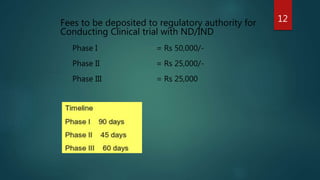
Fees to be deposited to regulatory authority for
Conducting Clinical trial with ND/IND
Phase I = Rs 50,000/-
Phase II = Rs 25,000/-
Phase III = Rs 25,000
12
CLINICAL TRIAL 13
• Clinical trial shall be initiated only after the permission by
the Licensing Authority (LA ) and the approval from
Ethics committee (EC ) .
• Investigator should possess appropriate qualifications,
training and experience and should have access to
proper facilities relevant to protocol.
• Laboratories should be compliant with Good Laboratory
Practices.
• Protocol amendments if any , should be notified to the
Licensing Authority in writing along with the approval
by EC
Responsibilities of 14
 Sponsor
 Investigator
 Ethics
Committee
Responsibilities of Sponsor 15
• Selection of Investigator(s) and study sites.
• Making legal agreement with the Investigator .
• Sponsor should establish detailed SOP’s .
• Study management, data handling and record keeping .
• Compensation for Participation.
• Supply, storage and handling of Pharmaceutical Products
• Sending status reports to regulatory authorities
periodically.
• If any SAE, report to authority within 14 working day
• Properly monitoring study sites .
• Sponsor should perform an audit as a part of QA
system.
• If Premature Termination or Suspension of a Study
,should
notify the investigator, the ethics committee and the
regulatory authorities accordingly.
Responsibilities of Sponsor cont’d. 16
• Medical care of the study subjects .
• Conducting of trial according to the protocol and GCP
guidelines .
• Communication with sponsor and EC
Promptly reporting of any deviations from protocol
to eliminate immediate hazards to the subjects .
SAE and unexpected AE should be reported to the
sponsor within 24hours and to EC within 7 working days
• Ensure the accuracy, completeness, legibility of the data
reported to the sponsor .
• Accountability of investigational product at the study site .
Responsibilities of Investigator
17
Responsibilities of Ethics Committee 18
• To ensure a competent review of all ethical aspects of
the project and execute the same free from any bias .
• To protect the dignity, rights and well being of the
potential research participants .
• Protect vulnerable subjects.
• Obtain and maintain record and SOPs .
• Ongoing review of project based on Periodic progress
report .
Informed Consent
19
Informed Consent 20
• In all trials, informed written consent is required to
be obtained from each subject .
• The Investigator must provide information about study
verbally and using a patient information sheet
(PIS) in a language that is nontechnical and
understandable by the subject.
• Both PIS and ICF should have been approved by the
ethics committee and submit to the Licensing
Authority .
Where a subject is not able to give informed consent
(e.g. unconscious person or a minor or those suffering from
severe mental illness or disability), the same may be
obtained from a legally acceptable representative
(LAR)
If the Subject is unable to read/write - an impartial
witness should be present during consent process who
must append his/her signatures to the consent form.
A checklist of essential elements to be included in ICF
given in Appendix V.
21
Human Pharmacology (Phase I)
• To estimate safety and tolerability .
• Often carried out in healthy adult volunteers using
clinical, physiological and biochemical observations.
• At least 2 subjects should be used on each dose.
• Carried out by investigators trained in clinical
pharmacology and having the necessary facilities to
closely observe and monitor the subjects .
Phases of clinical trial 22
Phases of clinical trial 23
Therapeutic exploratory trials (Phase II)
• To evaluate the effectiveness of a drug for
particular indication.
• To determine the short term side effects and risk
associated with drug .
• These studies are usually limited to 3-4 centres and
carried out by clinicians specialized on the
concerned therapeutic areas .
Phases of clinical trial 24
Therapeutic confirmatory trials (Phase III)
• To obtain evidence about the efficacy and safety of
the drug in a larger number of patients .
• Carried out by clinicians in the concerned
therapeutic areas
• If the drug is already approved in other countries,
phase III data on at least 100 patients distributed
over 3-4 centres should be provided in Indian
patients .
Phases of clinical trial 25
Post Marketing Trials (lV)
• Performed after drug approval and related to
the approved indication .
• To study drug-drug interaction, dose-response
or safety studies, mortality/morbidity studies .
• Should use the same scientific and ethical
standards as applied in pre-marketing studies
Studies in special
populations
26
Studies in special populations :
Geriatrics
27
Geriatric patients can be included in clinical study only if
• Disease to be treated is characteristically a disease of
aging
• Population to be treated having substantial
numbers of geriatric patients
• When the new drug is likely to alter the
geriatric patient’s response.
Paediatrics patients can be included in clinical trials
only if
• If the new drug is for disease exclusively affecting
paediatric patients .
• If the new drug is intended to treat serious or life-
threatening diseases, occurring in both adults and
paediatric patients .
Studies in special populations :
Paediatrics
28
Written informed consent should be obtained from the
parent/legal guardian. However, paediatric patients should
be informed to fullest extent .
If a paediatric patient wishes to withdraw from study of
serious or life-threatening diseases , continued
parental/legal guardian consent .
Studies in special populations
:Paediatrics
29
Carried out after the phase III clinical trials in adults, can be
studied earlier only if , disease occurs primarily in children .
Studies in special populations
:Pregnant or nursing women
30
• Drug is intended for use by pregnant/nursing
women or foetuses/nursing infants .
E.g.
To test the efficacy and safety of a drug for reducing
perinatal transmission of HIV infection .
• Follow-up data on the pregnancy, foetus and child
will be required .
• Where applicable, excretion of the drug or its
metabolites into human milk should be examined .
Pregnant or nursing women should be included in
clinical trials only when
New drugs should be closely monitored for their safety once
they are marketed.
The applicants shall furnish Periodic Safety Update Reports
(PSURs) in order to
• Report all the relevant new information (patient exposure)
• Summarize the market authorization status in different
countries and any significant variations related to safety
• Indicate whether changes should be made to product
information
PSURs shall be submitted every 6 months for the first two
years
For subsequent two years – annually .
Post marketing surveillance
:Periodic Safety Update Reports 31
Special studies:
Bioavailability/Bioequivalence Studies
32
• For drugs approved elsewhere in the world and
absorbed systemically, bioequivalence study with
the reference formulation should be carried out.
• Evaluation of the effect of
food should be carried out
• Dissolution and bioavailability
data to be submitted
• All BA / BE studies should be
conducted according to the
prescribed guidelines (ICMR guidelines)
Appendices 33
APPENDIX I -Data to be submitted along with the application to
conduct clinical trials/import/ manufacture of New drugs .
APPENDIX ll - Structure, Contents and Format for Clinical Study
Reports
APPENDIX lll -Format of Animal Toxicology
APPENDIX lV - Format of Animal Pharmacology
APPENDIX V - Format of Informed Consent
APPENDIX Vl - Requirements for approval of Fixed Dose
Combinations
APPENDIX Vll - Undertaking by Investigator
APPENDIX Vlll - Ethics Committee
APPENDIX lX - Stability testing of New Drugs
APPENDIX X - Contents of the proposed protocol for conducting
clinical trials
APPENDIX Xl - Data elements for reporting serious adverse events
occurring in a Clinical Trial.
34

Schedule y

  • 1.
    Schedule 1 Dr. AshishkumarBaheti MD Pharmacology
  • 2.
  • 3.
    It’s a Law notmerely Guidelines Schedule Y 3
  • 4.
    Schedule Y 4 “REQUIREMENTSAND GUIDELINES FOR PERMISSION TO IMPORT AND / OR MANUFACTURE OF NEW DRUGS FOR SALE OR TO UNDERTAKE CLINICAL TRIALS "
  • 5.
    Schedule Y Schedule Yis law established under Drug and Cosmetic Act,1945 enforced by CDSCO to be followed when conducting Clinical Trial in India. Enforced since 1988 Amended on 2005,2009 and 2011. 5
  • 6.
    Purpose of scheduley 6 Enabling India to adopt more sophisticated regulations to better protect their citizens and invite more industry, while at the same time ensuring that the data from India is more acceptable internationally .
  • 7.
    Why India ishottest destination for conducting global clinical trials ? 8  Large patient pool High level of ICH GCP and US FDA standards compliance Well trained and experienced Investigators Favourable regulatory environment Cost effectiveness (30-50% cost advantage over a similar trial in Europe or US ) Increasing prevalence of diseases.
  • 8.
    Difference between olderand amended Schedule Y 9 Older Schedule Y ( 1988) Amended Schedule Y (2005) Narrow and restrictive definitions of clinical trial phases . Provide pragmatic definition of all phases Restriction on number of patients and centers in early phases of trials No such restriction , depend on protocol requirements Details of Informed consent was not given Details of Informed consent Form is given . Ethical committee responsibility not mentioned Responsibilities of ethical committee mentioned. Post marketing study (Phase 4 ) not mentioned. Post marketing study (Phase 4 ) mentioned. Guidelines for Studies in special populations not given . Guidelines for Studies in special populations given .e.g. geriatric , child, pregnant etc.
  • 9.
    Structure of scheduleY 10 • Application for permission Clinical Trial • Conduct of clinical trial • Responsibilities of Sponsor Investigator(s), Ethics Committee • Informed Consent • Phases of clinical trial • Studies in special populations: Geriatrics Paediatrics Pregnant or nursing women • Post Marketing Surveillance- Periodic Safety Update Reports • Special studies: Bioavailability / Bioequivalence Studies
  • 10.
    Application for permissionunder FORM 44 and accompanied data as per Appendix I 1. Chemical and pharmaceutical Information 2. Animal pharmacology data 3. Animal toxicology data 4. Human clinical pharmacology data 5. Regulatory status in other countries 6. Prescribing Information 11
  • 11.
    Fees to bedeposited to regulatory authority for Conducting Clinical trial with ND/IND Phase I = Rs 50,000/- Phase II = Rs 25,000/- Phase III = Rs 25,000 12
  • 12.
    CLINICAL TRIAL 13 •Clinical trial shall be initiated only after the permission by the Licensing Authority (LA ) and the approval from Ethics committee (EC ) . • Investigator should possess appropriate qualifications, training and experience and should have access to proper facilities relevant to protocol. • Laboratories should be compliant with Good Laboratory Practices. • Protocol amendments if any , should be notified to the Licensing Authority in writing along with the approval by EC
  • 13.
    Responsibilities of 14 Sponsor  Investigator  Ethics Committee
  • 14.
    Responsibilities of Sponsor15 • Selection of Investigator(s) and study sites. • Making legal agreement with the Investigator . • Sponsor should establish detailed SOP’s . • Study management, data handling and record keeping . • Compensation for Participation. • Supply, storage and handling of Pharmaceutical Products
  • 15.
    • Sending statusreports to regulatory authorities periodically. • If any SAE, report to authority within 14 working day • Properly monitoring study sites . • Sponsor should perform an audit as a part of QA system. • If Premature Termination or Suspension of a Study ,should notify the investigator, the ethics committee and the regulatory authorities accordingly. Responsibilities of Sponsor cont’d. 16
  • 16.
    • Medical careof the study subjects . • Conducting of trial according to the protocol and GCP guidelines . • Communication with sponsor and EC Promptly reporting of any deviations from protocol to eliminate immediate hazards to the subjects . SAE and unexpected AE should be reported to the sponsor within 24hours and to EC within 7 working days • Ensure the accuracy, completeness, legibility of the data reported to the sponsor . • Accountability of investigational product at the study site . Responsibilities of Investigator 17
  • 17.
    Responsibilities of EthicsCommittee 18 • To ensure a competent review of all ethical aspects of the project and execute the same free from any bias . • To protect the dignity, rights and well being of the potential research participants . • Protect vulnerable subjects. • Obtain and maintain record and SOPs . • Ongoing review of project based on Periodic progress report .
  • 18.
  • 19.
    Informed Consent 20 •In all trials, informed written consent is required to be obtained from each subject . • The Investigator must provide information about study verbally and using a patient information sheet (PIS) in a language that is nontechnical and understandable by the subject. • Both PIS and ICF should have been approved by the ethics committee and submit to the Licensing Authority .
  • 20.
    Where a subjectis not able to give informed consent (e.g. unconscious person or a minor or those suffering from severe mental illness or disability), the same may be obtained from a legally acceptable representative (LAR) If the Subject is unable to read/write - an impartial witness should be present during consent process who must append his/her signatures to the consent form. A checklist of essential elements to be included in ICF given in Appendix V. 21
  • 21.
    Human Pharmacology (PhaseI) • To estimate safety and tolerability . • Often carried out in healthy adult volunteers using clinical, physiological and biochemical observations. • At least 2 subjects should be used on each dose. • Carried out by investigators trained in clinical pharmacology and having the necessary facilities to closely observe and monitor the subjects . Phases of clinical trial 22
  • 22.
    Phases of clinicaltrial 23 Therapeutic exploratory trials (Phase II) • To evaluate the effectiveness of a drug for particular indication. • To determine the short term side effects and risk associated with drug . • These studies are usually limited to 3-4 centres and carried out by clinicians specialized on the concerned therapeutic areas .
  • 23.
    Phases of clinicaltrial 24 Therapeutic confirmatory trials (Phase III) • To obtain evidence about the efficacy and safety of the drug in a larger number of patients . • Carried out by clinicians in the concerned therapeutic areas • If the drug is already approved in other countries, phase III data on at least 100 patients distributed over 3-4 centres should be provided in Indian patients .
  • 24.
    Phases of clinicaltrial 25 Post Marketing Trials (lV) • Performed after drug approval and related to the approved indication . • To study drug-drug interaction, dose-response or safety studies, mortality/morbidity studies . • Should use the same scientific and ethical standards as applied in pre-marketing studies
  • 25.
  • 26.
    Studies in specialpopulations : Geriatrics 27 Geriatric patients can be included in clinical study only if • Disease to be treated is characteristically a disease of aging • Population to be treated having substantial numbers of geriatric patients • When the new drug is likely to alter the geriatric patient’s response.
  • 27.
    Paediatrics patients canbe included in clinical trials only if • If the new drug is for disease exclusively affecting paediatric patients . • If the new drug is intended to treat serious or life- threatening diseases, occurring in both adults and paediatric patients . Studies in special populations : Paediatrics 28
  • 28.
    Written informed consentshould be obtained from the parent/legal guardian. However, paediatric patients should be informed to fullest extent . If a paediatric patient wishes to withdraw from study of serious or life-threatening diseases , continued parental/legal guardian consent . Studies in special populations :Paediatrics 29 Carried out after the phase III clinical trials in adults, can be studied earlier only if , disease occurs primarily in children .
  • 29.
    Studies in specialpopulations :Pregnant or nursing women 30 • Drug is intended for use by pregnant/nursing women or foetuses/nursing infants . E.g. To test the efficacy and safety of a drug for reducing perinatal transmission of HIV infection . • Follow-up data on the pregnancy, foetus and child will be required . • Where applicable, excretion of the drug or its metabolites into human milk should be examined . Pregnant or nursing women should be included in clinical trials only when
  • 30.
    New drugs shouldbe closely monitored for their safety once they are marketed. The applicants shall furnish Periodic Safety Update Reports (PSURs) in order to • Report all the relevant new information (patient exposure) • Summarize the market authorization status in different countries and any significant variations related to safety • Indicate whether changes should be made to product information PSURs shall be submitted every 6 months for the first two years For subsequent two years – annually . Post marketing surveillance :Periodic Safety Update Reports 31
  • 31.
    Special studies: Bioavailability/Bioequivalence Studies 32 •For drugs approved elsewhere in the world and absorbed systemically, bioequivalence study with the reference formulation should be carried out. • Evaluation of the effect of food should be carried out • Dissolution and bioavailability data to be submitted • All BA / BE studies should be conducted according to the prescribed guidelines (ICMR guidelines)
  • 32.
    Appendices 33 APPENDIX I-Data to be submitted along with the application to conduct clinical trials/import/ manufacture of New drugs . APPENDIX ll - Structure, Contents and Format for Clinical Study Reports APPENDIX lll -Format of Animal Toxicology APPENDIX lV - Format of Animal Pharmacology APPENDIX V - Format of Informed Consent APPENDIX Vl - Requirements for approval of Fixed Dose Combinations APPENDIX Vll - Undertaking by Investigator APPENDIX Vlll - Ethics Committee APPENDIX lX - Stability testing of New Drugs APPENDIX X - Contents of the proposed protocol for conducting clinical trials APPENDIX Xl - Data elements for reporting serious adverse events occurring in a Clinical Trial.
  • 33.