A Presentation
on
Growth and Trade
Presented by,
Mahabub Hasan
Development Studies Discipline
Khulna University, Khulna
Bangladesh.
Introduction
• Trade promotes growth enhancing economic welfare
by stimulating more efficient utilization of resources.
Factor endowments of different regions enabling
people to obtain goods from efficient sources of
supply
• Trade accelerate economic growth and has effect
poverty.
• During the 19th and 20th centuries trade has played a
leading role in bringing about global economic
growth.
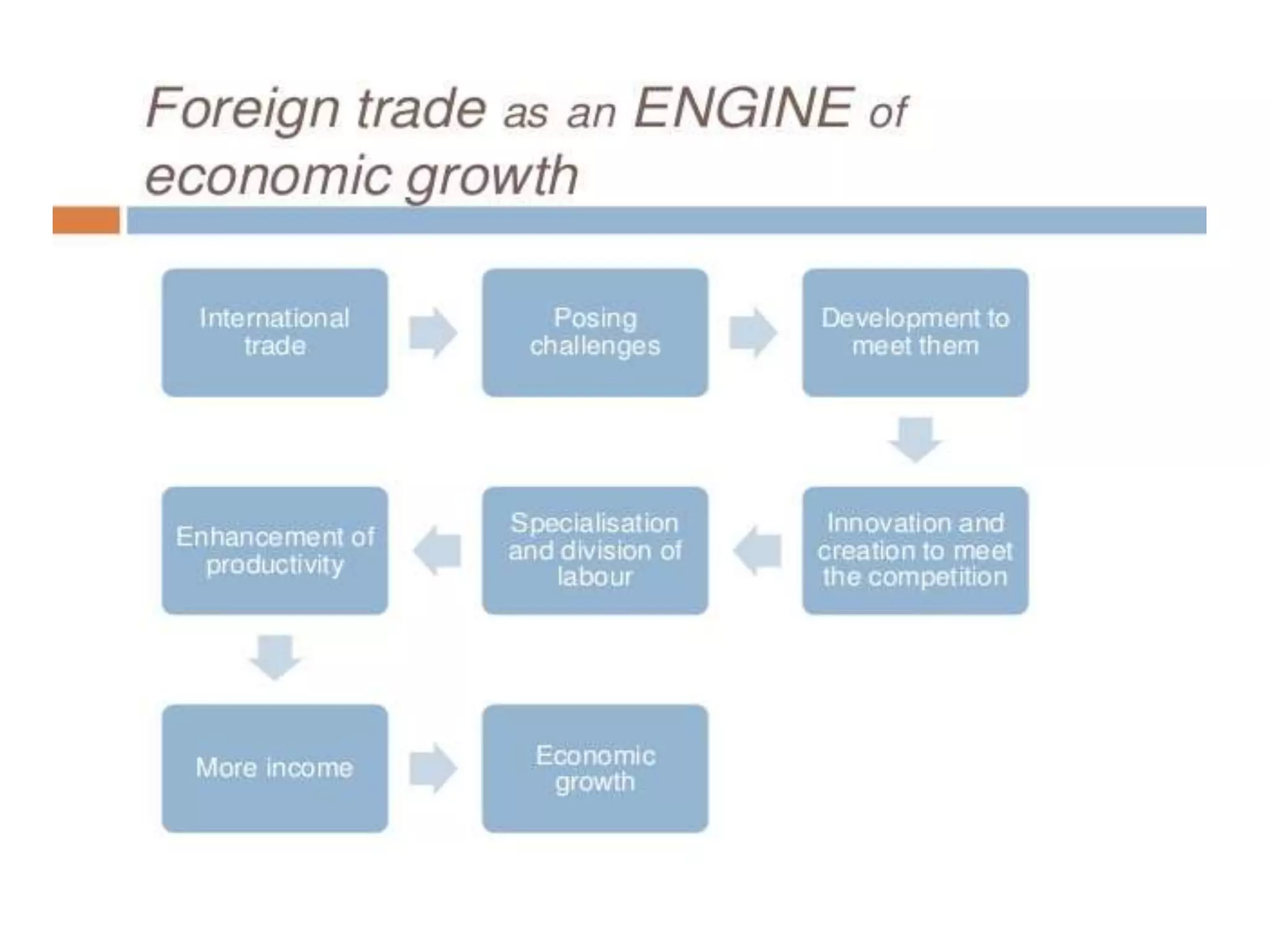
Trade as an Engine of Economic
Growth
• Trade: Trade is all commercial transactions private
and governmental, sales investment, logistics and
transportations that take place between two or more
regions, countries and nations beyond their political
boundary.
• Economic growth: Economic growth is the increase
in the amount of the goods and services produced by
an economy over time
• Economic growth typically refers to growth of
potential output.
Trade as an Engine of Economic
Growth
• Foreign trade market for a country’s output. Exports
lead to increase enlarge in national output and
become an engine of growth.
• Increase exports lead to greater utilization of exixting
capacities, reduce costs which may lead to further
increase in exports.
• Expanding exports provide greater employment
opportunities.
Trade as an Engine of Economic
Growth
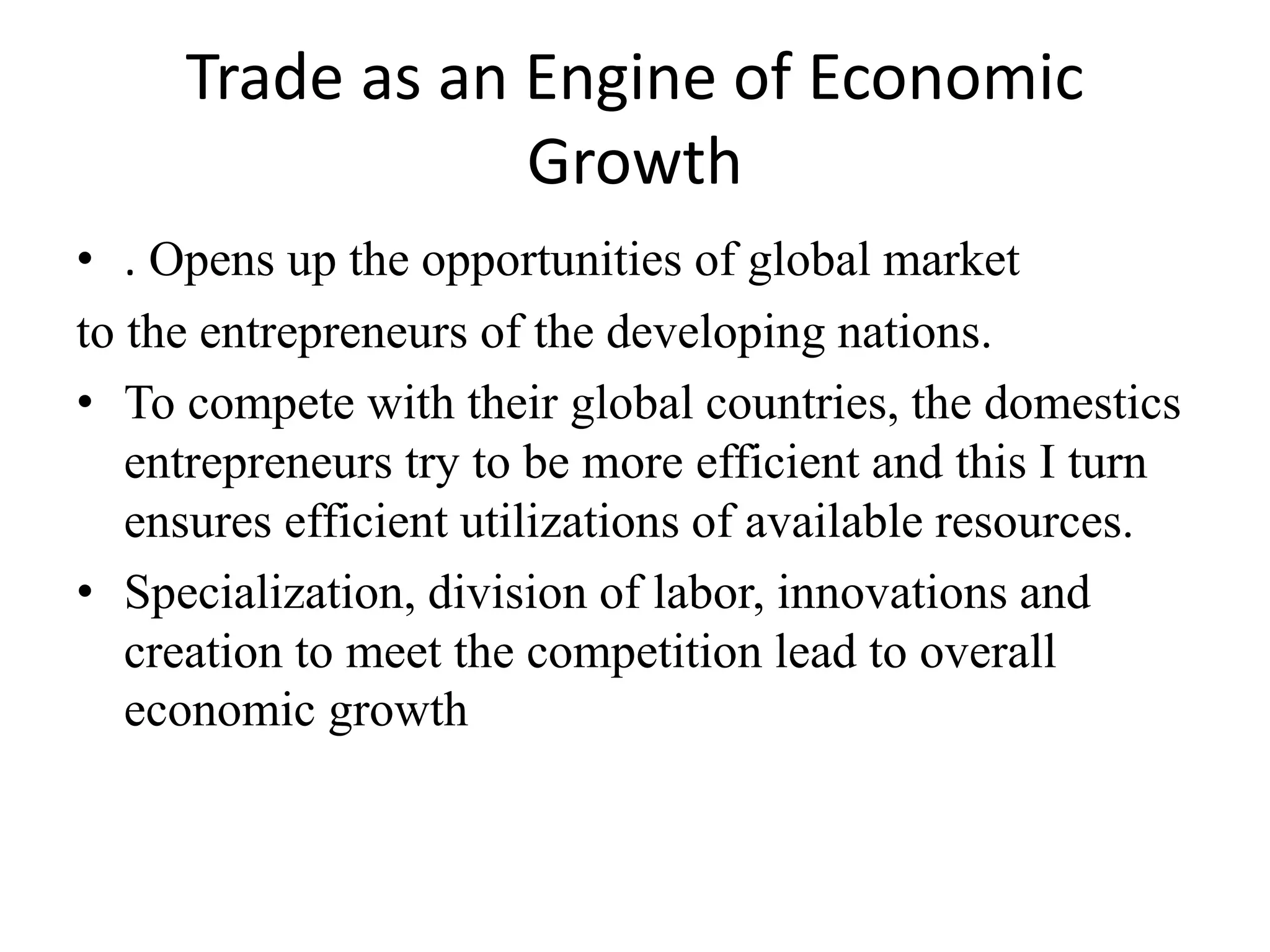
• . Opens up the opportunities of global market
to the entrepreneurs of the developing nations.
• To compete with their global countries, the domestics
entrepreneurs try to be more efficient and this I turn
ensures efficient utilizations of available resources.
• Specialization, division of labor, innovations and
creation to meet the competition lead to overall
economic growth
Sources of Economic Growth
 There are four important factors of economic growth of a country
which help to shift the PPF outward and thus increases the
economic growth. The four important factors are,
1. Natural Resources : The important natural resources here are
arable land, oil and gas, forests, water, mineral resources and
their quality and quantity.
2. Human Resources: The quantity of labour is a factor that
contribute to growth. The supply of labour and the quality of
labour force is important human resource. It is said that “larger is
the labour force and further out is the PPF .”
Continue…
3. Physical capital and technological factors : Physical capitals
include factories, machineries, shops, malls, offices, motor
vehicles and their quality or quantity. Technological factors
include appropriate technology, new production methods and
informational Technology.
4. Institutional Factors: Institutional factors are finance and
banking system, education system, health care, infrastructure and
political stability.
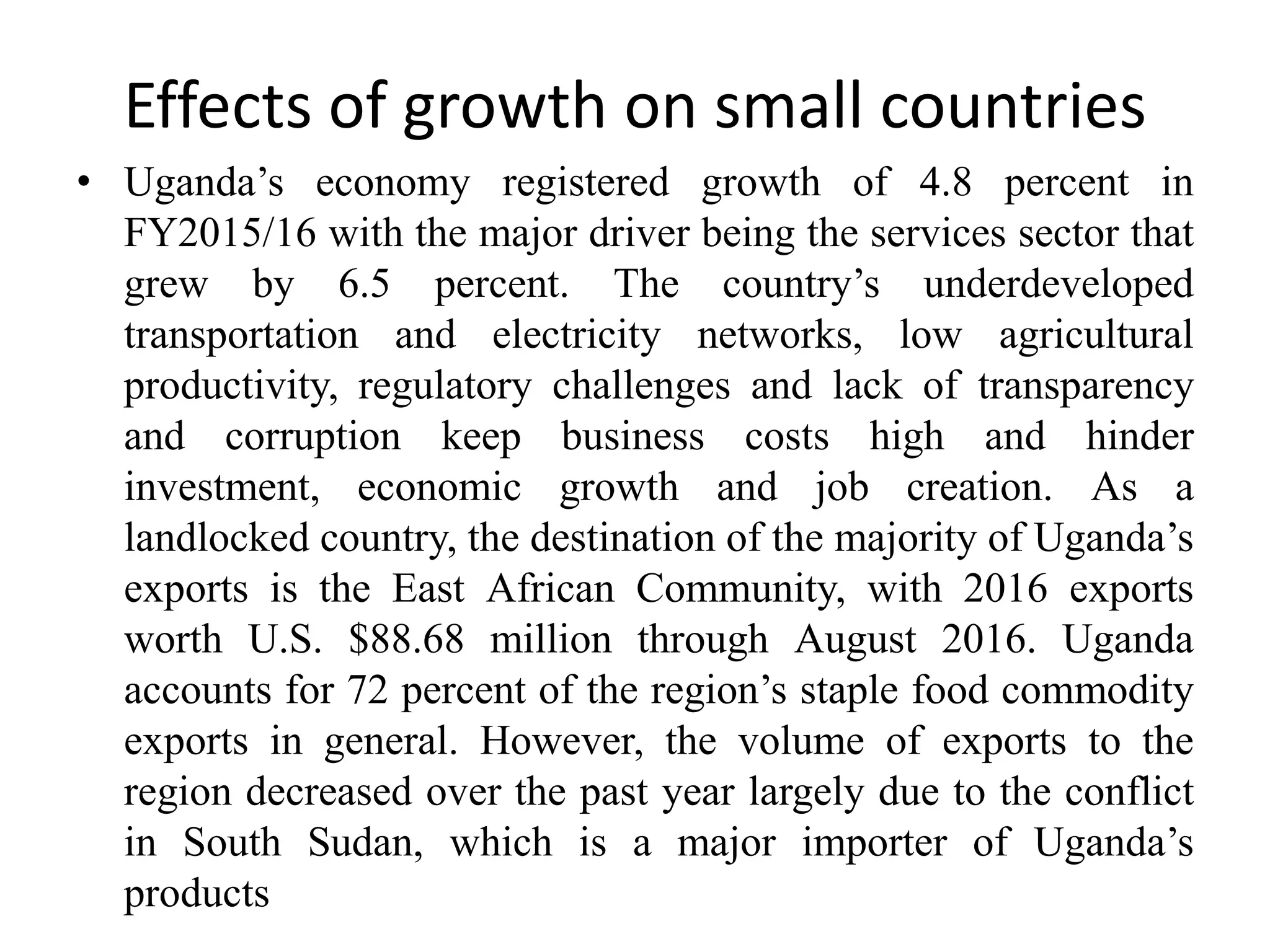
Effects of growth on small countries
• Uganda’s economy registered growth of 4.8 percent in
FY2015/16 with the major driver being the services sector that
grew by 6.5 percent. The country’s underdeveloped
transportation and electricity networks, low agricultural
productivity, regulatory challenges and lack of transparency
and corruption keep business costs high and hinder
investment, economic growth and job creation. As a
landlocked country, the destination of the majority of Uganda’s
exports is the East African Community, with 2016 exports
worth U.S. $88.68 million through August 2016. Uganda
accounts for 72 percent of the region’s staple food commodity
exports in general. However, the volume of exports to the
region decreased over the past year largely due to the conflict
in South Sudan, which is a major importer of Uganda’s
products
Positive effect of economics on large
countries
• Improved living standards
• Reduction in poverty
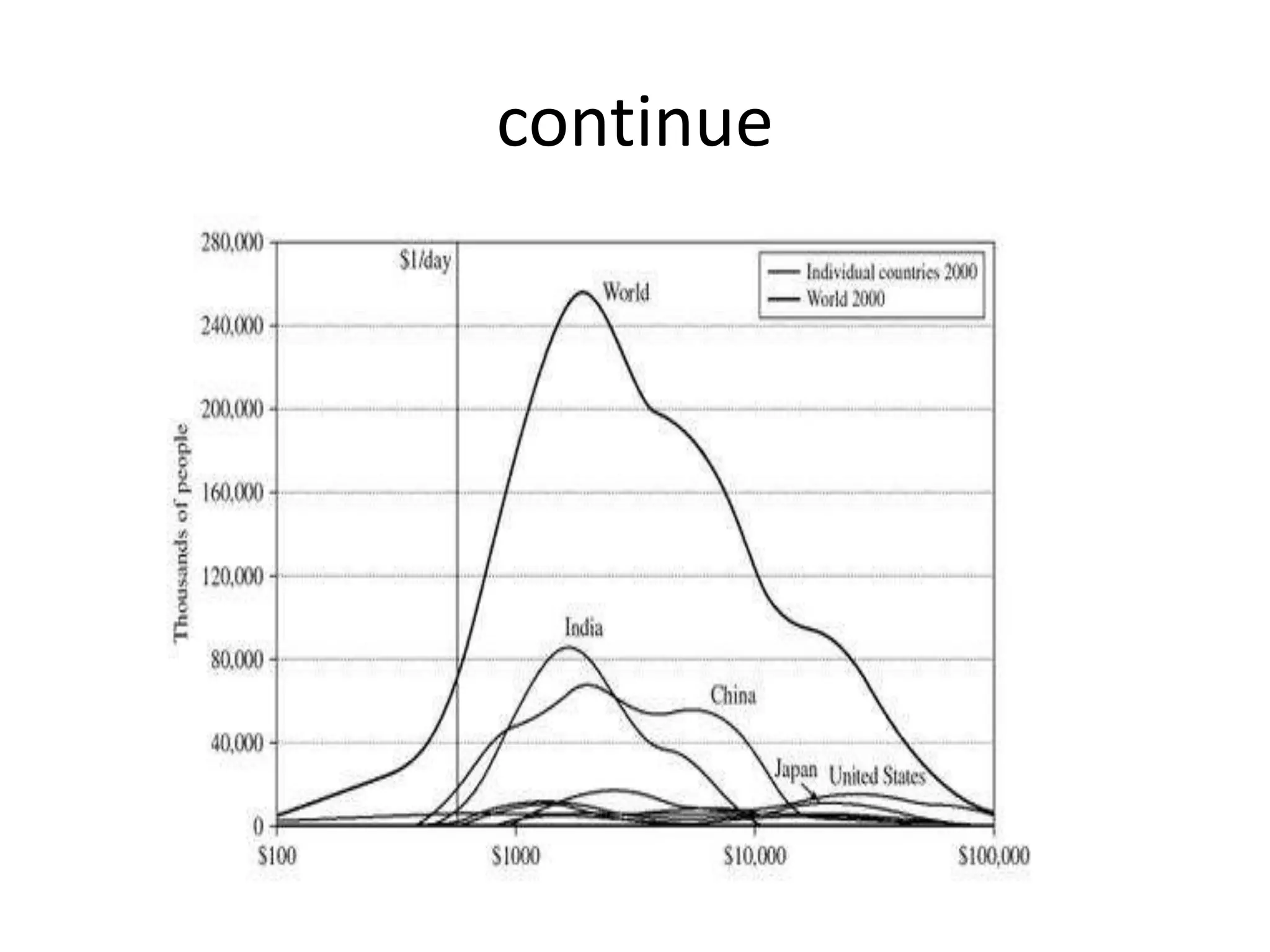
Figure 1 The World Distribution Of Income In 1970
continue
• Education
• Health
• Improve Technology and infrastructure.
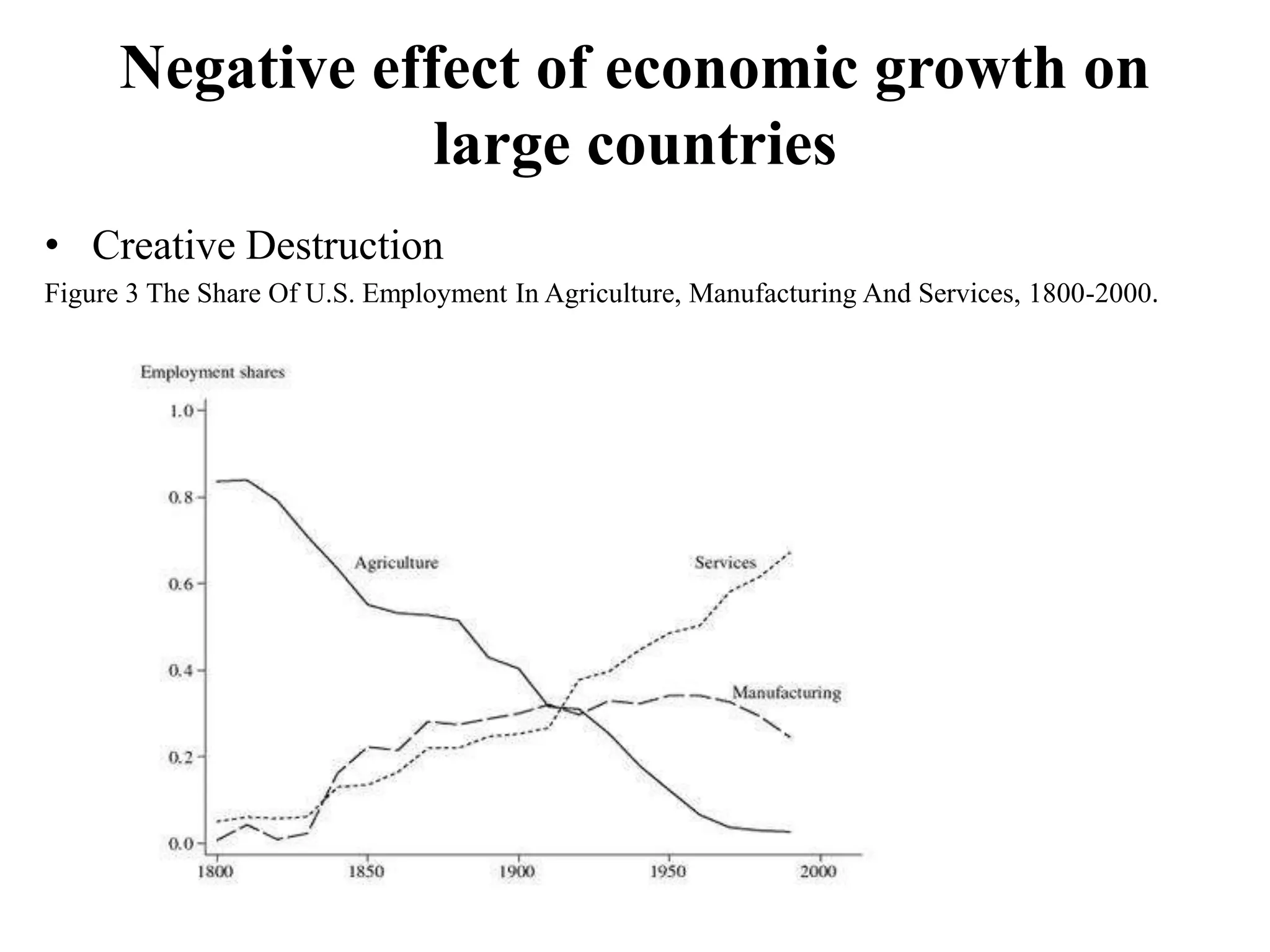
Negative effect of economic growth on
large countries
• Creative Destruction
Figure 3 The Share Of U.S. Employment In Agriculture, Manufacturing And Services, 1800-2000.
Continue..
• Health Challenges
• Increase in Income Inequality
• Increased Pollution
Trade Liberalization
Trade liberalization is the removal or reduction of restrictions or
barriers on the free exchange of goods between nations. This includes
the removal or reduction of tariff obstacles, and nontariff obstacles,
such as licensing rules, and other requirements. The easing or
eradication of these restrictions is often referred to as promoting “free
trade."
Trade liberalization involves:
 Reducing tariffs
 Reducing / eliminating quotas
 Reducing non-tariff barriers.
• Non-tariff barriers are factors that make trade difficult and
expensive. For example, having specific regulations on making
goods can give an unfair advantage to domestic producers.
Harmonizing environmental and safety legislation makes it easier
for international trade.
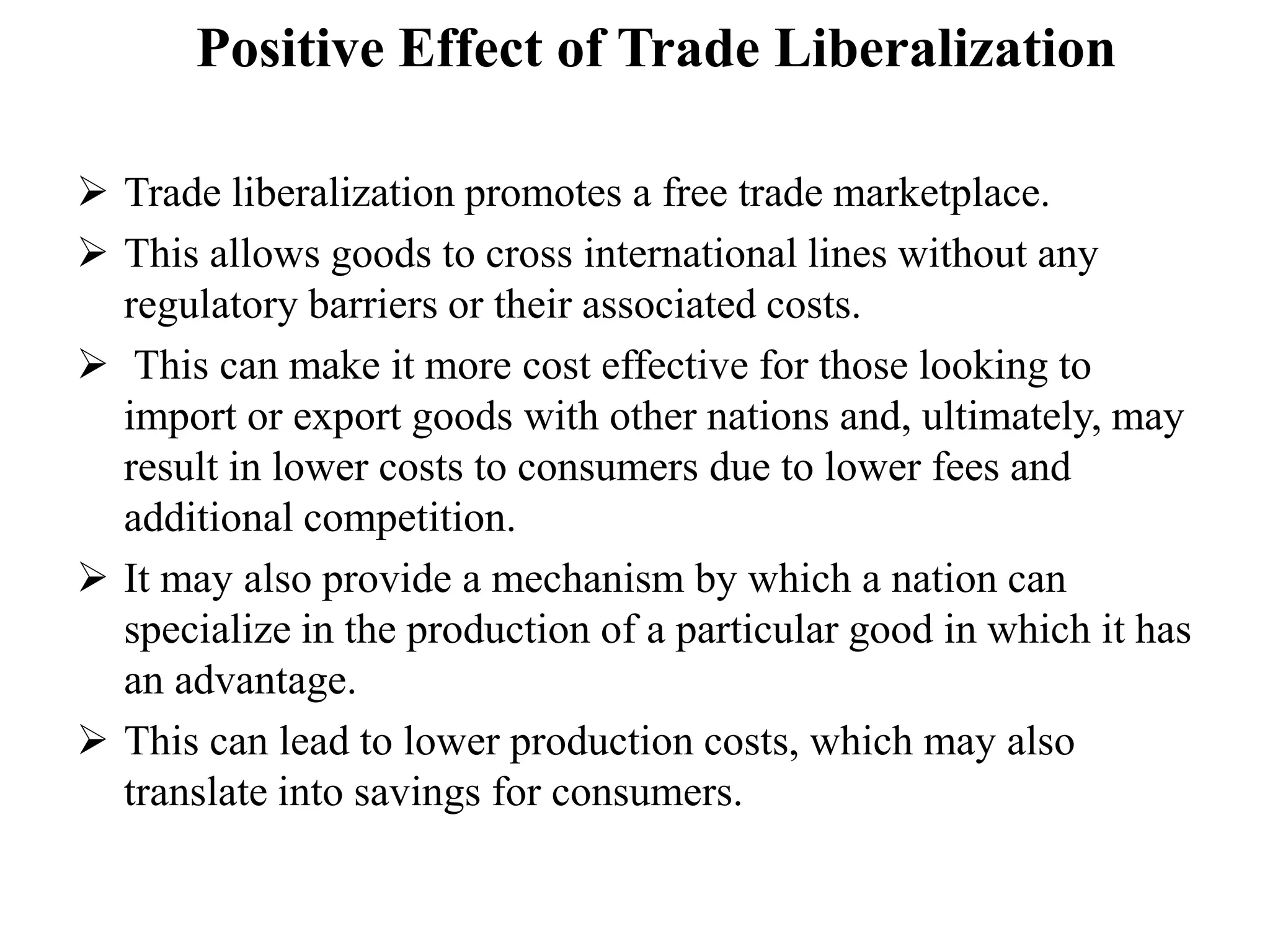
Positive Effect of Trade Liberalization
 Trade liberalization promotes a free trade marketplace.
 This allows goods to cross international lines without any
regulatory barriers or their associated costs.
 This can make it more cost effective for those looking to
import or export goods with other nations and, ultimately, may
result in lower costs to consumers due to lower fees and
additional competition.
 It may also provide a mechanism by which a nation can
specialize in the production of a particular good in which it has
an advantage.
 This can lead to lower production costs, which may also
translate into savings for consumers.
Negative Effect of Trade liberalization
• Trade liberalization is a good thing for growth
but the effect is not that great.
• In an early theoretical view it’s accepted that
trade liberalization can enhance growth BUT
under certain conditions (reforms, policies)
• Trade liberalization has raised the growth of
exports, but has raised the growth of imports
more,
• Trade liberalization has not been accompanied by a
reduction in world poverty (in absolute numbers).
• Trade liberalization has almost certainly increased
international inequality.
• It has led to massive trade deficits.
• the distribution of wealth is always not appropriate
and the negative external effects on the environment.
• the bargaining power between the trading partner is
uneven distributed, the chance of exploitation is
increased for the selling country.
• Trade liberalization has worsened the trade balance and the
trade-off between growth and the balance of payments
• Trade liberalization would raise the price of developing
countries’ abundant factor (unskilled-labor), thus reducing the
skilled wage premium and wage inequality
• -Decreases national sovereignty since foreign influence is
amplified with trade liberalization
• Lack of competition leads to worse products and a lack of
progress.
• Comparative advantage is just a sophisticated way to justify
cheap labor.
• With growth, argument for trade liberalization
even weaker
• Most of growth is related to technological
progress (Solow, 1957)
• Market failures are pervasive (Arrow, Stiglitz)
• liberalization have positive effect on overall
productivity of domestic firms, although the
least productive firms may have to close.
Reasons for positive effect:
Trade Liberalization - Growth & Poverty
 Trade openness are now widely accepted to be connected to economic
growth.
 However the relationship between trade liberalization and poverty is less
clear and still unsettled.
 It is responsible to expect that increased trade will generate growth and
employment in an economy.
 However it is also expected that the effects of trade liberalization will not
be equal for all sectors.
Continue...
 There will be winners and losers and poorest segments of a society may
not have the opportunity for taking advantage of trade liberalization as
an engine of growth without appropriate complementary policies.
 Trade openness has raised the growth of exports, but has raised the
imports more. Worsening the balance of trade as a percentage of GDP
and the trade-off between growth and balance of payments. The trade
reform are often associated with the creation or destruction of markets.
Does trade liberalization decrease
poverty
Case Study…
 SAFTA - In early 2004, South Asian Free Trade Agreement was signed.
 SAFTA has come into force 1 July 2006, with the aim of reducing
tariffs for intraregional trade among the 7 SAARC members.
Problems in SAFTA -
 Ineffective and slow tariffs reduction
 Long negative lists
 Phasing out of the negative list or eliminating NTB's.
 Rules of origin
 Investment and services
 Regional politics
Continue…
 New era of BFTA's
 Because of slow progress in SAFTA,
 BFTA's are now reality.
 BFTA's are more attractive than SAFTA
 According to UNCTAD report 2002, LDC's countries are less
beneficiary from trade liberalization and became more import oriented.
High interest of loan, lack of FDI & industrial development are
responsible for that.
 WTO - African countries are still face the problem of economic growth
and poverty. Because high rate of population growth and unbalanced
economy.
 Already developed countries like USA, Japan, China are the most
beneficial countries of trade liberalization. It helps them to increase
their economic growth and sustainability.
Trade Barrier
What is trade barrier: A government-imposed
restriction on trade with other countries, typically
used to protect domestic producers. It is any
regulation or policy that restricts international trade,
especially tariffs, quotas etc.
• Trade barriers are measures that governments or
public authorities introduce to make imported goods
or services less competitive than locally produced
goods and services. Not everything that prevents or
restricts trade can be characterized as a trade barrier.
Free trade vs. trade barriers
• Nations can trade freely with each other or there are
trade barriers.
free trade: nothing hinders or gets in the way from
tow nations trading with each other.
• Sometimes countries complain about trade. They say
that too much trade cause workers to lose jobs.
Therefore, countries sometimes try to limit trade by
creating trade barriers.
Types of trade barriers
• There are two major types of trade barriers we found.
those are tariffs and non-tariffs barriers.
• Tariffs: A tax imposed on imported goods and services.
Tariffs are used to restrict trade, as they increase the
price of imported goods and services, making them
more expensive to consumers.
• Non-tariff barriers: A form of restrictive trade where
barriers to trade are set up and take a form other than
a tariff. Nontariff barriers include quotas, levies,
embargoes, sanctions and other restrictions, and are
frequently used by large and developed economies.
• The most common types of trade barriers are tariffs
and quotas.
• A tariff is a tax on imports (imports are goods
purchased from other countries and exports are goods
sold to other countries).
• A quota is specific limit placed on the number of
imports that may enter a country. It is a limit on
amount of goods that can be imported.
• Another type of trade barrier is an embargo. A
complete trade block for a political purpose.
Benefits of trade barriers
Trade barriers provide many benefits:
 Protect homeland industries from competition.
 Protect jobs.
 Help provide extra income for the government.
 Increases the number of goods people can choose
from .
 Decreases the costs of these goods through increased
competition.
Costs of trade barriers
Tariffs increase the price of imported goods.
Less competition from world markets means
there is an increase in the price.
The tax on imported goods is passed along to
the consumer so the price of imported goods
higher.
 Distortion:
• When prices and production are higher or lower than levels
that would usually exist in a competitive market that is called
distortion
 Trade distortion:
• A policy that alters the amount of trade, up or down, from
what it would otherwise be. Agricultural subsidies, even if not
based on quantity of exports , are trade distorting unless they
are paid independently of whether and how much farmers
produce.
Thank You

A presentation on growth and trade

  • 1.
    A Presentation on Growth andTrade Presented by, Mahabub Hasan Development Studies Discipline Khulna University, Khulna Bangladesh.
  • 2.
    Introduction • Trade promotesgrowth enhancing economic welfare by stimulating more efficient utilization of resources. Factor endowments of different regions enabling people to obtain goods from efficient sources of supply • Trade accelerate economic growth and has effect poverty. • During the 19th and 20th centuries trade has played a leading role in bringing about global economic growth.
  • 3.
    Trade as anEngine of Economic Growth • Trade: Trade is all commercial transactions private and governmental, sales investment, logistics and transportations that take place between two or more regions, countries and nations beyond their political boundary. • Economic growth: Economic growth is the increase in the amount of the goods and services produced by an economy over time • Economic growth typically refers to growth of potential output.
  • 5.
    Trade as anEngine of Economic Growth • Foreign trade market for a country’s output. Exports lead to increase enlarge in national output and become an engine of growth. • Increase exports lead to greater utilization of exixting capacities, reduce costs which may lead to further increase in exports. • Expanding exports provide greater employment opportunities.
  • 6.
    Trade as anEngine of Economic Growth • . Opens up the opportunities of global market to the entrepreneurs of the developing nations. • To compete with their global countries, the domestics entrepreneurs try to be more efficient and this I turn ensures efficient utilizations of available resources. • Specialization, division of labor, innovations and creation to meet the competition lead to overall economic growth
  • 7.
    Sources of EconomicGrowth  There are four important factors of economic growth of a country which help to shift the PPF outward and thus increases the economic growth. The four important factors are, 1. Natural Resources : The important natural resources here are arable land, oil and gas, forests, water, mineral resources and their quality and quantity. 2. Human Resources: The quantity of labour is a factor that contribute to growth. The supply of labour and the quality of labour force is important human resource. It is said that “larger is the labour force and further out is the PPF .”
  • 8.
    Continue… 3. Physical capitaland technological factors : Physical capitals include factories, machineries, shops, malls, offices, motor vehicles and their quality or quantity. Technological factors include appropriate technology, new production methods and informational Technology. 4. Institutional Factors: Institutional factors are finance and banking system, education system, health care, infrastructure and political stability.
  • 9.
    Effects of growthon small countries • Uganda’s economy registered growth of 4.8 percent in FY2015/16 with the major driver being the services sector that grew by 6.5 percent. The country’s underdeveloped transportation and electricity networks, low agricultural productivity, regulatory challenges and lack of transparency and corruption keep business costs high and hinder investment, economic growth and job creation. As a landlocked country, the destination of the majority of Uganda’s exports is the East African Community, with 2016 exports worth U.S. $88.68 million through August 2016. Uganda accounts for 72 percent of the region’s staple food commodity exports in general. However, the volume of exports to the region decreased over the past year largely due to the conflict in South Sudan, which is a major importer of Uganda’s products
  • 10.
    Positive effect ofeconomics on large countries • Improved living standards • Reduction in poverty Figure 1 The World Distribution Of Income In 1970
  • 11.
  • 12.
    • Education • Health •Improve Technology and infrastructure.
  • 13.
    Negative effect ofeconomic growth on large countries • Creative Destruction Figure 3 The Share Of U.S. Employment In Agriculture, Manufacturing And Services, 1800-2000.
  • 14.
    Continue.. • Health Challenges •Increase in Income Inequality • Increased Pollution
  • 15.
    Trade Liberalization Trade liberalizationis the removal or reduction of restrictions or barriers on the free exchange of goods between nations. This includes the removal or reduction of tariff obstacles, and nontariff obstacles, such as licensing rules, and other requirements. The easing or eradication of these restrictions is often referred to as promoting “free trade." Trade liberalization involves:  Reducing tariffs  Reducing / eliminating quotas  Reducing non-tariff barriers. • Non-tariff barriers are factors that make trade difficult and expensive. For example, having specific regulations on making goods can give an unfair advantage to domestic producers. Harmonizing environmental and safety legislation makes it easier for international trade.
  • 16.
    Positive Effect ofTrade Liberalization  Trade liberalization promotes a free trade marketplace.  This allows goods to cross international lines without any regulatory barriers or their associated costs.  This can make it more cost effective for those looking to import or export goods with other nations and, ultimately, may result in lower costs to consumers due to lower fees and additional competition.  It may also provide a mechanism by which a nation can specialize in the production of a particular good in which it has an advantage.  This can lead to lower production costs, which may also translate into savings for consumers.
  • 17.
    Negative Effect ofTrade liberalization • Trade liberalization is a good thing for growth but the effect is not that great. • In an early theoretical view it’s accepted that trade liberalization can enhance growth BUT under certain conditions (reforms, policies) • Trade liberalization has raised the growth of exports, but has raised the growth of imports more,
  • 18.
    • Trade liberalizationhas not been accompanied by a reduction in world poverty (in absolute numbers). • Trade liberalization has almost certainly increased international inequality. • It has led to massive trade deficits. • the distribution of wealth is always not appropriate and the negative external effects on the environment. • the bargaining power between the trading partner is uneven distributed, the chance of exploitation is increased for the selling country.
  • 19.
    • Trade liberalizationhas worsened the trade balance and the trade-off between growth and the balance of payments • Trade liberalization would raise the price of developing countries’ abundant factor (unskilled-labor), thus reducing the skilled wage premium and wage inequality • -Decreases national sovereignty since foreign influence is amplified with trade liberalization • Lack of competition leads to worse products and a lack of progress. • Comparative advantage is just a sophisticated way to justify cheap labor.
  • 20.
    • With growth,argument for trade liberalization even weaker • Most of growth is related to technological progress (Solow, 1957) • Market failures are pervasive (Arrow, Stiglitz) • liberalization have positive effect on overall productivity of domestic firms, although the least productive firms may have to close. Reasons for positive effect:
  • 21.
    Trade Liberalization -Growth & Poverty  Trade openness are now widely accepted to be connected to economic growth.  However the relationship between trade liberalization and poverty is less clear and still unsettled.  It is responsible to expect that increased trade will generate growth and employment in an economy.  However it is also expected that the effects of trade liberalization will not be equal for all sectors.
  • 22.
    Continue...  There willbe winners and losers and poorest segments of a society may not have the opportunity for taking advantage of trade liberalization as an engine of growth without appropriate complementary policies.  Trade openness has raised the growth of exports, but has raised the imports more. Worsening the balance of trade as a percentage of GDP and the trade-off between growth and balance of payments. The trade reform are often associated with the creation or destruction of markets.
  • 23.
    Does trade liberalizationdecrease poverty
  • 24.
    Case Study…  SAFTA- In early 2004, South Asian Free Trade Agreement was signed.  SAFTA has come into force 1 July 2006, with the aim of reducing tariffs for intraregional trade among the 7 SAARC members. Problems in SAFTA -  Ineffective and slow tariffs reduction  Long negative lists  Phasing out of the negative list or eliminating NTB's.  Rules of origin  Investment and services  Regional politics
  • 25.
    Continue…  New eraof BFTA's  Because of slow progress in SAFTA,  BFTA's are now reality.  BFTA's are more attractive than SAFTA  According to UNCTAD report 2002, LDC's countries are less beneficiary from trade liberalization and became more import oriented. High interest of loan, lack of FDI & industrial development are responsible for that.  WTO - African countries are still face the problem of economic growth and poverty. Because high rate of population growth and unbalanced economy.  Already developed countries like USA, Japan, China are the most beneficial countries of trade liberalization. It helps them to increase their economic growth and sustainability.
  • 26.
    Trade Barrier What istrade barrier: A government-imposed restriction on trade with other countries, typically used to protect domestic producers. It is any regulation or policy that restricts international trade, especially tariffs, quotas etc. • Trade barriers are measures that governments or public authorities introduce to make imported goods or services less competitive than locally produced goods and services. Not everything that prevents or restricts trade can be characterized as a trade barrier.
  • 27.
    Free trade vs.trade barriers • Nations can trade freely with each other or there are trade barriers. free trade: nothing hinders or gets in the way from tow nations trading with each other. • Sometimes countries complain about trade. They say that too much trade cause workers to lose jobs. Therefore, countries sometimes try to limit trade by creating trade barriers.
  • 28.
    Types of tradebarriers • There are two major types of trade barriers we found. those are tariffs and non-tariffs barriers. • Tariffs: A tax imposed on imported goods and services. Tariffs are used to restrict trade, as they increase the price of imported goods and services, making them more expensive to consumers. • Non-tariff barriers: A form of restrictive trade where barriers to trade are set up and take a form other than a tariff. Nontariff barriers include quotas, levies, embargoes, sanctions and other restrictions, and are frequently used by large and developed economies.
  • 29.
    • The mostcommon types of trade barriers are tariffs and quotas. • A tariff is a tax on imports (imports are goods purchased from other countries and exports are goods sold to other countries). • A quota is specific limit placed on the number of imports that may enter a country. It is a limit on amount of goods that can be imported. • Another type of trade barrier is an embargo. A complete trade block for a political purpose.
  • 30.
    Benefits of tradebarriers Trade barriers provide many benefits:  Protect homeland industries from competition.  Protect jobs.  Help provide extra income for the government.  Increases the number of goods people can choose from .  Decreases the costs of these goods through increased competition.
  • 31.
    Costs of tradebarriers Tariffs increase the price of imported goods. Less competition from world markets means there is an increase in the price. The tax on imported goods is passed along to the consumer so the price of imported goods higher.
  • 32.
     Distortion: • Whenprices and production are higher or lower than levels that would usually exist in a competitive market that is called distortion  Trade distortion: • A policy that alters the amount of trade, up or down, from what it would otherwise be. Agricultural subsidies, even if not based on quantity of exports , are trade distorting unless they are paid independently of whether and how much farmers produce.
  • 33.