MARKET
FAILURE
Economics
Today's
Agenda
• ExplanationofMarket
Failure
Understandthe
sourceandtypesof
marketfailure
Giveanexample
aboutmarketfailure
Analysethesourceof
marketfailureandits
impact
Lesson
Objective
s
whereresourcesareinefficiently
allocatedduetoimpercetionsinthe
workingofthemarketmechanism.
MarketFailure
• Infinite wants & needs and finite
resources.
• Role of market is to allocate
scarceresources.
Remember!
MarketFailsintwoways:
• Markets may lead to production
of too many or too few goods
(PartialMarketFailure)
• Markets may not exist (Missing
Markets), leading to no
production of a good or service
(CompleteMarketFailure)
• Externalities
• Under-ProvisionofPublicGoods
• InformationGaps
• MoralHazard
• SpeculationandMarketBubbles
Sources/TypesofMarket
Failure
Externalities
TypesofMarketFailure
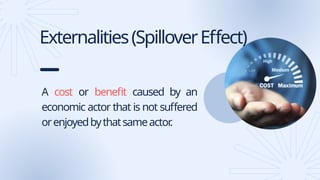
Externalities(SpilloverEffect)
A cost or benefit caused by an
economic actor that is not suffered
orenjoyedbythatsameactor
.
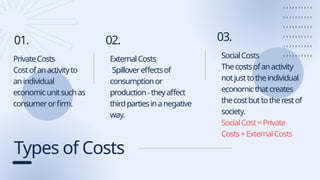
Types of Costs
01. 02.
PrivateCosts
Costofanactivityto
anindividual
economicunitsuchas
consumerorfirm.
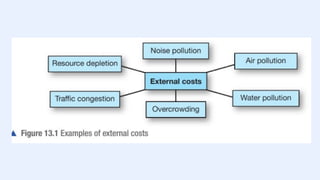
ExternalCosts
Spillovereffectsof
consumptionor
production-theyaffect
thirdpartiesinanegative
way.
03.
SocialCosts
Thecostsofanactivity
notjusttotheindividual
economicthatcreates
thecostbuttotherestof
society.
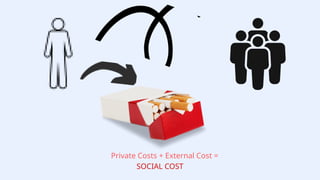
SocialCost=Private
Costs+ExternalCosts
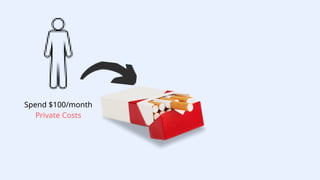
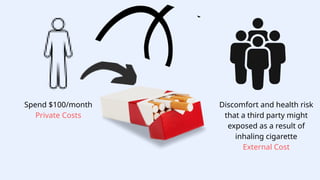
Spend $100/month
Private Costs
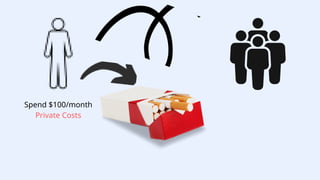
Spend $100/month
Private Costs
Spend $100/month
Private Costs
Discomfort and health risk
that a third party might
exposed as a result of
inhaling cigarette
External Cost
Private Costs + External Cost =
SOCIAL COST
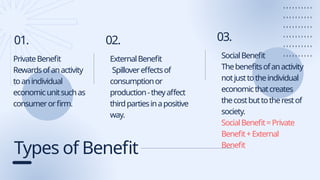
Types of Benefit
01. 02.
PrivateBenefit
Rewardsofanactivity
toanindividual
economicunitsuchas
consumerorfirm.
ExternalBenefit
Spillovereffectsof
consumptionor
production-theyaffect
thirdpartiesinapositive
way.
03.
SocialBenefit
Thebenefitsofanactivity
notjusttotheindividual
economicthatcreates
thecostbuttotherestof
society.
SocialBenefit=Private
Benefit+External
Benefit
01.
04.
02.
03.
ExternalitiesofProduction
andConsumption
ExternalCostsofProduction
ExternalBenefitsof
Consumption
PrivateandSocialCosts
PrivateandSocial
Notes
• If social costs is greater than private
costs, there will be a negative
externalitiyorexternalcost.
• If social benefit is greater than private
benefit, a positive externality or
externalbenefitissaidtobeexist.
ExternalitiesofProductionandConsumption
ProductionExternalitiesarisewhenthesocialcostsofproductiondifferdrom
theprivatecostsofproduction.
• NegativeExternalitiesofProduction(NegativeProductionExternalities)
• PositiveExternalitiesofProduction(PositiveProductionExternalities)
• PositiveExternalitiesofConsumption(PositiveConsumptionExternalities)
• NegativeExternalitiesofConsumption(NegativeConsumption
Externalities)
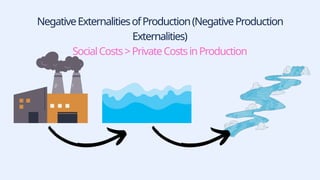
NegativeExternalitiesofProduction(NegativeProduction
Externalities)
SocialCosts>PrivateCostsinProduction
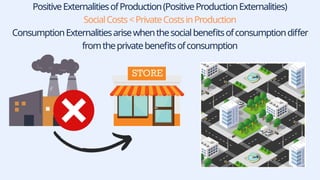
PositiveExternalitiesofProduction(PositiveProductionExternalities)
SocialCosts<PrivateCostsinProduction
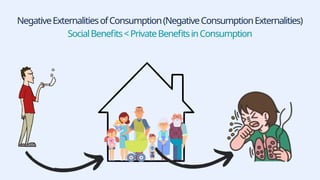
ConsumptionExternalitiesarisewhenthesocialbenefitsofconsumptiondiffer
fromtheprivatebenefitsofconsumption
NegativeExternalitiesofConsumption(NegativeConsumptionExternalities)
SocialBenefits<PrivateBenefitsinConsumption
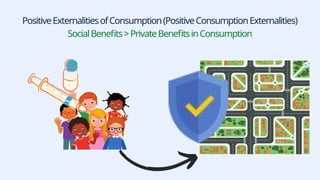
PositiveExternalitiesofConsumption(PositiveConsumptionExternalities)
SocialBenefits>PrivateBenefitsinConsumption
Whatdoesitrelationwiththe
market?
Outputisfixedwheredemand=supplyatthepointwhereprivate
costs=privatebenefits.Themisallocationofresourceswilloccurif
marketpricesdonotaccuratelyreflectthecostsandbenefitsto
societyofeconomicactivities.Therewillonlybeasocialoptimum
positionifoutputoccurswheresocialcostsequalsocialbenefits.
Whatdoesitrelationwiththe
market?
• The greater the externality, the larger will be the difference
between private costs and benefits and social costs and
benefits.
• The greatertheexternality, thegreaterthemarketfailureand
thelessmarketpricesprovideaccuratesignals fortheoptimal
allocationofresources.
Howcanyouknowthedifference
betweensocialcostsandsocial
benefits?
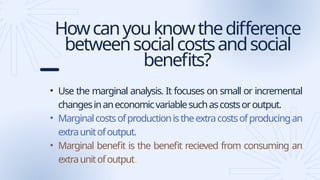
• Use the marginal analysis. It focuses on small or incremental
changesinaneconomicvariablesuchascostsoroutput.
• Marginalcostsofproductionistheextracostsofproducingan
extraunitofoutput.
• Marginal benefit is the benefit recieved from consuming an
extraunitofoutput.
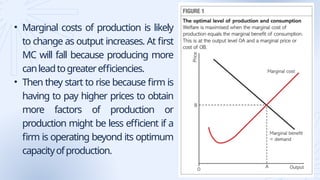
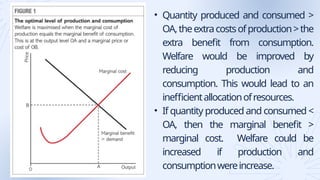
• Marginal costs of production is likely
to change as output increases. At first
MC will fall because producing more
canleadtogreaterefficiencies.
• Then they start to rise because firm is
having to pay higher prices to obtain
more factors of production or
production might be less efficient if a
firm is operating beyond its optimum
capacityofproduction.
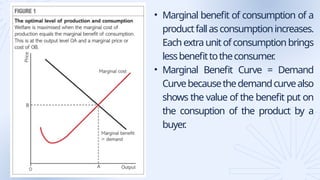
• Marginal benefit of consumption of a
productfallasconsumptionincreases.
Eachextraunitofconsumptionbrings
lessbenefittotheconsumer
.
• Marginal Benefit Curve = Demand
Curvebecausethedemandcurvealso
shows the value of the benefit put on
the consuption of the product by a
buyer
.
• Quantity produced and consumed >
OA,theextracostsofproduction>the
extra benefit from consumption.
Welfare would be improved by
reducing production and
consumption. This would lead to an
inefficientallocationofresources.
• If quantity produced and consumed <
OA, then the marginal benefit >
marginal cost. Welfare could be
increased if production and
consumptionwereincrease.
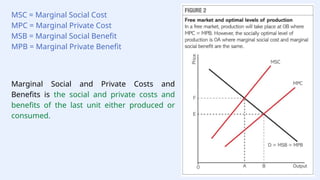
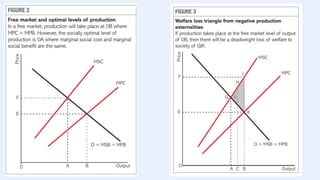
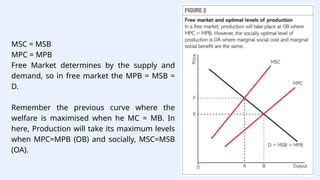
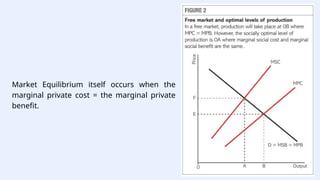
MSC = Marginal Social Cost
MPC = Marginal Private Cost
MSB = Marginal Social Benefit
MPB = Marginal Private Benefit
Marginal Social and Private Costs and
Benefits is the social and private costs and
benefits of the last unit either produced or
consumed.
MSC = MSB
MPC = MPB
Free Market determines by the supply and
demand, so in free market the MPB = MSB =
D.
Remember the previous curve where the
welfare is maximised when he MC = MB. In
here, Production will take its maximum levels
when MPC=MPB (OB) and socially, MSC=MSB
(OA).
Market Equilibrium itself occurs when the
marginal private cost = the marginal private
benefit.
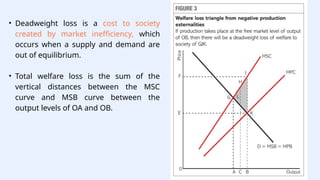
• Deadweight loss is a cost to society
created by market inefficiency, which
occurs when a supply and demand are
out of equilibrium.
• Total welfare loss is the sum of the
vertical distances between the MSC
curve and MSB curve between the
output levels of OA and OB.
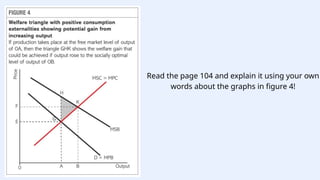
Read the page 104 and explain it using your own
words about the graphs in figure 4!
Exercise1:Diagram
FirmA,purchasedaland,Rp900.000.000,-. Theywanttobuildanewbranch
firminthatarea.Explainthemarketfailurethatwillhappenusingdiagram!
SomeoneboughtacarforRp180.000.000,-.Explainwhatwillhappentothe
marketusingadiagram!
SomeonegotothegymandpayRp500.000,-/monthforthegymmember
.
Openmasksduringthepandemicinthepublicarea.
Non Provision of
Public Goods
TYPES OF
GOODS
Public Goods
• Non-rivalry
• Non-excludability
Private Goods
• Rivalry
• Excludability
WHAT WILL MAKE THE
MARKET FAIL?
IF the provision of public goods left to the
market mechanism, there would be a
market failure.
FREE RIDER PROBLEM
Someone who receive benefits but allows
other to pay for it.
It can be solved by quasi-public or non pure
public good
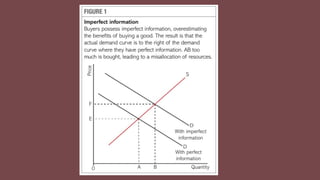
Information
Gap
where buyers or sellers or both lack
information to make an informed
decision.
Imperfect Market
Occurs when the other oarty has more
information than the other (assymmetric
gap) that might exploit the gap.
Information Gap
Reasons
Overestimate the benefit or underestimate
the benefit by buyers and sellers.
• Education
• Pensions
• Financial Services
• Advertising
Market Examples
1.Make a group of 4.
2.Read the book page 113.
3.Give the example about the market examples (2 market
examples).
4.Use the PPT or any visual aid to help you present your
ideas.
Notes: The example should be different with the book and it
should be real.
Group Work
MORAL
HAZARD
Definition
when an economic agent makes
decision in their own best interest
knowing that there are potential risk
and if the problem result, the cost will
be partly borne by other economic
agents.
What will you do if you know that Apple
will replace your product if anything
happen to your phone?
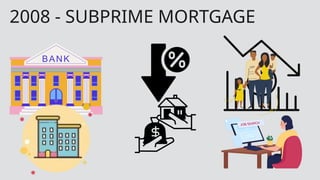
2008 - SUBPRIME MORTGAGE
Speculati
on &
MARKET BUBBLE
Speculation
Definition
Economic agents buys or sells something in
the expectation of a future price change in
the hope of generating a profit.
Market Bubble
Definition
Occurs when rising demand, for whatever
reason, drives prices beyond the level that
might normally be expected.
Additional
Information
• Market failure occurs when the price mechanism fails
to account for all the costs and benefits necessary to
provide and consume a good.
• When the market simply does not supply products at
all according to market demand then it is a complete
market failure as well.
• Partial market failure also occurs when the market
produces either the wrong quantity or wrong price.
Government
Intervention in
Markets
Market Failure
GOVERNMENT INTERVENTION
TO CORRECT MARKET FAILURE
• INDIRECT TAXES
• SUBSIDIES
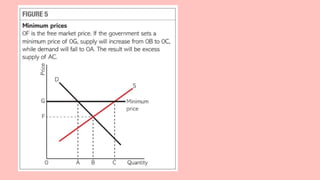
• MAXIMUM PRICES
• MINIMUM PRICES
• REGULATION
• TRADE POLLUTION PERMITS
• STATE PROVISION OF PUBLIC GOODS
• PROVISION OF INFORMATION
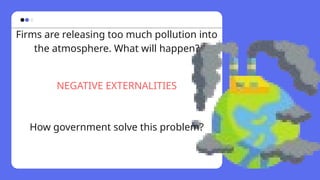
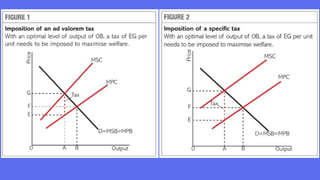
Firms are releasing too much pollution into
the atmosphere. What will happen?
NEGATIVE EXTERNALITIES
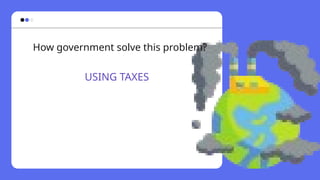
How government solve this problem?
USING TAXES
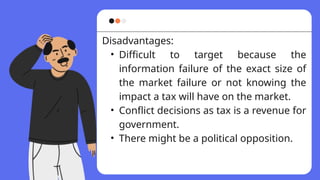
Disadvantages:
• Difficult to target because the
information failure of the exact size of
the market failure or not knowing the
impact a tax will have on the market.
• Conflict decisions as tax is a revenue for
government.
• There might be a political opposition.
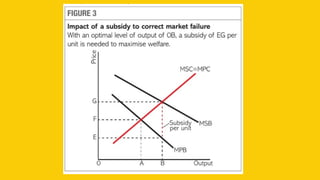
What if everyone starts using the
electric vehicle?
POSITIVE EXTERNALITIES
How government solve this problem?
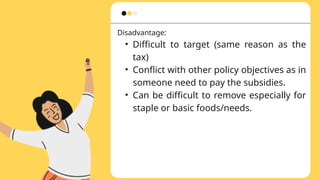
Disadvantage:
• Difficult to target (same reason as the
tax)
• Conflict with other policy objectives as in
someone need to pay the subsidies.
• Can be difficult to remove especially for
staple or basic foods/needs.
MAXIMUM PRICE
Remember that the market failure also happen
when there is a wrong price or quantity.
Let's say, if there is a poor family that could not
afford the staple food. What will happen?
MAXIMUM PRICE
Staple food/Basic food is going to have a positive
externalities because this affect the children
physical health and ability to function in society in
the future.
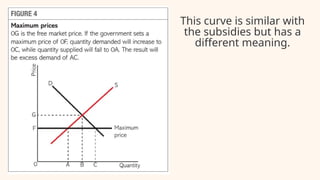
This curve is similar with
the subsidies but has a
different meaning.
MINIMUM PRICES
And there is other goods that cause negative
externalities. To correct this, government need
to raise the price by using minimum price.
It's easy to understand and relatively cheap to
enforce. But this has several difficulties:
• Government has difficulties to fix the right
level of regulation to ensure efficiency.
• Regulation tend not to discriminate between
different costs of reducing externalities .
REGULATION
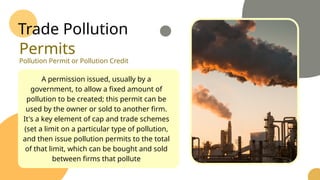
Trade Pollution
Permits
Pollution Permit or Pollution Credit
A permission issued, usually by a
government, to allow a fixed amount of
pollution to be created; this permit can be
used by the owner or sold to another firm.
It's a key element of cap and trade schemes
(set a limit on a particular type of pollution,
and then issue pollution permits to the total
of that limit, which can be bought and sold
between firms that pollute
STATE PROVISION OF PUBLIC
GOODS
Direct provision of public goods from the state.

• It may lead to inefficient production, particularly
if the government produces the good itself.
• It may also be inefficient because the wrong mix
of goods is produced, especially if the goods are
provided free of charge to taxpayers.
PROVISION OF INFORMATION
Government can step in to provide the information itself, such as
run advertising campaigns. Or it might force parties to a
trasaction to release information
GOVERNME
NT FAILURE
Occurs when it intervenes in the
market, but this intervention leads
to a net loss of economic welfare
rather than a gain.
It arises when the total social costs
arising from intervention are greater
than the social benefits that are
created by that intervention.
DEFINITION
• Distortion of Price Signals
• Unintended Consequences
• Excessive Administrative Costs
• Information Gaps
• Conflicting Objectives
• Politicians Maximising their Own
Welfare
TYPES
DISTORTION OF PRICE
SIGNALS
Some types of government intervention change price
signals in the market.
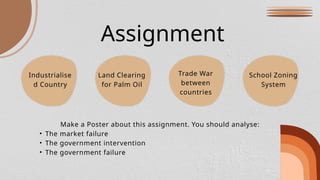
Assignment
Make a Poster about this assignment. You should analyse:
• The market failure
• The government intervention
• The government failure
Industrialise
d Country
Trade War
between
countries
School Zoning
System
Land Clearing
for Palm Oil
Explain using a diagram, what will government do if all the restaurants use styrofoam
and plastics for the take away order!

Economics - MARKET FAILURE PEARSON AS LEVEL