

DUAL GAP ANALYSIS
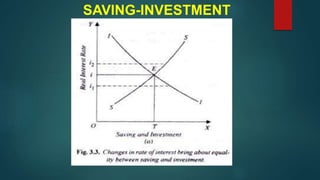
SAVING-INVESTMENT
Hollis chenery
Extention of harrod-domar model
Seperate indipendent constrain
 Targeted growth
Foreign aid –FILL GAP –ACHIEVE GROWTH
S<required investment
Net export earning
 Targeted growth is high ,invt is high
Domestic saving depends upon distribution of
income
LDC import needed for development
Export determine world price and quantity .that
change weather and natural condition
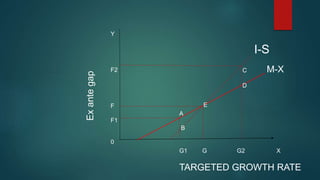
Y
F2
F
F1
0
G1 G G2 X
TARGETED GROWTH RATE
A
B
E
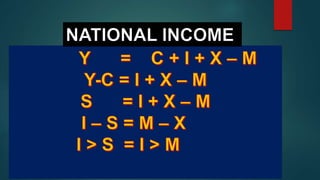
I-S
C M-X
D
Exantegap
We cannot reduce import.becuase larger
consumer demand and capital requirement
Chenry suggest restrictions on pattern of
consumption,distribution of incom,growth of
employment and exchange rate
Bridge adjustment without foreign aid
But retard growth
Resourse optimally allocated ,only saving
constrain
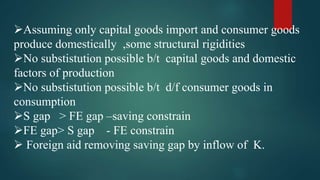
Assuming only capital goods import and consumer goods
produce domestically ,some structural rigidities
No substistution possible b/t capital goods and domestic
factors of production
No substistution possible b/t d/f consumer goods in
consumption
S gap > FE gap –saving constrain
FE gap> S gap - FE constrain
 Foreign aid removing saving gap by inflow of K.
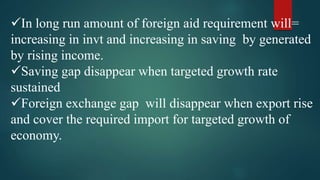
In long run amount of foreign aid requirement will=
increasing in invt and increasing in saving by generated
by rising income.
Saving gap disappear when targeted growth rate
sustained
Foreign exchange gap will disappear when export rise
and cover the required import for targeted growth of
economy.
LIMITATIONS
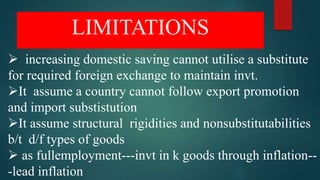
 increasing domestic saving cannot utilise a substitute
for required foreign exchange to maintain invt.
It assume a country cannot follow export promotion
and import substistution
It assume structural rigidities and nonsubstitutabilities
b/t d/f types of goods
 as fullemployment---invt in k goods through inflation--
-lead inflation
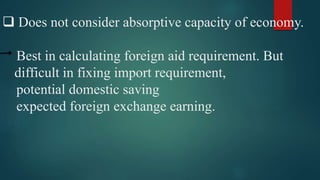
 Does not consider absorptive capacity of economy.
Best in calculating foreign aid requirement. But
difficult in fixing import requirement,
potential domestic saving
expected foreign exchange earning.
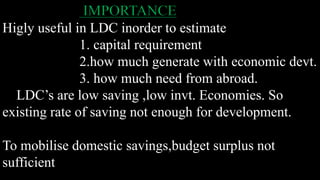
IMPORTANCE
Higly useful in LDC inorder to estimate
1. capital requirement
2.how much generate with economic devt.
3. how much need from abroad.
LDC’s are low saving ,low invt. Economies. So
existing rate of saving not enough for development.
To mobilise domestic savings,budget surplus not
sufficient
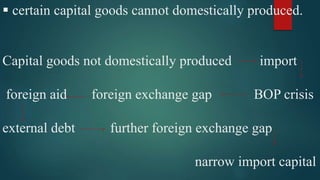
 certain capital goods cannot domestically produced.
Capital goods not domestically produced import
foreign aid foreign exchange gap BOP crisis
external debt further foreign exchange gap
narrow import capital
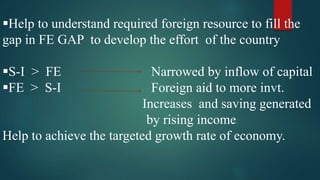
Help to understand required foreign resource to fill the
gap in FE GAP to develop the effort of the country
S-I > FE Narrowed by inflow of capital
FE > S-I Foreign aid to more invt.
Increases and saving generated
by rising income
Help to achieve the targeted growth rate of economy.
Dualgap analysis

Dualgap analysis

  • 1.
  • 2.
  • 4.
    Hollis chenery Extention ofharrod-domar model Seperate indipendent constrain  Targeted growth Foreign aid –FILL GAP –ACHIEVE GROWTH S<required investment Net export earning
  • 6.
     Targeted growthis high ,invt is high Domestic saving depends upon distribution of income LDC import needed for development Export determine world price and quantity .that change weather and natural condition
  • 7.
    Y F2 F F1 0 G1 G G2X TARGETED GROWTH RATE A B E I-S C M-X D Exantegap
  • 8.
    We cannot reduceimport.becuase larger consumer demand and capital requirement Chenry suggest restrictions on pattern of consumption,distribution of incom,growth of employment and exchange rate Bridge adjustment without foreign aid But retard growth Resourse optimally allocated ,only saving constrain
  • 9.
    Assuming only capitalgoods import and consumer goods produce domestically ,some structural rigidities No substistution possible b/t capital goods and domestic factors of production No substistution possible b/t d/f consumer goods in consumption S gap > FE gap –saving constrain FE gap> S gap - FE constrain  Foreign aid removing saving gap by inflow of K.
  • 10.
    In long runamount of foreign aid requirement will= increasing in invt and increasing in saving by generated by rising income. Saving gap disappear when targeted growth rate sustained Foreign exchange gap will disappear when export rise and cover the required import for targeted growth of economy.
  • 11.
    LIMITATIONS  increasing domesticsaving cannot utilise a substitute for required foreign exchange to maintain invt. It assume a country cannot follow export promotion and import substistution It assume structural rigidities and nonsubstitutabilities b/t d/f types of goods  as fullemployment---invt in k goods through inflation-- -lead inflation
  • 12.
     Does notconsider absorptive capacity of economy. Best in calculating foreign aid requirement. But difficult in fixing import requirement, potential domestic saving expected foreign exchange earning.
  • 13.
    IMPORTANCE Higly useful inLDC inorder to estimate 1. capital requirement 2.how much generate with economic devt. 3. how much need from abroad. LDC’s are low saving ,low invt. Economies. So existing rate of saving not enough for development. To mobilise domestic savings,budget surplus not sufficient
  • 14.
     certain capitalgoods cannot domestically produced. Capital goods not domestically produced import foreign aid foreign exchange gap BOP crisis external debt further foreign exchange gap narrow import capital
  • 15.
    Help to understandrequired foreign resource to fill the gap in FE GAP to develop the effort of the country S-I > FE Narrowed by inflow of capital FE > S-I Foreign aid to more invt. Increases and saving generated by rising income Help to achieve the targeted growth rate of economy.