Presentation
on
Market policy failure, Rationales for Government
Intervention, The Role of Quantitative Policy Analysis
PRESENTED BY.
VIJAY KUMAR PATEL
PH. D SCHOLAR
(FIRST YEAR)
Market failure
Definition and meaning :
• A market failure is a situation in which the invisible
hand pushes in such a way that individual decisions do
not lead to socially desirable outcomes
• An economic term that encompasses a situation
where, in any given market, the quantity of a product
demanded by consumers does not equate to the
quantity supplied by suppliers. This is a direct result of
a lack of certain economically ideal factors, which
prevents equilibrium.
 Just that the market fails to arrive at the “correct”
price and quantity
Market failure can arise in cases of
– Asymmetric information
– Public goods
– Externalities
– Common property resources
– abuse of monopoly power
– Merit Goods
– Demerit Goods
– Property rights
1. Asymmetric Information
• Asymmetric information occurs when one party to a
transaction knows more than does the other.
• Perfectly competitive markets assume perfect
information.
• In the real world, buyers and sellers do not usually have
equal information, and imperfect information can be a
cause of a market failure.
• Economists call such market failures “adverse selection
problems.”
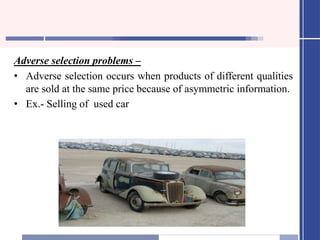
Adverse selection problems –
• Adverse selection occurs when products of different qualities
are sold at the same price because of asymmetric information.
• Ex.- Selling of used car
Policies to Deal with Informational
Problems
• Regulate the market and see that individuals provide the
correct information
• License individuals in the market and require them to
provide full information about the good being sold
• Allow markets to develop to provide information that
people need and will buy
• Application: Licensing of Doctors
• Medical care is an example of imperfect information,
patients usually don’t have a way of knowing if a doctor is
capable
• Current practice is to require medical licenses to establish a
minimum level of skill
• Another option is to provide the public with information on:
• Grades in college.
• Grades in medical school.
• Success rate for various procedures.
• Medical philosophy.
• Charges and fees.
2. Public Goods
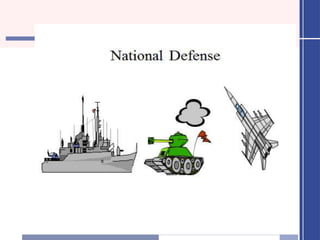
• Public Goods are goods that are available for all to consume,
regardless of who pays and who does not.
• Example: National Defence (pure public good)
• All public goods must exhibit two characteristics:
– Non-rivalry
– Non-excludability
• Non-rivalry means that one person’s consumption of the
good does not limit the ability of someone else to consume
the good.
• Example: A TV Show
• Non-excludability means that you can’t keep anyone from
consuming the good.
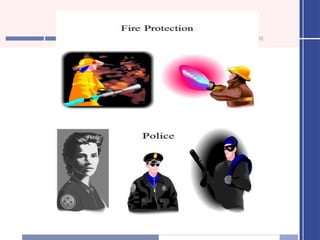
– Example: Police Protection.
This problem - someone benefiting from resources or
goods and services without paying for the cost of the
benefit - is known as the free rider problem
3. Externalities
• External cost and external benefit which occurs during
economic activity which not consider by buyer and seller
involve economic activity because external cost and
external benefit affect third party.
• A negative externality imposes an external cost and a
positive externality creates an external benefit
Externalities can be either positive or negative
• Negative externalities occur when the effects are detrimental
to others
Ex. Second-hand smoke and carbon monoxide
emissions, water pollution,
• Positive externalities occur when the effects are beneficial to
others
Examples include innovation, education, and new
business formation
Negative Externalities
• When negative externalities ensue third parties are hurt.
– A steel plant benefits the owner of the plant and the
buyers of steel.
– The plant’s neighbors are made worse off by the pollution
caused by the plant.
• When there are negative externalities, the competitive price
is too low and equilibrium quantity too high to maximize
social welfare.
• If externalities exist, it means that those involved in the
demand and supply in the market are not considering all the
costs and benefits when making their market decisions.
• As a result, the market fails to yield optimal results.
A Negative Externality: Pollution
A Positive Externality Example
Private trades can benefit third parties not involved in the
trade
– Example: a beekeeper locates beehives in an orange-
growing area, the bees primary purpose is to collect
nectar to make honey, but they also assist in pollination
so increase the productivity of orchards and vineyards.
– This increase production and profits for the farmers.
4. Monopoly Power
• Market dominance by monopolies can lead to under-
production and higher prices than would exist under
conditions of competition, causing consumer welfare to be
damaged
5. Common Property Resources
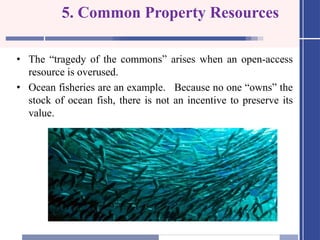
• The “tragedy of the commons” arises when an open-access
resource is overused.
• Ocean fisheries are an example. Because no one “owns” the
stock of ocean fish, there is not an incentive to preserve its
value.
6. Missing markets
• Markets may fail to form, resulting in a failure to meet a
need or want, such as the need for public goods, such as -
• defence, street lighting, and highways.
• Pure public goods clearly provide a benefit to the consumer,
but, for several reasons, are unlikely to exist in a market
economy.
• In this market demand exists, but supply is absent.
7. Merit Goods
• Merit Goods are goods that the government deems necessary
for society because the social benefits exceed the private
benefits
– Example: health care, education, roads
• Merit goods can be provided by the private &/or public
sector.
• To encourage increased consumption of merit goods,
governments will subsidize consumption.
8. Demerit Goods
• De-merit goods are those goods or services that create
negative externalities when the product is consumed.
– This reduces the social benefit of consumption and also
leads to potential market failure through over-
consumption.
• eg. cigarettes, alcohol
• Governments may choose to tax or regulate the
consumption of these goods.
9.Remedies of market failure
• In order to reduce or eliminate market failures, governments
can choose two basic strategies:
1. Use the price mechanism
2. Use legislation and force
• 1. Use the price mechanism
• The first strategy is to implement policies that change the
behaviour of consumers and producers by using the price
mechanism.
• For example, this could mean increasing the price of
‘harmful’ products, through taxation, and providing
subsidies for the ‘beneficial’ products. In this way,
behavior is changed through financial incentives, much the
same way that markets work to allocate resources.
• 2. Use legislation and force
• The second strategy is to use the force of the law to change
behavior.
• For example, by banning cars from city centers, or having a
licensing system for the sale of alcohol, or by penalizing
polluters, the unwanted behavior may be controlled.
• In the majority of cases of market failure, a combination of
remedies is most likely to succeed
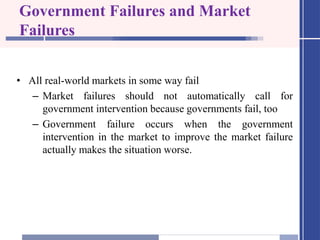
Government Failures and Market
Failures
• All real-world markets in some way fail
– Market failures should not automatically call for
government intervention because governments fail, too
– Government failure occurs when the government
intervention in the market to improve the market failure
actually makes the situation worse.
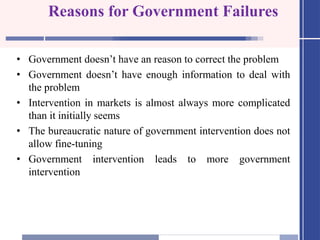
Reasons for Government Failures
• Government doesn’t have an reason to correct the problem
• Government doesn’t have enough information to deal with
the problem
• Intervention in markets is almost always more complicated
than it initially seems
• The bureaucratic nature of government intervention does not
allow fine-tuning
• Government intervention leads to more government
intervention
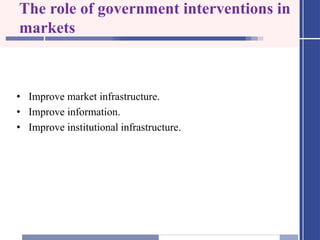
The role of government interventions in
markets
• Improve market infrastructure.
• Improve information.
• Improve institutional infrastructure.
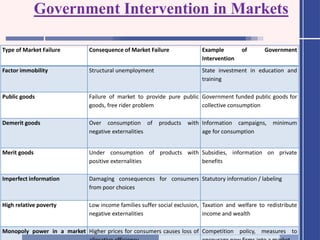
Government Intervention in Markets
Type of Market Failure Consequence of Market Failure Example of Government
Intervention
Factor immobility Structural unemployment State investment in education and
training
Public goods Failure of market to provide pure public
goods, free rider problem
Government funded public goods for
collective consumption
Demerit goods Over consumption of products with
negative externalities
Information campaigns, minimum
age for consumption
Merit goods Under consumption of products with
positive externalities
Subsidies, information on private
benefits
Imperfect information Damaging consequences for consumers
from poor choices
Statutory information / labeling
High relative poverty Low income families suffer social exclusion,
negative externalities
Taxation and welfare to redistribute
income and wealth
Monopoly power in a market Higher prices for consumers causes loss of Competition policy, measures to

Vijay ppt

  • 1.
    Presentation on Market policy failure,Rationales for Government Intervention, The Role of Quantitative Policy Analysis PRESENTED BY. VIJAY KUMAR PATEL PH. D SCHOLAR (FIRST YEAR)
  • 2.
    Market failure Definition andmeaning : • A market failure is a situation in which the invisible hand pushes in such a way that individual decisions do not lead to socially desirable outcomes • An economic term that encompasses a situation where, in any given market, the quantity of a product demanded by consumers does not equate to the quantity supplied by suppliers. This is a direct result of a lack of certain economically ideal factors, which prevents equilibrium.  Just that the market fails to arrive at the “correct” price and quantity
  • 3.
    Market failure canarise in cases of – Asymmetric information – Public goods – Externalities – Common property resources – abuse of monopoly power – Merit Goods – Demerit Goods – Property rights
  • 4.
    1. Asymmetric Information •Asymmetric information occurs when one party to a transaction knows more than does the other. • Perfectly competitive markets assume perfect information. • In the real world, buyers and sellers do not usually have equal information, and imperfect information can be a cause of a market failure. • Economists call such market failures “adverse selection problems.”
  • 5.
    Adverse selection problems– • Adverse selection occurs when products of different qualities are sold at the same price because of asymmetric information. • Ex.- Selling of used car
  • 6.
    Policies to Dealwith Informational Problems • Regulate the market and see that individuals provide the correct information • License individuals in the market and require them to provide full information about the good being sold • Allow markets to develop to provide information that people need and will buy • Application: Licensing of Doctors
  • 7.
    • Medical careis an example of imperfect information, patients usually don’t have a way of knowing if a doctor is capable • Current practice is to require medical licenses to establish a minimum level of skill
  • 8.
    • Another optionis to provide the public with information on: • Grades in college. • Grades in medical school. • Success rate for various procedures. • Medical philosophy. • Charges and fees.
  • 9.
    2. Public Goods •Public Goods are goods that are available for all to consume, regardless of who pays and who does not. • Example: National Defence (pure public good) • All public goods must exhibit two characteristics: – Non-rivalry – Non-excludability
  • 10.
    • Non-rivalry meansthat one person’s consumption of the good does not limit the ability of someone else to consume the good. • Example: A TV Show • Non-excludability means that you can’t keep anyone from consuming the good. – Example: Police Protection. This problem - someone benefiting from resources or goods and services without paying for the cost of the benefit - is known as the free rider problem
  • 13.
    3. Externalities • Externalcost and external benefit which occurs during economic activity which not consider by buyer and seller involve economic activity because external cost and external benefit affect third party. • A negative externality imposes an external cost and a positive externality creates an external benefit
  • 14.
    Externalities can beeither positive or negative • Negative externalities occur when the effects are detrimental to others Ex. Second-hand smoke and carbon monoxide emissions, water pollution, • Positive externalities occur when the effects are beneficial to others Examples include innovation, education, and new business formation
  • 15.
    Negative Externalities • Whennegative externalities ensue third parties are hurt. – A steel plant benefits the owner of the plant and the buyers of steel. – The plant’s neighbors are made worse off by the pollution caused by the plant.
  • 16.
    • When thereare negative externalities, the competitive price is too low and equilibrium quantity too high to maximize social welfare. • If externalities exist, it means that those involved in the demand and supply in the market are not considering all the costs and benefits when making their market decisions. • As a result, the market fails to yield optimal results.
  • 17.
    A Negative Externality:Pollution A Negative Externality: Pollution
  • 18.
    A Positive ExternalityExample Private trades can benefit third parties not involved in the trade – Example: a beekeeper locates beehives in an orange- growing area, the bees primary purpose is to collect nectar to make honey, but they also assist in pollination so increase the productivity of orchards and vineyards. – This increase production and profits for the farmers.
  • 19.
    4. Monopoly Power •Market dominance by monopolies can lead to under- production and higher prices than would exist under conditions of competition, causing consumer welfare to be damaged
  • 20.
    5. Common PropertyResources • The “tragedy of the commons” arises when an open-access resource is overused. • Ocean fisheries are an example. Because no one “owns” the stock of ocean fish, there is not an incentive to preserve its value.
  • 21.
    6. Missing markets •Markets may fail to form, resulting in a failure to meet a need or want, such as the need for public goods, such as - • defence, street lighting, and highways. • Pure public goods clearly provide a benefit to the consumer, but, for several reasons, are unlikely to exist in a market economy. • In this market demand exists, but supply is absent.
  • 22.
    7. Merit Goods •Merit Goods are goods that the government deems necessary for society because the social benefits exceed the private benefits – Example: health care, education, roads • Merit goods can be provided by the private &/or public sector. • To encourage increased consumption of merit goods, governments will subsidize consumption.
  • 23.
    8. Demerit Goods •De-merit goods are those goods or services that create negative externalities when the product is consumed. – This reduces the social benefit of consumption and also leads to potential market failure through over- consumption. • eg. cigarettes, alcohol • Governments may choose to tax or regulate the consumption of these goods.
  • 24.
    9.Remedies of marketfailure • In order to reduce or eliminate market failures, governments can choose two basic strategies: 1. Use the price mechanism 2. Use legislation and force
  • 25.
    • 1. Usethe price mechanism • The first strategy is to implement policies that change the behaviour of consumers and producers by using the price mechanism. • For example, this could mean increasing the price of ‘harmful’ products, through taxation, and providing subsidies for the ‘beneficial’ products. In this way, behavior is changed through financial incentives, much the same way that markets work to allocate resources.
  • 26.
    • 2. Uselegislation and force • The second strategy is to use the force of the law to change behavior. • For example, by banning cars from city centers, or having a licensing system for the sale of alcohol, or by penalizing polluters, the unwanted behavior may be controlled. • In the majority of cases of market failure, a combination of remedies is most likely to succeed
  • 27.
    Government Failures andMarket Failures • All real-world markets in some way fail – Market failures should not automatically call for government intervention because governments fail, too – Government failure occurs when the government intervention in the market to improve the market failure actually makes the situation worse.
  • 28.
    Reasons for GovernmentFailures • Government doesn’t have an reason to correct the problem • Government doesn’t have enough information to deal with the problem • Intervention in markets is almost always more complicated than it initially seems • The bureaucratic nature of government intervention does not allow fine-tuning • Government intervention leads to more government intervention
  • 29.
    The role ofgovernment interventions in markets • Improve market infrastructure. • Improve information. • Improve institutional infrastructure.
  • 30.
    Government Intervention inMarkets Type of Market Failure Consequence of Market Failure Example of Government Intervention Factor immobility Structural unemployment State investment in education and training Public goods Failure of market to provide pure public goods, free rider problem Government funded public goods for collective consumption Demerit goods Over consumption of products with negative externalities Information campaigns, minimum age for consumption Merit goods Under consumption of products with positive externalities Subsidies, information on private benefits Imperfect information Damaging consequences for consumers from poor choices Statutory information / labeling High relative poverty Low income families suffer social exclusion, negative externalities Taxation and welfare to redistribute income and wealth Monopoly power in a market Higher prices for consumers causes loss of Competition policy, measures to

Editor's Notes

  • #9 This information alternative would provide much more useful information to the public than the present licensing procedure Here are some words of caution about the informational alternative. To get a true picture of whether the present system is best would require experts on real-life practices and institutions. The problem is that the experts may have a vested interest in keeping things just the way they are.