Government FailureAS Microeconomics
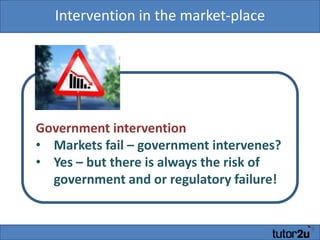
Intervention in the market-placeGovernment interventionMarkets fail – government intervenes?
Yes – but there is always the risk of government and or regulatory failure!What is government failure?Government failure occurs when a policy intervention leads to a deepening of the market failure or even worse a new failure may ariseIn other words – intervention creates further inefficiencies and a loss of welfare(1) Policies may have damaging long term consequences for the economy or society(2) Policies may be ineffective in meeting aims(3) Policies may create more losers than winners
Root causes of government failureDecisions made in political self interestLowvalue for money from public sector investmentPolicy myopia – short-termismRegulatory capture arising from lobbyingDisincentives arising from specific policiesInformation failures in government policiesThe “law of unintended consequences”The costs of regulation may outweigh the benefits
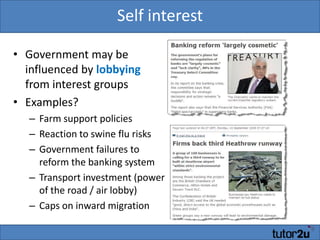
Self interestGovernment may be influenced by lobbying from interest groupsExamples?Farm support policiesReaction to swine flu risksGovernment failures to reform the banking systemTransport investment (power of the road / air lobby)Caps on inward migration
Value for money issuesWhat is the social benefit of public sector spending?Is the government getting value for money?Good grounds for thinking that public goods can be provided efficiently – e.g. Economies of scaleBut there are risksOver-staffing in public sector industriesRelatively low productivity compared to market sectorExcessive costs of bureaucracyNote though – waste is not the preserve of government – there are plenty of examples of private sector waste
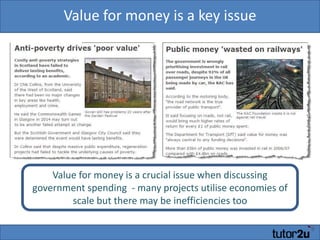
Value for money is a key issueValue for money is a crucial issue when discussing government spending  - many projects utilise economies of scale but there may be inefficiencies too
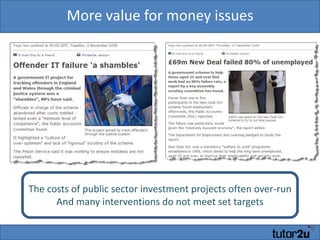
More value for money issuesThe costs of public sector investment projects often over-runAnd many interventions do not meet set targets
Policy myopia and quick-fixesPoliticians have a tendency to look for short term solutions or “quick fixes” to problemsThey favour short term initiatives rather than fully thought-through policies for the long termExamples?Road widening to cut traffic congestionASBOs for young offendersOffering surgery on the NHS to combat obesityZero-tolerance and visible anti-crime measures like CCTV
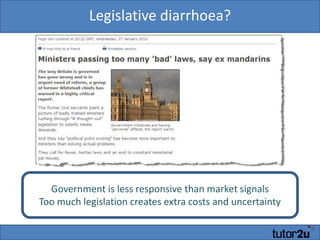
Legislative diarrhoea?Government is less responsive than market signalsToo much legislation creates extra costs and uncertainty
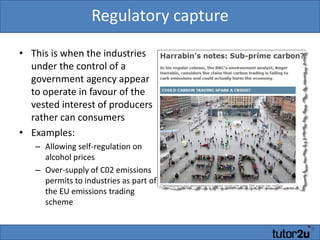
Regulatory captureThis is when the industries under the control of a government agency appear to operate in favour of the vested interest of producers rather can consumersExamples:Allowing self-regulation on alcohol pricesOver-supply of C02 emissions permits to industries as part of the EU emissions trading scheme
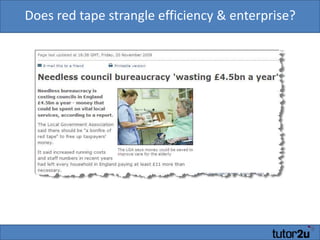
Does red tape strangle efficiency & enterprise?
DisincentivesWhere policy interventions lead to a loss of incentives either for consumers or producersFree market economists argue that attempts to redistribute income and & wealth can damage work incentivesExamples:Higher rates of income tax?The poverty trap facing low income familiesGovernment failure can happen if a policy decision fails to create enough of an incentive to change behaviour
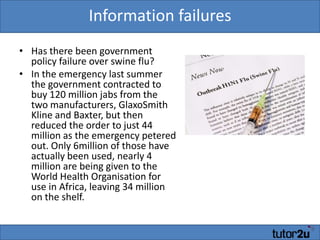
Information failuresHas there been government policy failure over swine flu?In the emergency last summer the government contracted to buy 120 million jabs from the two manufacturers, GlaxoSmith Kline and Baxter, but then reduced the order to just 44 million as the emergency petered out. Only 6million of those have actually been used, nearly 4 million are being given to the World Health Organisation for use in Africa, leaving 34 million on the shelf.
Law of unintended consequencesPolicy interventions have effects that are unanticipated or unintended. Particularly when people do not act in the way that the economics textbooks would predictRemember – economics is a social science!Well-intentioned legislation often act against the interests of those it is intended to serveThis law is crucial to understanding government failure – not all of the unintended consequences are negative!
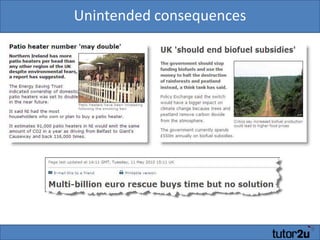
Negative unintended consequencesHigher capital gains tax – reduces new house building - worsens housing shortages /affordabilityBank bail-outs – raises the problem of moral hazardBio-fuel subsidy – causes food price inflation and hits the poorest in societySmoking ban – increases demand for and use of energy inefficient patio-heatersWindfall tax on North Sea oil and gas companies led to a huge fall in investment and exploration – just years before oil prices surgedTariffs on steel – hits domestic car and construction firmsTargets for treating patients – leads to reduction in the quality of care e.g. Staffordshire General scandal
Unintended consequences
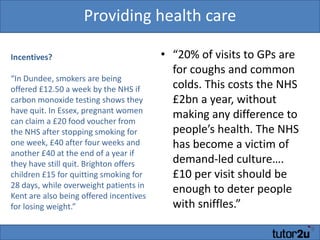
Providing health care“20% of visits to GPs are for coughs and common colds. This costs the NHS £2bn a year, without making any difference to people’s health. The NHS has become a victim of demand-led culture…. £10 per visit should be enough to deter people with sniffles.” Incentives?“In Dundee, smokers are being offered £12.50 a week by the NHS if carbon monoxide testing shows they have quit. In Essex, pregnant women can claim a £20 food voucher from the NHS after stopping smoking for one week, £40 after four weeks and another £40 at the end of a year if they have still quit. Brighton offers children £15 for quitting smoking for 28 days, while overweight patients in Kent are also being offered incentives for losing weight.”
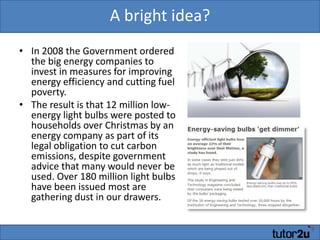
A bright idea?In 2008 the Government ordered the big energy companies to invest in measures for improving energy efficiency and cutting fuel poverty. The result is that 12 million low-energy light bulbs were posted to households over Christmas by an energy company as part of its legal obligation to cut carbon emissions, despite government advice that many would never be used. Over 180 million light bulbs have been issued most are gathering dust in our drawers.
Market forces?Many questions refer to the ongoing debate about free market forces versus government interventionMarkets are hugely powerful:As drivers of innovationIn finding solutions to long term problemsThe price mechanism performs several key functionsRationingAllocationSignallingSmart interventions can enhance the market, poorly-judged interventions can make things much worse
Tutor2uKeep up-to-date with economics, resources, quizzes and worksheets for your economics course.

Government failure markets

  • 1.
  • 2.
    Intervention in themarket-placeGovernment interventionMarkets fail – government intervenes?
  • 3.
    Yes – butthere is always the risk of government and or regulatory failure!What is government failure?Government failure occurs when a policy intervention leads to a deepening of the market failure or even worse a new failure may ariseIn other words – intervention creates further inefficiencies and a loss of welfare(1) Policies may have damaging long term consequences for the economy or society(2) Policies may be ineffective in meeting aims(3) Policies may create more losers than winners
  • 4.
    Root causes ofgovernment failureDecisions made in political self interestLowvalue for money from public sector investmentPolicy myopia – short-termismRegulatory capture arising from lobbyingDisincentives arising from specific policiesInformation failures in government policiesThe “law of unintended consequences”The costs of regulation may outweigh the benefits
  • 5.
    Self interestGovernment maybe influenced by lobbying from interest groupsExamples?Farm support policiesReaction to swine flu risksGovernment failures to reform the banking systemTransport investment (power of the road / air lobby)Caps on inward migration
  • 6.
    Value for moneyissuesWhat is the social benefit of public sector spending?Is the government getting value for money?Good grounds for thinking that public goods can be provided efficiently – e.g. Economies of scaleBut there are risksOver-staffing in public sector industriesRelatively low productivity compared to market sectorExcessive costs of bureaucracyNote though – waste is not the preserve of government – there are plenty of examples of private sector waste
  • 7.
    Value for moneyis a key issueValue for money is a crucial issue when discussing government spending - many projects utilise economies of scale but there may be inefficiencies too
  • 8.
    More value formoney issuesThe costs of public sector investment projects often over-runAnd many interventions do not meet set targets
  • 9.
    Policy myopia andquick-fixesPoliticians have a tendency to look for short term solutions or “quick fixes” to problemsThey favour short term initiatives rather than fully thought-through policies for the long termExamples?Road widening to cut traffic congestionASBOs for young offendersOffering surgery on the NHS to combat obesityZero-tolerance and visible anti-crime measures like CCTV
  • 10.
    Legislative diarrhoea?Government isless responsive than market signalsToo much legislation creates extra costs and uncertainty
  • 11.
    Regulatory captureThis iswhen the industries under the control of a government agency appear to operate in favour of the vested interest of producers rather can consumersExamples:Allowing self-regulation on alcohol pricesOver-supply of C02 emissions permits to industries as part of the EU emissions trading scheme
  • 12.
    Does red tapestrangle efficiency & enterprise?
  • 13.
    DisincentivesWhere policy interventionslead to a loss of incentives either for consumers or producersFree market economists argue that attempts to redistribute income and & wealth can damage work incentivesExamples:Higher rates of income tax?The poverty trap facing low income familiesGovernment failure can happen if a policy decision fails to create enough of an incentive to change behaviour
  • 14.
    Information failuresHas therebeen government policy failure over swine flu?In the emergency last summer the government contracted to buy 120 million jabs from the two manufacturers, GlaxoSmith Kline and Baxter, but then reduced the order to just 44 million as the emergency petered out. Only 6million of those have actually been used, nearly 4 million are being given to the World Health Organisation for use in Africa, leaving 34 million on the shelf.
  • 15.
    Law of unintendedconsequencesPolicy interventions have effects that are unanticipated or unintended. Particularly when people do not act in the way that the economics textbooks would predictRemember – economics is a social science!Well-intentioned legislation often act against the interests of those it is intended to serveThis law is crucial to understanding government failure – not all of the unintended consequences are negative!
  • 16.
    Negative unintended consequencesHighercapital gains tax – reduces new house building - worsens housing shortages /affordabilityBank bail-outs – raises the problem of moral hazardBio-fuel subsidy – causes food price inflation and hits the poorest in societySmoking ban – increases demand for and use of energy inefficient patio-heatersWindfall tax on North Sea oil and gas companies led to a huge fall in investment and exploration – just years before oil prices surgedTariffs on steel – hits domestic car and construction firmsTargets for treating patients – leads to reduction in the quality of care e.g. Staffordshire General scandal
  • 17.
  • 18.
    Providing health care“20%of visits to GPs are for coughs and common colds. This costs the NHS £2bn a year, without making any difference to people’s health. The NHS has become a victim of demand-led culture…. £10 per visit should be enough to deter people with sniffles.” Incentives?“In Dundee, smokers are being offered £12.50 a week by the NHS if carbon monoxide testing shows they have quit. In Essex, pregnant women can claim a £20 food voucher from the NHS after stopping smoking for one week, £40 after four weeks and another £40 at the end of a year if they have still quit. Brighton offers children £15 for quitting smoking for 28 days, while overweight patients in Kent are also being offered incentives for losing weight.”
  • 19.
    A bright idea?In2008 the Government ordered the big energy companies to invest in measures for improving energy efficiency and cutting fuel poverty. The result is that 12 million low-energy light bulbs were posted to households over Christmas by an energy company as part of its legal obligation to cut carbon emissions, despite government advice that many would never be used. Over 180 million light bulbs have been issued most are gathering dust in our drawers.
  • 20.
    Market forces?Many questionsrefer to the ongoing debate about free market forces versus government interventionMarkets are hugely powerful:As drivers of innovationIn finding solutions to long term problemsThe price mechanism performs several key functionsRationingAllocationSignallingSmart interventions can enhance the market, poorly-judged interventions can make things much worse
  • 21.
    Tutor2uKeep up-to-date witheconomics, resources, quizzes and worksheets for your economics course.