Elasticities
GCE	A-LEVEL	&	IB ECONOMICS
Lesson	Structure
◦Elasticities
◦ Price	Elasticity	of	Demand	(PED)
◦ Cross	Elasticity	of	Demand	(XED)
◦ Income	Elasticity	of	Demand	(YED)
◦ Price	Elasticity	of	Supply	(PES)
Price	Elasticity	of	Demand	(PED)
PED	measures	the	responsiveness	of	quantity	demanded,	given	a	change	in	
price.	(along	the	supply	curve)
PED	=	%	Change	in	Qd /	%	Change	in	P
If	PED	>	1,	what	does	this	mean?
If	PED	<	1,	what	does	this	mean?	
Try	drawing	the	demand	curve	if	this	is	the	case.
Price	Elasticity	of	Demand	(PED)
Calculating	PED:
(e)	(i)	Calculate	the	price	elasticity	of	demand	for	Good	A	when	its	price	falls between	January	2014	and	February	2014.	[2]
Price	Elasticity	of	Demand	(PED)
Calculating	PED:
(e)	(i)	Calculate	the	price	elasticity	of	demand	for	Good	A	when	its	price	falls between	January	2014	and	February	2014.	[2]
PED	=	%	Change	in	Qd /	%	Change	in	P	
=	[(220	– 160)	/	160]	/	[(6	– 8)	/	8]	=	- 1.5
Note	that	PED	is	nearly	ALWAYS	calculated	to	be	negative.	Why	do	you	think	that	is?
Price	Elasticity	of	Demand	(PED)
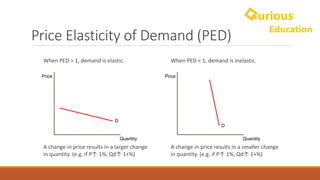
When	PED	<	1,	demand	is	inelastic.
A	change	in	price	results	in	a	smaller	change	
in	quantity.	(e.g.	if	P↑	1%,	Qd↑	1+%)
When	PED	>	1,	demand	is	elastic.
A	change	in	price	results	in	a	larger	change	
in	quantity.	(e.g.	if	P↑	1%,	Qd↑	1+%)
Price
Quantity
D
Price
Quantity
D
Price	Elasticity	of	Demand	(PED)
Can	you	think	of	some	goods	or	services	that	are
Price	elastic?	 Price	inelastic?
Price	Elasticity	of	Demand	(PED)
Can	you	think	of	some	goods	or	services	that	are
Price	elastic?	 Price	inelastic?
Price	Elasticity	of	Demand	(PED)
What	do	you	think	determines	the	elasticity	of	these	goods?
Price	elastic	 Price	inelastic
Price	Elasticity	of	Demand	(PED)
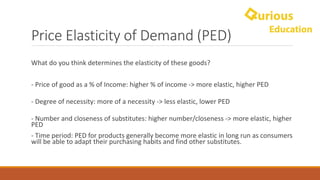
What	do	you	think	determines	the	elasticity	of	these	goods?
- Price	of	good	as	a	%	of	Income:	higher	%	of	income	->	more	elastic,	higher	PED
- Degree	of	necessity:	more	of	a	necessity	->	less	elastic,	lower	PED
- Number	and	closeness	of	substitutes:	higher	number/closeness	->	more	elastic,	higher	
PED
- Time	period:	PED	for	products	generally	become	more	elastic	in	long	run	as	consumers	
will	be	able	to	adapt	their	purchasing	habits	and	find	other	substitutes.
Price	Elasticity	of	Demand	(PED)
But	what	if	the	proportional	change	in	quantity	demanded	caused	by	price	is	the	
same?	i.e.	PED	=	1.
Price	Elasticity	of	Demand	(PED)
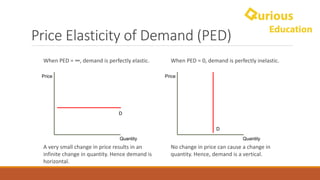
When	PED	=	0,	demand	is	perfectly	inelastic.
No	change	in	price	can	cause	a	change	in	
quantity.	Hence,	demand	is	a	vertical.
When	PED	= ∞,	demand	is	perfectly	elastic.
A	very	small	change	in	price	results	in	an	
infinite	change	in	quantity.	Hence	demand	is	
horizontal.	
Price
Quantity
D
Price
Quantity
D
Price	Elasticity	of	Demand	(PED)
But	what	if	the	proportional	change	in	quantity	demanded	caused	by	price	is	the	
same?	i.e.	PED	=	1.
Price	Elasticity	of	Demand	(PED)
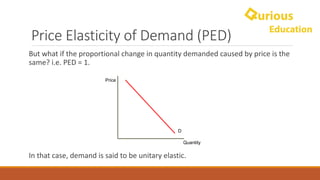
But	what	if	the	proportional	change	in	quantity	demanded	caused	by	price	is	the	
same?	i.e.	PED	=	1.	
In	that	case,	demand	is	said	to	be	unitary	elastic.
Price
Quantity
D
Price	Elasticity	of	Demand	(PED)
What’s	the	point	of	studying	this	you	ask?
Price	Elasticity	of	Demand	(PED)
Step	1:	Learn	PED
Step	2:	Use	it	in	Business
Step	3:	Decrease	prices	when	demand	is	elastic;	raise	prices	when	demand	is	
inelastic
Step	4:	$$$
Price	Elasticity	of	Demand	(PED)
Price
Quantity
D
Price
Quantity
D
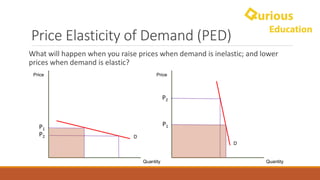
What	will	happen	when	you	raise	prices	when	demand	is	inelastic;	and	lower	
prices	when	demand	is	elastic?	
P1P1
P2
P2
Price	Elasticity	of	Demand	(PED)
Price
Quantity
D
Price
Quantity
D
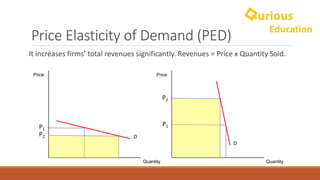
It	increases	firms’	total	revenues	significantly.	Revenues	=	Price	x	Quantity	Sold.
P1P1
P2
P2
Price	Elasticity	of	Demand	(PED)
Another	applications	of	PED:	
Tax	revenues	and	policies:	
- The	government	receives	higher	tax	revenue	by	imposing	it	on	inelastic	goods.	This	is	part	of	
the	reason	why	cigarettes,	petrol	and	alcohol	are	so	highly	taxed.
Manufactured	goods	vs	Primary	commodities:	
- Manufactured	goods	tend	to	have	a	high	PED	because	they	are	not	necessities	but	have	many	
close	substitutes.	E.g.	socks,	toys	and	furniture
- Primary	commodities	tend	to	have	a	low	PED	because	they	are	usually	necessities	with	no	
close	substitutes.	E.g.	wheat,	cow	leather,	raw	cane	sugar,	coal
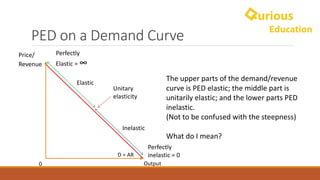
PED	on	a	Demand	Curve
D	=	AR
Output0
Elastic
Inelastic
Unitary	
elasticity
Perfectly
Elastic	=	∞
Perfectly	
inelastic	=	0
Price/	
Revenue
The	upper	parts	of	the	demand/revenue	
curve	is	PED	elastic;	the	middle	part	is	
unitarily	elastic;	and	the	lower	parts	PED	
inelastic.	
(Not	to	be	confused	with	the	steepness)	
What	do	I	mean?
PED	on	a	Demand	Curve
D	=	AR
Output0
Elastic
Inelastic
Unitary	
elasticity
Perfectly
Elastic	=	∞
Perfectly	
inelastic	=	0
Price/	
Revenue
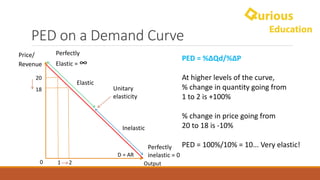
PED	=	%ΔQd/%ΔP
At	higher	levels	of	the	curve,	
%	change	in	quantity	going	from	
1	to	2	is	+100%
%	change	in	price	going	from	
20	to	18	is	-10%
PED	=	100%/10%	=	10...	Very	elastic!
1 2
20
18
PED	on	a	Demand	Curve
D	=	AR
Output0
Elastic
Inelastic
Unitary	
elasticity
Perfectly
Elastic	=	∞
Perfectly	
inelastic	=	0
Price/	
Revenue
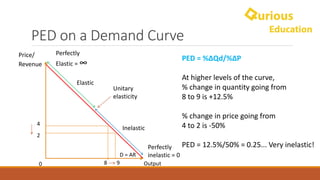
PED	=	%ΔQd/%ΔP
At	higher	levels	of	the	curve,	
%	change	in	quantity	going	from	
8	to	9	is	+12.5%
%	change	in	price	going	from	
4	to	2	is	-50%
PED	=	12.5%/50%	=	0.25...	Very	inelastic!
4
2
8							9
Cross	Elasticity	of	Demand	(XED)
XED	measures	the	responsiveness	of	quantity	demanded,	given	a	change	in	
price	of	another	good.
XED	=	%	Change	in	Qd for	good	A	/	%	Change	in	P	for	good	B
It	demonstrates	the	relationship	between	the	two	goods.
Cross	Elasticity	of	Demand	(XED)
What	relationships	do	these	pairs	of	goods	have?
Cross	Elasticity	of	Demand	(XED)
XED	=	%	Change	in	Qd for	good	A	/	%	Change	in	P	for	good	B
When	will	XED	be:
Positive? Negative?
Cross	Elasticity	of	Demand	(XED)
XED	=	%	Change	in	Qd for	good	A	/	%	Change	in	P	for	good	B
XED	is Positive	when:	increase	in	price	for	B	leads	to	an	increase	in	demand	for	A;	or	a	
decrease	in	price	B	leads	to	a	decrease	in	demand	for	A.
Meaning	A	and	B	are	substitutes
XED	is	Negative when:	decrease	in	price	for	B	leads	to	an	increase	in	demand	for	A;	or	an	
increase	in	price	B	leads	to	a	decrease	in	demand	for	A.
Meaning	A	and	B	are	complements
Cross	Elasticity	of	Demand	(XED)
XED	=	%	Change	in	Qd for	good	A	/	%	Change	in	P	for	good	B
What	if	XED	is 0?	
There	is	0	change	in	Qd for	good	A	despite	a	change	in	price	for	good	B.	E.g.	toilet	brushes	and	
spicy	curries.
Meaning	A	and	B	are	unrelated.	
The	bigger	the	XED,	the	bigger	effect	price	
of	B	has	on	demand	for	A.	This	signifies	a	
closer	relationship.
Cross	Elasticity	of	Demand	(XED)
XED	=	%	Change	in	Qd for	good	A	/	%	Change	in	P	for	good	B
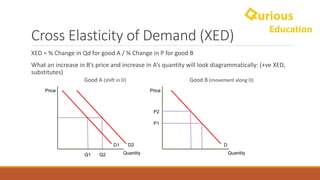
What	an	increase	in	B’s	price	and	increase	in	A’s	quantity	will	look	diagrammatically:	(+ve XED,	
substitutes)
Price
Quantity
D1 D2
Price
Quantity
D
P1
P2
Good	A	(shift	in	D)	 Good	B	(movement	along	D)	
Q1 Q2
Cross	Elasticity	of	Demand	(XED)
How	can	businesses	utilise	XED?
- Identify	and	monitor	prices	of	goods	with	a	positive/negative	XED	to	what	they	produce,	as	it	
will	affect	their	revenues
- Offer	goods	with	high	negative	XED	values	(i.e.	complements)	to	promote	cross	selling	of	
products	they	offer.
- Offer	goods	with	low	positive	XED	values	(i.e.	goods	with	little	or	no	substitutes)	and	enter	into	
a	market	with	little	competition	and	keep	prices	high.
Cross	Elasticity	of	Demand	(XED)
Calculating	XED:
(ii)	Calculate	the	cross	elasticity	of	demand	between	Good	A	and	Good	B when	the	price	of	Good	A	falls	between	January	
2014	and	February 2014.	[2]
Cross	Elasticity	of	Demand	(XED)
Calculating	XED:
(ii)	Calculate	the	cross	elasticity	of	demand	between	Good	A	and	Good	B when	the	price	of	Good	A	falls	between	January	
2014	and	February 2014.	[2]
PED	=	%	Change	in	Qd of	A	/	%	Change	in	P	of	B
=	[(190	– 200)	/	200]	/	[(6	– 8)	/	8]	=	0.2
Income	Elasticity	of	Demand	(YED)
What	is	YED?	
YED	measures	the	responsiveness	of	quantity	demanded,	given	a	change	in	
income.
YED	=	%	Change	in	Qd /	%	Change	in	income
Income	Elasticity	of	Demand	(YED)
Normal	goods:	Goods	where	demand	increases	as	income	increases	(e.g.	cars	in	China)
Inferior	goods:	Goods	where	demand	decreases	as	income	increases	(e.g.	bikes	in	China)
What	do	you	think	the	YED	of	these	goods	would	be?
YED	=	%	Change	in	Qd /	%	Change	in	income
Income	Elasticity	of	Demand	(YED)
Normal	goods:	Goods	where	demand	increases	as	income	increases	(e.g.	cars	in	China)
Inferior	goods:	Goods	where	demand	decreases	as	income	increases	(e.g.	bikes	in	China)
What	do	you	think	the	YED	of	these	goods	would	be?
YED	=	%	Change	in	Qd /	%	Change	in	income
Normal	goods	will	have	a	positive	YED;	and	inferior	goods	a	negative	YED.
Note	that	the	entire	demand	curve	for	the	good	shifts	when	incomes	increase/decrease
Income	Elasticity	of	Demand	(YED)
What	do	you	think	are	the	YED	of	luxury	goods	(e.g.	champagne)	and	necessity	goods	(e.g.	
electricity)?
YED	=	%	Change	in	Qd /	%	Change	in	income
YED	is	relatively	inelastic	for	necessities	(YED	<	1)	as	it	is	bought	even	if	the	level	of	income	
changes	(increases/decreases)	greatly	
YED	is	relatively	elastic	(YED	>	1)	for	luxury	goods	as	it	is	bought	in	a	great	number,	once	basic	
necessities	are	fulfilled.
Income	Elasticity	of	Demand	(YED)
YED	=	%	Change	in	Qd /	%	Change	in	income
Do	you	think	the	YED	of	these	goods	and	services	are	high	(YED	>	1)	or	low	(YED	<	1)	?
Income	Elasticity	of	Demand	(YED)
With	the	concept	of	YED,	producers	can	predict	their	revenues	relative	to	the	
state	of	the	economy.	Why	is	that?
The	business	cycle	(recessions/booms)	affects	incomes	of	households	and	individuals.	If	YED	for	
necessity	goods	is	inelastic	and	luxury	goods	is	elastic,	this	means:
- Producers	of	primary	products	(low	YED)	will	see	limited	change	in	revenue	throughout	the	
business	cycle
- Producers	of	manufactured	goods	(higher	YED)	will	see	fall	in	revenues	during	a	recession,	vice	
versa
- Producers	of	services	(high	YED)	will	see	significant	decreases	in	revenues	during	a	recession,	
vice	versa

Elasticities Notes - A-level & IB Economics