WELCOME
GLP
(GOOD LABORATORY PRACTICES)
GOOD LABORATORY PRACTICES
1.Introduction
2.History
3.OECD principles
4.GLP at glance
5.GLP in India
1.Introduction
1.INTRODUCTION:
What is a good laboratory practice?

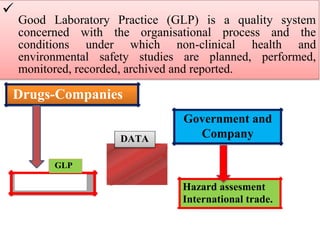
Good Laboratory Practice (GLP) is a quality system
concerned with the organisational process and the
conditions under which non-clinical health and
environmental safety studies are planned, performed,
monitored, recorded, archived and reported.

Drugs-Companies
DATA
Government and
Company
GLP
Laboratories Hazard assesment
International trade.
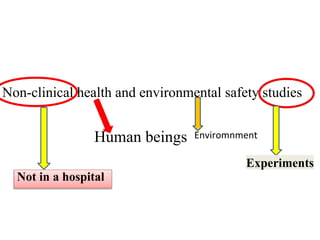
Non-clinical health and environmental safety studies
Human beings Enviromnment
Experiments
Not in a hospital
2. HISTORY
GLP was instituted in US following cases of fraud generated by toxicology labs in data
submitted to the FDA by pharmaceutical companies. Industrial Bio Test Lab (IBT) was
the most notable case, where thousands of safety tests for chemical manufacturers
were falsely claimed to have been performed or were so poor .
1976
1972
The word GLP- Newzealand

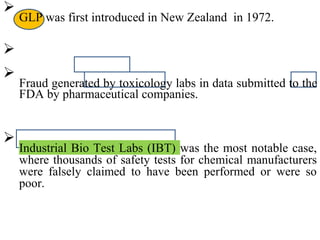
GLP was first introduced in New Zealand in 1972.

 

Fraud generated by toxicology labs in data submitted to the
FDA by pharmaceutical companies.


Industrial Bio Test Labs (IBT) was the most notable case,
where thousands of safety tests for chemical manufacturers
were falsely claimed to have been performed or were so
poor.

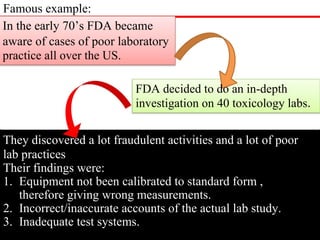
Famous example:
In the early 70’s FDA became
aware of cases of poor laboratory
practice all over the US.
FDA decided to do an in-depth
investigation on 40 toxicology labs.
They discovered a lot fraudulent activities and a lot of poor
lab practices
Their findings were:
1. Equipment not been calibrated to standard form ,
therefore giving wrong measurements.
2. Incorrect/inaccurate accounts of the actual lab study.
3. Inadequate test systems.

One investigation- made headline news



The name of the Lab was Industrial Bio Test. IBT
Ran tests for big companies-
Procter and Gamble.


It was discovered tha mice that they had used to test
cosmetics such as lotion and deodorants had developed
cancer and died.


Industrial Bio Test lab threw the dead
mice and covered results deeming the
products good for human
consumption. Those involved in
production, distribution and sales for
the lab eventually served jail time.


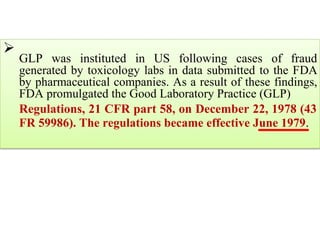
GLP was instituted in US following cases of fraud
generated by toxicology labs in data submitted to the FDA
by pharmaceutical companies. As a result of these findings,
FDA promulgated the Good Laboratory Practice (GLP)

Regulations, 21 CFR part 58, on December 22, 1978 (43
FR 59986). The regulations became effective June 1979.
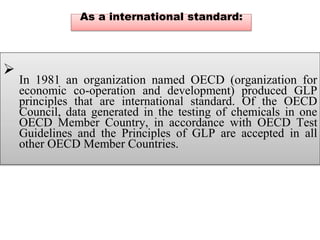
As a international standard:

In 1981 an organization named OECD (organization for
economic co-operation and development) produced GLP
principles that are international standard. Of the OECD
Council, data generated in the testing of chemicals in one
OECD Member Country, in accordance with OECD Test
Guidelines and the Principles of GLP are accepted in all
other OECD Member Countries.

INSTITUITIONS -GLP
INTERNATIONAL LEVEL
OECD
USA FDA
COUNTRY LEVEL
ORIGINATOR FOR THE GLP
OBJECTIVES OF GLP
 GLP makes sure that the data submitted are a true
reflection of the results that are obtained during
the study.


 GLP also makes sure that not to indulge in any
fraud activity by labs.


 Promotes international acceptance of tests.
3.GOOD LABORATORY PRACTICE
PRINCIPLES
GOOD LABORATORY PRACTICE - PRINCIPLES
1.Test Facility Organisation and Personnel
2. Quality Assurance Programme
3. Facilities
4. Apparatus, Material, and Reagents
5. Test Systems
6. Test and Reference Items
7. Performance of the Study
8. Reporting of Study Results
9. Storage and Retention of Records and Materials
1.Test Facility Organisation and Personnel
A. Test Facility Management’s Responsibilities
B. Study Director’s Responsibilities
C. Principal Investigator’s Responsibilities
D. Study Personnel’s Responsibilities
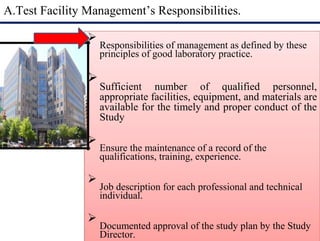
A.Test Facility Management’s Responsibilities.

Responsibilities of management as defined by these
principles of good laboratory practice.


Sufficient number of qualified personnel,
appropriate facilities, equipment, and materials are
available for the timely and proper conduct of the
Study


Ensure the maintenance of a record of the
qualifications, training, experience.


Job description for each professional and technical
individual.


Documented approval of the study plan by the Study
Director.

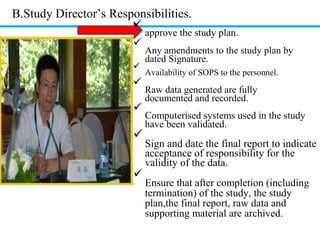
B.Study Director’s Responsibilities.

approve the study plan.


Any amendments to the study plan by
dated Signature.


Availability of SOPS to the personnel.


Raw data generated are fully
documented and recorded.


Computerised systems used in the study
have been validated.


Sign and date the final report to indicate
acceptance of responsibility for the
validity of the data.


Ensure that after completion (including
termination) of the study, the study
plan,the final report, raw data and
supporting material are archived.

C.Principal Investigator’s Responsibilities

The Principal Investigator will ensure that the delegated
phases of the study are conducted in accordance with the
applicable Principles of Good Laboratory Practice

Knowledgeable
Responsibilities
Instructions
Health
precautions Recording
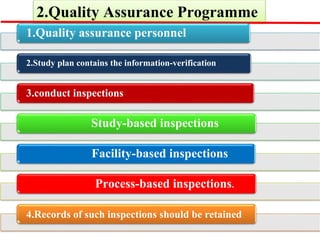
2.Quality Assurance Programme
1.Quality assurance personnel
2.Study plan contains the information-verification
3.conduct inspections
Study-based inspections
Facility-based inspections
Process-based inspections.
4.Records of such inspections should be retained
3. Facilities
1.Test system facilities

Sufficient number of rooms or areas assure the isolation of
test systems and the isolation of individual projects
involving substances or organisms known to be or
suspected of being biohazardous.


There should be storage rooms or areas as needed for supplies
and equipment.


Areas should be available for the diagnosis, treatment
and control of diseases, in order to ensure that there is no
unacceptable degree of deterioration of test systems.

Archive Facilities

Archive facilities should be provided for the secure storage and
retrieval of study plans, raw data, final reports, samples of test
items and specimens.


Archive design and archive conditions should protect contents from
untimely deterioration.

waste disposal

Handling and disposal of wastes should be carried out in such a way
as not to jeopardise the integrity of studies. This includes provision for
appropriate collection, storage and disposal facilities, and
decontamination and transportation procedures

4. Apparatus, Material, and Reagents
 Apparatus, including validated computerised systems, used for the
generation, storage and retrieval of data, and for controlling
environmental factors relevant to the study.

 Apparatus used in a study should be periodically inspected, cleaned,
maintained, and calibrated according to Standard Operating
Procedures.

 Apparatus and materials used in a study should not interfere
adversely with the test systems.

 Chemicals, reagents, and solutions should be labelled to indicate
identity (with concentration if appropriate), expiry date and specific
storage instructions. Information concerning source, preparation
date and stability should be available. The expiry date may be
extended on the basis of documented evaluation or analysis.
5&6.Test Items and test systems and
characterisation
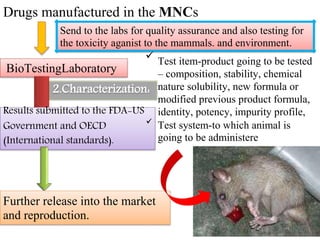
Drugs manufactured in the MNCs
Send to the labs for quality assurance and also testing for
the toxicity aganist to the mammals. and environment.

BioTestingLaboratory
2.Characterization:
Results submitted to the FDA-US
Government and OECD 
(International standards).
Test item-product going to be tested
– composition, stability, chemical
nature solubility, new formula or
modified previous product formula,
identity, potency, impurity profile,
Test system-to which animal is
going to be administere
Further release into the market
and reproduction.
7.Performance of the Study
1. Study Plan
2. Content of the Study Plan
3. Dates
4. Test Methods
5. Issues (where applicable)
6. Records.
7. A list of records to be retained.
8. Conduct of the Study.
8.Reporting of Study Results
1. Content of the Final Report
2. Identification of the Study, the Test Item and
Reference Item
3. Information Concerning the Sponsor and the Test Facility
4. Dates
5. Statement
6. Description of Materials and Test Methods
7. Results
8. Storage
9. Storage and Retention of Records and Materials

The study plan, raw data, samples of test and reference items,
specimens and the final report of each study.


Records of all inspections performed by the Quality Assurance
Programme, as well as master schedules.


Records of qualifications, training, experience and job
descriptions of personnel.


Records and reports of the maintenance and calibration of
apparatus.


Validation documentation for computerised systems.

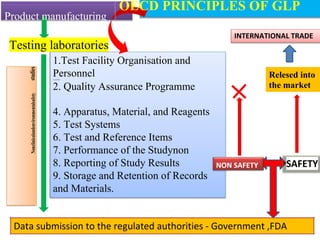
GLP AT A GLANCE
Product manufacturing
OECD PRINCIPLES OF GLP
Testing laboratories
1.Test Facility Organisation and
studies
Personnel3. Facilities
2. Quality Assurance Programme
Nonclinicalandenvironmentalsafety
4. Apparatus, Material, and Reagents
5. Test Systems
6. Test and Reference Items
7. Performance of the Studynon
8. Reporting of Study Results
9. Storage and Retention of Records
and Materials.
INTERNATIONAL TRADE
Relesed into
the market
NON SAFETY SAFETY
Data submission to the regulated authorities - Government ,FDA
INDIA
GLP IN OUR COUNTRY
 National GLP-compliance Monitoring Authority was established by
the Department of Science & Technology
 approval of the Union Cabinet on April 24, 2002
 A provisional member of the OECD for GLP.
 India is an Observer to the OECD’s Working Group on GLP
 The Authority has trained 33 experts in the country as GLP
inspectors.
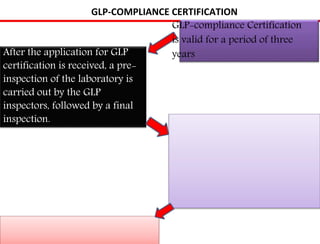
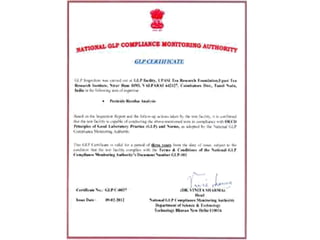
GLP-COMPLIANCE CERTIFICATION
After the application for GLP
certification is received, a pre-
inspection of the laboratory is
carried out by the GLP
inspectors, followed by a final
inspection.
GLP-compliance Certification
is valid for a period of three
years
The test facilities/laboratories
have to apply in the prescribed
application form
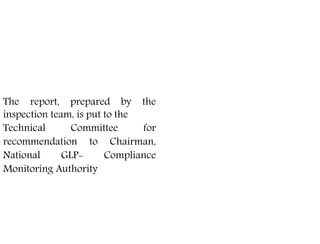
The report, prepared by the
inspection team, is put to the
Technical Committee for
recommendation to Chairman,
National GLP- Compliance
Monitoring Authority
HEAD OF NGCMA:
Dr D R Prasada Raju
Head /Scientist G
drpraju@nic.in
National GLP Compliance Monitoring Authority
Department of Science and Technology
Technology Bhawan, New Mehrauli Road,
New Delhi-110 016 (Telefax 011-26510686)
Mrs Ekta Kapoor
Scientist D
Department of Science and Technology
Technology Bhawan, New Mehrauli Road,
New Delhi-110 016 (Phone: 011-26590242)
E-mail: -ektakapoor.glp@gmail.com
Our aim :
is to be get the status of full membership in the
near future so that the Indian industries do not have
to get their test facility (products) certified from
safety angle by other GLP monitoring authorities and
do not lose on the trade front.
Conclusion
GLP is an FDA regulation which is accepted and
Approved as international standards by OECD to avoid
the fraud activities of the testing laboratories for
pesticides, pharmaceuticals, and food additives, dyes, to
save the human and environmental health and also erect
good international trade and establish good relationship
among the countries.
Thanks a lot
-PRESENTED BY
SHAHNAWAZ AHMED
STUDY DIRECTOR IIRT
GHAZIABAD

Glp ppt

  • 1.
  • 2.
    GOOD LABORATORY PRACTICES 1.Introduction 2.History 3.OECDprinciples 4.GLP at glance 5.GLP in India
  • 3.
  • 4.
    1.INTRODUCTION: What is agood laboratory practice?
  • 5.
     Good Laboratory Practice(GLP) is a quality system concerned with the organisational process and the conditions under which non-clinical health and environmental safety studies are planned, performed, monitored, recorded, archived and reported.  Drugs-Companies DATA Government and Company GLP Laboratories Hazard assesment International trade.
  • 6.
    Non-clinical health andenvironmental safety studies Human beings Enviromnment Experiments Not in a hospital
  • 7.
  • 8.
    GLP was institutedin US following cases of fraud generated by toxicology labs in data submitted to the FDA by pharmaceutical companies. Industrial Bio Test Lab (IBT) was the most notable case, where thousands of safety tests for chemical manufacturers were falsely claimed to have been performed or were so poor . 1976 1972 The word GLP- Newzealand
  • 9.
     GLP was firstintroduced in New Zealand in 1972.     Fraud generated by toxicology labs in data submitted to the FDA by pharmaceutical companies.   Industrial Bio Test Labs (IBT) was the most notable case, where thousands of safety tests for chemical manufacturers were falsely claimed to have been performed or were so poor. 
  • 10.
    Famous example: In theearly 70’s FDA became aware of cases of poor laboratory practice all over the US. FDA decided to do an in-depth investigation on 40 toxicology labs. They discovered a lot fraudulent activities and a lot of poor lab practices Their findings were: 1. Equipment not been calibrated to standard form , therefore giving wrong measurements. 2. Incorrect/inaccurate accounts of the actual lab study. 3. Inadequate test systems.
  • 11.
     One investigation- madeheadline news    The name of the Lab was Industrial Bio Test. IBT Ran tests for big companies- Procter and Gamble.   It was discovered tha mice that they had used to test cosmetics such as lotion and deodorants had developed cancer and died.   Industrial Bio Test lab threw the dead mice and covered results deeming the products good for human consumption. Those involved in production, distribution and sales for the lab eventually served jail time. 
  • 12.
     GLP was institutedin US following cases of fraud generated by toxicology labs in data submitted to the FDA by pharmaceutical companies. As a result of these findings, FDA promulgated the Good Laboratory Practice (GLP)  Regulations, 21 CFR part 58, on December 22, 1978 (43 FR 59986). The regulations became effective June 1979.
  • 13.
    As a internationalstandard:  In 1981 an organization named OECD (organization for economic co-operation and development) produced GLP principles that are international standard. Of the OECD Council, data generated in the testing of chemicals in one OECD Member Country, in accordance with OECD Test Guidelines and the Principles of GLP are accepted in all other OECD Member Countries. 
  • 14.
    INSTITUITIONS -GLP INTERNATIONAL LEVEL OECD USAFDA COUNTRY LEVEL ORIGINATOR FOR THE GLP
  • 15.
    OBJECTIVES OF GLP GLP makes sure that the data submitted are a true reflection of the results that are obtained during the study.    GLP also makes sure that not to indulge in any fraud activity by labs.    Promotes international acceptance of tests.
  • 16.
  • 17.
    GOOD LABORATORY PRACTICE- PRINCIPLES 1.Test Facility Organisation and Personnel 2. Quality Assurance Programme 3. Facilities 4. Apparatus, Material, and Reagents 5. Test Systems 6. Test and Reference Items 7. Performance of the Study 8. Reporting of Study Results 9. Storage and Retention of Records and Materials
  • 18.
    1.Test Facility Organisationand Personnel A. Test Facility Management’s Responsibilities B. Study Director’s Responsibilities C. Principal Investigator’s Responsibilities D. Study Personnel’s Responsibilities
  • 19.
    A.Test Facility Management’sResponsibilities.  Responsibilities of management as defined by these principles of good laboratory practice.   Sufficient number of qualified personnel, appropriate facilities, equipment, and materials are available for the timely and proper conduct of the Study   Ensure the maintenance of a record of the qualifications, training, experience.   Job description for each professional and technical individual.   Documented approval of the study plan by the Study Director. 
  • 20.
    B.Study Director’s Responsibilities.  approvethe study plan.   Any amendments to the study plan by dated Signature.   Availability of SOPS to the personnel.   Raw data generated are fully documented and recorded.   Computerised systems used in the study have been validated.   Sign and date the final report to indicate acceptance of responsibility for the validity of the data.   Ensure that after completion (including termination) of the study, the study plan,the final report, raw data and supporting material are archived. 
  • 21.
    C.Principal Investigator’s Responsibilities  ThePrincipal Investigator will ensure that the delegated phases of the study are conducted in accordance with the applicable Principles of Good Laboratory Practice 
  • 22.
  • 23.
    2.Quality Assurance Programme 1.Qualityassurance personnel 2.Study plan contains the information-verification 3.conduct inspections Study-based inspections Facility-based inspections Process-based inspections. 4.Records of such inspections should be retained
  • 24.
    3. Facilities 1.Test systemfacilities  Sufficient number of rooms or areas assure the isolation of test systems and the isolation of individual projects involving substances or organisms known to be or suspected of being biohazardous.   There should be storage rooms or areas as needed for supplies and equipment.   Areas should be available for the diagnosis, treatment and control of diseases, in order to ensure that there is no unacceptable degree of deterioration of test systems. 
  • 25.
    Archive Facilities  Archive facilitiesshould be provided for the secure storage and retrieval of study plans, raw data, final reports, samples of test items and specimens.   Archive design and archive conditions should protect contents from untimely deterioration.  waste disposal  Handling and disposal of wastes should be carried out in such a way as not to jeopardise the integrity of studies. This includes provision for appropriate collection, storage and disposal facilities, and decontamination and transportation procedures 
  • 26.
    4. Apparatus, Material,and Reagents  Apparatus, including validated computerised systems, used for the generation, storage and retrieval of data, and for controlling environmental factors relevant to the study.   Apparatus used in a study should be periodically inspected, cleaned, maintained, and calibrated according to Standard Operating Procedures.   Apparatus and materials used in a study should not interfere adversely with the test systems.   Chemicals, reagents, and solutions should be labelled to indicate identity (with concentration if appropriate), expiry date and specific storage instructions. Information concerning source, preparation date and stability should be available. The expiry date may be extended on the basis of documented evaluation or analysis.
  • 27.
    5&6.Test Items andtest systems and characterisation
  • 28.
    Drugs manufactured inthe MNCs Send to the labs for quality assurance and also testing for the toxicity aganist to the mammals. and environment.  BioTestingLaboratory 2.Characterization: Results submitted to the FDA-US Government and OECD  (International standards). Test item-product going to be tested – composition, stability, chemical nature solubility, new formula or modified previous product formula, identity, potency, impurity profile, Test system-to which animal is going to be administere Further release into the market and reproduction.
  • 29.
    7.Performance of theStudy 1. Study Plan 2. Content of the Study Plan 3. Dates 4. Test Methods 5. Issues (where applicable) 6. Records. 7. A list of records to be retained. 8. Conduct of the Study.
  • 30.
    8.Reporting of StudyResults 1. Content of the Final Report 2. Identification of the Study, the Test Item and Reference Item 3. Information Concerning the Sponsor and the Test Facility 4. Dates 5. Statement 6. Description of Materials and Test Methods 7. Results 8. Storage
  • 31.
    9. Storage andRetention of Records and Materials  The study plan, raw data, samples of test and reference items, specimens and the final report of each study.   Records of all inspections performed by the Quality Assurance Programme, as well as master schedules.   Records of qualifications, training, experience and job descriptions of personnel.   Records and reports of the maintenance and calibration of apparatus.   Validation documentation for computerised systems. 
  • 32.
    GLP AT AGLANCE
  • 33.
    Product manufacturing OECD PRINCIPLESOF GLP Testing laboratories 1.Test Facility Organisation and studies Personnel3. Facilities 2. Quality Assurance Programme Nonclinicalandenvironmentalsafety 4. Apparatus, Material, and Reagents 5. Test Systems 6. Test and Reference Items 7. Performance of the Studynon 8. Reporting of Study Results 9. Storage and Retention of Records and Materials. INTERNATIONAL TRADE Relesed into the market NON SAFETY SAFETY Data submission to the regulated authorities - Government ,FDA
  • 34.
  • 35.
     National GLP-complianceMonitoring Authority was established by the Department of Science & Technology  approval of the Union Cabinet on April 24, 2002  A provisional member of the OECD for GLP.  India is an Observer to the OECD’s Working Group on GLP  The Authority has trained 33 experts in the country as GLP inspectors.
  • 36.
    GLP-COMPLIANCE CERTIFICATION After theapplication for GLP certification is received, a pre- inspection of the laboratory is carried out by the GLP inspectors, followed by a final inspection. GLP-compliance Certification is valid for a period of three years
  • 37.
    The test facilities/laboratories haveto apply in the prescribed application form The report, prepared by the inspection team, is put to the Technical Committee for recommendation to Chairman, National GLP- Compliance Monitoring Authority
  • 39.
    HEAD OF NGCMA: DrD R Prasada Raju Head /Scientist G drpraju@nic.in National GLP Compliance Monitoring Authority Department of Science and Technology Technology Bhawan, New Mehrauli Road, New Delhi-110 016 (Telefax 011-26510686) Mrs Ekta Kapoor Scientist D Department of Science and Technology Technology Bhawan, New Mehrauli Road, New Delhi-110 016 (Phone: 011-26590242) E-mail: -ektakapoor.glp@gmail.com
  • 40.
    Our aim : isto be get the status of full membership in the near future so that the Indian industries do not have to get their test facility (products) certified from safety angle by other GLP monitoring authorities and do not lose on the trade front.
  • 47.
    Conclusion GLP is anFDA regulation which is accepted and Approved as international standards by OECD to avoid the fraud activities of the testing laboratories for pesticides, pharmaceuticals, and food additives, dyes, to save the human and environmental health and also erect good international trade and establish good relationship among the countries.
  • 48.
    Thanks a lot -PRESENTEDBY SHAHNAWAZ AHMED STUDY DIRECTOR IIRT GHAZIABAD