
GOOD LABORATORY
PRACTICES (GLP)
• BY:- SHOAB MALEK
• Certified Quality
Auditor & Pharma
Consultant
• Shoab.malek@gmail.com
• +91 9638069084
GLP: GOOD LABORATORY PRACTICE
 GLP is an FDA regulation.
 Definition: GLP embodies a set
of principles that provides a
framework within which
laboratory studies are planned
performed, monitored, reported
and archived.
 GLP is sometimes confused with
the standards of laboratory
safety like wearing safety
goggles.
HISTORY
 GLP is a formal regulation that was created by the FDA (United
states food and drug administration) in 1978.
 Although GLP originated in the United States , it had a world
wide impact.
 Non-US companies that wanted to do business with the United
states or register their pharmacies in the United States had to
comply with the United States GLP regulations.
 They eventually started making GLP regulations in their home
countries.
 In 1981 an organization named OECD (organization for
economic co-operation and development ) produced GLP
principles that are international standard.
WHY WAS GLP CREATED?
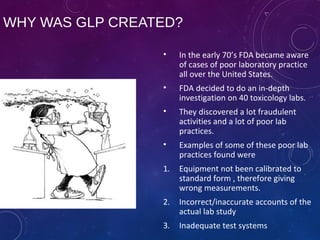
• In the early 70’s FDA became aware
of cases of poor laboratory practice
all over the United States.
• FDA decided to do an in-depth
investigation on 40 toxicology labs.
• They discovered a lot fraudulent
activities and a lot of poor lab
practices.
• Examples of some of these poor lab
practices found were
1. Equipment not been calibrated to
standard form , therefore giving
wrong measurements.
2. Incorrect/inaccurate accounts of the
actual lab study
3. Inadequate test systems
FAMOUS EXAMPLE
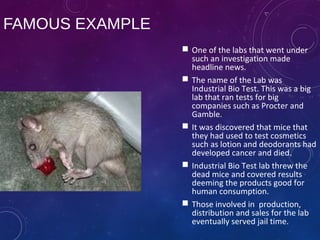
 One of the labs that went under
such an investigation made
headline news.
 The name of the Lab was
Industrial Bio Test. This was a big
lab that ran tests for big
companies such as Procter and
Gamble.
 It was discovered that mice that
they had used to test cosmetics
such as lotion and deodorants had
developed cancer and died.
 Industrial Bio Test lab threw the
dead mice and covered results
deeming the products good for
human consumption.
 Those involved in production,
distribution and sales for the lab
eventually served jail time.
OBJECTIVES OF GLP
 GLP makes sure that the data submitted are a true reflection of the results that are
obtained during the study.
 GLP also makes sure that data is traceable.
 Promotes international acceptance of tests.
MISSION OF GLP
• Test systems
• Archiving of records and materials.
• Apparatus, material and reagent facilities.
• Quality assurance programs.
• Performance of the study.
• Reporting of study results.
• Standard operating procedures (SOP)
• Personnel and test facility organization
STANDARD OPERATING
PROCEDURES (SOP)
 Written procedures for a laboratories program.
 They define how to carry out protocol-specified activities.
 Most often written in a chronological listing of action steps.
 They are written to explain how the procedures are suppose to work
SOP
 Routine inspection, cleaning, maintenance, testing and calibration.
 Actions to be taken in response to equipment failure.
 Analytical methods
 Definition of raw data
 Keeping records, reporting, storage, mixing, and retrieval of data
STATISTICAL PROCEDURES
FOR DATA EVALUATION
 Statistical procedures are not simply chosen from a text book
 Practitioners in a particular field may adopt certain standards which are deemed
acceptable within that field.
 Regulatory agencies often describe acceptable statistical procedures.
INSTRUMENTATION VALIDATION
• This is a process necessary for any analytical laboratory.
• Data produced by “faulty” instruments may give the appearance of valid data.
• The frequency for calibration, re-validation and testing depends on the instrument
and extent of its use in the laboratory.
• Whenever an instrument’s performance is outside the “control limits” reports must
be discontinued
INSTRUMENT VALIDATION (CONT)
 Equipment records should include:
 Name of the equipment and manufacturer
 Model or type for identification
 Serial number
 Date equipment was received in the laboratory
 Copy of manufacturers operating instruction (s)
REAGENT/ MATERIALS CERTIFICATION
 This policy is to assure that reagents used are specified in the standard operating
procedure.
 Purchasing and testing should be handled by a quality assurance program.
REAGENTS AND SOLUTIONS
CONT
 Requirements:
 Reagents and solutions shall be labeled
 Deteriorated or outdated reagents and solutions shall not be used
 Include Date opened
 Stored under ambient temperature
 Expiration date
ANALYST CERTIFICATION
 Some acceptable proof of satisfactory training and/or competence with specific
laboratory procedures must be established for each analyst.
 Qualification can come from education, experience or additional trainings, but it
should be documented
 Sufficient people
 Requirements of certification vary
LABORATORY CERTIFICATION
Normally done by an external agency
Evaluation is concerned with issues such as
Adequate space
Ventilation
Storage
Hygiene
SPECIMEN/SAMPLE TRACKING
 Vary among laboratories
 Must maintain the unmistakable connection between a set of analytical data and
the specimen and/or samples from which they were obtained.
 Original source of specimen/sample (s) must be recorded and unmistakably
connected with the set of analytical data.
DOCUMENTATION AND
MAINTENANCE OF RECORDS
Maintenance of all records provide documentation
which may be required in the event of legal
challenges due to repercussions of decisions based
on the original analytical results.
General guidelines followed in regulated laboratories
is to maintain records for at least five years
Length of time over which laboratory records should
be maintained will vary with the situation
IMPORTANT QUESTIONS TO BE
ANSWERED FOR ANY ANALYTICAL
INSTRUMENT
 What is the equipment being used for?
 Is the instrument within specification and is the
documentation to prove this available?
 If the instrument is not within specifications, how much
does it deviate by?
 If the instrument is not within specifications what action
has been taken to overcome the defect?
 Can the standards used to test and calibrate the
instrument be traced back to national standards?
WHAT HAPPENS IF A WORKPLACE
DOES NOT COMPLY WITH FEDERAL
GOOD LABORATORY PRACTICE
STANDARDS?
.
DISQUALIFICATION OF A FACILITY
 Before a workplace can experience the consequences of noncompliance, an
explanation of disqualification is needed
 The FDA states the purpose of disqualification as the exclusion of a testing facility
from completing laboratory studies or starting any new studies due to not
following the standards of compliance set by the Good Laboratory Practice manual
POSSIBLE VIOLATIONS
 Falsifying information for permit, registration or any required records
 Falsifying information related to testing~ protocols, ingredients, observations, data
equipment, ect.
 Failure to prepare, retain, or submit written records required by law
GROUNDS FOR DISQUALIFICATION
• The testing facility failed to comply with one or more regulations implemented by
the GLP manual
• The failure to comply led to adverse outcomes in the data; in other words, it
affected the validity of the study
• Warnings or rejection of previous studies have not been adequate to improve the
facility’s compliance
CONSEQUENCES OF
NONCOMPLIANCE The FDA states the following consequences of noncompliance:
 The commissioner will send a written proposal of
disqualification to the testing facility
 A regulatory hearing on the disqualification will be
scheduled
 If the commissioner finds that after the hearing, the
facility has complied, then a written statement with an
explanation of termination of disqualification will be sent
to the facility
 Thus, if it can be shown that such disqualifications did not
affect the integrity and outcome of the study itself, or did
not occur at all, then the study may be reinstated at the
will of the commissioner
UPON DISQUALIFICATION…
If the commissioner finds that the facility was noncompliant
on any of the grounds after the hearing, then a final order
of noncompliance will be sent to the facility with
explanations
• If a testing facility has been disqualified, any studies done
before of after the disqualification will need to be determined
as essential to a decision (acceptable or not)
• If the study is determined unacceptable, then the facility itself
may need to show that the study was not affected by the
noncompliance that led to the disqualification
• Once finally disqualified, the facility may not receive or be
considered for a research or marketing permit and the study is
rejected.
UPON DISQUALIFICATION…
 The commissioner may notify the public and all interested
persons, including other federal agencies the facility may have
contacted
 The FDA may ask the other agencies to consider whether to
support the facility or not under the disqualification
 Civil or criminal proceedings may occur at the discretion of the
commissioner
 Fines of up to $50,000 if one knowingly commits crime and/or 1
year imprisonment~ for registration applicants and producers
 Fines up to $5,000 all others~ civil penalty after failing to improve
after a minor violation warning was issued~ only those involved in
testing will be given civil penalties
 Those involved in the distribution or sales will be assessed more
heavy penalties, such as criminal penalties
UPON DISQUALIFICATION…
• The FDA may turn it over to the federal, state or local law enforcement
• The facility’s sponsor may terminate or suspend the facility from doing any non-
clinical study for a permit
• The sponsor is required to notify the FDA in writing within 15 working days that the
facility is to be suspended or terminated and why
REINSTATEMENT OF A
DISQUALIFIED FACILITY
The testing facility may be reinstated as acceptable
non-clinical study to be turned into the FDA if the
commissioner can be certain that future studies will
be conducted in compliance with the Good
Laboratory Practice standards and that any current
studies integrity have not been severely harmed by
the disqualification
The disqualified facility will be required to put in
writing to the commissioner reasons why it should be
reinstated and any actions the facility will take or
have taken to assure any disqualification problems
will not happen again
REINSTATEMENT OF A
DISQUALIFIED FACILITY
 The commissioner will inspect the facility and determine if it shall be reinstated
 If it is reinstated, the commissioner is required to notify all persons that were
notified of the disqualification including the facility itself
REFERENCES
 http://www.sjsu.edu/faculty/chem55/55glpout.htm
 http://www.labcompliance.com/tutorial/glp/default.aspx?sm=d_a
 UGA Office of the Vice President for Research
 Wikipedia
THANK YOU

Good Laboratory Practice (GLP)

  • 1.
    GOOD LABORATORY PRACTICES (GLP) •BY:- SHOAB MALEK • Certified Quality Auditor & Pharma Consultant • Shoab.malek@gmail.com • +91 9638069084
  • 2.
    GLP: GOOD LABORATORYPRACTICE  GLP is an FDA regulation.  Definition: GLP embodies a set of principles that provides a framework within which laboratory studies are planned performed, monitored, reported and archived.  GLP is sometimes confused with the standards of laboratory safety like wearing safety goggles.
  • 3.
    HISTORY  GLP isa formal regulation that was created by the FDA (United states food and drug administration) in 1978.  Although GLP originated in the United States , it had a world wide impact.  Non-US companies that wanted to do business with the United states or register their pharmacies in the United States had to comply with the United States GLP regulations.  They eventually started making GLP regulations in their home countries.  In 1981 an organization named OECD (organization for economic co-operation and development ) produced GLP principles that are international standard.
  • 4.
    WHY WAS GLPCREATED? • In the early 70’s FDA became aware of cases of poor laboratory practice all over the United States. • FDA decided to do an in-depth investigation on 40 toxicology labs. • They discovered a lot fraudulent activities and a lot of poor lab practices. • Examples of some of these poor lab practices found were 1. Equipment not been calibrated to standard form , therefore giving wrong measurements. 2. Incorrect/inaccurate accounts of the actual lab study 3. Inadequate test systems
  • 5.
    FAMOUS EXAMPLE  Oneof the labs that went under such an investigation made headline news.  The name of the Lab was Industrial Bio Test. This was a big lab that ran tests for big companies such as Procter and Gamble.  It was discovered that mice that they had used to test cosmetics such as lotion and deodorants had developed cancer and died.  Industrial Bio Test lab threw the dead mice and covered results deeming the products good for human consumption.  Those involved in production, distribution and sales for the lab eventually served jail time.
  • 6.
    OBJECTIVES OF GLP GLP makes sure that the data submitted are a true reflection of the results that are obtained during the study.  GLP also makes sure that data is traceable.  Promotes international acceptance of tests.
  • 7.
    MISSION OF GLP •Test systems • Archiving of records and materials. • Apparatus, material and reagent facilities. • Quality assurance programs. • Performance of the study. • Reporting of study results. • Standard operating procedures (SOP) • Personnel and test facility organization
  • 8.
    STANDARD OPERATING PROCEDURES (SOP) Written procedures for a laboratories program.  They define how to carry out protocol-specified activities.  Most often written in a chronological listing of action steps.  They are written to explain how the procedures are suppose to work
  • 9.
    SOP  Routine inspection,cleaning, maintenance, testing and calibration.  Actions to be taken in response to equipment failure.  Analytical methods  Definition of raw data  Keeping records, reporting, storage, mixing, and retrieval of data
  • 10.
    STATISTICAL PROCEDURES FOR DATAEVALUATION  Statistical procedures are not simply chosen from a text book  Practitioners in a particular field may adopt certain standards which are deemed acceptable within that field.  Regulatory agencies often describe acceptable statistical procedures.
  • 11.
    INSTRUMENTATION VALIDATION • Thisis a process necessary for any analytical laboratory. • Data produced by “faulty” instruments may give the appearance of valid data. • The frequency for calibration, re-validation and testing depends on the instrument and extent of its use in the laboratory. • Whenever an instrument’s performance is outside the “control limits” reports must be discontinued
  • 12.
    INSTRUMENT VALIDATION (CONT) Equipment records should include:  Name of the equipment and manufacturer  Model or type for identification  Serial number  Date equipment was received in the laboratory  Copy of manufacturers operating instruction (s)
  • 13.
    REAGENT/ MATERIALS CERTIFICATION This policy is to assure that reagents used are specified in the standard operating procedure.  Purchasing and testing should be handled by a quality assurance program.
  • 14.
    REAGENTS AND SOLUTIONS CONT Requirements:  Reagents and solutions shall be labeled  Deteriorated or outdated reagents and solutions shall not be used  Include Date opened  Stored under ambient temperature  Expiration date
  • 15.
    ANALYST CERTIFICATION  Someacceptable proof of satisfactory training and/or competence with specific laboratory procedures must be established for each analyst.  Qualification can come from education, experience or additional trainings, but it should be documented  Sufficient people  Requirements of certification vary
  • 16.
    LABORATORY CERTIFICATION Normally doneby an external agency Evaluation is concerned with issues such as Adequate space Ventilation Storage Hygiene
  • 17.
    SPECIMEN/SAMPLE TRACKING  Varyamong laboratories  Must maintain the unmistakable connection between a set of analytical data and the specimen and/or samples from which they were obtained.  Original source of specimen/sample (s) must be recorded and unmistakably connected with the set of analytical data.
  • 18.
    DOCUMENTATION AND MAINTENANCE OFRECORDS Maintenance of all records provide documentation which may be required in the event of legal challenges due to repercussions of decisions based on the original analytical results. General guidelines followed in regulated laboratories is to maintain records for at least five years Length of time over which laboratory records should be maintained will vary with the situation
  • 19.
    IMPORTANT QUESTIONS TOBE ANSWERED FOR ANY ANALYTICAL INSTRUMENT  What is the equipment being used for?  Is the instrument within specification and is the documentation to prove this available?  If the instrument is not within specifications, how much does it deviate by?  If the instrument is not within specifications what action has been taken to overcome the defect?  Can the standards used to test and calibrate the instrument be traced back to national standards?
  • 20.
    WHAT HAPPENS IFA WORKPLACE DOES NOT COMPLY WITH FEDERAL GOOD LABORATORY PRACTICE STANDARDS? .
  • 21.
    DISQUALIFICATION OF AFACILITY  Before a workplace can experience the consequences of noncompliance, an explanation of disqualification is needed  The FDA states the purpose of disqualification as the exclusion of a testing facility from completing laboratory studies or starting any new studies due to not following the standards of compliance set by the Good Laboratory Practice manual
  • 22.
    POSSIBLE VIOLATIONS  Falsifyinginformation for permit, registration or any required records  Falsifying information related to testing~ protocols, ingredients, observations, data equipment, ect.  Failure to prepare, retain, or submit written records required by law
  • 23.
    GROUNDS FOR DISQUALIFICATION •The testing facility failed to comply with one or more regulations implemented by the GLP manual • The failure to comply led to adverse outcomes in the data; in other words, it affected the validity of the study • Warnings or rejection of previous studies have not been adequate to improve the facility’s compliance
  • 24.
    CONSEQUENCES OF NONCOMPLIANCE TheFDA states the following consequences of noncompliance:  The commissioner will send a written proposal of disqualification to the testing facility  A regulatory hearing on the disqualification will be scheduled  If the commissioner finds that after the hearing, the facility has complied, then a written statement with an explanation of termination of disqualification will be sent to the facility  Thus, if it can be shown that such disqualifications did not affect the integrity and outcome of the study itself, or did not occur at all, then the study may be reinstated at the will of the commissioner
  • 25.
    UPON DISQUALIFICATION… If thecommissioner finds that the facility was noncompliant on any of the grounds after the hearing, then a final order of noncompliance will be sent to the facility with explanations • If a testing facility has been disqualified, any studies done before of after the disqualification will need to be determined as essential to a decision (acceptable or not) • If the study is determined unacceptable, then the facility itself may need to show that the study was not affected by the noncompliance that led to the disqualification • Once finally disqualified, the facility may not receive or be considered for a research or marketing permit and the study is rejected.
  • 26.
    UPON DISQUALIFICATION…  Thecommissioner may notify the public and all interested persons, including other federal agencies the facility may have contacted  The FDA may ask the other agencies to consider whether to support the facility or not under the disqualification  Civil or criminal proceedings may occur at the discretion of the commissioner  Fines of up to $50,000 if one knowingly commits crime and/or 1 year imprisonment~ for registration applicants and producers  Fines up to $5,000 all others~ civil penalty after failing to improve after a minor violation warning was issued~ only those involved in testing will be given civil penalties  Those involved in the distribution or sales will be assessed more heavy penalties, such as criminal penalties
  • 27.
    UPON DISQUALIFICATION… • TheFDA may turn it over to the federal, state or local law enforcement • The facility’s sponsor may terminate or suspend the facility from doing any non- clinical study for a permit • The sponsor is required to notify the FDA in writing within 15 working days that the facility is to be suspended or terminated and why
  • 28.
    REINSTATEMENT OF A DISQUALIFIEDFACILITY The testing facility may be reinstated as acceptable non-clinical study to be turned into the FDA if the commissioner can be certain that future studies will be conducted in compliance with the Good Laboratory Practice standards and that any current studies integrity have not been severely harmed by the disqualification The disqualified facility will be required to put in writing to the commissioner reasons why it should be reinstated and any actions the facility will take or have taken to assure any disqualification problems will not happen again
  • 29.
    REINSTATEMENT OF A DISQUALIFIEDFACILITY  The commissioner will inspect the facility and determine if it shall be reinstated  If it is reinstated, the commissioner is required to notify all persons that were notified of the disqualification including the facility itself
  • 30.
  • 31.