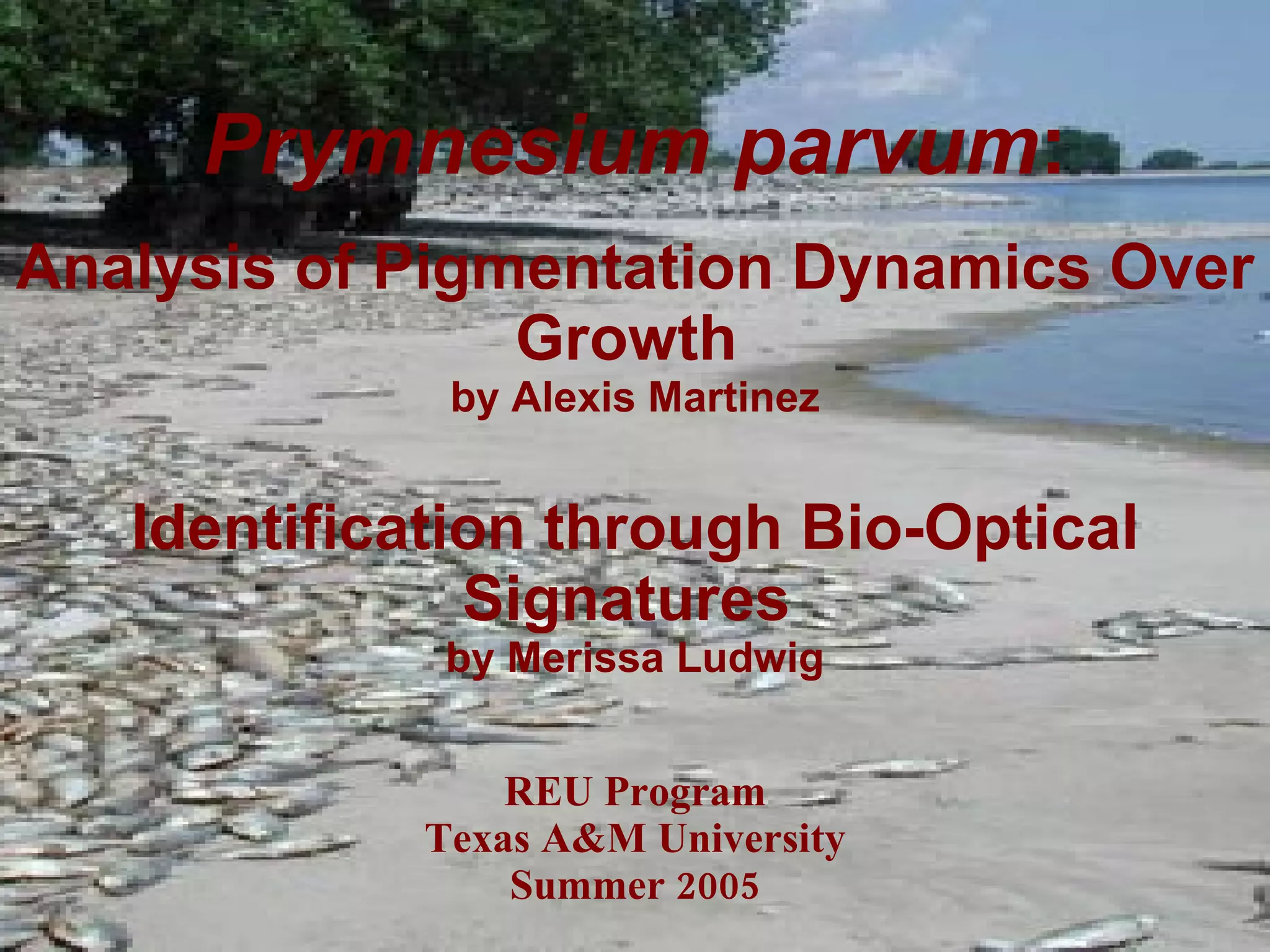


Prymnesium parvum : Analysis of Pigmentation Dynamics Over Growth  by Alexis Martinez Identification through Bio-Optical Signatures  by Merissa Ludwig   REU Program Texas A&M University Summer 2005
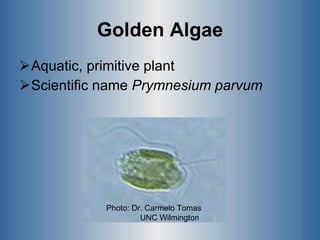
Golden Algae Aquatic, primitive plant Scientific name  Prymnesium parvum          Photo: Dr. Carmelo Tomas UNC Wilmington
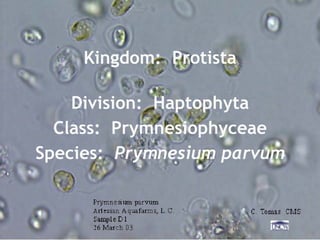
Kingdom:  Protista Division:  Haptophyta Class:  Prymnesiophyceae Species:  Prymnesium parvum
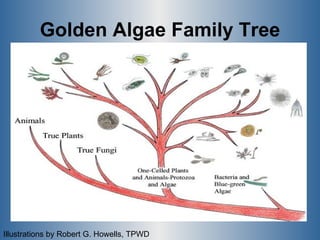
Golden Algae Family Tree Illustrations by Robert G. Howells, TPWD
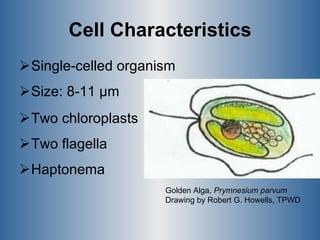
Cell Characteristics Single-celled organism Size: 8-11 µm Two chloroplasts  Two flagella Haptonema                                 Golden Alga,  Prymnesium parvum Drawing by Robert G. Howells, TPWD
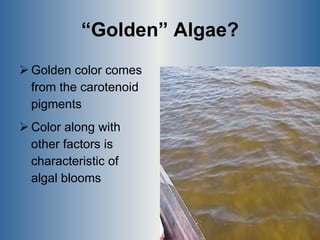
“ Golden” Algae? Golden color comes from the carotenoid  pigments Color along with  other factors is  characteristic of  algal blooms
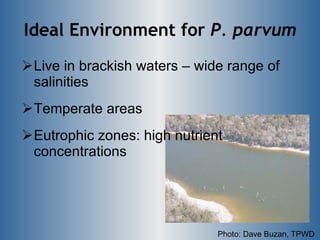
Live in brackish waters – wide range of salinities Temperate areas Eutrophic zones: high nutrient concentrations Ideal Environment for  P. parvum Photo: Dave Buzan, TPWD
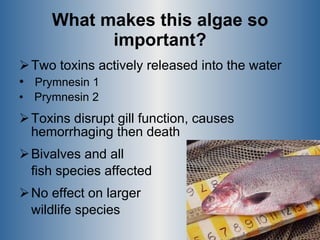
What makes this algae so important? Two toxins actively released into the water Prymnesin 1 Prymnesin 2 Toxins disrupt gill function, causes hemorrhaging then death Bivalves and all  fish species affected No effect on larger  wildlife species
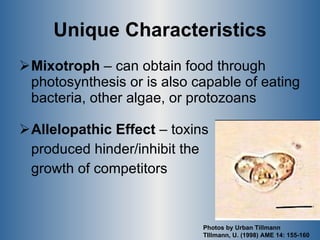
Unique Characteristics Mixotroph  – can obtain food through photosynthesis or is also capable of eating bacteria, other algae, or protozoans Allelopathic Effect  – toxins  produced hinder/inhibit the  growth of competitors Photos by Urban Tillmann TIllmann, U. (1998) AME 14: 155-160
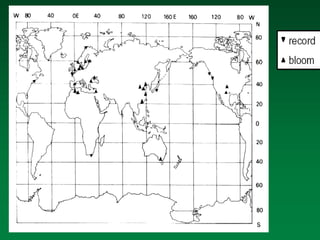
Where can we find golden algae? First identified in 1930’s in Holland and Denmark Israel, China, England, Norway, United States, Australia, Morocco thought to be found in Scotland, Germany, Spain, Bulgaria, and South Africa and many other areas
 
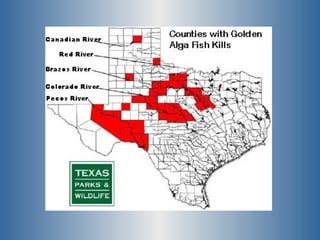
Locations found in the U.S. Texas Alabama Arkansas Georgia New Mexico North Carolina Oklahoma South Carolina Wyoming  Thought to be  present in  Nebraska
 
History of  P. parvum  in Texas First discovered in Texas in 1985, suspected in fish kills since 1960’s  From 1985-2003, over $7 million lost in 41 fish kill events The rate of fish kills has increased over recent years.
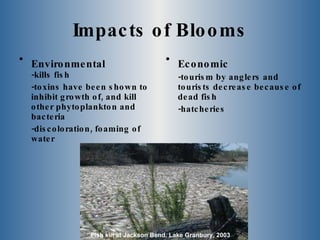
Impacts of Blooms Environmental -kills fish -toxins have been shown to inhibit growth of, and kill other phytoplankton and bacteria -discoloration, foaming of water  Economic -tourism by anglers and tourists decrease because of dead fish -hatcheries  Fish kill at Jackson Bend, Lake Granbury, 2003
Problem Research Solution Persistent toxic algae with the ability to decimate fish,  bivalve, and other phytoplankton populations.  Texas  economy feels effect in declining tourism and recreation  due to dead fish. Knowledge about  P. parvum  is limited, inability to detect indicators prior to harmful algal bloom. Immediate need for simple, rapid, and more accurate method to detect  P. parvum and to identify possible indicators before harmful algal bloom.
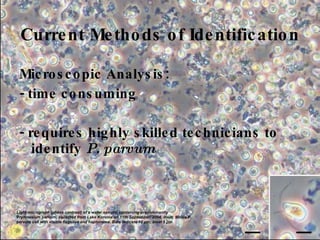
Current Methods of Identification   Microscopic Analysis: - time consuming - requires highly skilled technicians to identify  P. parvum Light micrograph (phase contrast) of a water sample, containing predominantly Prymnesium parvum , collected from Lake Koronia on 11th September, 2004. Inset: Motile  P. parvum  cell with visible flagellae and haptonema. Bars indicate 10 μm; inset 5 μm.
Future Methods IDENTIFY Optical Signature   Pigment Ratios DETECT Remote Sensing    Chemical Taxonomy
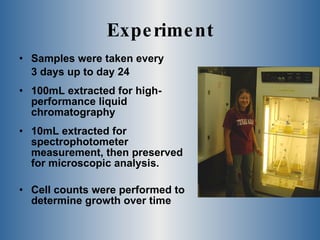
Experiment Triplicate flasks containing growth medium inoculated with  P. parvum  culture (obtained from UT culture collection of algae 22181) Incubation consisted of 12/12 light /dark cycle at 19ºC Flasks were rotated in incubator and stirred daily
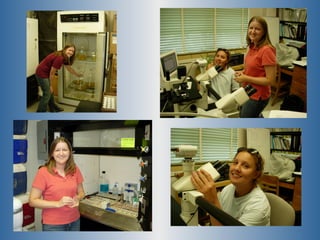
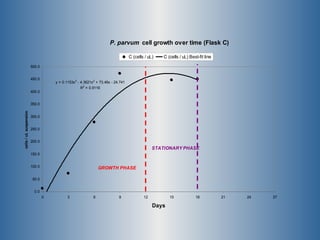
Experiment Samples were taken every 3 days up to day 24  100mL extracted for high-performance liquid chromatography  10mL extracted for spectrophotometer measurement, then preserved for microscopic analysis. Cell counts were performed to determine growth over time
 
Prymnesium   parvum  Growth Characteristics:  Analysis of Pigmentation with Cell Growth Alexis Martinez
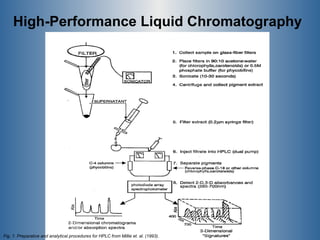
Method for Assessing   Phytoplankton Assemblages Microscopic Analysis Optical Absorption bioassays using spectrophotometer, fluorometer to determine abs. / wavelength High-Performance Liquid Chromatography to determine concentration of pigments
Pigments -Chemical compounds which absorb specific wavelengths of light, means by which photosynthesis is carried out -Pigments are divided into classes:  Chlorophylls   Carotenoids (carotenes and xanthophylls)
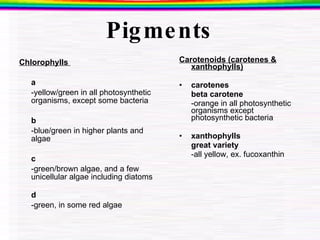
Pigments Chlorophylls  a   -yellow/green in all photosynthetic organisms, except some bacteria b -blue/green in higher plants and algae c -green/brown algae, and a few unicellular algae including diatoms d -green, in some red algae Carotenoids (carotenes & xanthophylls) carotenes beta carotene  -orange in all photosynthetic organisms except photosynthetic bacteria xanthophylls great variety -all yellow, ex. fucoxanthin  *Specific algal groups contain diagnostic pigments
High-Performance Liquid Chromatography   Fig. 1. Preparative and analytical procedures for HPLC from Millie et. al. (1993).
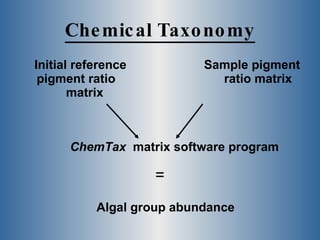
Chemical Taxonomy Initial reference pigment ratio  matrix Sample pigment ratio matrix ChemTax   matrix software program = Algal group abundance
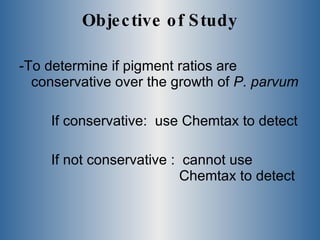
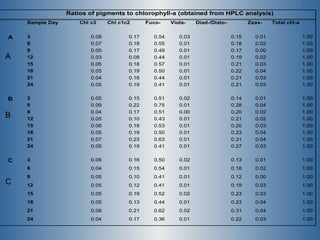
Objective of Study -To determine if pigment ratios are conservative over the growth of  P. parvum If conservative:  use Chemtax to detect  If not conservative :  cannot use  Chemtax to detect
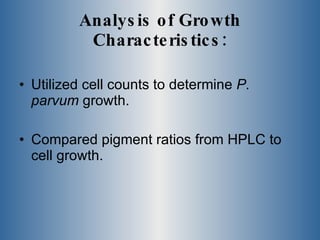
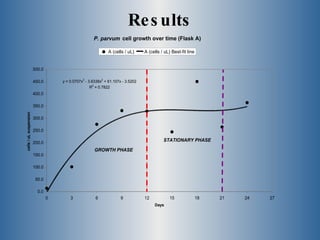
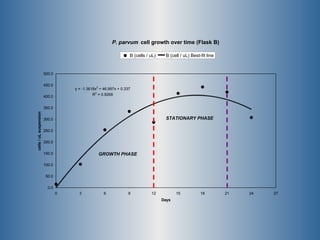
Analysis of Growth Characteristics: Utilized cell counts to determine  P. parvum  growth. Compared pigment ratios from HPLC to cell growth.
Results
 
 
A B C
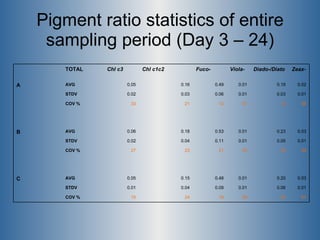
Pigment ratio statistics of entire sampling period (Day 3 – 24) 57 30 38 18 24 15 COV %   0.01 0.06 0.01 0.09 0.04 0.01 STDV   0.03 0.20 0.01 0.48 0.15 0.05 AVG C     39 24 53 21 23 27 COV %   0.01 0.05 0.01 0.11 0.04 0.02 STDV   0.03 0.23 0.01 0.53 0.18 0.06 AVG B     56 13 57 12 21 33 COV %   0.01 0.03 0.01 0.06 0.03 0.02 STDV   0.02 0.19 0.01 0.49 0.16 0.05 AVG A Zeax- Diado-/Diato Viola- Fuco- Chl c1c2 Chl c3 TOTAL  
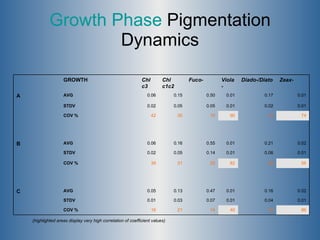
Growth Phase  Pigmentation Dynamics (highlighted areas display very high correlation of coefficient values) 86 23 40 14 21 16 COV %   0.01 0.04 0.01 0.07 0.03 0.01 STDV   0.02 0.16 0.01 0.47 0.13 0.05 AVG C     56 28 82 25 31 39 COV %   0.01 0.06 0.01 0.14 0.05 0.02 STDV   0.02 0.21 0.01 0.55 0.16 0.06 AVG B     74 10 90 10 30 42 COV %   0.01 0.02 0.01 0.05 0.05 0.02 STDV   0.01 0.17 0.01 0.50 0.15 0.06 AVG A Zeax- Diado-/Diato Viola- Fuco- Chl c1c2 Chl c3 GROWTH  
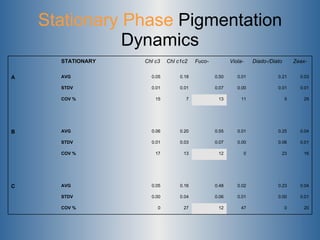
Stationary Phase  Pigmentation Dynamics 20 0 47 12 27 0 COV %   0.01 0.00 0.01 0.06 0.04 0.00 STDV   0.04 0.23 0.02 0.48 0.16 0.05 AVG C     16 23 0 12 13 17 COV %   0.01 0.06 0.00 0.07 0.03 0.01 STDV   0.04 0.25 0.01 0.55 0.20 0.06 AVG B     29 5 11 13 7 15 COV %   0.01 0.01 0.00 0.07 0.01 0.01 STDV   0.03 0.21 0.01 0.50 0.18 0.05 AVG A Zeax- Diado-/Diato Viola- Fuco- Chl c1c2 Chl c3 STATIONARY  
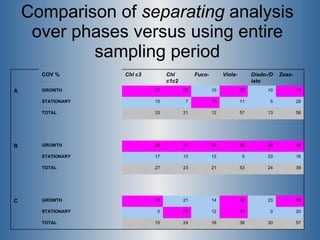
Comparison of  separating  analysis over phases versus using entire sampling period 57 30 38 18 24 15 TOTAL   20 0 47 12 27 0 STATIONARY    86 23 40 14 21 16 GROWTH  C       39 24 53 21 23 27 TOTAL   16 23 0 12 13 17 STATIONARY   56 28 82 25 31 39 GROWTH B       56 13 57 12 21 33 TOTAL   29 5 11 13 7 15 STATIONARY   74 10 90 10 30 42 GROWTH A Zeax- Diado-/Diato Viola- Fuco- Chl c1c2 Chl c3 COV %  
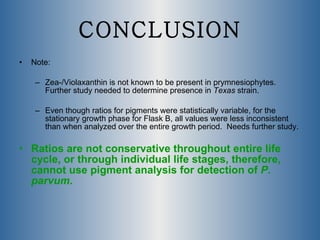
CONCLUSION Note:  Zea-/Violaxanthin is not known to be present in prymnesiophytes.  Further study needed to determine presence in  Texas  strain. Even though ratios for pigments were statistically variable, for the stationary growth phase for Flask B, all values were less inconsistent than when analyzed over the entire growth period.  Needs further study. Ratios are not conservative throughout entire life cycle, or through individual life stages, therefore, cannot use pigment analysis for detection of  P. parvum .
Rapid Detection through use of Optical Signatures Merissa Ludwig
Bio-Optical Methodologies HPLC-derived photopigment and chlorophyll  a  fluorescence analyses In vivo absorption assays Multi-spectral remote sensing All characterize phytoplankton biomass, composition, or physiological state
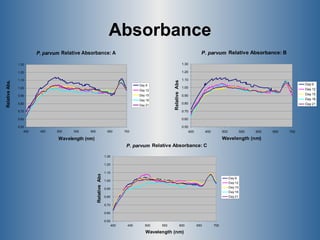
Finding an Optical Signature Measure absorbance of  P. parvum  during life and growth cycle  If variance is small, optical signature can be determined Rapidly method to detect presence of  P. parvum
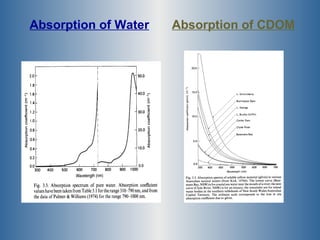
Absorption Light absorption in water is attributable to: Water Colored dissolved organic matter (CDOM) Photosynthetic biota Inanimate particulate matter (tripton) Must account for these factors when  calculating absorption
Absorption of Water Absorption of CDOM
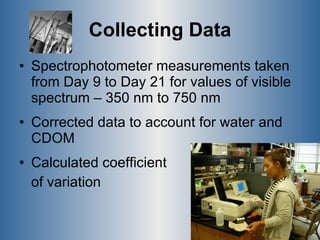
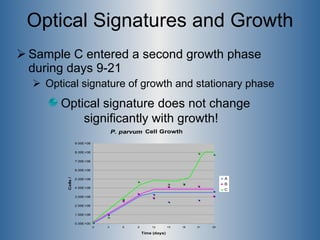
Collecting Data Spectrophotometer measurements taken from Day 9 to Day 21 for values of visible spectrum – 350 nm to 750 nm Corrected data to account for water and CDOM Calculated coefficient  of variation
Absorbance
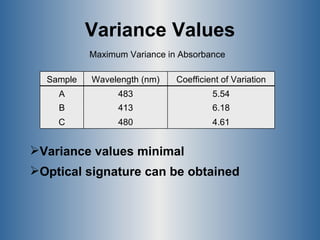
Variance Values Variance values minimal Optical signature can be obtained   4.61 480 C 6.18 413 B 5.54 483 A Coefficient of Variation Wavelength (nm) Sample Maximum Variance in Absorbance
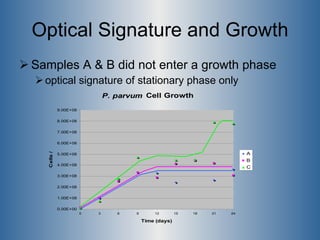
Optical Signature and Growth Samples A & B did not enter a growth phase optical signature of stationary phase only
Optical Signatures and Growth Sample C entered a second growth phase during days 9-21 Optical signature of growth and stationary phase Optical signature does not change  significantly with growth!
Other Projects in the Lab Measuring chlorophyll-a  Ash free dry weight analysis Grain-size analysis Field work at ANWR
 
Acknowledgements Advisor – Dr. Daniel Roelke Mentor – Reagan Errera Department of Wildlife and Fisheries Sciences  Texas A&M University REU Faculty

Golden Algae

  • 1.
    Prymnesium parvum :Analysis of Pigmentation Dynamics Over Growth by Alexis Martinez Identification through Bio-Optical Signatures by Merissa Ludwig REU Program Texas A&M University Summer 2005
  • 2.
    Golden Algae Aquatic,primitive plant Scientific name Prymnesium parvum          Photo: Dr. Carmelo Tomas UNC Wilmington
  • 3.
    Kingdom: ProtistaDivision: Haptophyta Class: Prymnesiophyceae Species: Prymnesium parvum
  • 4.
    Golden Algae FamilyTree Illustrations by Robert G. Howells, TPWD
  • 5.
    Cell Characteristics Single-celledorganism Size: 8-11 µm Two chloroplasts Two flagella Haptonema                                 Golden Alga, Prymnesium parvum Drawing by Robert G. Howells, TPWD
  • 6.
    “ Golden” Algae?Golden color comes from the carotenoid pigments Color along with other factors is characteristic of algal blooms
  • 7.
    Live in brackishwaters – wide range of salinities Temperate areas Eutrophic zones: high nutrient concentrations Ideal Environment for P. parvum Photo: Dave Buzan, TPWD
  • 8.
    What makes thisalgae so important? Two toxins actively released into the water Prymnesin 1 Prymnesin 2 Toxins disrupt gill function, causes hemorrhaging then death Bivalves and all fish species affected No effect on larger wildlife species
  • 9.
    Unique Characteristics Mixotroph – can obtain food through photosynthesis or is also capable of eating bacteria, other algae, or protozoans Allelopathic Effect – toxins produced hinder/inhibit the growth of competitors Photos by Urban Tillmann TIllmann, U. (1998) AME 14: 155-160
  • 10.
    Where can wefind golden algae? First identified in 1930’s in Holland and Denmark Israel, China, England, Norway, United States, Australia, Morocco thought to be found in Scotland, Germany, Spain, Bulgaria, and South Africa and many other areas
  • 11.
  • 12.
    Locations found inthe U.S. Texas Alabama Arkansas Georgia New Mexico North Carolina Oklahoma South Carolina Wyoming Thought to be present in Nebraska
  • 13.
  • 14.
    History of P. parvum in Texas First discovered in Texas in 1985, suspected in fish kills since 1960’s From 1985-2003, over $7 million lost in 41 fish kill events The rate of fish kills has increased over recent years.
  • 15.
    Impacts of BloomsEnvironmental -kills fish -toxins have been shown to inhibit growth of, and kill other phytoplankton and bacteria -discoloration, foaming of water Economic -tourism by anglers and tourists decrease because of dead fish -hatcheries Fish kill at Jackson Bend, Lake Granbury, 2003
  • 16.
    Problem Research SolutionPersistent toxic algae with the ability to decimate fish, bivalve, and other phytoplankton populations. Texas economy feels effect in declining tourism and recreation due to dead fish. Knowledge about P. parvum is limited, inability to detect indicators prior to harmful algal bloom. Immediate need for simple, rapid, and more accurate method to detect P. parvum and to identify possible indicators before harmful algal bloom.
  • 17.
    Current Methods ofIdentification Microscopic Analysis: - time consuming - requires highly skilled technicians to identify P. parvum Light micrograph (phase contrast) of a water sample, containing predominantly Prymnesium parvum , collected from Lake Koronia on 11th September, 2004. Inset: Motile P. parvum cell with visible flagellae and haptonema. Bars indicate 10 μm; inset 5 μm.
  • 18.
    Future Methods IDENTIFYOptical Signature Pigment Ratios DETECT Remote Sensing Chemical Taxonomy
  • 19.
    Experiment Triplicate flaskscontaining growth medium inoculated with P. parvum culture (obtained from UT culture collection of algae 22181) Incubation consisted of 12/12 light /dark cycle at 19ºC Flasks were rotated in incubator and stirred daily
  • 20.
    Experiment Samples weretaken every 3 days up to day 24 100mL extracted for high-performance liquid chromatography 10mL extracted for spectrophotometer measurement, then preserved for microscopic analysis. Cell counts were performed to determine growth over time
  • 21.
  • 22.
    Prymnesium parvum Growth Characteristics: Analysis of Pigmentation with Cell Growth Alexis Martinez
  • 23.
    Method for Assessing Phytoplankton Assemblages Microscopic Analysis Optical Absorption bioassays using spectrophotometer, fluorometer to determine abs. / wavelength High-Performance Liquid Chromatography to determine concentration of pigments
  • 24.
    Pigments -Chemical compoundswhich absorb specific wavelengths of light, means by which photosynthesis is carried out -Pigments are divided into classes: Chlorophylls Carotenoids (carotenes and xanthophylls)
  • 25.
    Pigments Chlorophylls a -yellow/green in all photosynthetic organisms, except some bacteria b -blue/green in higher plants and algae c -green/brown algae, and a few unicellular algae including diatoms d -green, in some red algae Carotenoids (carotenes & xanthophylls) carotenes beta carotene -orange in all photosynthetic organisms except photosynthetic bacteria xanthophylls great variety -all yellow, ex. fucoxanthin *Specific algal groups contain diagnostic pigments
  • 26.
    High-Performance Liquid Chromatography Fig. 1. Preparative and analytical procedures for HPLC from Millie et. al. (1993).
  • 27.
    Chemical Taxonomy Initialreference pigment ratio matrix Sample pigment ratio matrix ChemTax matrix software program = Algal group abundance
  • 28.
    Objective of Study-To determine if pigment ratios are conservative over the growth of P. parvum If conservative: use Chemtax to detect If not conservative : cannot use Chemtax to detect
  • 29.
    Analysis of GrowthCharacteristics: Utilized cell counts to determine P. parvum growth. Compared pigment ratios from HPLC to cell growth.
  • 30.
  • 31.
  • 32.
  • 33.
  • 34.
    Pigment ratio statisticsof entire sampling period (Day 3 – 24) 57 30 38 18 24 15 COV %   0.01 0.06 0.01 0.09 0.04 0.01 STDV   0.03 0.20 0.01 0.48 0.15 0.05 AVG C     39 24 53 21 23 27 COV %   0.01 0.05 0.01 0.11 0.04 0.02 STDV   0.03 0.23 0.01 0.53 0.18 0.06 AVG B     56 13 57 12 21 33 COV %   0.01 0.03 0.01 0.06 0.03 0.02 STDV   0.02 0.19 0.01 0.49 0.16 0.05 AVG A Zeax- Diado-/Diato Viola- Fuco- Chl c1c2 Chl c3 TOTAL  
  • 35.
    Growth Phase Pigmentation Dynamics (highlighted areas display very high correlation of coefficient values) 86 23 40 14 21 16 COV %   0.01 0.04 0.01 0.07 0.03 0.01 STDV   0.02 0.16 0.01 0.47 0.13 0.05 AVG C     56 28 82 25 31 39 COV %   0.01 0.06 0.01 0.14 0.05 0.02 STDV   0.02 0.21 0.01 0.55 0.16 0.06 AVG B     74 10 90 10 30 42 COV %   0.01 0.02 0.01 0.05 0.05 0.02 STDV   0.01 0.17 0.01 0.50 0.15 0.06 AVG A Zeax- Diado-/Diato Viola- Fuco- Chl c1c2 Chl c3 GROWTH  
  • 36.
    Stationary Phase Pigmentation Dynamics 20 0 47 12 27 0 COV %   0.01 0.00 0.01 0.06 0.04 0.00 STDV   0.04 0.23 0.02 0.48 0.16 0.05 AVG C     16 23 0 12 13 17 COV %   0.01 0.06 0.00 0.07 0.03 0.01 STDV   0.04 0.25 0.01 0.55 0.20 0.06 AVG B     29 5 11 13 7 15 COV %   0.01 0.01 0.00 0.07 0.01 0.01 STDV   0.03 0.21 0.01 0.50 0.18 0.05 AVG A Zeax- Diado-/Diato Viola- Fuco- Chl c1c2 Chl c3 STATIONARY  
  • 37.
    Comparison of separating analysis over phases versus using entire sampling period 57 30 38 18 24 15 TOTAL   20 0 47 12 27 0 STATIONARY   86 23 40 14 21 16 GROWTH C       39 24 53 21 23 27 TOTAL   16 23 0 12 13 17 STATIONARY   56 28 82 25 31 39 GROWTH B       56 13 57 12 21 33 TOTAL   29 5 11 13 7 15 STATIONARY   74 10 90 10 30 42 GROWTH A Zeax- Diado-/Diato Viola- Fuco- Chl c1c2 Chl c3 COV %  
  • 38.
    CONCLUSION Note: Zea-/Violaxanthin is not known to be present in prymnesiophytes. Further study needed to determine presence in Texas strain. Even though ratios for pigments were statistically variable, for the stationary growth phase for Flask B, all values were less inconsistent than when analyzed over the entire growth period. Needs further study. Ratios are not conservative throughout entire life cycle, or through individual life stages, therefore, cannot use pigment analysis for detection of P. parvum .
  • 39.
    Rapid Detection throughuse of Optical Signatures Merissa Ludwig
  • 40.
    Bio-Optical Methodologies HPLC-derivedphotopigment and chlorophyll a fluorescence analyses In vivo absorption assays Multi-spectral remote sensing All characterize phytoplankton biomass, composition, or physiological state
  • 41.
    Finding an OpticalSignature Measure absorbance of P. parvum during life and growth cycle If variance is small, optical signature can be determined Rapidly method to detect presence of P. parvum
  • 42.
    Absorption Light absorptionin water is attributable to: Water Colored dissolved organic matter (CDOM) Photosynthetic biota Inanimate particulate matter (tripton) Must account for these factors when calculating absorption
  • 43.
    Absorption of WaterAbsorption of CDOM
  • 44.
    Collecting Data Spectrophotometermeasurements taken from Day 9 to Day 21 for values of visible spectrum – 350 nm to 750 nm Corrected data to account for water and CDOM Calculated coefficient of variation
  • 45.
  • 46.
    Variance Values Variancevalues minimal Optical signature can be obtained 4.61 480 C 6.18 413 B 5.54 483 A Coefficient of Variation Wavelength (nm) Sample Maximum Variance in Absorbance
  • 47.
    Optical Signature andGrowth Samples A & B did not enter a growth phase optical signature of stationary phase only
  • 48.
    Optical Signatures andGrowth Sample C entered a second growth phase during days 9-21 Optical signature of growth and stationary phase Optical signature does not change significantly with growth!
  • 49.
    Other Projects inthe Lab Measuring chlorophyll-a Ash free dry weight analysis Grain-size analysis Field work at ANWR
  • 50.
  • 51.
    Acknowledgements Advisor –Dr. Daniel Roelke Mentor – Reagan Errera Department of Wildlife and Fisheries Sciences Texas A&M University REU Faculty