



SEMINAR ON
GOAL ORIENTED PROJECT
PLANNING FOR EFFECTIVE
PROBLEM SOLVING
By-
Vinaya Kumar H M
Ph.D scholar
OUTLINE OF THE
PRESENTATION
 Introduction
 Clarification of concepts
 Types of plans
 Principles of GOPP
 Description of GOPP steps
 GOPP for problem solving
INTRODUCTION
 Leon. J. Rosenberg
 Management tool
 Bilateral and Multilateral
 NGO’s
 Mandatory for Financial aid
 Participatory
If you really want to do something
you’ll find the way;
If you don’t,
You’ll find an excuse.
- Jim Rohn
To understand the GOPP and its related
concepts
To get an insight about the procedure and
steps involved in GOPP
To use GOPP as a tool for effective problem
solving
UNDERSTANDING OF GOPP
AND ITS RELATED CONCEPTS
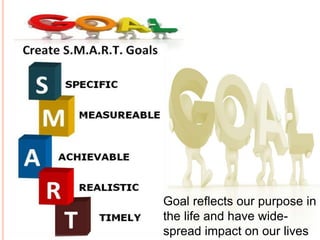
Goal reflects our purpose in
the life and have wide-
spread impact on our lives
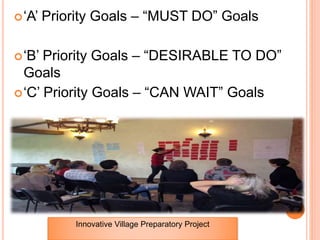
‘A’ Priority Goals – “MUST DO” Goals
‘B’ Priority Goals – “DESIRABLE TO DO”
Goals
‘C’ Priority Goals – “CAN WAIT” Goals
Innovative Village Preparatory Project
 Goal
The longer term or wider objective
 Objective:
Immediate aims of the project – what is
set out to do
Outcomes
 Effects or change in the project aims to bring
about.
Outputs
What the project will specially deliver.
Task to be completed or activities to be
implemented.
Activities
What needs to be done to achieve the
outputs.
GOPP
 GOPP stands for Goal Oriented Project (Programme or
Participatory) Planning.
 Also know as OOPP
 In French GOPP know as PIPO
 In German as ZOPP
 LF is also used as a term
GOPP
 An innovative tool
 interactive workshops
 Using the GOPP approach, all the stakeholders and
(future) partners are involved
GOPP HAS POTENTIAL USE
 Used in a wide variety of situations since the 1980s
and has proved to be robust and effective in helping
groups defining clear objectives and designing
related action plans
 An excellent method for improving team
effectiveness, HRM and problem solving
 Planning and re-planning of interventions
The idea of GOPP is to make sure
• That decisions are reached and recorded
• That if anything left undecided the reasons for
this are agreed and
• That team members reach a consensus on the
aims and actions of the project.
• Key to it all is the facilitator, who remains
neutral and ensures objectivity.
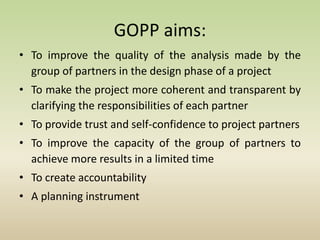
GOPP aims:
• To improve the quality of the analysis made by the
group of partners in the design phase of a project
• To make the project more coherent and transparent by
clarifying the responsibilities of each partner
• To provide trust and self-confidence to project partners
• To improve the capacity of the group of partners to
achieve more results in a limited time
• To create accountability
• A planning instrument
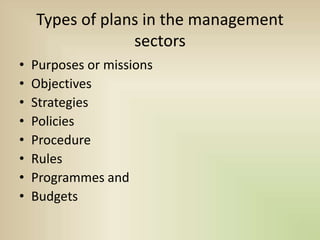
Types of plans in the management
sectors
• Purposes or missions
• Objectives
• Strategies
• Policies
• Procedure
• Rules
• Programmes and
• Budgets
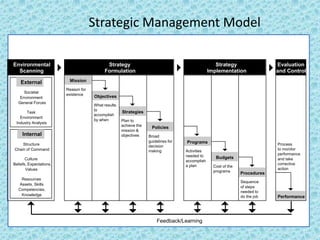
Strategic Management Model
Strategy
Formulation
Strategy
Implementation
Evaluation
and Control
Mission
Objectives
Strategies
Policies
Feedback/Learning
Environmental
Scanning
Societal
Environment
General Forces
Task
Environment
Industry Analysis
Structure
Chain of Command
Resources
Assets, Skills
Competencies,
Knowledge
Culture
Beliefs, Expectations,
Values
Reason for
existence
What results
to
accomplish
by when Plan to
achieve the
mission &
objectives Broad
guidelines for
decision
making
Programs
Activities
needed to
accomplish
a plan
Budgets
Cost of the
programs
Procedures
Sequence
of steps
needed to
do the job
Process
to monitor
performance
and take
corrective
action
Performance
External
Internal
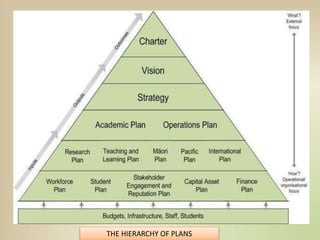
THE HIERARCHY OF PLANS
PERT (Programme Evaluation Review
Technique) and CPM (Critical Path Method)
• Techniques of project management useful in
the basic managerial functions of Planning
scheduling and control
• used to break down the large projects to
individual jobs or events and arranged in a
logical network
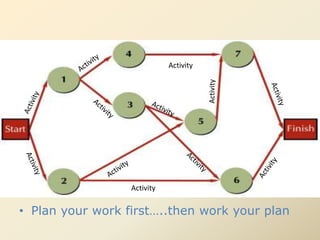
• Plan your work first…..then work your plan
Activity
Activity
Activity
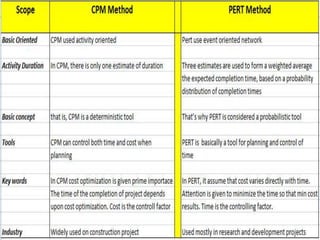
PERT and Time Estimates
Optimistic Time Estimate
Pessimistic Time Estimate
Most probable/ Most likely Time Estimate
The PERT Assumption
Activities are independent
The CPM Model
• A “Deterministic” rather than “probabilistic”
model
• Allows for variations in job times as the
planned and expected outcome of resource
assignments
• Advantages of CPM and PERT
The procedure and steps
involved in GOPP
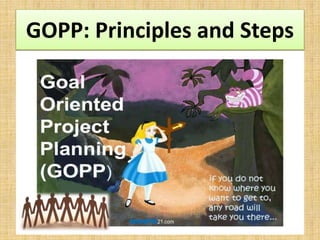
GOPP: Principles and Steps
Principles of GOPP
• Planning is done logically and completely
documented
• Planning is done in groups, together with those who
have to implemented
• Planning first determines the goal and then the
appropriate measure to achieve the goal
Objectives of GOPP
• Identify potential participants in a project
• Improve communication and cooperation
• Analyze the causes and effects of a given core
problem
• Define realistic, definite and sustainable
project objectives
• Clarify the scope of responsibility of project
participants
• Specify necessary project inputs/activities
necessary to achieve results and
• Provide sound basis for supervising projects,
monitoring and controlling progress,
evaluating impact and making appropriate
changes when necessary
Steps involved in GOPP
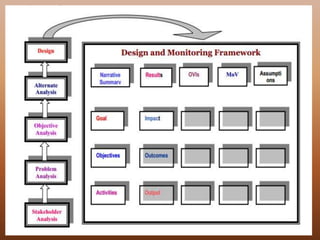
• 1 Analysis of project´s Context
• 2 Analysis of Stakeholders
• 3 Problem Analysis/Situation Analysis
• 4 Objectives Analysis
• 5 Plan of Activities
• 6 Plan of Resources/Inputs
• 7 Indicators/measurements
• 8 Risk Analysis
• 9 Analysis of Assumptions
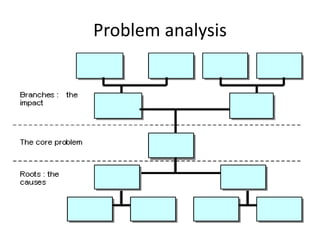
Problem analysis
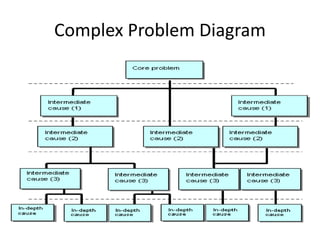
Complex Problem Diagram
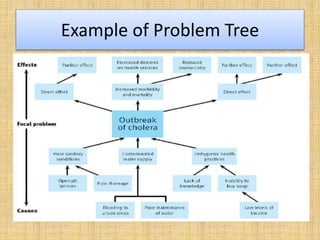
Example of Problem Tree
Example of a Project
Planning Matrix
• A problem is the difference between
someone’s actual state and the state he wants
to be in.
• A well-defined problem is already half way to
being solved
• The seriousness of the anticipated efforts of a
problem determines both how the problem is
perceived and how urgently a solution is
sought
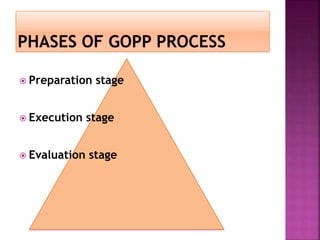
 Preparation stage
 Execution stage
 Evaluation stage
• The principles of GOPP ensures and confirm
that it is an effective tool for defining the
problem and solving it effectively.
• It helps to retain what has proved successful,
remember the steps which improved progress
and discover the weak points
• GOPP assists extension in problem-solving by
lending support to people in solving their
problem by helping them to analyze it in a
structured way, as well as by informing and
motivating them to solve it.
Benefits of Structured Problem
Solving process
Remove time lost in debate
Identify weak points in processes
Discover systemic causes
Explain with reasons why an incident occurred
Gives a factual representation of the incident
Compare what actually happened against what
should have happened, at any point during the
incident
It avoids the complexity of reality
• The primary strength of the technique is
considered to be the principle of basing all
planning on the analysis of existing problems,
as perceived by those who actually have to
deal with them
• This anchors each plan in reality, assures its
relevance and ensures that the interests of the
‘beneficiaries’ are served first and foremost,
rather than those of the ‘suppliers’
Goal oriented project planning for effective problem solving by vinay

Goal oriented project planning for effective problem solving by vinay

  • 2.
    SEMINAR ON GOAL ORIENTEDPROJECT PLANNING FOR EFFECTIVE PROBLEM SOLVING By- Vinaya Kumar H M Ph.D scholar
  • 3.
    OUTLINE OF THE PRESENTATION Introduction  Clarification of concepts  Types of plans  Principles of GOPP  Description of GOPP steps  GOPP for problem solving
  • 4.
  • 5.
     Leon. J.Rosenberg  Management tool  Bilateral and Multilateral  NGO’s  Mandatory for Financial aid  Participatory
  • 6.
    If you reallywant to do something you’ll find the way; If you don’t, You’ll find an excuse. - Jim Rohn
  • 8.
    To understand theGOPP and its related concepts To get an insight about the procedure and steps involved in GOPP To use GOPP as a tool for effective problem solving
  • 9.
    UNDERSTANDING OF GOPP ANDITS RELATED CONCEPTS
  • 10.
    Goal reflects ourpurpose in the life and have wide- spread impact on our lives
  • 11.
    ‘A’ Priority Goals– “MUST DO” Goals ‘B’ Priority Goals – “DESIRABLE TO DO” Goals ‘C’ Priority Goals – “CAN WAIT” Goals Innovative Village Preparatory Project
  • 12.
     Goal The longerterm or wider objective  Objective: Immediate aims of the project – what is set out to do
  • 13.
    Outcomes  Effects orchange in the project aims to bring about. Outputs What the project will specially deliver. Task to be completed or activities to be implemented. Activities What needs to be done to achieve the outputs.
  • 14.
    GOPP  GOPP standsfor Goal Oriented Project (Programme or Participatory) Planning.  Also know as OOPP  In French GOPP know as PIPO  In German as ZOPP  LF is also used as a term
  • 15.
    GOPP  An innovativetool  interactive workshops  Using the GOPP approach, all the stakeholders and (future) partners are involved
  • 16.
    GOPP HAS POTENTIALUSE  Used in a wide variety of situations since the 1980s and has proved to be robust and effective in helping groups defining clear objectives and designing related action plans  An excellent method for improving team effectiveness, HRM and problem solving  Planning and re-planning of interventions
  • 17.
    The idea ofGOPP is to make sure • That decisions are reached and recorded • That if anything left undecided the reasons for this are agreed and • That team members reach a consensus on the aims and actions of the project. • Key to it all is the facilitator, who remains neutral and ensures objectivity.
  • 18.
    GOPP aims: • Toimprove the quality of the analysis made by the group of partners in the design phase of a project • To make the project more coherent and transparent by clarifying the responsibilities of each partner • To provide trust and self-confidence to project partners • To improve the capacity of the group of partners to achieve more results in a limited time • To create accountability • A planning instrument
  • 19.
    Types of plansin the management sectors • Purposes or missions • Objectives • Strategies • Policies • Procedure • Rules • Programmes and • Budgets
  • 20.
    Strategic Management Model Strategy Formulation Strategy Implementation Evaluation andControl Mission Objectives Strategies Policies Feedback/Learning Environmental Scanning Societal Environment General Forces Task Environment Industry Analysis Structure Chain of Command Resources Assets, Skills Competencies, Knowledge Culture Beliefs, Expectations, Values Reason for existence What results to accomplish by when Plan to achieve the mission & objectives Broad guidelines for decision making Programs Activities needed to accomplish a plan Budgets Cost of the programs Procedures Sequence of steps needed to do the job Process to monitor performance and take corrective action Performance External Internal
  • 21.
  • 23.
    PERT (Programme EvaluationReview Technique) and CPM (Critical Path Method) • Techniques of project management useful in the basic managerial functions of Planning scheduling and control • used to break down the large projects to individual jobs or events and arranged in a logical network
  • 24.
    • Plan yourwork first…..then work your plan Activity Activity Activity
  • 26.
    PERT and TimeEstimates Optimistic Time Estimate Pessimistic Time Estimate Most probable/ Most likely Time Estimate The PERT Assumption Activities are independent
  • 27.
    The CPM Model •A “Deterministic” rather than “probabilistic” model • Allows for variations in job times as the planned and expected outcome of resource assignments • Advantages of CPM and PERT
  • 28.
    The procedure andsteps involved in GOPP
  • 29.
  • 30.
    Principles of GOPP •Planning is done logically and completely documented • Planning is done in groups, together with those who have to implemented • Planning first determines the goal and then the appropriate measure to achieve the goal
  • 31.
    Objectives of GOPP •Identify potential participants in a project • Improve communication and cooperation • Analyze the causes and effects of a given core problem • Define realistic, definite and sustainable project objectives
  • 32.
    • Clarify thescope of responsibility of project participants • Specify necessary project inputs/activities necessary to achieve results and • Provide sound basis for supervising projects, monitoring and controlling progress, evaluating impact and making appropriate changes when necessary
  • 33.
    Steps involved inGOPP • 1 Analysis of project´s Context • 2 Analysis of Stakeholders • 3 Problem Analysis/Situation Analysis • 4 Objectives Analysis • 5 Plan of Activities • 6 Plan of Resources/Inputs • 7 Indicators/measurements • 8 Risk Analysis • 9 Analysis of Assumptions
  • 34.
  • 35.
  • 36.
  • 38.
    Example of aProject Planning Matrix
  • 41.
    • A problemis the difference between someone’s actual state and the state he wants to be in. • A well-defined problem is already half way to being solved • The seriousness of the anticipated efforts of a problem determines both how the problem is perceived and how urgently a solution is sought
  • 42.
     Preparation stage Execution stage  Evaluation stage
  • 43.
    • The principlesof GOPP ensures and confirm that it is an effective tool for defining the problem and solving it effectively. • It helps to retain what has proved successful, remember the steps which improved progress and discover the weak points • GOPP assists extension in problem-solving by lending support to people in solving their problem by helping them to analyze it in a structured way, as well as by informing and motivating them to solve it.
  • 44.
    Benefits of StructuredProblem Solving process Remove time lost in debate Identify weak points in processes Discover systemic causes Explain with reasons why an incident occurred Gives a factual representation of the incident Compare what actually happened against what should have happened, at any point during the incident It avoids the complexity of reality
  • 46.
    • The primarystrength of the technique is considered to be the principle of basing all planning on the analysis of existing problems, as perceived by those who actually have to deal with them • This anchors each plan in reality, assures its relevance and ensures that the interests of the ‘beneficiaries’ are served first and foremost, rather than those of the ‘suppliers’