ASSISTED REPRODUCTIVE
TECHNIQUES
DR DONA MARIYA C J
ART
 ART describes clinical and laboratory techniques used to achieve
pregnancy in infertile couples for whom direct corrections of
underlying causes are not feasible
 By convention however ART procedures are those that at some
point require extraction and isolation of an oocyte
PRINCIPLE STEPS OF ART CYCLE
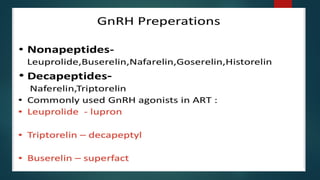
 Downregulation using GnRH agonist to prevent premature LH surge
 Controlled ovarian stimulation
 Monitoring of follicular growth (serum E2,TVS)
 Ovulation triggering
 Oocyte retrieval
 Fertilization in vitro(IVF,ICSI)
 In vitro embryo culture
 Transfer of fresh embryos
 Luteal support with progesterone
 Tests for pregnancy and monitoring
 Cryopreservation of surplus embryos
DIFFERENT PROTOCOLS FOR
STIMULATION
 GnRH AGONIST PROTOCOLS:
 LONG PROTOCOL
 STOP PROTOCOL
 SHORT PROTOCOL
 ULTRASHORT PROTOCOL
 MICROFLARE
 GnRH ANTAGONIST PROTOCOL :
 FIXED
 FLEXIBLE
 SPECIAL CASES :
 ULTRA LONG PROTOCOL
 DOUBLE STIMULATION PROTOCOLS
USES :
 Pituitary suppression prior to ovarian stimulation
 Used as trigger in antagonist protocol
 Prevention of premature LH surge
 Prevention of OHSS
 Breast cancer patients
 Endometriosis
 Central precocious puberty
 Fibroids
 Hirsutism
 Adenomyosis
Advantages :
 Synchronization of follicular growth
 Flexibility in IVF programming
 Abolition of spontaneous LH surge
 Less expensive than antagonist
Side effects:
 Hot flushes
 Vaginal dryness
 Transient frontal headaches
 Arthralgia
 Myalgia
 Insomnia
 Headache
 Loss of libido
 Expressive supression
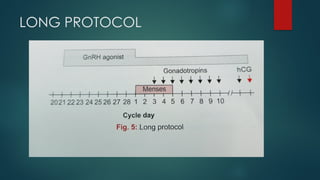
LONG PROTOCOL:
Day 21 of previous cycle till day of HCG trigger
Protocols using depot :
 Long luteal depot :
once on day 21
 Ultralong protocol for 8-12 weeks –
In Endomeriosis
LONG PROTOCOL
Dosage :
Daily dose of leuprolide1mg is
started on day 21 of previous
cycle.
TO CONFIRM DOWN REGULATION :
 USG – Endometrial thickness <5mm & no cyst >10mm
 Serum E2 levels < 50pg/ml
 Serum LH < 5mIU/ml
 Serum progesterone <0.5ng/ml
STOP PROTOCOLS
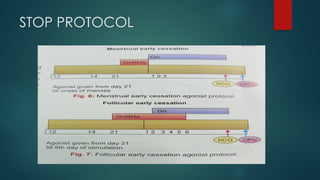
Menstrual early cessation protocol:
 Agonist given from day 21 of previous cycle until menses i.e at the
initiation of gonadotropins.
Follicular early cessation protocol:
 Agonist given from day 21 of previous cycle until stimulation day 5.
STOP PROTOCOL
SHORT PROTOCOL
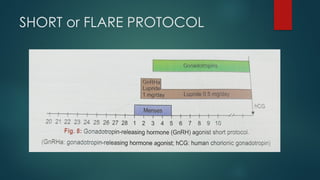
 GnRH agonist started from day 2/3 of cycle to day of HCG trigger
(8-12 days)
 The agonist of 1mg daily started on day 2-4 of cycle and thereafter
at a reduced dose (0.5mg daily) along with gonadotropins starts
on day 3 of cycle.
 Both are continued till the day of HCG injection.
 Initial dose of agonist releases the stored FSH &LH, the flare
augments the folliculogenesis already in progress.
SHORT or FLARE PROTOCOL
Disadvantages
 The flare effect causing surge of LH in the initial phase of
folliculogenesis may have adverse effects on the
developing follicles.
 Significant increase in serum progesterone and
androgen levels, may be due to the late corpus luteal
rescue.
 Hence, this may be deleterious to the oocyte and may
hamper the fertilization and pregnancy rates.
MICRODOSE FLARE PROTOCOL
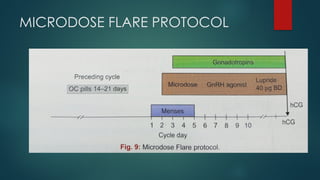
 Pretreatment with OCPs for 14-21 days of previous cycle.
 GnRHa 40mcg twice a day from day2 of withdrawl
bleed is given till day of HCG trigger along with
gonadotropins started from day3 of cycle.
MICRODOSE FLARE PROTOCOL
Advantages
 This protocol does not cause any increase in serum progesterone or
androgen concentration, possibly because:
. The doses of GnRH agonist given are lower
. The preliminary OCP treatment
Ultrashort protocol
 Agonist started with start of gonadotropins but stopped in 2-3 days
as suppression will outlast the stimulation.
Advantages :
 The flare effect augments the folliculogenesis already in progress.
Hence,may enhance the no.of follicles to be recruited in that
particular cycle.
Disadvantages :
 Excess of LH & high androgens in the early phase may be
deleterious to the growing follicles hence,lead with declined oocyte
quality & ongoing pregnancy rate.
GnRH ANTAGONISTS
 Though the problem of premature LH surge was
managed by the introduction of GnRH agonist, newer
problems like :
- Estrogen deprivation symptoms during down
regulation period (rarely)
- Occurrence of cyst formation
- OHSS after the administration of HCG were noted.
GnRH ANTAGONIST PROTOCOLS
SINGLE DOSE PROTOCOL
MULTIPLE DOSE PROTOCOL:
FIXED PROTOCOL
FLEXIBLE PROTOCOL
Mechanism of action
Competitively block pituitary GnRH receptor.
Direct inhibitory , Reversible suppressive effect on gonadotropin
secretion.
 Suppression is immediate
 The 1st
and 2nd
generations GnRH antagonist had histamine release –
causing allergic reactions and pedal odema.
 Third generation – CETRORELIX , GANIRELIX , ABARELIX , ANTARELIX
 NO RISK OF ANAPHYLAXIS and odema due to histamine.
 Only cetrorelix and ganirelix are registered in IVF.
DOSAGE :
Cetrorelix – Half life is 20hrs
0.25 mg daily dose
3.0 mg depot single dose
-- No adjustment in dose for obese women required for cetrorelix.
Ganirelix – Half life is 16hrs
0.25 mg daily dose inj only.
-- Adjustment in dose is required for obese women
Advantages :
 Prevention of premature LH surge.
 Acts in <6hrs after administration
 No flare effects
 No risk of cyst formation
 No profound hypoestrogenemia
 Requirement of gonadotropin is reduced
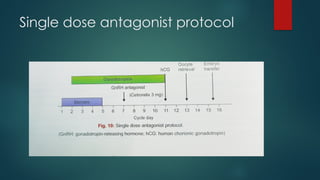
SINGLE DOSE:
 HMG / FSH : from Day 2 or 3 of the cycle
Cetrorelix:
Single dose, 3mg s/c on stimulation day 7
 HCG is given when the follicles are mature by USG & E2 levels.
 GnRHa single dose can be given instead of HCG to reduce
incidence of OHSS.
Single dose antagonist protocol
Multiple-dose antagonist protocol
 Both cetrorelix and ganirelix can be used.
 Most commonly used protocol now
 Gonadotropin stimulation is started on day 2 or 3 of cycle
 Here Fixed or Flexible protocol can be used
Fixed antagonist protocol
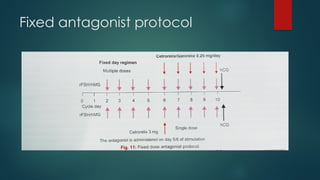
 GnRH antagonist is started on day 6 and is continued till the day of
HCG trigger.
 It is a simple approach and requires less cyclical monitoring
Fixed antagonist protocol
Flexible antagonist protocol
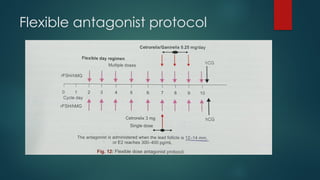
 GnRH antagonist is started once the leading follicle is >14mm or
E2 levels >200pg/ml.
 It is more cost-effective
 No stastistically significant difference found in pregnancy rate
between fixed and flexible protocol.
Flexible antagonist protocol
Antagonist protocols
Advantages
 Safer
 Decreased dose of
gonadotropins
 Agonist trigger can be used
 Negligible chances of OHSS
Disadvantages
 Does not supress raised LH levels
in the early phase of stimulation
 Does not allow flexibility in IVF
 More expensive than GnRH
Agonist
 Does not favour batch IVF
 GnRH agonist long protocol yield more number of oocytes which is the goal of
controlled ovarian hyper stimulation.
 This protocol has delivered satisfactory results in most women.
 However, antagonist protocol has lower pregnancy and implantation rates due to
because of low LH level and impaired estrogen secretion.
 Compared to pts treated with antagonist protocol, pts with agonist protocol
demonstrated significantly higher number of oocyte retrieved &pregnancy rates.
 While cancellation rate was similar.
 In order to avoid severe OHSS, Many centre’s replaced agonist to antagonist
protocol.
IN VITRO FERTIZATION AND EMBRYO
TRANSFER(IVF-EF)
 The field of reproductive medicine has changed forever with the
birth of lousis brown in 1978 by in vitro fertilization and embryo (IVF-
ET)
 Patrick Steptoe and Robert Edwards of England are remembered
for their revolutionary work
 Robert Edward was awarded the nobel prize on physiology and
medicine for his work on IVF
 IVF has opened up the research for diagnosis of genetic
disease,embryonic stem cell research and fertility preservation
INDICATIONS OF IVF
 Fallopian tube block or absent
 Unexplained infertility
 Endometriosis
 Oligozoosper,ia or azoospermia requiring TESE
 Advanced reproductive age
 Fertility preservation
 Failed ovulation induction
 Ovarian failure(donor oocyte IVF)
 Women with normal ovaries but no functional uterus
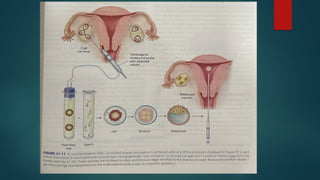
 During IVF, mature oocyte from stimulated ovaries are retrieved
transvaginally with sonographic guidance
 Sperm and ova are then combined in vitro to prompt fertilization
 If successful viable embryos are transferred transcervically into the
endometrial cavity using sonographic guidance
MONITORING OF FOLLICULAR
GROWTH
 The follicular growth response is monitored by sonographic
measurement of the follicles and serum estradiol estimation,
commencing on the 8th day of treatment cycle.
 The endometrial thickness (stripe) ≥8-9 mm (trilaminar) is optimum.
When two or more follicles are 17-18 mm in diameter and serum E,
levels >250 pg/ml/follicle, 5000-10000 IU of HCG is given
intramuscularly.
 Oocyte is retrieved 34-36 hours after the hCG induces oocyte
maturation
OOCYTE RETRIEVAL
 Oocyte retrieval is done aseptically through vaginal route under
ultrasound guidance
 With use of vaginal transducers vaginal needle aspiration is done
about 36 hours after hCG administration but before ovulation
occurs
 IV analgesia and sedation (propofol) is adequate in most of the
cases
 The oocyte is readily recognisable as a single cell surrounded by a
mass of cumulous cells
 After recovery the oocytes are maintained in culture in vitro for 4-6
hours
 Complications of aspiration of follicles (oocyte retrieval) are
infection
Internal bleeding
And ovarian torsion
FERTILIZATION (in vitro)
 The sperm (husband or donor) used for insemination in vitro is
prepared by the wash and swim-up or density gradient
centrifugation (preferred) technique.
 Approximately 50,000 to 100,000 capacitated sperm are placed
into the culture media containing the oocyte within 4-6 hours of
retrieval.
 The eggs may demonstrate signs of fertilization when examined 16-
18 hours after insemination (presence of two pronuclei in the
presence of a second polar body).
 Sperm density and motility are the two most important criteria for
successful IVF. The semen is collected just prior to ovum retrieval.
EMBRYO TRANSFER
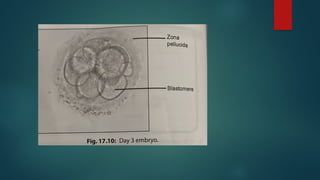
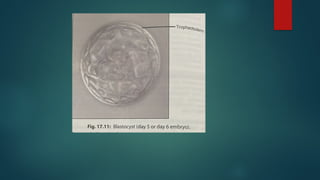
 The fertilized ova at the 6-8 blastomere stage are placed
into the uterine cavity close to the fundus about 3 days
after fertilization through a fine flexible soft catheter
transcervically
 Three days old embryos are assessed for transfer.
 Important criteria are: blastomere morphology,
symmetry, and degree of embryo fragmentation.
Fragmentation is felt to be the extracellular debris
created by the embryonic cells.
 Embryos with fragmentation of > 10% of the
embryo are associated with lower implantation
and pregnancy rates. Commonly patients are
awake for the embryos transfer.
 Usually two and not more than three embryos
are transferred per cycle to minimize multiple
pregnancy. D5 or D6 blastocyst transfer is also
done .
 The process of transfer should be accurate, atraumatic and aseptic.
 Small volume transfer using soft catheter under ultrasound guidance
gives the best result.
 Trial transfer is beneficial. The number of embryos to be transferred
depends mainly on maternal age and the embryo quality.
 Excess embryos and cryopreservation: Excess embryos of good
quality that are not transferred may be cryopreserved.
 Vitrification is a method of ultrarapid freezing using high
concentration of cryoprotectants. Higher chance of live birth rates
after frozen embryo transfer versus fresh transfer (49% vs 42% ).
 Luteal phase support is maintained with progesterone.
 It is started on the day after oocyte retrieval. hCG is given in
supplemental doses (1,500-2,500 IU).
 Micronized progesterone 200 mg thrice a day oral or as vaginal
suppository (preferred) or progesterone in oil injection 50 mg IM
daily is continued for about 14 days.
 By this time diagnosis of pregnancy by estimation of B-hCG
(quantitative value) is possible.
 Result: The overall live birth rate varies from 45.7% in women of age
<37 years to 7.8% at age >42 years per cycle oocyte retrieval.
 There is increased risk of miscarriage (18%), multiple pregnancy
(31%), ectopic (0.9%), low birth weight baby and prematurity. The
risk of congenital malformation of the baby remains similar to
general population.
Prognostic factors for IVF-ET
 Maternal age-there is age related decline in response to ovarian
stimulation, less oocytes, poor oocyte quality, less embryo and
implantation rates
 Ovarian reserve-declines with age
 Indication of IVF and past reproductive success. Women with tubal
or ovulatory factors, endometriosis, or unexplained factor-have
higher success rate compared to women with poor ovarian reserve.
 Presence of hydrosalpinges— affect the outcome adversely.
 Fibroid uterus— especially the submucous or interstitial variety have
adverse outcome.
 Smoking-poor outcome.
RECURRENT IMPLANTATION
FAILURE(RIF)
 It is defined when the woman is unable to conceive after three or
more transfers of one or two good quality embryos.
 It is also considered after two failed transfers of euploid embryos.
 Causes of RIF.
 1.Anatomic evolution of the uterus (saline
sonography/hysteroscopy) and HSG to rule out hydrosalpinges
 2. Embryo quality: Earlier stage embryo, embryos from older
reproductive age women.
 3. Endometrial receptivity analysis (ERA): gene expression analysis of
an endometrial sample at the time of implantation window. The
gene profiles are read as: receptive, pre-receptive or post-
receptive or nonreceptive ERA.
 Cases with displaced window of implantation, use of progesterone
for a longer or shorter duration is recommended.
 4)Chronic endometritis, endometriosis, or progesterone resistance
Gamete intrafallopian
transfer(GIFT)
 Gamete intrafallopian transfer (GIFT) was first described by Asch
and colleagues in 1984.
 It is a more invasive and expensive procedure than IVF but the
result seems better than IVF. In this procedure, both the sperm and
the unfertilized oocytes are transferred into the fallopian tubes.
Fertilization is then achieved in vivo.
 The prerequisite for GIFT procedure is to have normal uterine tubes.
The indications are the same as that of IVF except the tubal factor.
 Best result is obtained in unexplained infertility and the result is poor
in male factor abnormality.
 The superovulation is done as in IVF.
 Two collected oocytes along with approximately
200,000-500,000 motile sperm for each fallopian tube are
placed in a plastic tube container.
 It is then passed through laparoscope and inserted 4 cm
into the distal end of the fallopian tube where the
combination is injected.
 Result: The overall delivered pregnancy rate is as high as
27-30%.Modification of GIFT includes: Pronuclear stage
tubal transfer (PROST) or zygote intrafallopian transfer
(ZIFT) and tubal embryo stage transter (TEST).
 Invitro maturation (IVM) of the oocytes: Women with
PCOS with anovulation could be treated for IVF following
aspiration of immature eggs in a natural cycle.
 No or minimal gonadotropin stimulation is used before
ocyte aspiration.
 IVM of the oocytes, followed by ICSI is then carried out.
Aspiration of immature oocytes is easier in women with
PCOS.
 The risk of OHS is avoided. However, it is not
recommended for routine use as the success rate for
IVM is lower as compared with conventional IVF-ET
(ASRM-2013).
 Oocyte Embryo Cryopreservation
 Currently oocyte and embryo cryopreservation are the
growing need.
 Main indications are:1. Women electively delaying
childbearing for carrier plan and at the same time
avoiding) the detrimental effects of aging.
 2. To preserve fertility in young women with cancer as
she is to be treated with chemotherapy.
 Preservation of embryos rather than oocytes is more
successful in terms of ultimate pregnancy rates.
INTRACYTOPLASMIC SPERM
INJECTION(ICSI)
 Intracytoplasmic sperm injection (ICSI) was first described by van
Steirteghem and colleagues in Belgium (1992).
 Indications■
 Severe oligospermia (5 million sperm/mL)
 Asthenospermia, teratospermia
 Presence of sperm antibodies
 Obstruction of efferent duct system (male)
 Congenital absence of vas (bilateral)
 Failure of fertilization in IVF
 Fertilization of cryopreserved oocytes (with hardened zona pellucida)*
 Unexplained infertility.
 Sperm is recovered from the ejaculate. Otherwise sperm
is retrieved by testicular sperm extraction (TESE) or by
microsurgical epididymal sperm aspiration (MESA)
procedures.
 Technique: One single spermatozoon or even a
spermatid is injected directly into the cytoplasm of an
oocyte by micropuncture of the zona pellucida.
 This procedure is carried out under a high quality
inverted operating microscope. The oocyte is stabilized
at 6 or 12 O'clock position and entered at the 3 O'clock
position.
 The injecting pipette pierces the zona and oolemma
and the sperm is injected directly into the ooplasm .
 Presently, ICSI is utilized in all cases of male infertility and for all
couples where IVF produces have failed.
 Pregnancy rate after ICSI is ≥15% even if the retrieved sperm by TESE
or PESA remain immotile.
 Pregnancy rates per embryo transfer are now similar after ICSI
compared with other indications for IVF. Presently ICSI is used in 60%
to 70% of all cases of IVF.
 The number of ICSI has increased as it has been used even for
minor sperm abnormalities. The presence of a combination of
azoospermia and an elevated FSH level is not a contraindication for
performing TESE.
 Male evaluation: karyotyping is needed for men with
nonobstructive azoospermia or severe oligospermia (<5 million/mL)
before their sperms are used for IVF with ICSI.
 Results: Fertilization rate is about 60-70%. Pregnancy rate is20-40%
per embryo transfer.Unexplained infertility/advanced reproductive
age:
 Women with unexplained infertility may be considered for IVF once
they fail to conceive after few cycles treatment with COC and IUI.
Women with advanced age may be advised directly to IVF after 3
cycles of CC and IUI ("fast track") or gonadotropin-IUI therapy.
 IVF has higher cycle fecundity rate than IUI. Women aged 38 to 42
years are strongly suggested directly to IVF as the clinical
pregnancy rates are higher compared to IUI treatment
Frozen embryo transfer
 To prime endometrium (proliferative changes), estrogen
therapy (oral, transdermal or IM routes) is given over a 2-
week period, before ET.
 Frozen embryo transfer can be done in a natural
ovulatory cycle without estrogen priming. Patient
monitoring to hormone therapy can be done with TVS,
measuring the endometrial thickness and blood E2
measurement.
 With the endometrial thickness of ≥6-8 mm, (optimum,
progesterone supplementation (vaginal or IM route) is
started, 4-6 days prior the scheduled ET.
 Embryos are thawed on the day of scheduled
transfer.With vitrification (freezing method), survival is
more than 90%.
 Thawed embryos are then transferred into the patient's
uterus. A soft catheter is used under ultrasound
guidance.
EMBRYO OR OOCYTE DONATION
 Indications
 Women with premature ovarian failure
 Women with removed ovaries
 Older women (poor oocyte quality)
 Failure to respond with superovulation regimen (poor
ovarian reserve)
 Women with repeated failure of ART cycles
 Genetic disease.
 THE OOCYTES ARE COLLECTED FROM
 Sister or a friend (age between 21 and 34 years).
 Those for IVF candidates, excess oocytes following
retrieval and cryopreservation (see above).*
 One undergoing laparoscopic sterilization (with financial
compensation).*
 Donor invitro fertilization: Pregnancy rates using oocyte
from young donors are higher (60-70%). However,
obstetric complication rates (GDM, pre-eclampsia) are
increased.
 The oocyte donor like the semen donor must be
screened for infection and genetic diseases.Successful
implantation needs a perfect coordination of embryo
and the endometrium
 . Estrogen therapy (in the recipient) is started at the same
time when the donor gets cycle stimulation.
Progesterone treatment in the recipient generally begins
on the day the donor undergoes ovum retrieval.
Generally, third day embryos are transferred on the
fourth day of progesterone therapy.
 Luteal support: As the recipient has no corpus luteum,
exogenous luteal support is needed. Exogenous
estrogen and progesterone treatment should therefore
be continued until 10 weeks of gestation. Oocytes and
embryos can be cryopreserved (at - 196° under liquid
nitrogen) for restoration of fertility in future. Survival of
cryopreserved embryo is more than that of oocytes.
 Results: Live birth rate is approximately 55%.Fertility
preservation (FP) for women
Indications for fertility preservation for women
 Young women with cancer about to have
chemotherapy
 Young healthy women desiring to delay child bearing for
carrier plan
 Women with her husband/partner-desiring use of sperm
to fertilize the oocyte and to freeze embryo rather than
oocytes. This is more successful in terms of pregnancy
rates.*
 Women with an immunologic disorder
 Well established methods of FP are: ART to harvest and
cryopreserve mature oocyte or embryos.
INTRAUTERINE INSEMINATION
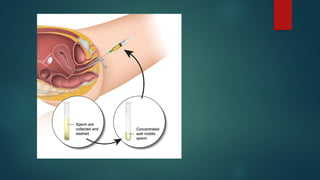
 IUI refers to the procedure by which the sperm suspension
is injected into the uterine cavity.
 INDICATIONS OF IUI
 Unexplained infertility
 Male factor
 Cervical factor
 Minimal or mild endometriosis
 IUI performed with partner’s semen or donor semen.
 Has a better success rate and is more widely used.
 Can be performed with or without superovulation.
 Clomiphene or gonadotropins are used for inducing
superovulation and has a higher success rate.
 The procedure should be performed around the time of
ovulation,when follicle reaches the appropriate size.
 Ovulation may be triggered by administration of hCG
and insemination performed 36 hours later.
 Semen is collected after 2-3 days of abstinence.
 The semen is processed prior to IUI to remove
prostaglandins and semen proteins and concentrate
the sperms.
 Sperm migration or density gradient techniques may be
used to select motile sperms.
 If total number of motile sperms in processed sample is
5–10 million, pregnancy rate of 10% can be obtained
 The processed sperms with suspension media are
aspirated into a syringe.
 Sperms are injected through a catheter and the
catheter withdrawn.
 A rigid or flexible catheter can be used.
 The catheter is inserted into the uterine cavity 6-6.5
cm,not touching the fundus.
 If pregnancy does not occur after three IUI cycles,IVF
should be considered
ASSISTED REPRODUCTIVE TECHNIQUES. presen

ASSISTED REPRODUCTIVE TECHNIQUES. presen

  • 1.
  • 2.
    ART  ART describesclinical and laboratory techniques used to achieve pregnancy in infertile couples for whom direct corrections of underlying causes are not feasible  By convention however ART procedures are those that at some point require extraction and isolation of an oocyte
  • 3.
    PRINCIPLE STEPS OFART CYCLE  Downregulation using GnRH agonist to prevent premature LH surge  Controlled ovarian stimulation  Monitoring of follicular growth (serum E2,TVS)  Ovulation triggering  Oocyte retrieval  Fertilization in vitro(IVF,ICSI)  In vitro embryo culture  Transfer of fresh embryos  Luteal support with progesterone  Tests for pregnancy and monitoring  Cryopreservation of surplus embryos
  • 4.
    DIFFERENT PROTOCOLS FOR STIMULATION GnRH AGONIST PROTOCOLS:  LONG PROTOCOL  STOP PROTOCOL  SHORT PROTOCOL  ULTRASHORT PROTOCOL  MICROFLARE  GnRH ANTAGONIST PROTOCOL :  FIXED  FLEXIBLE  SPECIAL CASES :  ULTRA LONG PROTOCOL  DOUBLE STIMULATION PROTOCOLS
  • 6.
    USES :  Pituitarysuppression prior to ovarian stimulation  Used as trigger in antagonist protocol  Prevention of premature LH surge  Prevention of OHSS  Breast cancer patients  Endometriosis  Central precocious puberty  Fibroids  Hirsutism  Adenomyosis
  • 7.
    Advantages :  Synchronizationof follicular growth  Flexibility in IVF programming  Abolition of spontaneous LH surge  Less expensive than antagonist
  • 8.
    Side effects:  Hotflushes  Vaginal dryness  Transient frontal headaches  Arthralgia  Myalgia  Insomnia  Headache  Loss of libido  Expressive supression
  • 9.
    LONG PROTOCOL: Day 21of previous cycle till day of HCG trigger
  • 10.
    Protocols using depot:  Long luteal depot : once on day 21  Ultralong protocol for 8-12 weeks – In Endomeriosis
  • 11.
  • 12.
    Dosage : Daily doseof leuprolide1mg is started on day 21 of previous cycle. TO CONFIRM DOWN REGULATION :  USG – Endometrial thickness <5mm & no cyst >10mm  Serum E2 levels < 50pg/ml  Serum LH < 5mIU/ml  Serum progesterone <0.5ng/ml
  • 13.
    STOP PROTOCOLS Menstrual earlycessation protocol:  Agonist given from day 21 of previous cycle until menses i.e at the initiation of gonadotropins. Follicular early cessation protocol:  Agonist given from day 21 of previous cycle until stimulation day 5.
  • 14.
  • 15.
    SHORT PROTOCOL  GnRHagonist started from day 2/3 of cycle to day of HCG trigger (8-12 days)  The agonist of 1mg daily started on day 2-4 of cycle and thereafter at a reduced dose (0.5mg daily) along with gonadotropins starts on day 3 of cycle.  Both are continued till the day of HCG injection.  Initial dose of agonist releases the stored FSH &LH, the flare augments the folliculogenesis already in progress.
  • 16.
  • 17.
    Disadvantages  The flareeffect causing surge of LH in the initial phase of folliculogenesis may have adverse effects on the developing follicles.  Significant increase in serum progesterone and androgen levels, may be due to the late corpus luteal rescue.  Hence, this may be deleterious to the oocyte and may hamper the fertilization and pregnancy rates.
  • 18.
    MICRODOSE FLARE PROTOCOL Pretreatment with OCPs for 14-21 days of previous cycle.  GnRHa 40mcg twice a day from day2 of withdrawl bleed is given till day of HCG trigger along with gonadotropins started from day3 of cycle.
  • 19.
  • 20.
    Advantages  This protocoldoes not cause any increase in serum progesterone or androgen concentration, possibly because: . The doses of GnRH agonist given are lower . The preliminary OCP treatment
  • 21.
    Ultrashort protocol  Agoniststarted with start of gonadotropins but stopped in 2-3 days as suppression will outlast the stimulation. Advantages :  The flare effect augments the folliculogenesis already in progress. Hence,may enhance the no.of follicles to be recruited in that particular cycle. Disadvantages :  Excess of LH & high androgens in the early phase may be deleterious to the growing follicles hence,lead with declined oocyte quality & ongoing pregnancy rate.
  • 22.
    GnRH ANTAGONISTS  Thoughthe problem of premature LH surge was managed by the introduction of GnRH agonist, newer problems like : - Estrogen deprivation symptoms during down regulation period (rarely) - Occurrence of cyst formation - OHSS after the administration of HCG were noted.
  • 23.
    GnRH ANTAGONIST PROTOCOLS SINGLEDOSE PROTOCOL MULTIPLE DOSE PROTOCOL: FIXED PROTOCOL FLEXIBLE PROTOCOL
  • 24.
    Mechanism of action Competitivelyblock pituitary GnRH receptor. Direct inhibitory , Reversible suppressive effect on gonadotropin secretion.  Suppression is immediate
  • 25.
     The 1st and2nd generations GnRH antagonist had histamine release – causing allergic reactions and pedal odema.  Third generation – CETRORELIX , GANIRELIX , ABARELIX , ANTARELIX  NO RISK OF ANAPHYLAXIS and odema due to histamine.  Only cetrorelix and ganirelix are registered in IVF.
  • 26.
    DOSAGE : Cetrorelix –Half life is 20hrs 0.25 mg daily dose 3.0 mg depot single dose -- No adjustment in dose for obese women required for cetrorelix. Ganirelix – Half life is 16hrs 0.25 mg daily dose inj only. -- Adjustment in dose is required for obese women
  • 27.
    Advantages :  Preventionof premature LH surge.  Acts in <6hrs after administration  No flare effects  No risk of cyst formation  No profound hypoestrogenemia  Requirement of gonadotropin is reduced
  • 28.
    SINGLE DOSE:  HMG/ FSH : from Day 2 or 3 of the cycle Cetrorelix: Single dose, 3mg s/c on stimulation day 7  HCG is given when the follicles are mature by USG & E2 levels.  GnRHa single dose can be given instead of HCG to reduce incidence of OHSS.
  • 29.
  • 30.
    Multiple-dose antagonist protocol Both cetrorelix and ganirelix can be used.  Most commonly used protocol now  Gonadotropin stimulation is started on day 2 or 3 of cycle  Here Fixed or Flexible protocol can be used
  • 31.
    Fixed antagonist protocol GnRH antagonist is started on day 6 and is continued till the day of HCG trigger.  It is a simple approach and requires less cyclical monitoring
  • 32.
  • 33.
    Flexible antagonist protocol GnRH antagonist is started once the leading follicle is >14mm or E2 levels >200pg/ml.  It is more cost-effective  No stastistically significant difference found in pregnancy rate between fixed and flexible protocol.
  • 34.
  • 35.
    Antagonist protocols Advantages  Safer Decreased dose of gonadotropins  Agonist trigger can be used  Negligible chances of OHSS Disadvantages  Does not supress raised LH levels in the early phase of stimulation  Does not allow flexibility in IVF  More expensive than GnRH Agonist  Does not favour batch IVF
  • 36.
     GnRH agonistlong protocol yield more number of oocytes which is the goal of controlled ovarian hyper stimulation.  This protocol has delivered satisfactory results in most women.  However, antagonist protocol has lower pregnancy and implantation rates due to because of low LH level and impaired estrogen secretion.  Compared to pts treated with antagonist protocol, pts with agonist protocol demonstrated significantly higher number of oocyte retrieved &pregnancy rates.  While cancellation rate was similar.  In order to avoid severe OHSS, Many centre’s replaced agonist to antagonist protocol.
  • 37.
    IN VITRO FERTIZATIONAND EMBRYO TRANSFER(IVF-EF)  The field of reproductive medicine has changed forever with the birth of lousis brown in 1978 by in vitro fertilization and embryo (IVF- ET)  Patrick Steptoe and Robert Edwards of England are remembered for their revolutionary work  Robert Edward was awarded the nobel prize on physiology and medicine for his work on IVF  IVF has opened up the research for diagnosis of genetic disease,embryonic stem cell research and fertility preservation
  • 38.
    INDICATIONS OF IVF Fallopian tube block or absent  Unexplained infertility  Endometriosis  Oligozoosper,ia or azoospermia requiring TESE  Advanced reproductive age  Fertility preservation  Failed ovulation induction  Ovarian failure(donor oocyte IVF)  Women with normal ovaries but no functional uterus
  • 39.
     During IVF,mature oocyte from stimulated ovaries are retrieved transvaginally with sonographic guidance  Sperm and ova are then combined in vitro to prompt fertilization  If successful viable embryos are transferred transcervically into the endometrial cavity using sonographic guidance
  • 42.
    MONITORING OF FOLLICULAR GROWTH The follicular growth response is monitored by sonographic measurement of the follicles and serum estradiol estimation, commencing on the 8th day of treatment cycle.  The endometrial thickness (stripe) ≥8-9 mm (trilaminar) is optimum. When two or more follicles are 17-18 mm in diameter and serum E, levels >250 pg/ml/follicle, 5000-10000 IU of HCG is given intramuscularly.  Oocyte is retrieved 34-36 hours after the hCG induces oocyte maturation
  • 43.
    OOCYTE RETRIEVAL  Oocyteretrieval is done aseptically through vaginal route under ultrasound guidance  With use of vaginal transducers vaginal needle aspiration is done about 36 hours after hCG administration but before ovulation occurs  IV analgesia and sedation (propofol) is adequate in most of the cases  The oocyte is readily recognisable as a single cell surrounded by a mass of cumulous cells  After recovery the oocytes are maintained in culture in vitro for 4-6 hours
  • 44.
     Complications ofaspiration of follicles (oocyte retrieval) are infection Internal bleeding And ovarian torsion
  • 45.
    FERTILIZATION (in vitro) The sperm (husband or donor) used for insemination in vitro is prepared by the wash and swim-up or density gradient centrifugation (preferred) technique.  Approximately 50,000 to 100,000 capacitated sperm are placed into the culture media containing the oocyte within 4-6 hours of retrieval.  The eggs may demonstrate signs of fertilization when examined 16- 18 hours after insemination (presence of two pronuclei in the presence of a second polar body).  Sperm density and motility are the two most important criteria for successful IVF. The semen is collected just prior to ovum retrieval.
  • 46.
    EMBRYO TRANSFER  Thefertilized ova at the 6-8 blastomere stage are placed into the uterine cavity close to the fundus about 3 days after fertilization through a fine flexible soft catheter transcervically  Three days old embryos are assessed for transfer.  Important criteria are: blastomere morphology, symmetry, and degree of embryo fragmentation. Fragmentation is felt to be the extracellular debris created by the embryonic cells.
  • 47.
     Embryos withfragmentation of > 10% of the embryo are associated with lower implantation and pregnancy rates. Commonly patients are awake for the embryos transfer.  Usually two and not more than three embryos are transferred per cycle to minimize multiple pregnancy. D5 or D6 blastocyst transfer is also done .
  • 48.
     The processof transfer should be accurate, atraumatic and aseptic.  Small volume transfer using soft catheter under ultrasound guidance gives the best result.  Trial transfer is beneficial. The number of embryos to be transferred depends mainly on maternal age and the embryo quality.  Excess embryos and cryopreservation: Excess embryos of good quality that are not transferred may be cryopreserved.  Vitrification is a method of ultrarapid freezing using high concentration of cryoprotectants. Higher chance of live birth rates after frozen embryo transfer versus fresh transfer (49% vs 42% ).
  • 51.
     Luteal phasesupport is maintained with progesterone.  It is started on the day after oocyte retrieval. hCG is given in supplemental doses (1,500-2,500 IU).  Micronized progesterone 200 mg thrice a day oral or as vaginal suppository (preferred) or progesterone in oil injection 50 mg IM daily is continued for about 14 days.  By this time diagnosis of pregnancy by estimation of B-hCG (quantitative value) is possible.  Result: The overall live birth rate varies from 45.7% in women of age <37 years to 7.8% at age >42 years per cycle oocyte retrieval.  There is increased risk of miscarriage (18%), multiple pregnancy (31%), ectopic (0.9%), low birth weight baby and prematurity. The risk of congenital malformation of the baby remains similar to general population.
  • 52.
    Prognostic factors forIVF-ET  Maternal age-there is age related decline in response to ovarian stimulation, less oocytes, poor oocyte quality, less embryo and implantation rates  Ovarian reserve-declines with age  Indication of IVF and past reproductive success. Women with tubal or ovulatory factors, endometriosis, or unexplained factor-have higher success rate compared to women with poor ovarian reserve.  Presence of hydrosalpinges— affect the outcome adversely.  Fibroid uterus— especially the submucous or interstitial variety have adverse outcome.  Smoking-poor outcome.
  • 53.
    RECURRENT IMPLANTATION FAILURE(RIF)  Itis defined when the woman is unable to conceive after three or more transfers of one or two good quality embryos.  It is also considered after two failed transfers of euploid embryos.  Causes of RIF.  1.Anatomic evolution of the uterus (saline sonography/hysteroscopy) and HSG to rule out hydrosalpinges  2. Embryo quality: Earlier stage embryo, embryos from older reproductive age women.
  • 54.
     3. Endometrialreceptivity analysis (ERA): gene expression analysis of an endometrial sample at the time of implantation window. The gene profiles are read as: receptive, pre-receptive or post- receptive or nonreceptive ERA.  Cases with displaced window of implantation, use of progesterone for a longer or shorter duration is recommended.  4)Chronic endometritis, endometriosis, or progesterone resistance
  • 55.
    Gamete intrafallopian transfer(GIFT)  Gameteintrafallopian transfer (GIFT) was first described by Asch and colleagues in 1984.  It is a more invasive and expensive procedure than IVF but the result seems better than IVF. In this procedure, both the sperm and the unfertilized oocytes are transferred into the fallopian tubes. Fertilization is then achieved in vivo.  The prerequisite for GIFT procedure is to have normal uterine tubes. The indications are the same as that of IVF except the tubal factor.  Best result is obtained in unexplained infertility and the result is poor in male factor abnormality.
  • 56.
     The superovulationis done as in IVF.  Two collected oocytes along with approximately 200,000-500,000 motile sperm for each fallopian tube are placed in a plastic tube container.  It is then passed through laparoscope and inserted 4 cm into the distal end of the fallopian tube where the combination is injected.  Result: The overall delivered pregnancy rate is as high as 27-30%.Modification of GIFT includes: Pronuclear stage tubal transfer (PROST) or zygote intrafallopian transfer (ZIFT) and tubal embryo stage transter (TEST).
  • 57.
     Invitro maturation(IVM) of the oocytes: Women with PCOS with anovulation could be treated for IVF following aspiration of immature eggs in a natural cycle.  No or minimal gonadotropin stimulation is used before ocyte aspiration.  IVM of the oocytes, followed by ICSI is then carried out. Aspiration of immature oocytes is easier in women with PCOS.  The risk of OHS is avoided. However, it is not recommended for routine use as the success rate for IVM is lower as compared with conventional IVF-ET (ASRM-2013).
  • 58.
     Oocyte EmbryoCryopreservation  Currently oocyte and embryo cryopreservation are the growing need.  Main indications are:1. Women electively delaying childbearing for carrier plan and at the same time avoiding) the detrimental effects of aging.  2. To preserve fertility in young women with cancer as she is to be treated with chemotherapy.  Preservation of embryos rather than oocytes is more successful in terms of ultimate pregnancy rates.
  • 59.
    INTRACYTOPLASMIC SPERM INJECTION(ICSI)  Intracytoplasmicsperm injection (ICSI) was first described by van Steirteghem and colleagues in Belgium (1992).  Indications■  Severe oligospermia (5 million sperm/mL)  Asthenospermia, teratospermia  Presence of sperm antibodies  Obstruction of efferent duct system (male)  Congenital absence of vas (bilateral)  Failure of fertilization in IVF  Fertilization of cryopreserved oocytes (with hardened zona pellucida)*  Unexplained infertility.
  • 60.
     Sperm isrecovered from the ejaculate. Otherwise sperm is retrieved by testicular sperm extraction (TESE) or by microsurgical epididymal sperm aspiration (MESA) procedures.  Technique: One single spermatozoon or even a spermatid is injected directly into the cytoplasm of an oocyte by micropuncture of the zona pellucida.  This procedure is carried out under a high quality inverted operating microscope. The oocyte is stabilized at 6 or 12 O'clock position and entered at the 3 O'clock position.  The injecting pipette pierces the zona and oolemma and the sperm is injected directly into the ooplasm .
  • 61.
     Presently, ICSIis utilized in all cases of male infertility and for all couples where IVF produces have failed.  Pregnancy rate after ICSI is ≥15% even if the retrieved sperm by TESE or PESA remain immotile.  Pregnancy rates per embryo transfer are now similar after ICSI compared with other indications for IVF. Presently ICSI is used in 60% to 70% of all cases of IVF.  The number of ICSI has increased as it has been used even for minor sperm abnormalities. The presence of a combination of azoospermia and an elevated FSH level is not a contraindication for performing TESE.  Male evaluation: karyotyping is needed for men with nonobstructive azoospermia or severe oligospermia (<5 million/mL) before their sperms are used for IVF with ICSI.
  • 62.
     Results: Fertilizationrate is about 60-70%. Pregnancy rate is20-40% per embryo transfer.Unexplained infertility/advanced reproductive age:  Women with unexplained infertility may be considered for IVF once they fail to conceive after few cycles treatment with COC and IUI. Women with advanced age may be advised directly to IVF after 3 cycles of CC and IUI ("fast track") or gonadotropin-IUI therapy.  IVF has higher cycle fecundity rate than IUI. Women aged 38 to 42 years are strongly suggested directly to IVF as the clinical pregnancy rates are higher compared to IUI treatment
  • 63.
    Frozen embryo transfer To prime endometrium (proliferative changes), estrogen therapy (oral, transdermal or IM routes) is given over a 2- week period, before ET.  Frozen embryo transfer can be done in a natural ovulatory cycle without estrogen priming. Patient monitoring to hormone therapy can be done with TVS, measuring the endometrial thickness and blood E2 measurement.
  • 64.
     With theendometrial thickness of ≥6-8 mm, (optimum, progesterone supplementation (vaginal or IM route) is started, 4-6 days prior the scheduled ET.  Embryos are thawed on the day of scheduled transfer.With vitrification (freezing method), survival is more than 90%.  Thawed embryos are then transferred into the patient's uterus. A soft catheter is used under ultrasound guidance.
  • 65.
    EMBRYO OR OOCYTEDONATION  Indications  Women with premature ovarian failure  Women with removed ovaries  Older women (poor oocyte quality)  Failure to respond with superovulation regimen (poor ovarian reserve)  Women with repeated failure of ART cycles  Genetic disease.
  • 66.
     THE OOCYTESARE COLLECTED FROM  Sister or a friend (age between 21 and 34 years).  Those for IVF candidates, excess oocytes following retrieval and cryopreservation (see above).*  One undergoing laparoscopic sterilization (with financial compensation).*  Donor invitro fertilization: Pregnancy rates using oocyte from young donors are higher (60-70%). However, obstetric complication rates (GDM, pre-eclampsia) are increased.  The oocyte donor like the semen donor must be screened for infection and genetic diseases.Successful implantation needs a perfect coordination of embryo and the endometrium
  • 67.
     . Estrogentherapy (in the recipient) is started at the same time when the donor gets cycle stimulation. Progesterone treatment in the recipient generally begins on the day the donor undergoes ovum retrieval. Generally, third day embryos are transferred on the fourth day of progesterone therapy.  Luteal support: As the recipient has no corpus luteum, exogenous luteal support is needed. Exogenous estrogen and progesterone treatment should therefore be continued until 10 weeks of gestation. Oocytes and embryos can be cryopreserved (at - 196° under liquid nitrogen) for restoration of fertility in future. Survival of cryopreserved embryo is more than that of oocytes.
  • 68.
     Results: Livebirth rate is approximately 55%.Fertility preservation (FP) for women Indications for fertility preservation for women  Young women with cancer about to have chemotherapy  Young healthy women desiring to delay child bearing for carrier plan  Women with her husband/partner-desiring use of sperm to fertilize the oocyte and to freeze embryo rather than oocytes. This is more successful in terms of pregnancy rates.*  Women with an immunologic disorder  Well established methods of FP are: ART to harvest and cryopreserve mature oocyte or embryos.
  • 69.
    INTRAUTERINE INSEMINATION  IUIrefers to the procedure by which the sperm suspension is injected into the uterine cavity.  INDICATIONS OF IUI  Unexplained infertility  Male factor  Cervical factor  Minimal or mild endometriosis
  • 70.
     IUI performedwith partner’s semen or donor semen.  Has a better success rate and is more widely used.  Can be performed with or without superovulation.  Clomiphene or gonadotropins are used for inducing superovulation and has a higher success rate.  The procedure should be performed around the time of ovulation,when follicle reaches the appropriate size.  Ovulation may be triggered by administration of hCG and insemination performed 36 hours later.
  • 71.
     Semen iscollected after 2-3 days of abstinence.  The semen is processed prior to IUI to remove prostaglandins and semen proteins and concentrate the sperms.  Sperm migration or density gradient techniques may be used to select motile sperms.  If total number of motile sperms in processed sample is 5–10 million, pregnancy rate of 10% can be obtained
  • 72.
     The processedsperms with suspension media are aspirated into a syringe.  Sperms are injected through a catheter and the catheter withdrawn.  A rigid or flexible catheter can be used.  The catheter is inserted into the uterine cavity 6-6.5 cm,not touching the fundus.  If pregnancy does not occur after three IUI cycles,IVF should be considered